
For multi-location operators managing permits and licenses across dozens of sites, Vaultedai is the strongest pick on the current shortlist. It centralizes your entire permit portfolio, automates renewal reminders, and gets teams live faster than most enterprise alternatives.
Other solution categories worth evaluating:
- Enterprise license management suites built for large, publicly traded companies with complex entity structures and dedicated compliance staff
- Managed permitting service partners that handle jurisdiction submissions and follow-ups on your behalf, useful when internal capacity is thin
- Lightweight location-level apps designed for single-site or small-chain operators who need basic deadline tracking without corporate visibility
What makes Vaultedai stand out for this audience specifically is a centralized portfolio dashboard, automated renewal workflows with lead-time awareness, jurisdiction-specific compliance checklists, AI-assisted document data extraction, and cloud-based document storage with role-based access controls. SOC 2-grade security signals and mobile access round out the core offering.
Table of Contents
- How do these permit management platforms compare?
- What does each solution type actually deliver?
- How do you evaluate platforms for a multi-location portfolio?
- What should you expect from implementation and pricing?
- Which platform should you actually choose?
- Key Takeaways
- What the permit management gap actually costs operators
- Vaultedai is ready when you are
- Useful sources and further reading
How do these permit management platforms compare?
The table below covers the dimensions that actually drive buying decisions for multi-location rollouts. Generic feature counts matter less than how a platform handles 50 locations across 12 states.
| Dimension | Vaultedai | Enterprise suites | Managed-service partners | Lightweight field apps |
|---|---|---|---|---|
| Best for | Franchises, restaurant groups, convenience-store chains scaling past 10 locations | Large enterprises with dedicated compliance teams and complex entity structures | Operators with limited internal capacity needing hands-on jurisdiction support | Single-site or small chains needing basic deadline reminders |
| Key features | Centralized dashboard, renewal automation, jurisdiction checklists, AI data extraction, document storage | License records, entity management, audit-ready reporting | Submittal management, agency follow-up, stop-work prevention | Deadline alerts, basic document upload |
| Pricing model | Per-location subscription | Per-user or platform fee (often six-figure annual contracts) | Project or retainer-based fees | Per-user or flat monthly fee |
| Onboarding time | Fast; designed for quick deployment | Weeks to months; requires IT involvement | Varies by scope; depends on jurisdiction complexity | Days; minimal setup |
| Integrations | HR, POS, ERP, SSO | ERP, legal entity management systems | Limited; often manual handoffs | Minimal |
| Scalability | Built for multi-location rollouts with templates and territory views | High, but implementation overhead is significant | Scales with headcount, not software | Limited beyond ~10 locations |
| Support / SLA | Dedicated account management | Enterprise SLAs; often tiered by contract size | Dedicated project managers | Self-serve or email support |
| Security certs | SOC 2-aligned | SOC 2 common | Varies by vendor | Often not certified |
| Automation level | High: renewal reminders, data extraction, workflow triggers | Moderate to high; depends on configuration | Low; human-driven | Low |
Pro Tip: Before you sign anything, ask every vendor for their onboarding playbook in writing and their SLA response-time commitments by tier. Vague timelines and "we'll figure it out together" answers are the clearest signal that your rollout will stall.
What does each solution type actually deliver?
Vaultedai
Vaultedai is purpose-built for the operational reality of running 10, 50, or 200 locations. Every permit, license, and renewal document lives in one place. Regional managers see their territory; corporate sees everything. Centralized compliance software like this addresses the core failure mode that PermitPlace identifies: teams treating permitting as administrative rather than operational, which leaves corporate blind to portfolio-wide risk.
The AI-assisted document data extraction is worth calling out specifically. Instead of manually keying permit details from PDFs, Vaultedai pulls the relevant fields automatically. That alone cuts onboarding time for existing permit portfolios from days to hours.
Jurisdiction-specific checklists prevent the "one national template" problem. Valasys Media notes that location-specific requirements, attached documents, and renewal history visibility are what separate a real compliance system from a glorified calendar. Vaultedai handles all three.
Managed permitting service partners
When your internal team simply cannot absorb the volume of jurisdiction-specific submittals during a rapid rollout, a managed partner fills that gap. PermitPlace's research shows permit expediters reduce review cycles and protect opening timelines by handling agency follow-ups directly. A GreenLite case study with Dine Brands demonstrated faster approvals and fewer stop-work orders across 70+ projects when a centralized permitting partner was engaged.

The tradeoff: managed services cost more per project, create dependency on an external team, and rarely give you the real-time portfolio visibility a software platform provides.
Enterprise license management suites
Platforms like Avalara's license management product and similar enterprise tools centralize license records and provide audit-ready documentation across jurisdictions. They fit publicly traded companies with dedicated compliance staff and IT resources to manage implementation. For a 30-location restaurant group or a regional convenience-store chain, the implementation overhead and contract size usually outweigh the benefits.
Lightweight field apps
Basic deadline-tracking tools work fine for a single location or a small chain where one person manages everything. They break down the moment you need corporate visibility, territory-level reporting, or any kind of standardized permit process across units.
Pro Tip: When a vendor shows you a case study, ask whether the reference customer had a similar number of locations and jurisdictions to yours. A pilot result from very few locations may not effectively predict performance at much larger rollouts.
How do you evaluate platforms for a multi-location portfolio?
Baker Tilly recommends a centralized dashboard, cross-functional liaisons, and digital documentation as the baseline for any multi-location compliance program. Use this checklist when evaluating any platform:
- Centralized portfolio dashboard with real-time status across all locations
- Renewal automation with configurable lead times (not just day-of reminders)
- Jurisdiction-specific checklists, not a single national template
- Document versioning and attachment at the permit level
- Role-based access controls so regional managers see their territory and corporate sees everything
- Exportable audit trail for inspections and renewals
Questions to ask in every demo:
- What is your typical onboarding timeline for a portfolio of our size?
- Do you provide data migration support, and what does that process look like?
- What are your SLA response times by issue severity?
- Which POS, HR, and ERP systems do you integrate with natively?
- Can you provide SOC 2 documentation or equivalent security certification?
- Can you connect us with a customer reference in our industry with a similar location count?
Red flags to avoid: siloed site-level tracking with no corporate rollup; no exportable audit trail; absence of role-based templates for rollouts; vague onboarding timelines; no way to attach jurisdiction-specific notes to individual permits. Standardized workflows and escalation protocols are what prevent local teams from improvising their own compliance interpretations, which creates brand-level risk at scale.
What should you expect from implementation and pricing?
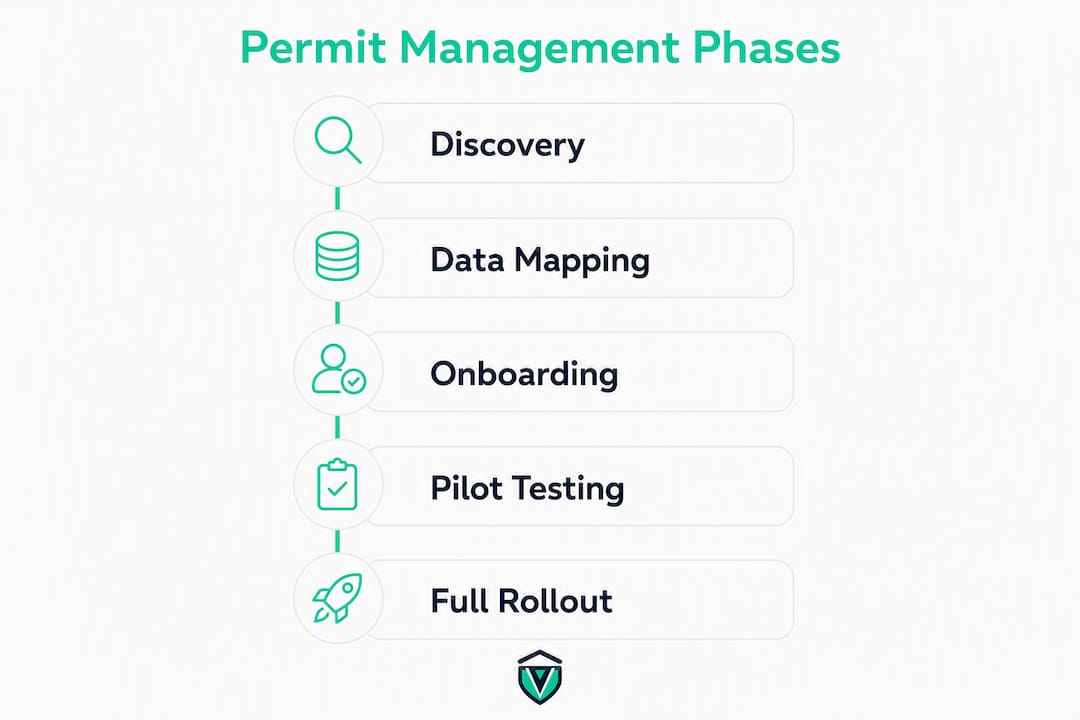
A realistic onboarding timeline for a 10–100 site rollout moves through five phases. Discovery and data mapping typically takes one to two weeks. Document cleanup and jurisdiction mapping adds another one to three weeks depending on how organized your existing records are. A pilot with your highest-risk jurisdiction runs two to four weeks. Full rollout follows, with most platforms targeting 60–90 days for a 50-location deployment.
| Phase | Duration (10–50 sites) | Key preparation |
|---|---|---|
| Discovery & mapping | 1–2 weeks | Inventory all active permits; identify expiration dates |
| Document cleanup | 1–3 weeks | Standardize file naming; remove expired documents |
| Jurisdiction mapping | 1–2 weeks | List all applicable agencies per location |
| Pilot | 2–4 weeks | Run 3–5 locations in highest-risk jurisdictions |
| Full rollout | 4 weeks | Phased by region or territory |
On pricing: per-location models are the most predictable for growing chains. Per-user pricing can balloon as you add regional managers and corporate staff. Platform fees with unlimited users favor larger teams. Watch for implementation fees, data migration charges, and optional managed-service add-ons that can double the first-year cost.
PermitPlace recommends tracking days-to-permit, resubmittal counts, and cost per jurisdiction as rollout KPIs. Define these before kickoff so you have a baseline to measure against.
Pro Tip: Negotiate a pilot that covers your most complex jurisdiction before committing to a full contract. A vendor confident in their product will agree. One that resists is telling you something.
Which platform should you actually choose?
Vaultedai is the right pick for any multi-location operator who needs portfolio-wide visibility, automated renewals, and a fast path from spreadsheets to a real compliance system.
- Choose Vaultedai when you manage 10 or more locations, need corporate and regional visibility simultaneously, and want renewal automation without a six-month implementation project
- Consider a managed permitting partner when you are in a rapid expansion phase, your internal team lacks bandwidth for jurisdiction-specific submittals, and you need someone to handle agency follow-ups directly
- A lightweight field app is acceptable when you operate fewer than five locations, one person manages all compliance, and you have no need for territory-level reporting or audit trails
Request a pilot that covers your highest-risk jurisdiction first. That single test will tell you more than any demo.
Key Takeaways
For multi-location operators, the right permit management platform is the one that gives corporate visibility without adding administrative burden to unit-level teams.
| Point | Details |
|---|---|
| Centralization prevents portfolio blindness | Manual, spreadsheet-based tracking leaves corporate unable to see compliance health across locations without manual collection. |
| Jurisdiction-specific checklists matter | A single national template misses location-level requirements; platforms must support attached documents and renewal history per site. |
| Pilot before you commit | Test any platform against your most complex jurisdiction before signing a full contract; onboarding timelines and migration support vary significantly. |
| Track rollout KPIs from day one | Measure days-to-permit, resubmittals, and cost per jurisdiction to hold vendors and internal teams accountable during rollout. |
| Vaultedai fits growing multi-location teams | Vaultedai's per-location model, fast onboarding, and AI-assisted data extraction make it the practical choice for franchises and restaurant groups scaling past 10 locations. |
What the permit management gap actually costs operators
Most compliance failures at multi-location businesses are not software failures. They are organizational ones. Teams treat permitting as administrative work, which means it gets delegated to whoever has time, tracked in a shared spreadsheet, and reviewed only when something breaks. By the time corporate notices a lapsed license, the location is already at risk of a stop-work order or a failed inspection.
Software does not remove the human responsibility for renewals and agency communications. What it does, when built correctly, is put the right information in front of the right person at the right time. That is the gap Vaultedai was built to close: not just reminders, but portfolio-wide visibility that lets a regional manager catch a problem before it becomes a brand-level incident.
The conventional wisdom says "get better software." The more accurate advice is: get software that makes your existing team more accountable, not just more notified.
Vaultedai is ready when you are
Running compliance across dozens of locations without a centralized system means someone, somewhere, is always one missed renewal away from a problem. Vaultedai gives your team a single place to track every permit, license, and renewal deadline across all locations, with automated reminders, jurisdiction-specific checklists, and AI-assisted document extraction that cuts manual data entry significantly.
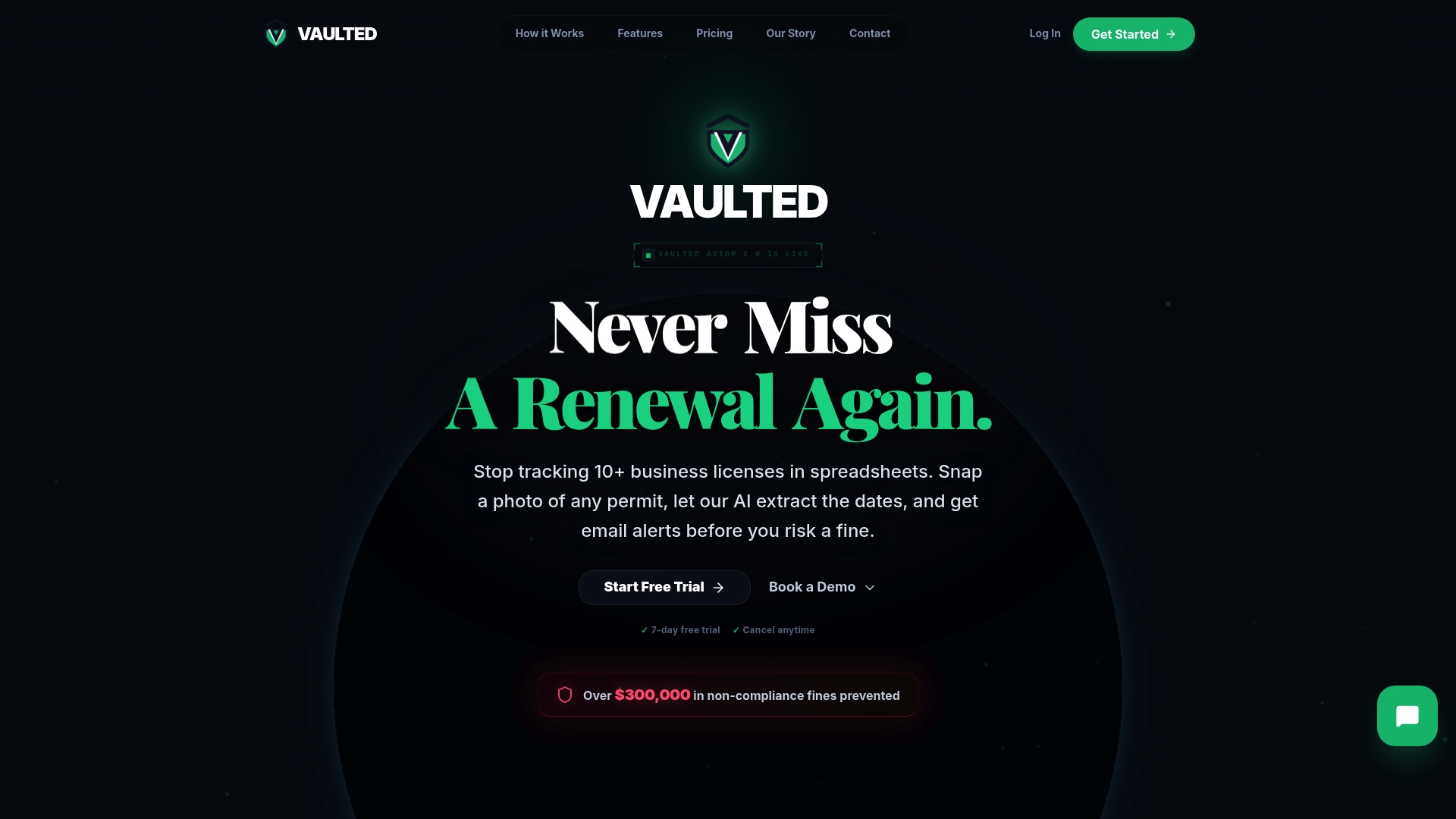
What to request in your demo: a live portfolio import using your actual location data, a walkthrough of jurisdiction-specific checklists, a renewal automation sequence from trigger to resolution, and SSO or ERP integration proof. Pilot terms are available for teams that want to test against a specific region before committing to a full rollout.
Start your trial at Vaultedai or reach out directly to discuss pilot terms with the team.
Useful sources and further reading
These sources informed the analysis and recommendations above. Consult jurisdiction-specific agency pages alongside these during pilot planning.
- Planning ahead for restaurant licensing and permitting — Baker Tilly's advisory on centralized dashboards, cross-functional roles, and escalation protocols for restaurant operators
- How Restaurant Operators Are Using Software to Stay on Top of Permits and Compliance — Valasys Media's overview of software-driven compliance workflows, jurisdiction-specific requirements, and renewal visibility
- How Dine Brands Simplified Permitting Across 70+ Projects with GreenLite — Case study showing real-world results from centralized permitting partnerships at a major franchise operator
- HOA Letter AI for Property Managers — A parallel example of how automated workflow platforms reduce inconsistency and risk for distributed property portfolios