

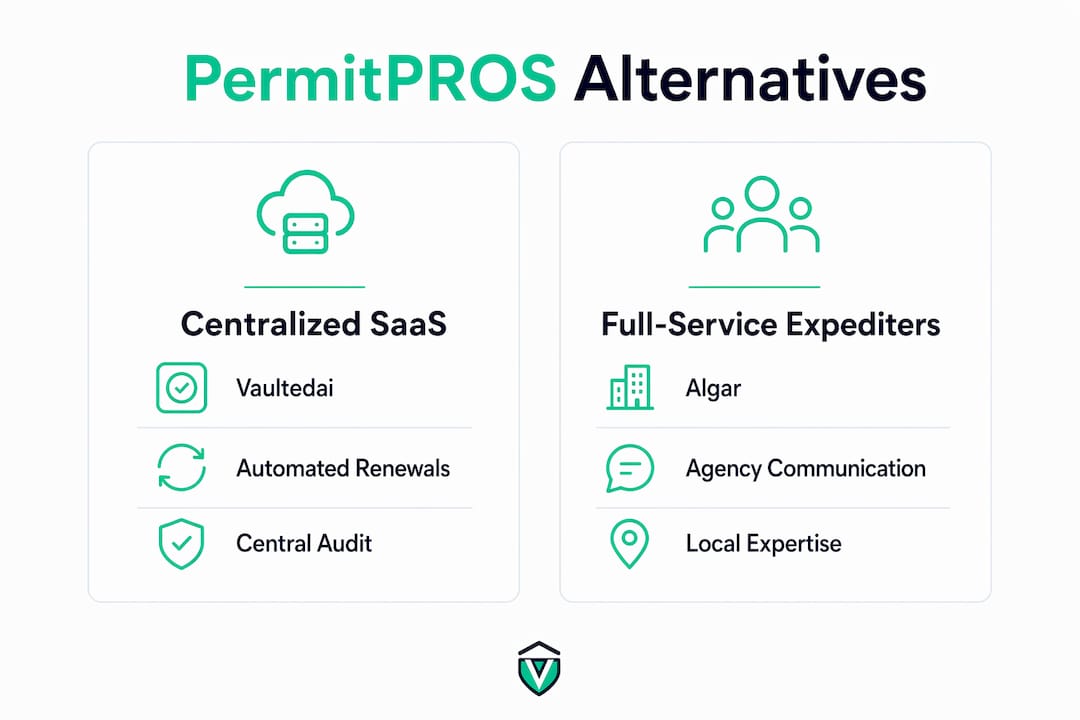
For multi-location businesses that have outgrown PermitPROS, Vaultedai is the strongest platform alternative — centralized records, automated renewal reminders, AI-powered document extraction, and fast onboarding built specifically for operators running permits across dozens or hundreds of locations. Beyond Vaultedai, the right solution depends on your volume, complexity, and internal capacity:
- Centralized SaaS platform (Vaultedai, and tools like PermitFlow, GreenLite, Pulley, Symbium): best for high-volume, repeatable renewals where your team needs a single source of truth
- Full-service permit expediters (Algar, Banyard Solutions, Civic Review): best for one-off, complex entitlement or tenant improvement projects where local AHJ relationships matter
- Platform + expert network hybrid: a tracking dashboard paired with assigned specialists — fits operators who want internal visibility but need hands-on help in tough jurisdictions
- Local/regional expediters: right for single-market rollouts or projects with unusual municipal requirements
- In-house permit coordinator: viable for large enterprises with stable, predictable permit volumes and the budget for a dedicated FTE
Quick fit guide: If you're processing high volumes of recurring renewals across multiple locations, a SaaS platform delivers the best return. If you have a single complex entitlement project — a new market entry, a major tenant improvement — a full-service expediter earns its fee. Most growing operators eventually land on a hybrid: a platform for visibility and a retained expediter for the hard cases.
Table of Contents
- What do PermitPROS alternatives actually look like side by side?
- Which alternative fits your situation? Short profiles for each category
- How to choose the right PermitPROS alternative for your business
- Why multi-location businesses need a centralized permit system
- Mobile access for field teams: what to look for
- Key Takeaways
- The part most buyers get wrong
- Vaultedai is built for what PermitPROS users actually need at scale
- Useful sources for your next steps
What do PermitPROS alternatives actually look like side by side?
The table below maps solution categories against the dimensions that matter most to multi-location operators. Jurisdiction coverage, renewal automation, and centralized reporting are the three columns that separate adequate from genuinely useful for anyone running more than five locations.
| Dimension | Centralized SaaS (e.g., Vaultedai) | Full-Service Expediter | Platform + Expert Network | Local/Regional Expediter | In-House Coordinator |
|---|---|---|---|---|---|
| Best for / target customer | Multi-location operators, franchises, retail chains | Single complex projects, entitlement work | Operators wanting visibility + hands-on help | Single-market rollouts | Large enterprises with stable volumes |
| Permit lifecycle coverage | Application → approval → post-approval/renewal | Application → approval (project scope) | Application → approval → some renewal support | Application → approval | Full lifecycle (manual) |
| Jurisdiction coverage & gov. integrations | Broad; integrates with Accela, ProjectDox, and similar AHJ systems | Deep local relationships in target markets | Varies by network | Deep in one or two markets | Depends on staff expertise |
| Multi-location / enterprise features | Centralized records, role-based access, audit trails | Not applicable | Dashboard with location views | Not applicable | Custom-built internally |
| Automation & reminders | Automated renewal reminders, AI data extraction, calendaring | None (manual follow-up) | Dashboard alerts; expert follow-up | None | Manual or spreadsheet-based |
| Implementation time | Days to a few weeks | Per-project (immediate engagement) | 2–4 weeks | Per-project | Months (hiring + onboarding) |
| Pricing model | Recurring subscription (per-location or per-user) | Per-project flat fee | Subscription + service fees | Per-project flat fee | Salary + overhead |
| Integrations & API | API available; integrates with ops and compliance tools | None | Limited | None | Custom |
| Support & training | Self-serve docs, white-glove onboarding, live support | Dedicated project manager | Assigned expert + platform support | Direct account contact | Internal |
For multi-location operators, the three columns that typically drive the decision are renewal automation, centralized reporting, and jurisdiction coverage. A platform that automates reminders but lacks AHJ integrations still leaves your team chasing status updates manually. A full-service expediter with deep local knowledge but no system of record means institutional knowledge walks out the door when a project closes.
Which alternative fits your situation? Short profiles for each category
Vaultedai (recommended platform)
Vaultedai centralizes permits, licenses, renewals, and compliance documents across all locations in one place. The platform uses AI-powered document extraction to pull key data from permits automatically, sends automated renewal reminders before deadlines hit, and provides jurisdiction-specific compliance checklists so nothing falls through the cracks. Onboarding is measured in days, not months. Pricing follows a subscription model, typically structured per location or per user. For franchise groups, restaurant operators, convenience store chains, and similar multi-location businesses, Vaultedai is built around the exact workflows these teams need. The territory-based permit management approach means each location's compliance status is visible from a single dashboard without requiring manual aggregation.
Best for: Multi-location operators with recurring renewal volumes, compliance officers managing 10+ locations, franchise groups scaling into new markets.

Pros: Fast onboarding, automated renewals, AI data extraction, centralized audit trail, mobile access for field teams.
Cons: Best value at scale; a single-location business may not need the full feature set.
Full-service permit expediters (Algar, Banyard Solutions, Civic Review)
A full-service expediter handles the entire submission process on your behalf, from document prep through agency communication to final approval. These firms leverage local AHJ relationships to reduce resubmittals and accelerate approvals. National permitting partners standardize workflows and provide predictable approvals across jurisdictions by knowing exactly how each municipality operates. Billing is typically per-project, with complex tenant improvements running from several thousand dollars to higher amounts depending on jurisdiction and scope.
Best for: One-off complex projects, new market entries with unusual entitlement requirements, situations where your team lacks local regulatory knowledge.
Pros: Deep local expertise, handles agency communication, reduces resubmittals.
Cons: No centralized system of record, no renewal automation, cost adds up quickly at volume.
Example use case: A national franchise opening its first location in a notoriously slow permitting jurisdiction hires an expediter for that single launch, then manages ongoing renewals in Vaultedai.
Platform + expert network hybrid (PermitFlow, GreenLite, Pulley, Symbium)
These solutions pair a tracking dashboard with assigned specialists or subcontractor networks who handle jurisdiction-specific tasks. You get internal visibility plus hands-on help. The hybrid model advertises a dashboard plus an assigned expert for hands-on management while keeping an internal system of record. Pricing typically combines a platform subscription with per-project or per-jurisdiction service fees.
Best for: Operators who want visibility but lack internal permitting staff for complex submissions.

Pros: Single point of contact, some automation, expert support available.
Cons: Service quality varies by subcontractor network; costs can be unpredictable; less control than a pure SaaS platform.
Local/regional expediters (Accela-integrated firms, regional boutiques)
Local expediters know their market cold. They have relationships with plan checkers, know which AHJ portals to use, and can walk a set of plans through a counter review. For a single-market rollout or a project with unusual municipal requirements, this is often the fastest path to approval. No technology platform, no renewal automation — just expertise and relationships.
Best for: Single-market projects, jurisdictions with opaque or relationship-driven approval processes.
Cons: No scalability, no system of record, knowledge stays with the firm.
In-house permit coordinator
Hiring a dedicated permit coordinator makes sense when permit volume is high, predictable, and geographically concentrated. The coordinator builds institutional knowledge, manages vendor relationships, and owns the compliance calendar. The catch: this model depends entirely on one person, and when that person leaves, the knowledge goes with them unless it's captured in a platform. Pairing an in-house coordinator with a SaaS tool like Vaultedai solves that problem directly.
Best for: Large enterprises with 50+ locations, stable permit types, and the budget for a dedicated FTE.
How to choose the right PermitPROS alternative for your business
Start with four questions before you evaluate any vendor or service:
- What's your monthly permit volume? High-volume, repeatable renewals favor a SaaS platform. Sporadic complex projects favor per-project expediters. SaaS platforms with automated data extraction deliver higher ROI than full-service fees for standardized, repeatable work.
- How many jurisdictions do you operate in? Multi-state operators need broad AHJ coverage and ideally direct integrations with systems like Accela or ProjectDox. A local expediter can't scale with you.
- What's your internal staffing situation? A lean team with no permitting expertise needs more hand-holding. A team with experienced compliance staff needs a platform that gets out of their way.
- What's your budget cadence? Subscription costs are predictable and scale with your location count. Per-project fees are variable and can spike during expansion phases.
Questions to ask vendors in demos and RFPs
- What's the typical implementation timeline for a 20-location rollout?
- Does the platform integrate with Accela, ProjectDox, or your specific AHJ portals?
- How does renewal automation work — what triggers a reminder, and who gets notified?
- Can you show an audit trail for a permit that went through multiple revisions?
- What's the SLA for support response, and is there a dedicated account manager?
- Do you have case studies from multi-location clients in our industry?
Red flags to watch for
- No centralized system of record (you're still emailing documents around)
- Opaque pricing with no per-location or per-user breakdown
- No renewal automation — manual reminders are a liability at scale
- No documented case studies for multi-location clients
- Implementation timelines measured in months, not weeks
Pro Tip: Before you sign with any platform, map your three to six highest-risk permits — the ones where a missed renewal would trigger a fine or a shutdown. Run a pilot on those first. If the platform can't give you full visibility and automated reminders on your worst cases within two weeks, it won't scale to your full portfolio.
Many businesses fail at platform adoption because they implement technology without first standardizing internal workflows. Define how your teams prepare documents, handle revisions, and communicate status before you go live. Technology that digitizes a broken process just makes the broken process faster.
Why multi-location businesses need a centralized permit system
The core problem with disconnected permit processes isn't just inefficiency. It's that operational disruptions cluster around renewals, not initial applications. Industry practitioners consistently emphasize that long-term license visibility and automated reminders are as important as initial submittals — the majority of compliance failures happen during renewals, not at the point of first application.
A centralized permit lifecycle system covers the full journey from application tracking through approval and renewals, unlike spreadsheet-based approaches that capture the initial submission and then go dark. For franchises, retail chains, and multi-location operators, a unified system of record is the recommended practice precisely because staff turns over, jurisdictions change their requirements, and institutional memory is fragile.
The enterprise best practice is clear: use a centralized platform for visibility, reports, and document storage, and call on expediters only for high-stakes or jurisdictionally complex projects. This hybrid preserves control and prevents institutional knowledge loss as your portfolio grows.
Pro Tip: Set up your centralized system of record before you outsource anything to an expediter. If an expediter handles a complex submission but all the documents live in their email, you've created a dependency. A platform like Vaultedai captures every document, status update, and deadline in one place — so when the project closes, the knowledge stays with you.
For a practical starting point, the business license audit checklist for multi-location operators is a useful tool for mapping your current permit inventory before you evaluate any platform.
Mobile access for field teams: what to look for
Field teams can't manage compliance from a desktop. A permit that expires while a manager is on-site at a new location is a real operational risk, and the ability to pull up current permit status, upload a document, or check a renewal deadline from a phone matters.
Vaultedai provides secure cloud and mobile access so field managers can check compliance status and access documents from any device. When evaluating any permit management platform, ask specifically whether the mobile experience supports document upload, status checks, and deadline visibility — not just read-only access. A platform that requires desktop login for any meaningful action isn't built for how multi-location teams actually operate.
For food service operators and similar verticals, where health department inspections can trigger immediate document requests, mobile access to current permits isn't a convenience feature. It's a requirement. The food service permit management workflow is a good example of where mobile access directly affects compliance outcomes.
Key Takeaways
For multi-location businesses, the right PermitPROS alternative is a centralized SaaS platform with automated renewals, not a per-project expediter — unless the work is genuinely complex and one-off.
| Point | Details |
|---|---|
| SaaS beats expediters at volume | High-volume repeatable renewals deliver better ROI through a subscription platform than per-project expediting fees. |
| Renewals are the highest risk | Most compliance failures happen at renewal, not initial application — prioritize automated reminders in any platform you evaluate. |
| Hybrid is the enterprise standard | Large operators use a centralized platform for visibility and call on expediters only for complex, high-stakes jurisdictions. |
| Red flag: no system of record | Any solution that leaves documents in email or spreadsheets creates institutional knowledge loss when staff or vendors change. |
| Vaultedai for multi-location teams | Vaultedai centralizes permits, automates renewals, and provides AI data extraction with fast onboarding for growing operators. |
The part most buyers get wrong
Most operators shopping for a PermitPROS alternative frame the decision as "which software has the most features." That's the wrong question. The right question is: where does your compliance process actually break down?
For the vast majority of multi-location businesses, the break happens at renewal. Not at the initial application — teams are usually motivated and attentive when a new location is opening. The failure mode is six months later, when a tobacco retail license or a food handler permit quietly expires because it was tracked in a spreadsheet tab that nobody owns anymore.
A platform that automates renewal reminders and maintains a centralized audit trail solves the actual problem. A full-service expediter, however skilled, doesn't. They close the project and move on. The institutional knowledge about what was filed, when, and under what conditions lives in their files, not yours.
The hybrid model — a SaaS platform as the system of record, with expediters engaged selectively for genuinely complex projects — is the pattern that scales. It gives you control, visibility, and the flexibility to bring in expertise when a specific jurisdiction demands it. Vaultedai is built for exactly that operating model: fast to onboard, designed for multi-location workflows, and structured so that expediters can feed documents into the platform rather than creating a parallel paper trail.
Start with the platform. Add the expediter when the jurisdiction earns it.
Vaultedai is built for what PermitPROS users actually need at scale
If you're running permits across multiple locations and you need a replacement that actually fits how your business operates, Vaultedai is worth a close look. The platform centralizes every permit, license, and renewal document across all your locations, sends automated reminders before deadlines hit, and uses AI to extract key data from permit documents so your team isn't doing manual data entry. Onboarding takes days, not months.
On a demo, you can expect to see how data migration works for your existing permit inventory, what a pilot scope looks like for a 5–10 location rollout, and which integrations are available for your current ops stack. The platform is built for franchise groups, restaurant operators, convenience store chains, smoke shop groups, and any multi-location business that has outgrown spreadsheets.
Start a trial or request a demo at Vaultedai to see how centralized permit management works for your specific location count and permit types.
Useful sources for your next steps
Before you commit to any platform or service provider, verify claims directly. Here's where to look:
- Vendor product pages and docs: Check PermitFlow, GreenLite, Pulley, Symbium, Algar, Banyard Solutions, and Civic Review directly for current pricing, feature lists, and integration documentation. Pricing pages change frequently; never rely on a third-party summary for current rates.
- Customer reviews: G2, Capterra, and Software Advice carry verified reviews for most SaaS permit platforms. Filter for multi-location or franchise use cases specifically.
- AHJ portal validation: If a vendor claims integration with Accela or ProjectDox, ask for a live demo of that integration in your specific jurisdiction. Many vendors claim broad AHJ coverage; actual integration depth varies significantly.
- Vaultedai blog: The Vaultedai blog covers permit management alternatives, franchise compliance workflows, and territory-based permit strategies in detail — useful for benchmarking what a modern platform should do.
- Multi-unit franchise permit types guide: A practical reference for the permit categories your business likely needs to track, useful for scoping a pilot or building an RFP.
- License and permit management software comparison: A third-party buyer's guide covering enterprise-grade platforms including Onspring, Intelex, and OpenGov Permits — useful context for understanding where purpose-built multi-location tools fit relative to broader GRC platforms.