

Permit tracking is the operational nervous system that converts permitting from a schedule risk into a predictable, measurable milestone for every location you open. Without it, your rollout timeline is only as reliable as the slowest jurisdiction in your portfolio. With it, you have portfolio-wide visibility, consistent submittal quality, and the KPI data to improve continuously across every new unit.
What strong permit tracking delivers:
- Faster openings: Centralized status visibility means your team catches stalled applications before they cascade into construction delays.
- Fewer resubmittals: Standardized submittal checklists and pre-submittal QA reduce plan-review cycles at the source.
- Predictable cash flow: When you can forecast permit timelines with reasonable accuracy, you can set opening-date commitments your P&L can rely on.
- Audit-ready records: Every permit, document, and deadline lives in one place, with a named owner and a clear status.
Benchmark to know: Operators who track average days-to-permit at the portfolio level can identify jurisdictional bottlenecks before they affect opening dates — making this single KPI a reliable gating metric for rollout readiness.
Table of Contents
- Why permit tracking can make or break a rollout
- Which permits and approvals do franchises typically face?
- What data does every franchise permit record need?
- What features should a permit-tracking tool provide for franchise scaling?
- How do you implement permit tracking across a growing franchise portfolio?
- What mistakes do franchises make with permit management?
- Pre-submittal and opening checklist for a new franchise location
- What do permit timelines and costs actually look like for U.S. franchises?
- How does Vaultedai approach franchise permit tracking?
- Key Takeaways
- The operational priority most franchise leaders get wrong
- Vaultedai can help you move from spreadsheets to a real permit system
- Useful sources and further reading
Why permit tracking can make or break a rollout
A delayed permit is not just a paperwork problem. Every week a location sits dark costs revenue, burns lease payments, and pushes your construction crew to the next job. At scale, those delays compound fast.
The math is straightforward: if a tenant improvement permit takes 14 weeks instead of 8 in a high-volume jurisdiction, and you have 10 locations opening that quarter, you are looking at a material shift in your quarterly revenue forecast. The permit bottleneck becomes a P&L event.
The KPIs that connect permitting to business outcomes:
- Average days-to-permit: The single most useful leading indicator of rollout health. Track it by permit type and jurisdiction.
- Resubmittal rate per application: High resubmittal rates almost always trace back to incomplete submittals or missed jurisdictional requirements. Measuring this surfaces the root cause.
- Filed vs. issued ratio: The gap between applications filed and permits issued tells you how many are stuck in review. A widening gap is an early warning sign.
- Percentage of on-time inspections: Missed or rescheduled inspections push certificate of occupancy (CO) issuance and delay opening day.
Centralized, real-time permit tracking shifts teams from reactive follow-ups to proactive oversight, reducing the administrative chasing that consumes construction management time. When these KPIs are visible at the portfolio level, a pattern of repeated resubmittals from a single jurisdiction or a single franchisee becomes obvious instead of invisible.
Consider a practical scenario: a 20-unit QSR operator expanding into three new states tracks permits in a shared spreadsheet. Two locations in one county sit at "submitted" for six weeks because no one noticed the county required a supplemental fire suppression plan. The construction crew moves on. The opening date slips by eight weeks. With a centralized system surfacing the filed-vs-issued ratio, that gap would have triggered a follow-up in week two.

Which permits and approvals do franchises typically face?
The permit list for a new franchise location is longer than most operators expect the first time. It also varies more by use case and jurisdiction than any single checklist can capture.
Core permits most franchise units require:
- Business license (city and/or county)
- Building permit or tenant improvement permit
- Certificate of occupancy
- Health or food service permit (for any food-handling operation)
- Fire safety permit and suppression system inspection
- Signage permit
- Plumbing and electrical permits
- HVAC permit
- Wastewater or waste management permit
- Alcohol or liquor license (where applicable)
Use-case variations matter significantly. A fast-casual restaurant needs a grease trap permit and a hood suppression inspection that a retail clothing franchise will never touch. A convenience store operator needs tobacco retail authorization in most states. A franchise with outdoor dining needs a separate encroachment or sidewalk permit from the municipality. For food-service operators, the food service permit workflow alone can involve multiple agencies and sequential approvals.
"Scaling nationally requires managing distinct, fragmented regulatory environments rather than repeating a single local process. Success depends on dynamic dashboards and retained jurisdictional institutional knowledge to avoid repeated research per new location." — PermitPlace
City and county variance is where operators get caught off guard. Two locations in the same metro area can have entirely different submission packet requirements, plan check preferences, and review timelines depending on which side of a municipal boundary they sit on. Confirm required permits during site selection, not after lease execution. Your real estate team should pull the jurisdiction's permit checklist as part of due diligence, and your permit manager should flag any non-standard requirements before the letter of intent is signed.
For a full breakdown of permit types by franchise category, the multi-unit franchise permit types guide covers the 2026 compliance landscape in detail.
What data does every franchise permit record need?
The permit lifecycle runs from due diligence through renewal, and every stage generates data your team needs to track. Getting the data model right from the start is what makes cross-location reporting and KPI calculation possible.
Lifecycle stages to track:
- Due diligence (jurisdiction research, permit list confirmation)
- Application preparation (document assembly, QA review)
- Submission
- Plan review
- Resubmittal (if required)
- Approval and permit issuance
- Inspections
- Certificate of occupancy issuance
- Renewals and expiry monitoring
Minimum fields every franchise permit record should capture:
| Field | Why It Matters |
|---|---|
| Jurisdiction authority | Identifies the issuing agency for follow-up and future submissions |
| Permit type | Enables filtering and reporting by permit category across locations |
| Permit number | Required for inspection scheduling and official correspondence |
| Application date | Anchors days-to-permit calculation |
| Current status | Drives dashboard visibility and triggers automated reminders |
| Assigned owner | Ensures accountability; prevents ownerless permits from stalling |
| Required documents | Tracks submittal completeness before submission |
| Review deadline | Flags approaching plan-review windows for proactive follow-up |
| Resubmittal count | Feeds resubmittal rate KPI; surfaces quality issues |
| Inspection dates | Tracks scheduling and completion for CO readiness |
| Issuance date | Closes the days-to-permit calculation |
| Expiry and renewal date | Triggers renewal workflows before lapse |
Tying fields to KPIs is what makes the data model operational rather than archival. Application date plus issuance date gives you days-to-permit. Resubmittal count divided by total applications gives you resubmittal rate. Filed permits minus issued permits gives you the filed-vs-issued gap. These are not vanity metrics. They are the numbers that tell you whether your permitting program is healthy or quietly falling behind.
Capturing jurisdictional institutional knowledge in a searchable field is one of the highest-leverage moves a growing franchise can make. When your team records that a specific county prefers applications in a particular format, or that a local fire marshal requires a pre-submittal meeting, that knowledge stays in the system instead of walking out the door with a departing employee.
Pro Tip: Add a "Jurisdiction Notes" free-text field to every permit record and make it searchable. Over 10–20 locations, this field becomes a competitive advantage: your team stops re-researching the same quirks and starts submitting correctly the first time.
What features should a permit-tracking tool provide for franchise scaling?
Not every tool marketed as permit management is built for multi-location franchise operations. The difference between a field app and a platform that actually supports scaling shows up in outcomes, not feature lists.
Capability checklist for franchise permit-tracking tools:
- Multi-site dashboard with portfolio-level status visibility
- Centralized document repository with version control for plan sets
- Automated reminders for renewals, inspection deadlines, and review windows
- Workflow ownership and RACI assignment at the permit level
- Jurisdictional rule fields to capture local submission requirements
- Integration or API availability with project management, CRM, and accounting systems
- Portfolio-level KPI reporting (days-to-permit, resubmittal rate, filed-vs-issued)
- Audit logs with timestamped activity history
- Secure, role-based access controls for corporate, franchisee, and GC users
How each feature maps to a business outcome:
| Feature | Business Outcome |
|---|---|
| Multi-site dashboard | Spot stalled applications before they delay openings |
| Automated reminders | Fewer missed renewals and lapsed permits |
| Jurisdiction rule fields | Fewer resubmittals from missed local requirements |
| Version-controlled document repo | No confusion over which plan set was submitted |
| RACI workflow assignment | Every permit has a named owner; nothing falls through |
| KPI reporting | Continuous improvement data to reduce days-to-permit over time |
| PM and accounting integrations | Permit milestones feed directly into construction and budget timelines |
| Audit logs | Audit-ready records without manual reconstruction |
Permit management platforms with nationwide coverage reduce approval times and administrative overhead by centralizing submission and follow-up activity. The integration question matters more than most operators realize: when permit milestones live in a silo, your project manager is manually reconciling two systems. Out-of-the-box connectors or a clean API means permit status flows into your construction schedule automatically.
The gap between an entry-level field app and an enterprise permit-tracking platform is not the feature count. It is whether the tool can surface portfolio-level KPIs across 50 locations as easily as it handles 5, and whether it retains jurisdictional intelligence as your team grows and turns over.
How do you implement permit tracking across a growing franchise portfolio?
Implementation is where most operators underinvest. Buying a tool is not the same as deploying a system. The rollout itself needs the same structured approach you would apply to any critical operational program.
Step-by-step rollout
- Discovery and inventory: Audit every active permit and license across your current portfolio. Document status, owner, expiry date, and jurisdiction for each.
- Define your data model and KPIs: Agree on the minimum fields (see the data table above) and the three to five KPIs your team will track from day one.
- Select your tool or partner: Evaluate against the feature checklist above. Confirm integration compatibility with your existing PM and accounting systems.
- Migrate historical data: Import existing permit records. Prioritize active permits and upcoming renewals first.
- Configure workflows and jurisdictions: Set up jurisdiction-specific rules, assign permit owners, and configure automated reminders.
- Pilot across one to three locations: Run a 90-day pilot before full rollout. Measure KPIs against your baseline.
- Full portfolio rollout: Expand to all locations with lessons from the pilot incorporated.
- Continuous improvement cadence: Review KPIs quarterly. Identify jurisdictions with high resubmittal rates or long review cycles and address root causes.
RACI guidance for franchise permit management:
| Role | Responsible For |
|---|---|
| Corporate real estate lead | Site due diligence, jurisdiction permit list confirmation |
| Construction lead | Building, TI, plumbing, electrical, HVAC permit coordination |
| Permit manager or coordinator | Application preparation, submission, follow-up, resubmittal |
| Franchisee | Local business license, health permit applications where required |
| General contractor (GC) | Trade permit pulls, inspection scheduling |
| Corporate compliance | Renewal tracking, audit readiness, governance oversight |
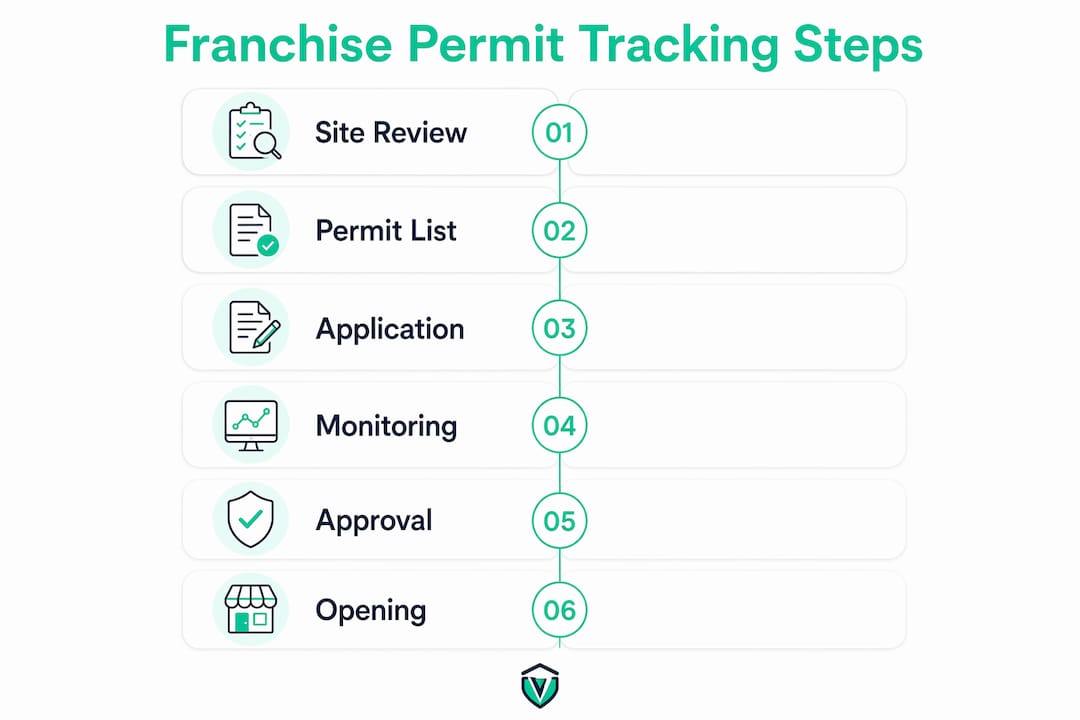
Clear RACI mappings and corporate oversight reduce variance in permit outcomes across locations. When GCs handle permits ad hoc without a repeatable process, you get inconsistent results. Formalizing ownership is not bureaucracy; it is the difference between a rollout that runs on schedule and one that does not.
Timeline mapping is the other piece most teams skip. Permit milestones need to be locked into your construction schedule before the lease is signed. If plan review in a target jurisdiction takes several weeks, your construction start date needs to account for that. Permit milestones that are not on the Gantt chart get treated as someone else's problem until they become everyone's emergency.
For franchisee onboarding, keep training minimal and focused. A two-page permit responsibility summary, a short walkthrough of the tracking tool, and a clear escalation path covers 90% of what a new franchisee needs. Governance rules should be simple: every permit gets a named owner, every status update goes into the system, and no permit sits at "submitted" for more than two weeks without a follow-up logged.
What mistakes do franchises make with permit management?
Most permitting failures are not caused by difficult jurisdictions. They are caused by process gaps that a tracking system either prevents or makes visible.
Common pitfalls and their fixes:
- Spreadsheets and email threads as the system of record. Status lives in someone's inbox. When that person is out, the permit stalls. Fix: a centralized portal that replaces scattered tracking with a single source of truth.
- Incomplete submittals. Missing a single document triggers a resubmittal cycle that adds weeks to your timeline. Fix: a pre-submittal checklist with a mandatory QA sign-off before any application goes out.
- Ownerless permits. No one is assigned, so no one follows up. Fix: RACI assignment at the permit level, enforced by the system.
- Missed renewals. A lapsed business license or health permit can force a location to close. Fix: automated reminders set at 90, 60, and 30 days before expiry.
- Broken document versioning. The wrong plan set gets submitted. Fix: version-controlled document storage with a clear "current" designation.
- Lost jurisdictional intelligence. A team member who knew the county's informal preferences leaves, and the next submittal gets kicked back. Fix: a searchable jurisdiction notes field that captures and retains local knowledge.
Self-assessment checklist — where is your process most exposed?
- Do you have a single system where every permit's status, owner, and expiry date is visible?
- Does every permit have a named owner who is accountable for follow-up?
- Do you run a QA review of every submittal packet before it goes to the jurisdiction?
- Are renewal reminders automated, or does someone have to remember to check?
- Is your jurisdictional knowledge documented and searchable, or does it live in people's heads?
The human factor matters here. When internal teams manage multiple jurisdictions simultaneously, the administrative burden of permit chasing often consumes construction management time and creates domino delays. A dedicated permit coordinator, or a permit management partner, prevents the drift that happens when permitting is everyone's secondary responsibility and no one's primary one.
Pre-submittal and opening checklist for a new franchise location
Running a new location through a standardized checklist before submission and before opening is the single most reliable way to cut resubmittals and inspection delays. Here is a practical sequence.
Pre-submittal steps:
- Complete site due diligence: confirm zoning, jurisdiction authority, and full permit list required for this use type.
- Pull the jurisdiction's current submittal requirements and plan check preferences. Note any non-standard items in the jurisdiction notes field.
- Align prototype plans to local code edition (check the International Building Code adoption status for the jurisdiction).
- Assign a named owner for each permit on the list.
- Assemble the submittal packet and run a QA review against the jurisdiction checklist. Corporate sign-off required before submission.
- Schedule a pre-submittal meeting with the jurisdiction if required or if the project has non-standard elements.
- Submit and log the application date in the tracking system immediately.
Pre-opening steps:
- Confirm all inspections are scheduled and logged with dates in the system.
- Verify the CO checklist is complete: all trade inspections passed, punch list items resolved.
- Confirm signage permit is issued and installation is code-compliant.
- Verify ADA compliance documentation is complete.
- Confirm insurance and certificate of insurance (COI) are current and on file.
- Archive all final permits, inspection reports, and the CO in the central document repository.
- Set renewal reminders for every permit with an expiry date.
Pro Tip: Before any submittal goes out, run it against a master checklist that includes both the jurisdiction's published requirements and your own internal standards. A 30-minute internal QA review catches the missing document or mismatched plan note that would otherwise cost you three weeks in a resubmittal cycle.
Sign-off responsibility: corporate real estate or compliance signs off on steps 1–6 of the pre-submittal phase. The GC owns inspection scheduling. The franchisee confirms insurance and COI. Corporate compliance archives the final record. The franchise location opening checklist covers the full 2026 compliance sequence in more detail.
What do permit timelines and costs actually look like for U.S. franchises?
Operators who plan permit timelines based on best-case scenarios end up with opening dates they cannot hit. Build your schedule around realistic ranges, not optimistic ones.
Typical permit timeline ranges by activity (U.S. franchises):
| Permit or Activity | Conservative Timeline | Optimistic Timeline |
|---|---|---|
| Tenant improvement plan review | 10–14 weeks | 4–6 weeks |
| Health or food service permit | 4–8 weeks | 2–3 weeks |
| Signage permit | 3–6 weeks | 1–2 weeks |
| Alcohol or liquor license | 90 days | 60 days |
| Certificate of occupancy | 2–4 weeks after final inspection | 1 week |
| Business license | 2–4 weeks | 1–5 business days |
These ranges vary significantly by jurisdiction size and local workload. A large urban planning department with a backlog processes plan reviews on a different timeline than a small suburban municipality. Averaging portfolio-level KPIs across locations helps blunt single-jurisdiction outliers from distorting your overall forecast.
Common cost drivers to budget for:
- Plan check fees (typically calculated as a percentage of construction value or a flat fee per jurisdiction)
- Permit application fees (vary widely by permit type and jurisdiction)
- Expediting fees when timeline compression is needed
- Permit consultant or expediter fees for complex or high-volume markets
- Resubmittal fees charged by some jurisdictions for each additional review cycle
- Bond or escrow requirements for certain permit types or jurisdictions
For a detailed breakdown of how these costs are structured across a multi-unit portfolio, the franchise permit cost guide covers the fee types operators encounter most often.
Practical contingency guidance: add a two-week buffer per permit type to your construction schedule for jurisdictions you have not worked in before. Budget a 15–20% cost contingency on permit-related fees for new markets. Both buffers shrink as your jurisdictional knowledge base grows.
How does Vaultedai approach franchise permit tracking?
Vaultedai is built specifically for multi-location operators who have outgrown spreadsheets and need a single source of truth across their entire permit portfolio. The platform maps directly to the data model and KPIs covered throughout this guide.
How Vaultedai's features connect to operational outcomes:
- Multi-location dashboard: Every permit across every location is visible in one view. Status, owner, deadline, and document links are accessible without digging through email threads.
- Automated reminders: Renewal and deadline alerts fire at configurable intervals, so missed renewals stop being a risk that depends on someone's memory.
- Jurisdiction rule fields: Capture local submission preferences and non-standard requirements in searchable fields that your whole team can access for future locations.
- Document management: Centralized storage with version control means the right plan set is always the one on file, and the full permit record is audit-ready at any time.
- KPI reporting: Average days-to-permit, resubmittal counts, and filed-vs-issued ratios are visible at the portfolio level, not buried in individual location records.
Onboarding a multi-unit franchise portfolio on Vaultedai:
- Pilot: Start with three to five locations. Migrate active permits and upcoming renewals first.
- Configure: Set up jurisdiction-specific fields, assign permit owners, and configure reminder workflows.
- Validate: Run the pilot for 60–90 days. Measure KPIs against your pre-Vaultedai baseline.
- Deploy: Roll out to the full portfolio with the pilot's configuration as the template.
- Govern: Establish data entry standards and a quarterly KPI review cadence to sustain improvement.
Vaultedai supports franchise rollouts, territory-based permit management, and fast onboarding for new franchisees who need to get up to speed on their permit responsibilities quickly. The platform is designed for operators who need clarity across locations, not another tool that requires a dedicated administrator to maintain.
For operators managing state and local permits simultaneously across multiple jurisdictions, the state and local permit coordination guide covers the sequencing and ownership questions that come up most often.
Key Takeaways
Permit tracking is the single operational system that converts franchise expansion from a schedule risk into a repeatable, measurable process — and the operators who measure it first improve it fastest.
| Point | Details |
|---|---|
| Measure days-to-permit first | Average days-to-permit is the most reliable leading indicator of rollout health; track it by permit type and jurisdiction from day one. |
| Centralize before you scale | A single permit record per location with named owners and document links prevents the email-thread chaos that stalls multi-unit rollouts. |
| QA every submittal | A pre-submittal checklist with a mandatory sign-off is the highest-leverage action for cutting resubmittal rates and shortening approval timelines. |
| Build in realistic buffers | Add a two-week schedule buffer and a 15–20% cost contingency for new jurisdictions until your portfolio KPIs give you a tighter baseline. |
| Vaultedai for centralized tracking | Vaultedai centralizes permits, deadlines, and documents across all locations with automated reminders and portfolio-level KPI reporting built in. |
The operational priority most franchise leaders get wrong
There is a version of this conversation that focuses on tools, and a version that focuses on data. Most operators jump to the tool question first. That is the wrong order.
The single most valuable thing a franchise operations leader can do before selecting any platform is run a 30-day permit inventory across their current portfolio. Pull every active permit, every upcoming renewal, every open application. Assign a named owner to each one. Record the application date and current status. That exercise alone surfaces the gaps: the permits no one owns, the renewals three weeks from lapsing, the applications that have been "submitted" for months with no follow-up logged.
Once you have that baseline, the KPI picture becomes clear. You know your average days-to-permit. You know your resubmittal rate. You know which jurisdictions are slow and which are fast. That data is what makes every subsequent decision, including which tool to use, defensible rather than arbitrary.
The change management piece is simpler than most leaders expect. Franchisees and GCs do not resist structure when the structure reduces their workload. A clear permit responsibility summary, a two-field status update requirement, and an automated reminder system covers the governance without creating overhead. The operators who struggle with adoption are usually the ones who tried to implement a complex system before they had a simple, agreed-upon data model.
Centralize the inventory. Measure the baseline. Then pick the tool that fits the data model you have already defined.
Vaultedai can help you move from spreadsheets to a real permit system
If the permit inventory exercise above sounds familiar because you are already living it, Vaultedai is built for exactly this transition. The platform gives multi-location franchise operators a centralized home for every permit, license, renewal, and compliance document across their entire portfolio, without the administrative overhead of maintaining a custom spreadsheet system that breaks every time someone leaves the team.
A practical pilot scope: start with three to five locations, migrate your active permits and upcoming renewals, and run a 90-day KPI test. Measure your average days-to-permit and resubmittal rate before and after. Those two numbers will tell you whether the system is working. Vaultedai's onboarding is designed to get a multi-unit operator live quickly, with the data model and jurisdiction fields already covered in this guide built into the platform from day one.
The Vaultedai platform is the practical next step for franchise teams that are ready to stop chasing permits and start managing them. Visit the site to see how the platform maps to your portfolio size and get started.
Useful sources and further reading
The sources below are worth bookmarking depending on where you are in your permitting program.
For executives and operations leads:
- How to Streamline Franchise Rollout Permit Management — covers centralization, KPI frameworks, and jurisdictional intelligence for multi-unit operators.
- A Guide to Multi-Unit Franchise Permit Services — practical guidance on when to hire a permit partner and how to structure governance.
- Commercial Building Permits at Scale — useful for understanding the complexity of nationwide construction permitting.
For permit coordinators and construction leads:
- International Building Code (ICC) — the primary reference for understanding which code edition applies in a given jurisdiction.
- Permit Expediting for Multi-Location and Franchise Projects — covers expediting strategies for high-volume or time-sensitive rollouts.
Vaultedai internal guides by role:
| Guide | Best For |
|---|---|
| Multi-unit franchise permit types | Executives mapping permit requirements to franchise use cases |
| New franchisee permit setup workflow | Franchisees getting up to speed on permit responsibilities |
| Territory-based permit management | Operations leads managing rollouts by region or territory |
| Franchise location opening checklist | Construction and compliance teams preparing for opening day |
| Types of permits franchises must maintain | Compliance teams managing ongoing renewals and inspections |
Where to start based on your role: If you are an executive deciding whether to invest in a permit management system, start with the KPI framework in the PermitPlace rollout guide and the Vaultedai multi-unit permit types overview. If you are an operations lead building the system, the new franchisee setup workflow and the territory-based management guide give you the most practical starting points. If you are a franchisee new to permit responsibilities, the opening checklist is the fastest path to understanding what you own.