
Territory-based permit management in franchising is the coordinated practice of aligning geographic territory rights with multi-jurisdictional permit compliance to keep every franchise location legally operational. Most franchise operators treat territory rights and permit tracking as separate problems. They are not. When a territory boundary shifts, permit obligations shift with it, and the franchisees who miss that connection face fines, forced closures, and failed transfers. This guide covers how FDD Item 12 defines your territory rights, how mapping tools like drive-time polygons translate those rights into permit obligations, and how automation platforms reduce the compliance gaps that manual tracking creates.
What is territory-based permit management in franchising?
Territory-based permit management is the practice of treating franchise territory rights and jurisdiction-specific permit requirements as a single, coupled compliance dataset rather than two separate administrative tasks. FDD Item 12 disclosures define whether your territory is exclusive, protected, or non-exclusive, and those definitions directly determine which jurisdictions you must hold permits in and which regulatory bodies have authority over your operations.
The three territory types carry meaningfully different permit implications:
- Exclusive territories prohibit the franchisor from placing any competing unit inside your boundary. You hold full permit responsibility for that geographic area.
- Protected territories prevent same-brand physical units inside your boundary but preserve franchisor rights to online sales, ghost kitchens, delivery platforms like DoorDash and Uber Eats, and non-traditional venues such as university campuses. Protected territories are the industry norm because they balance franchisor flexibility with franchisee position.
- Non-exclusive territories offer the least protection and the most permit complexity, since overlapping units in the same jurisdiction can create conflicting license registrations.
The boundary definition method matters as much as the exclusivity type. Franchisors define territories by fixed radius, ZIP code clusters, county lines, or drive-time polygons. Drive-time isochrone mapping is more defensible and equitable than fixed-radius circles because it reflects real customer accessibility rather than arbitrary geometry. A five-mile radius in Manhattan covers a radically different population than a five-mile radius in rural Nebraska, and your permit obligations in each jurisdiction reflect that difference.
Pro Tip: When reviewing your FDD, map your territory boundary against the specific city, county, and state permit jurisdictions it crosses. A single territory defined by a drive-time polygon can span three counties, each with separate business license, health permit, and zoning requirements.

The carve-out list in Item 12 is where most franchisees underestimate their exposure. Research shows 92% of franchise agreements include alternative distribution channel rights and 87% include non-traditional venue carve-outs. Ghost kitchen carve-outs increased notably starting in 2022. Each carve-out represents a channel where the franchisor can operate inside your territory without triggering your permit jurisdiction, which means your compliance map must account for what you do not control, not just what you do.
How do mapping and automation tools improve multi-location permit tracking?
Mapping and automation tools convert static territory definitions into live compliance workflows. Without them, a franchise manager overseeing 15 locations across three states is manually tracking renewal dates in spreadsheets, which is a system that fails the moment one deadline is missed or one territory boundary is modified.
The core mapping techniques used in franchise territory management are:
- Drive-time polygons that reflect actual travel time from a central point, accounting for road networks and traffic patterns
- ZIP code clusters that align with postal service boundaries, useful for direct mail and local government permit filings
- Radius boundaries that provide simple, defensible perimeters for smaller franchise systems
- Population thresholds that tie territory size to demographic viability, often integrated with U.S. Census Bureau data
The permit management software category has matured significantly. Here is a comparison of the primary approaches franchise operators use:
| Approach | Core capability | Best for | Key limitation |
|---|---|---|---|
| Vaultedai | Centralized permit and license tracking, renewal alerts, multi-location dashboard | Multi-location franchises scaling past 5 units | Focused on compliance, not territory mapping |
| GeoComply / OneComply | Automated license workflows, vendor surveillance, material change alerts | Gaming, hospitality, and regulated industries | Industry-specific pricing and setup |
| Maptive | FDD-aligned territory mapping, boundary visualization | Franchisors designing territory structures | Does not track permit renewals |
| Spreadsheet systems | Low cost, flexible | Single-location or early-stage operators | No automation, high error rate at scale |
Automation that standardizes renewals with notifications and vendor compliance tracking transforms franchise permit management from reactive to proactive. Penn Entertainment's compliance transformation using OneComply achieved 95% faster application completion and reduced compliance risks across thousands of licenses. That result is not exceptional. It is what happens when system integrity replaces individual scheduling as the compliance mechanism.
Pro Tip: Configure your permit management platform to trigger a compliance review automatically whenever a territory boundary is modified. Mapping territory permit compliance as coupled datasets allows franchise managers to anticipate regulatory changes triggered by territory modifications before they become violations.
The most underused feature in permit management software is vendor license surveillance. If a supplier or contractor operating inside your territory loses their license, your franchise can be held liable for continuing to work with them. Platforms that monitor third-party license status in real time close that blind spot without requiring manual checks.
What does a territory permit compliance workflow look like?
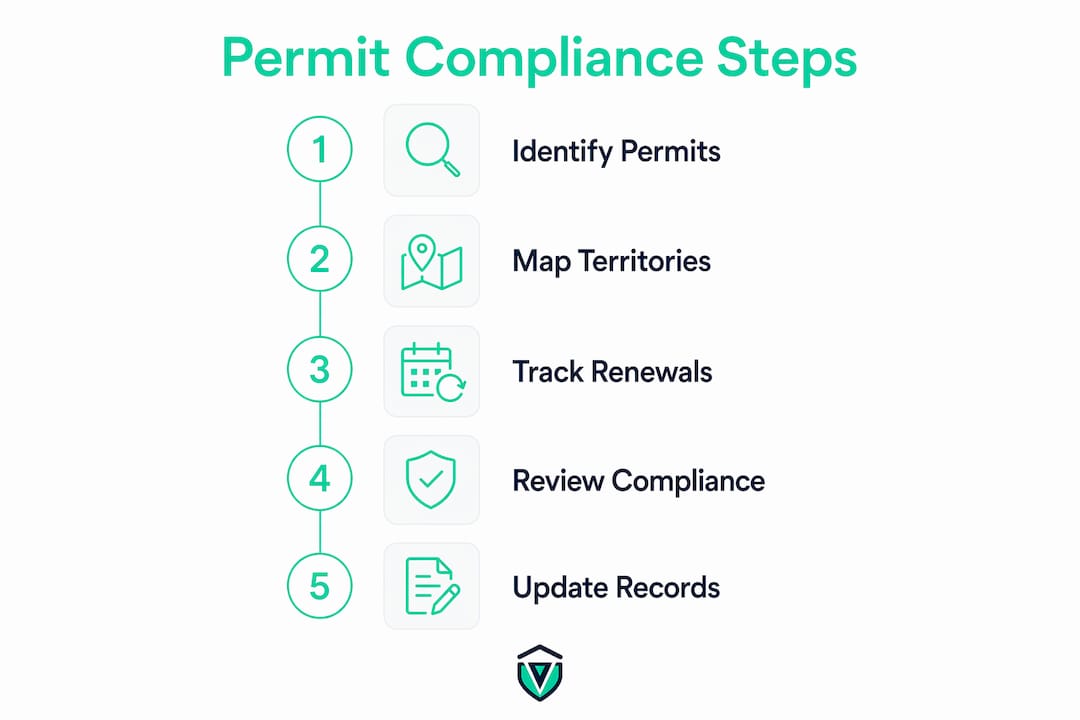
A repeatable territory permit compliance workflow has five sequential stages. Skipping any stage creates the gaps that produce fines and operational shutdowns.
- Verify territory boundaries. Pull your current FDD Item 12 disclosure and confirm the boundary definition method, the exclusivity type, and all active carve-outs. Cross-reference against your franchise agreement for any negotiated modifications.
- Identify all permit jurisdictions. Map your territory boundary against city, county, and state lines. A single location can require a franchise health permit from the county, a business license from the city, a zoning permit from the municipality, and an environmental permit from the state. Each is a separate renewal cycle.
- Schedule permit applications and renewals. Enter every permit type, issuing authority, renewal date, and fee into a centralized system. Vaultedai is built specifically for this step, giving multi-location operators a single dashboard that surfaces upcoming deadlines across all jurisdictions.
- Monitor compliance continuously. Set automated alerts for renewals due within 90, 60, and 30 days. Flag any territory modification for an immediate permit gap scan.
- Manage changes and encroachment. When a territory boundary changes through expansion, contraction, or transfer, run a full permit audit against the new boundary before the change takes legal effect.
Here is how manual and automated approaches compare on the metrics that matter most to franchise operators:
| Factor | Manual tracking | Automated tracking |
|---|---|---|
| Renewal miss rate | High, dependent on individual memory | Low, system-driven alerts |
| Time per location per month | 3 to 5 hours | Under 30 minutes |
| Encroachment detection | Reactive, after the fact | Proactive, boundary-triggered |
| Audit readiness | Inconsistent documentation | Centralized, timestamped records |
| Scalability | Breaks down past 5 locations | Scales linearly with locations added |
The most common troubleshooting scenario franchise managers face is overlapping permits when a territory expands into a jurisdiction where another franchisee already holds licenses. Resolving this requires a direct review of your franchise agreement's encroachment provisions and, in most cases, a formal modification request to the franchisor before any new permit applications are filed.
Pro Tip: Keep a franchise permit types reference document specific to each jurisdiction in your territory. Local permit requirements change more frequently than state or federal requirements, and a jurisdiction-specific reference prevents application errors that delay approvals.
How should you handle permits during territory transfers and expansions?
Territory transfers are the highest-risk moment in franchise permit management. The legal transfer of territory rights and the operational transfer of permit compliance are two separate processes that must run in parallel, not sequentially. Territory transfers require managing consent, rights of first refusal, and permit renewal synchronization to avoid operational delays that can stall a franchise sale for months.
A transfer checklist that integrates both legal and compliance steps looks like this:
- Confirm franchisor consent and any right of first refusal (ROFR) period has elapsed
- Audit all active permits for the transferring territory, noting expiration dates and renewal windows
- Identify any permits that will expire during the transfer period and file renewals before the transfer closes
- Confirm the incoming franchisee meets all jurisdictional requirements for permit holder eligibility
- Transfer or reapply for permits that are non-transferable under local law (many franchise construction permits and health permits fall into this category)
- Document all permit status changes with timestamped records for both parties
The distinction between transferable and non-transferable permits is where most transfer delays originate. A franchise health permit issued to a specific legal entity typically cannot be transferred to a new owner. The incoming franchisee must apply fresh, which means the transfer timeline must account for the issuing authority's processing time, which can range from two weeks to three months depending on the jurisdiction.
Franchise construction permits and franchise environmental permits carry similar complexity during territory expansions. When a franchisee adds a new location inside an existing territory, they trigger a full permit application cycle for the new site. Business expansion permit requirements vary significantly by state and municipality, and assuming that a permit type you hold at one location automatically applies to a new location in the same territory is the single most expensive assumption a franchise operator can make.
Operationally, territory transfers should align legal consent with permit compliance status to prevent franchise sales delays and protect both buyer and seller from post-transfer liability. The franchisees who close transfers cleanly are the ones who treat permit gap scans as a non-negotiable step in the due diligence process, not an afterthought.
Key takeaways
Effective territory-based permit management requires treating FDD territory rights and jurisdictional permit compliance as a single integrated system, not two separate administrative functions.
| Point | Details |
|---|---|
| FDD Item 12 drives permit scope | Your territory type and boundary definition determine exactly which jurisdictions require permits. |
| Carve-outs create hidden exposure | 92% of franchise agreements include alternative channel rights that operate inside your territory without your permit coverage. |
| Automation reduces missed deadlines | Automated renewal alerts and vendor surveillance replace individual scheduling as the compliance mechanism at scale. |
| Transfers require parallel workflows | Legal consent and permit gap scans must run simultaneously to prevent transfer delays and post-sale liability. |
| Drive-time mapping is most defensible | Isochrone boundaries reflect real customer access and reduce territory conflict disputes more effectively than radius or ZIP methods. |
Why most franchise operators are still solving the wrong problem
The conversation I hear most often from franchise managers focuses on which permit they missed, not why the system allowed them to miss it. That framing keeps operators in a permanent reactive posture, filing late renewals and paying penalty fees instead of building a process that makes missing a deadline structurally difficult.
The more interesting problem is the carve-out gap. Most franchisees I have spoken with cannot name every carve-out in their FDD Item 12. They know they have a protected territory, and they assume that means something close to exclusive. It rarely does. The territory rights disclosure in FDD Item 12 informs but does not guarantee exclusivity. Franchisees must read carve-outs closely for their true protection level. When a franchisor launches a ghost kitchen or a delivery-only brand inside your territory, your permit coverage does not extend to that operation, and your revenue does not benefit from it either.
My practical advice is to treat your first territory permit audit as a negotiation tool, not just a compliance exercise. When you know exactly which jurisdictions you are responsible for, which carve-outs reduce your effective exclusivity, and which permit types are most operationally critical, you have a factual basis for renegotiating territory terms at renewal. Franchisors respond to data. Operators who show up with a mapped compliance picture get better outcomes than those who show up with grievances.
The technology side of this is genuinely easier than it was five years ago. Platforms built for multi-location compliance have made centralized permit tracking accessible to operators running five locations, not just enterprise systems with 500. The barrier is not cost or complexity anymore. It is the willingness to stop managing permits in a spreadsheet and start managing them in a system designed for the job.
— Rakin
Manage all your franchise permits from one place with Vaultedai
Franchise permit management across multiple territories should not require a dedicated staff member manually tracking renewal dates in a shared spreadsheet.

Vaultedai is built for multi-location operators who need a single dashboard to track every permit, license, and renewal across all their locations and jurisdictions. The platform centralizes compliance documents, sends automated renewal alerts before deadlines hit, and flags territory-level changes that trigger new permit requirements. Franchise operators use Vaultedai to cut the time spent on permit administration and eliminate the compliance gaps that come with manual tracking. If you are managing more than three locations and still relying on spreadsheets, the permit tracking platform at Vaultedai is the operational upgrade your compliance process needs.
FAQ
What is a franchise territory permit?
A franchise territory permit is any license or regulatory authorization required to operate within the specific geographic boundaries defined in your franchise agreement. The permit types required depend on the jurisdictions your territory crosses, including city, county, and state authorities.
What is a franchise transfer permit?
A franchise transfer permit refers to the regulatory approvals and license reapplications required when franchise territory rights change ownership. Many permits, including health permits and business licenses, are non-transferable and must be reissued to the incoming franchisee by the relevant authority.
What is a franchise construction permit?
A franchise construction permit is a local government authorization required before building, renovating, or expanding a physical franchise location. Requirements vary by municipality, and expanding into a new territory triggers a fresh application cycle regardless of permits held at existing locations.
What is a franchise health permit?
A franchise health permit is a county or municipal authorization confirming that a food service or health-related franchise location meets local sanitation and safety standards. Health permits are typically issued to a specific legal entity and must be reapplied for during ownership transfers.
How does FDD Item 12 affect permit management?
FDD Item 12 requires disclosure of territory exclusivity status, boundary definitions, and franchisor carve-out rights, all of which determine which jurisdictions a franchisee must hold permits in. Franchisees should map their Item 12 territory against actual jurisdictional lines before filing any permit applications.