

Effective franchise permit management is the operational foundation that keeps every location in your food service network legally open and inspection-ready. To manage food service permits across a franchise network, operators must coordinate business licenses, health permits, food safety certifications, and jurisdiction-specific requirements for every single location. The standard industry term for this discipline is "multi-location compliance management," and it goes far beyond what most franchisors provide. Franchisors set brand standards. Permit compliance is your responsibility. This guide covers the exact permits you need, how to apply for them at scale, and the tools that make the process manageable.
What permits and certifications must franchise owners secure for food service?
Food service licensing requirements vary by city, county, and state, but every location needs a core set of permits before serving a single customer. The most common permit types include a primary business license, a food service health permit, food safety certifications, and any location-specific permits tied to your build-out or menu.
Primary business licenses
A Common Victualler License or Food Premises License is the first permit a new restaurant location must obtain. This license is required before a food service health permit can even be issued. That sequencing matters. If you apply for permits out of order, you add weeks to your opening timeline.
Food safety certifications
At least one person at each food service establishment must hold a valid Food Protection Manager Certificate. That certificate is valid for 5 years before renewal. Many jurisdictions also require Allergen Awareness certification as a condition of the initial food service permit application. For a franchise with 10 locations, that means tracking 10 separate certification holders and their individual renewal dates.

Additional permits by location type
Beyond the core licenses, many locations require:
- Signage permits (regulated separately from the building permit in most cities)
- Liquor licenses (if alcohol is served, often requiring a separate application process with longer timelines)
- Construction or build-out permits (required before any interior modifications)
- Fire safety certificates (typically issued after a fire marshal inspection)
- Zoning compliance letters (confirming food service use is permitted at that address)
The table below shows how permit requirements typically differ across jurisdiction types.
| Permit type | City jurisdiction | County jurisdiction | State jurisdiction |
|---|---|---|---|
| Business license | Required | Sometimes required | Not typically required |
| Food service health permit | Required | Required | Not typically required |
| Food Protection Manager Certificate | Required | Required | Required |
| Liquor license | Required | Required | Required |
| Signage permit | Required | Varies | Not required |
| Fire safety certificate | Required | Required | Not required |
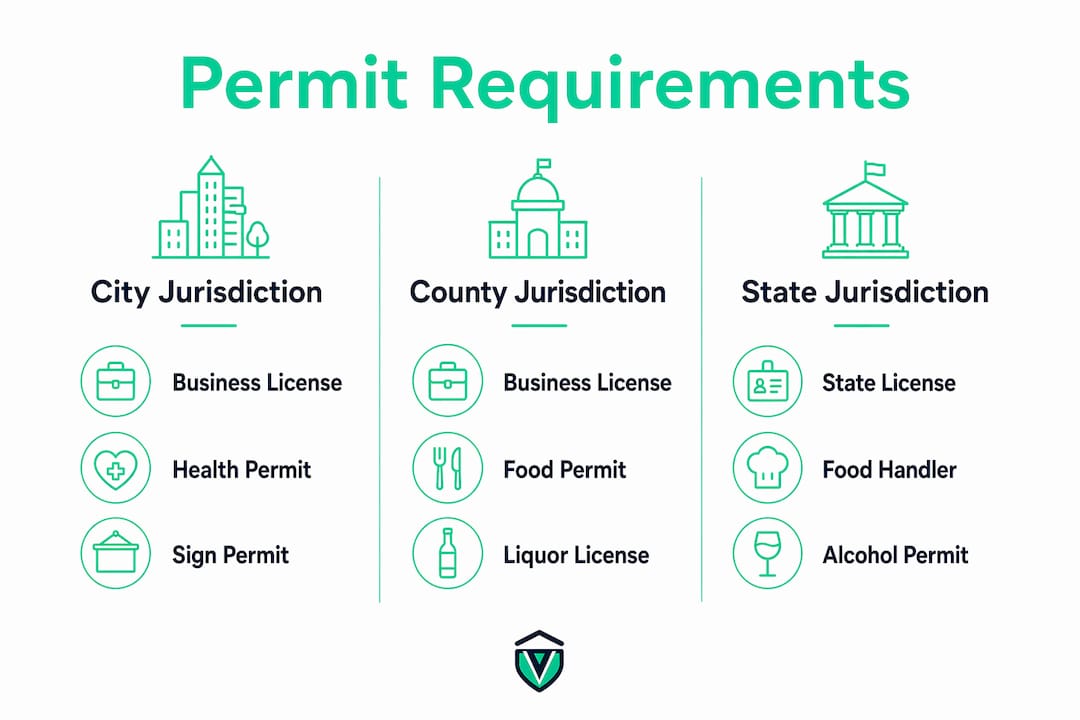
No two jurisdictions are identical. A franchise expanding from Texas into Illinois will encounter different health code standards, different application portals, and different inspection schedules at every new location.
How can franchise owners organize the permit application process at scale?
Preparation is the single biggest factor in whether a new location opens on time. Successful restaurant openings depend on open communication between franchise owners, architects, and franchisors during the design and permitting phases. Skipping that coordination creates costly revisions and delays.
Documents you need before applying
Gather these before submitting any permit application:
- Signed lease or proof of property ownership for the location
- Approved construction or floor plans (often requiring franchisor sign-off first)
- Fire safety plan prepared by a licensed architect or engineer
- Food Protection Manager Certificate for the designated manager
- Completed health department application forms specific to that jurisdiction
- Proof of prior business license (where sequencing rules apply)
Franchisor approval is often required for construction plans before you submit them to local authorities. That approval step adds time. Build it into your project schedule from day one.
Navigating submission formats
Submission formats vary by jurisdiction, including paper forms, online portals, and hybrid systems. A county health department may still require a paper application mailed with a check, while a neighboring city accepts everything through an online portal. Understanding each jurisdiction's preferred method prevents delays that have nothing to do with your actual compliance status.
Pro Tip: Start permit applications at least 4 weeks before your planned opening date. Missing documents cause automatic rejection, and resubmission resets the clock entirely.
For franchise operators opening multiple locations per year, building a location-specific application checklist for each jurisdiction is not optional. It is the only way to avoid repeating the same costly mistakes across locations.
What strategies and tools work best for managing permits across multiple locations?
The core challenge of multi-location compliance management is visibility. When you operate five or more locations, tracking renewal deadlines, certification expirations, and inspection schedules in a spreadsheet creates gaps. Franchise owners rarely receive a comprehensive compliance tracking system from their franchisors. Operators must independently track vendor contracts, employee certifications, and permits across their entire portfolio.
Building a permit matrix
Scaling franchise compliance requires a jurisdiction-by-jurisdiction permit requirements matrix. This matrix documents every permit type, renewal date, submission format, and responsible contact for each location. A generic compliance approach fails because health codes and licensing requirements differ even across neighboring regions. The matrix makes those differences visible and manageable.
A well-built permit matrix includes:
- Location name and address
- Each permit type held at that location
- Permit expiration date and renewal window
- Submission format (paper, online, hybrid)
- Local health department contact
- Status (current, pending renewal, expired)
Using technology to manage food permits
Digital permit tracking platforms provide centralized visibility of permit statuses, renewal deadlines, and document completeness across all franchise locations. These tools reduce the risk of missed deadlines and costly resubmissions. Vaultedai is built specifically for multi-location operators who have outgrown spreadsheets. The platform centralizes permits, licenses, renewals, and compliance documents across every location in one dashboard.
The problems that digital tracking eliminates include:
- Missed renewal deadlines due to no automated alerts
- Incomplete document submissions caught only after rejection
- No single view of compliance status across all locations
- Duplicate data entry across multiple spreadsheets
- Lost documents during staff turnover
Pro Tip: Set renewal alerts 60 days before expiration, not 30. Health departments in cities like Boston and Chicago process renewals on their own timelines, and a 30-day buffer is often not enough.
For operators managing territory-based permit requirements, a platform that maps permits to specific jurisdictions saves significant time during both new openings and annual renewals.
What are common pitfalls when managing franchise food service permits?
The most expensive permit mistakes are also the most preventable. Most cities require food service permits and business licenses to be renewed annually with specific deadlines. Late renewals incur fees or risk license revocation. A single lapsed permit can force a location to close until compliance is restored.
The one-size-fits-all trap
Applying the same compliance process to every location is the most common mistake franchise operators make. A process that works in one city will fail in another because health codes, inspection schedules, and required certifications differ. Franchise-specific permit management must address varied business activities, zoning rules, and renewal cycles at each location.
Permit transfers during ownership changes
Permit transfers during franchise ownership changes require coordinated documentation and communication with licensing boards. Ownership changes do not automatically transfer existing permits. The new owner must apply for permits in their name, and some jurisdictions require a new health inspection before issuing updated licenses. Failing to complete this process leaves the incoming owner operating without valid permits, which creates liability for both parties.
Common pitfalls to avoid across your network:
- Assuming a permit transfers automatically when a location changes hands
- Missing the renewal window because no one owns the tracking responsibility
- Submitting incomplete applications and assuming the health department will follow up
- Relying on a single employee to hold all certifications at a location (if they leave, the location may fall out of compliance)
Pro Tip: Build a direct relationship with your local health department contact at each location. A phone call before submitting a complex application can prevent a rejection that costs you weeks.
Involving franchisees early in permit processes reduces bottlenecks and better ensures both brand and legal compliance. The franchisee who understands why a permit matters is the one who renews it on time.
Key takeaways
Effective multi-location compliance management requires a jurisdiction-specific permit matrix, early application timelines, and centralized digital tracking to keep every franchise location legally operational.
| Point | Details |
|---|---|
| Permits are location-specific | Health codes and licensing requirements differ by city, county, and state. |
| Sequence your applications correctly | A business license must precede a food service health permit in most jurisdictions. |
| Certifications expire independently | Track each location's Food Protection Manager Certificate separately, as they expire on individual schedules. |
| Build a permit matrix | Document every permit, renewal date, and submission format for each location in one place. |
| Digital tracking prevents costly gaps | Automated alerts and centralized dashboards eliminate missed deadlines and incomplete submissions. |
The compliance burden no one warns you about
When I talk with franchise operators who are managing five or more locations, the conversation almost always reaches the same point. They assumed the franchisor would handle compliance. They were wrong, and they found out the hard way.
The franchisor provides the brand, the operating manual, and the supply chain. The permits are yours. That division of responsibility is clear in most franchise agreements, but it does not feel clear until you are two weeks from opening a new location and realize you never started the health permit application.
What I have seen work, consistently, is treating compliance as its own operational department. Not a task that falls to whoever has time. A defined owner, a defined process, and a defined tool. Operators who centralize their permit tracking, even in a basic matrix at first, open locations faster and close fewer locations due to compliance failures.
The other thing worth saying directly: do not wait until you are at 10 locations to build a real system. The habits you build at 3 locations determine whether you can scale to 30. A franchise operator who tracks permits manually at 3 locations will still be tracking manually at 15, and by then the gaps will cost real money.
Embrace digital tools early. The learning curve is short. The cost of not doing it compounds every year.
— Rakin
How Vaultedai helps franchise operators stay compliant
Franchise operators managing permits across multiple locations need more than a spreadsheet. They need a system that shows every location's compliance status at a glance, alerts them before deadlines hit, and stores every document in one place.
Vaultedai is built for exactly that. The platform centralizes permits, licenses, renewals, and compliance documents for every location in your network. Operators get automated renewal alerts, a full document library, and a clear dashboard that shows what is current, what is expiring, and what needs attention. For food service franchise networks managing complex permit requirements across multiple jurisdictions, Vaultedai removes the manual work and the guesswork from compliance. Visit Vaultedai to see how the platform fits your network.
FAQ
What permits does a food service franchise location need?
Every food service location needs a primary business license, a food service health permit, and a Food Protection Manager Certificate at minimum. Additional permits like liquor licenses, signage permits, and fire safety certificates depend on the location and menu.
How far in advance should I apply for food service permits?
Submit permit applications at least 4 weeks before your planned opening date. Missing documents cause rejection, and resubmission resets the processing timeline.
Does a franchisor handle permits for new locations?
Franchisors rarely provide a comprehensive compliance tracking system. Franchise owners are responsible for obtaining and renewing all permits and certifications at each location independently.
What happens if a food service permit lapses?
Most cities require annual renewal, and late renewals incur fees or risk license revocation. A lapsed permit can force a location to close until compliance is restored.
How do I manage permits when a franchise location changes ownership?
Permits do not transfer automatically during ownership changes. The new owner must apply for permits in their name, and some jurisdictions require a new health inspection before issuing updated licenses.