
A franchise location opening permit checklist is a structured, step-by-step compliance document that confirms every legal and regulatory requirement is met before a new franchise site opens its doors. Most operators underestimate the scope. Total launch timelines span 150+ tasks across 8+ workstreams over 16–24 weeks, and delays can cost $50,000 or more per week in lost revenue. The permit process sits at the center of that timeline. Get it right, and your opening runs on schedule. Miss a step, and you are looking at forced closures, variance hearings, and dry openings with no liquor license in sight. This guide walks you through every stage of the new franchise location permit process, from zoning verification to final inspection sign-off.
What permits does a new franchise location require?
Every new franchise location requires a distinct set of permits tied to its physical space, business type, and local jurisdiction. There is no single universal list. That said, most franchise openings share a core set of approvals that form the foundation of any solid franchise setup checklist.
The permits you will encounter most often fall into these categories:
- Building permit: Required before any construction, renovation, or tenant improvement work begins. Your architect or general contractor submits stamped plans to the local building department for review and approval.
- Certificate of occupancy: Issued after final inspections confirm the space meets building codes. No certificate means no legal occupancy, regardless of how ready the location looks.
- Health department permit: Mandatory for any food service franchise. This covers kitchen layout, equipment standards, food handling procedures, and sanitation. Food service permit requirements vary significantly by state and county.
- Fire department inspection and permit: Covers sprinkler systems, fire suppression equipment, exit signage, and occupancy load. Fire marshals conduct on-site inspections before approving occupancy.
- Signage permit: Most municipalities require approval for exterior signs, including dimensions, lighting, and placement. Franchise brand standards often conflict with local sign codes, so resolve this early.
- Seller's permit: Required for any retail franchise collecting sales tax. This is a state-level registration with the department of revenue or equivalent agency.
- Liquor license: Applies to food and beverage franchises serving alcohol. Liquor licenses carry the longest processing times and are often quota-limited, meaning treating them as secondary causes months of dry operations after opening.
- Zoning and conditional use permit: Required when the proposed business use does not automatically conform to the property's current zoning designation.
Permit requirements also differ by franchise type. A fast-casual restaurant franchise faces a heavier health and fire permit load than a retail apparel franchise. A convenience store franchise may need tobacco, lottery, and fuel-related permits on top of the standard stack.
How do you verify zoning before applying for permits?

Zoning verification is the first task on any credible franchise location opening permit checklist, and it must happen before you sign the lease. Starting the permitting process without confirming zoning is a primary cause of project failure, leading to forced closures or costly public hearings for variances. A lease signed on a property with incompatible zoning locks you into a space you legally cannot use for your intended business.
The verification process starts with your local planning or zoning department. Request a zoning confirmation letter or use the municipality's online zoning map to confirm the property's designation. Then cross-reference that designation against the permitted uses list for your franchise type. If your use is conditionally permitted rather than outright permitted, you will need a conditional use permit, which adds weeks or months to your timeline.
Pro Tip: Schedule a predevelopment or intake meeting with the local permit office before submitting any application. Permit offices provide written submittal checklists during these meetings, and early contact minimizes application rejections and costly rework.
Confirm that your architect and engineer hold active licenses in the state where the project is located. Some jurisdictions require locally licensed professionals to stamp drawings. Discovering this after plans are drafted means starting over.
What is the step-by-step permit application process?
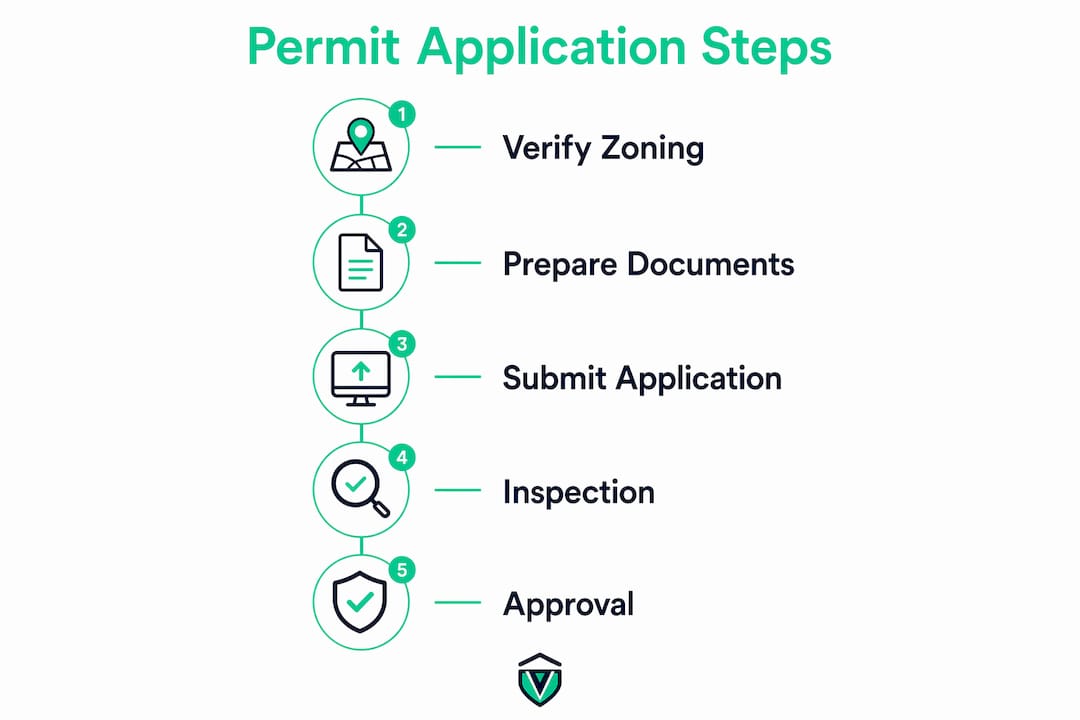
The permit application process for a new franchise location follows a defined sequence. Skipping steps or running them out of order creates downstream delays that compound quickly. Typical phase timelines run 30–60 days for site selection, 30–90 days for permitting, 60–120 days for construction, and 2–4 weeks for pre-opening activities.
Follow this numbered sequence to stay on track:
- Confirm zoning and execute the lease. No permit application is worth submitting until zoning is verified and the lease is signed. This is your gate criterion for advancing to the next phase.
- Engage your architect and engineer. Commission construction drawings that meet local code requirements. Confirm professional license validity in the project jurisdiction.
- Submit building permit application. Include stamped architectural plans, site plans, and any required engineering documents. Verify the local submittal format, whether digital or paper, before submission.
- Apply for health department approval. Submit kitchen layout plans, equipment specifications, and food handling procedures simultaneously with or immediately after the building permit application. Health reviews often run on a parallel track.
- File for your liquor license immediately. If your franchise serves alcohol, start this application on day one. Liquor licenses require early prioritization because processing times are long and quota limits are real.
- Schedule fire department pre-inspection. Coordinate with the fire marshal early to understand suppression system requirements and inspection scheduling windows.
- Track all permit statuses in one place. Use a centralized tracker to monitor submission dates, review cycles, and approval deadlines. Task dependency mapping reveals how delays in one permit cascade into downstream delays, allowing proactive schedule adjustments before costs escalate.
- Pass all building inspections. Schedule rough-in, framing, electrical, plumbing, and final inspections in the sequence your jurisdiction requires. Missing an inspection window can add weeks.
- Obtain certificate of occupancy. This is the final gate before opening. Confirm all inspection sign-offs are documented and on file.
- Compile your compliance file. Store all permits, inspection reports, and approval letters in a single organized record. You will need these for renewals, audits, and future ownership transfers.
Pro Tip: Build a written communication log with every permit office you contact. Date-stamp every conversation, email, and submission confirmation. When a reviewer claims they never received your documents, that log is your defense.
How do jurisdiction-specific rules affect your permit strategy?
No universal permit checklist exists for franchise operators. Permit requirements vary by jurisdiction, and multi-state franchise groups face distinct compliance stacks that require a location-by-location permit matrix. What clears review in Texas in two weeks may take three months in California with additional state agency sign-offs.
The table below illustrates how permit requirements shift across jurisdiction types:
| Permit Type | Urban Municipality | Suburban County | Rural Township |
|---|---|---|---|
| Building permit | Digital submission, strict review cycles | Paper or digital, moderate timelines | Paper only, variable timelines |
| Health department | State + city dual review common | County health department only | County or state only |
| Liquor license | Quota-limited, 90–180 day processing | Moderate processing, fewer quotas | Faster processing, limited quotas |
| Signage permit | Strict design review boards | Standard approval process | Minimal restrictions |
| Conditional use permit | Frequent requirement, public hearings | Case-by-case basis | Rarely required |
For multi-location operators, the solution is a territory-based permit matrix that maps every jurisdiction's requirements, submission formats, renewal cycles, and key contacts. Treat each location as a custom compliance project, not a copy-paste of the last one. Franchise networks that adopt this approach avoid the costly assumption that what worked in one market will work in another.
What are the most common permit mistakes franchise operators make?
Permit delays are almost always preventable. The same mistakes appear repeatedly across franchise openings, and each one has a direct cost attached to it.
- Skipping zoning verification before signing the lease. This is the single most expensive mistake in the franchise opening requirements process. A zoning mismatch discovered after lease execution can mean months of lost revenue and legal fees to pursue a variance.
- Treating the liquor license as a secondary task. Operators who file this application late open their doors without alcohol service, losing a primary revenue stream from day one.
- Submitting incomplete permit applications. Missing a single required document triggers a rejection and restarts the review clock. Always obtain the written submittal checklist from the permit office before filing.
- Failing to sequence permits correctly. Health department approval often depends on finalized construction drawings. Fire inspections depend on completed suppression system installation. Running these out of order creates bottlenecks that are entirely avoidable.
- Ignoring renewal cycles. Permits are not permanent. Health permits, food handler certifications, and fire safety inspections all carry annual or biannual renewal requirements. Missing a renewal can trigger a shutdown.
Pro Tip: Build a digital playbook for each franchise location that includes every permit type, submission deadline, renewal date, and responsible contact. Franchise networks using project-managed playbooks with gate milestones avoid last-minute scrambles and launch on schedule.
Key takeaways
A complete franchise location opening permit checklist is the difference between a smooth launch and a costly, delayed opening that bleeds revenue before the first customer walks in.
| Point | Details |
|---|---|
| Zoning comes first | Verify zoning before signing any lease to avoid forced closures or variance hearings. |
| Liquor licenses need early filing | Apply for liquor licenses on day one to prevent dry openings caused by long processing times. |
| No universal checklist exists | Build a jurisdiction-specific permit matrix for every new location to match local requirements. |
| Sequence permits correctly | Health, fire, and building permits have dependencies; running them out of order creates avoidable delays. |
| Digital tracking prevents missed deadlines | Centralized permit tracking with task dependencies allows proactive adjustments before costs escalate. |
The part of permit management nobody talks about
Most articles on franchise opening requirements focus on the list of permits you need. That is the easy part. The hard part is the sequencing, the communication, and the institutional knowledge that separates operators who open on time from those who do not.
I have watched franchise groups spend months building out a beautiful location, only to sit idle because a health department review was submitted two weeks late or a liquor license application was filed after construction started. The financial damage is real. At $50,000 or more per week in delayed revenue, a three-week permit slip is a six-figure problem.
What I have found actually works is treating the permit process like a project with hard gate criteria. You do not advance from lease execution to design without confirmed zoning. You do not advance from design to construction without permit submissions in hand. Each gate forces the team to verify before spending more money. That discipline is uncomfortable when everyone is eager to break ground, but it is the only approach that consistently delivers on-time openings.
The other thing I would push back on is the idea that permit management is an administrative task. It is a strategic one. The operators who understand their jurisdiction-specific requirements, who have relationships with local permit offices, and who track every deadline in a centralized system are the ones who scale successfully. The ones who treat it as paperwork to hand off and forget are the ones calling me after a forced closure.
— Rakin
How Vaultedai helps you track every permit across every location
Opening a franchise location involves dozens of moving parts, and permits are the ones that can shut you down if they slip. Vaultedai is built specifically for multi-location operators who need to track permits, licenses, renewals, and compliance documents across every site in one place.
The platform centralizes your entire permit workflow, from initial application tracking to renewal deadline alerts, so nothing falls through the cracks as you scale. Vaultedai's task dependency mapping shows you exactly how one delayed permit affects the rest of your opening timeline, giving you the visibility to act before a small delay becomes a costly one. If you are managing multiple franchise openings or preparing to expand, explore Vaultedai to see how centralized permit management keeps your locations opening on time and in compliance.
FAQ
What is a franchise location opening permit checklist?
A franchise location opening permit checklist is a structured document listing every permit, license, and inspection required before a new franchise site can legally open. It covers building permits, health approvals, fire inspections, signage permits, and any jurisdiction-specific requirements.
Why do franchise location openings require permits?
Permits confirm that a franchise location meets local building codes, health standards, fire safety regulations, and zoning requirements. Operating without required permits exposes franchise owners to fines, forced closures, and liability.
How long does the franchise permit process take?
The permitting phase typically takes 30–90 days, with full buildout spanning 3–6 months after permit approval. Liquor licenses often take 90–180 days in urban markets, making early application critical.
What happens if you skip zoning verification?
Skipping zoning verification before signing a lease is a primary cause of project failure. A zoning mismatch can result in forced closures, costly variance hearings, and months of lost revenue with no legal path to operate.
Can you use the same permit checklist for every franchise location?
No. Permit requirements vary by jurisdiction, and no universal checklist applies across all locations. Multi-location franchise operators need a jurisdiction-specific permit matrix that accounts for local submission formats, review timelines, and renewal cycles.