
The new franchisee permit setup workflow is the structured process franchise owners must complete to secure every license, permit, and regulatory approval required before opening a new location. Most franchise managers underestimate how early this process must begin. Municipal permitting alone takes 4–10 weeks, and that window stretches further in dense markets like coastal California, Manhattan, or Cook County. Getting the workflow right means treating permits as a strategic launch milestone, not a final checklist item. This guide covers legal entity formation, critical permit types, coordination strategies, and the most common mistakes that push opening dates back by months.
What does the new franchisee permit setup workflow require first?
Every permit application requires a legally formed business entity behind it. You cannot apply for a business license, open a bank account, or register with the IRS under a personal name. The franchisee application process starts with entity formation, and that step must happen before anything else moves.
Legal entity formation
Forming an LLC or corporation in your home state costs $50–$500 in state filing fees, depending on the jurisdiction. Processing takes 3–15 business days in most states. That timeline matters because every downstream permit application depends on having a registered entity name and state-issued entity number.

After formation, apply for an Employer Identification Number (EIN) through the IRS. The IRS issues an EIN online in 15 minutes. That speed is a genuine advantage. Use it immediately, because your EIN unlocks your business bank account, state tax registration, and employer accounts.
The full prerequisite sequence looks like this:
- File your LLC or corporation with the state secretary of state office
- Obtain your EIN from the IRS online portal
- Open a dedicated business bank account under the entity name
- Register for state sales tax and employer withholding accounts
- Confirm your registered agent is in place for legal correspondence
Pro Tip: Register your entity in the state where your franchise location sits, not just your home state. Operating across state lines without proper foreign qualification creates compliance gaps that surface during permit reviews.
| Step | Typical cost | Typical timeline |
|---|---|---|
| State entity filing | $50–$500 | 3–15 business days |
| EIN from IRS | Free | 15 minutes online |
| State tax registration | $0–$100 | 1–5 business days |
| Business bank account | Varies by bank | 1–3 business days |
What permits does every franchise need before opening?
The franchise permit requirements for a new location fall into six core categories. Each has its own timeline, cost range, and inspection process. Missing any one of them delays your certificate of occupancy and your opening date.
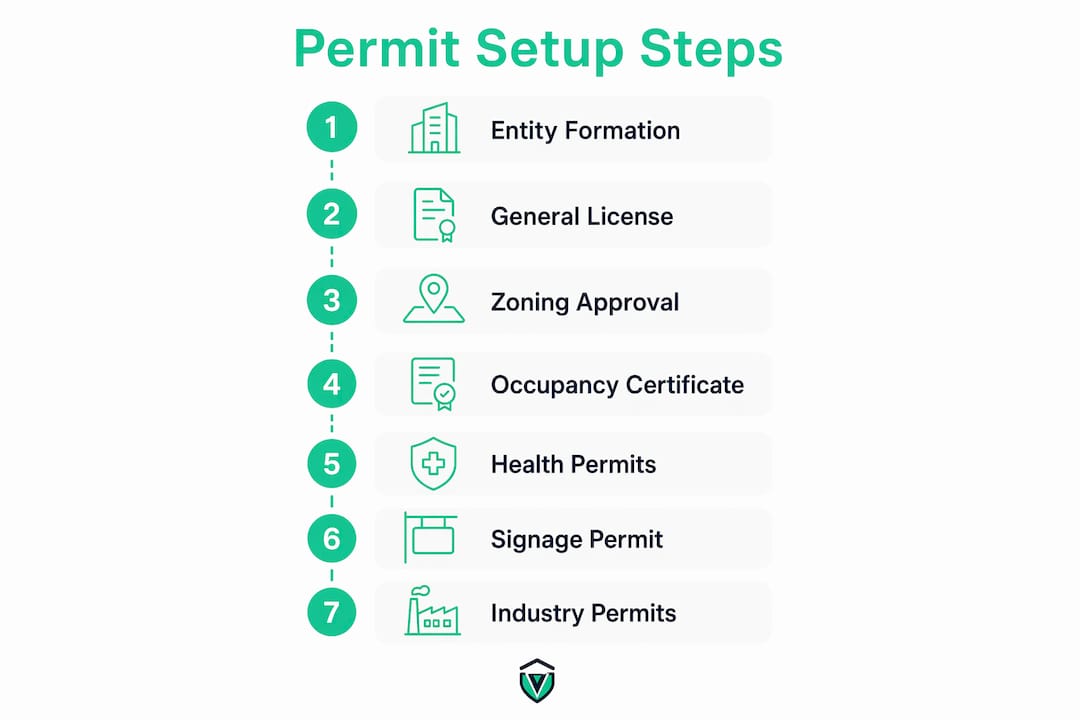
General business license is the baseline permit every franchise needs. Most municipalities issue these for $50–$500. Processing is usually fast, but the application requires your EIN, entity documents, and a confirmed physical address.
Zoning and land use permits confirm that your chosen location is approved for your franchise type. A quick-service restaurant, a fitness studio, and a retail shop each require different zoning classifications. Verify zoning before you sign a lease. Discovering a zoning conflict after signing costs far more than a pre-lease zoning check.
Certificate of occupancy is issued after construction or renovation passes final inspection. This permit confirms the space meets building codes for your specific use. The timeline depends entirely on your contractor's pace and the local building department's backlog.
Health department permits apply to any franchise handling food or beverages. Health inspections typically require two passes: a rough inspection during build-out and a final inspection before opening. Each stage takes 5–15 business days if no deficiencies appear. A single failed inspection resets that clock.
Signage permits are governed by local ordinances and your franchisor's brand standards simultaneously. Fees run $100–$500, but the real risk is submitting signage designs that conflict with local size or lighting restrictions. Get local approval before ordering fabricated signs.
Industry-specific permits carry the highest cost and the longest timelines. Liquor licenses cost $5,000–$15,000 and take 3–6 months to process. Franchises that open without a liquor license in place face "dry openings" that cut into projected revenue from day one. Contractor licenses, food handler certifications, and tobacco retail permits follow similar patterns of high cost and long lead times.
Pro Tip: Build a franchise permit checklist specific to your location before you apply for anything. Local requirements frequently differ from what your franchisor's standard checklist covers.
How do you coordinate with franchisors, contractors, and local authorities?
Coordination is where most franchise onboarding workflows either accelerate or stall. The parties involved, your franchisor, your general contractor, local permitting officials, and your architect, each hold information the others need. Gaps between them create delays.
Your franchisor provides brand-approved construction plans, equipment specifications, and signage standards. Use these documents as the foundation for every permit application. Submitting non-approved plans forces revisions that restart review timelines. Franchisors provide license checklists, but the legal responsibility to verify and obtain every permit rests entirely with you as the franchisee.
- Hire a permit expediter for high-density markets. These professionals know local reviewers, understand common rejection reasons, and can cut weeks off approval timelines.
- Schedule a pre-application meeting with your local permitting office before submitting anything. Pre-application meetings uncover "show-stopper" issues before they appear as formal rejections.
- Keep all permit documents in a single centralized location. Scattered files across email threads and shared drives create version confusion during inspections.
- Communicate with your contractor weekly during build-out. Unannounced construction changes can void pending permit applications.
- Build permit milestone dates into your construction schedule as hard deadlines, not estimates.
Pro Tip: Treat your local permitting office as a partner, not an obstacle. Officials who recognize your name and trust your documentation move your applications faster than those reviewing a cold submission.
What common pitfalls delay the franchise permit process?
The biggest mistake in any new franchise setup guide is treating permits as a backend task. Permits must be an early strategic priority, not something you address after construction begins. Franchises that delay permit applications routinely push their opening dates back by 30–90 days or more.
-
Underestimating processing times. Permit timelines suffer from what planning professionals call "optimism bias." Estimates can stretch from 30 to 90+ days unexpectedly due to bureaucratic backlogs, especially in coastal and urban markets. Build a 90-day buffer into your schedule and financial projections.
-
Relying only on the franchisor's checklist. Local regulations vary and frequently require permits your franchisor's standard list does not include. A franchise opening in Austin faces different requirements than the same brand opening in Chicago. Independent verification is not optional.
-
Underbudgeting for permit costs. Operators who budget only for the general business license are blindsided by signage fees, health department fees, and industry-specific permit costs. Review the cost structure for franchise permits before finalizing your pre-opening budget.
-
Ignoring industry-specific licenses until late in build-out. Liquor licenses are the most common example. A franchise that starts the liquor license application after construction is complete will open without one. That costs real revenue.
-
Skipping the certificate of occupancy process. Some operators assume the landlord handles this. The franchisee is responsible for confirming the space is legally approved for its intended use.
Permitting is not paperwork. It is the operational gate between your investment and your first day of revenue. Every week of delay after a planned opening date carries a direct financial cost. The franchises that open on time treat permits the same way they treat lease signing: as a non-negotiable milestone with a fixed deadline.
Key Takeaways
A disciplined new franchisee permit setup workflow, starting with entity formation and running through industry-specific licenses, is the single most reliable way to open a franchise location on time and within budget.
| Point | Details |
|---|---|
| Start permits before construction | Apply for permits as soon as your entity is formed, not after build-out begins. |
| Budget for the full permit stack | Include signage, health, and industry-specific fees, not just the general business license. |
| Verify local requirements independently | Franchisor checklists do not cover every local regulation; confirm requirements with your municipality. |
| Build schedule buffers | Add 90 days to any permit timeline estimate to account for backlogs and resubmissions. |
| Centralize all permit documents | Keep every application, approval, and inspection record in one place to avoid version confusion. |
Why I think most franchisees get permits wrong from the start
I have watched franchise owners spend months perfecting their grand opening marketing while their permit applications sat in a municipal queue. The pattern is consistent. Operators treat the physical build-out as the real work and permits as the administrative follow-up. That mental model is exactly backward.
The permit workflow is not a formality. It is the critical path. Every other opening milestone, your equipment installation, your staff training, your marketing launch, depends on permits clearing first. A failed health inspection or a missing certificate of occupancy stops everything, regardless of how ready the rest of your operation is.
The franchises I have seen open on schedule share one habit: they start the franchise onboarding workflow with permits, not with construction. They schedule pre-application meetings in week one. They hire permit expediters in high-complexity markets. They track every application with the same rigor they apply to their financial covenants.
The operators who struggle treat permits as someone else's problem, either the franchisor's or the contractor's. The franchise agreement makes the franchisee fully responsible. That responsibility does not transfer, and it does not wait for you to feel ready.
— Rakin
How Vaultedai helps franchise owners manage permit workflows
Tracking permits across a new location, or multiple locations, with spreadsheets creates the exact gaps that cause missed deadlines and compliance failures.
Vaultedai is built for franchise owners who need one place to manage every permit, license, renewal, and compliance document across their locations. The platform centralizes your entire permit stack, sends renewal alerts before deadlines hit, and gives you full visibility into where each application stands. For franchise managers opening new locations in 2026, Vaultedai removes the manual tracking burden that causes costly delays. See how the permit tracking platform works for multi-location franchise operations.
FAQ
What is the new franchisee permit setup workflow?
The new franchisee permit setup workflow is the structured sequence of legal entity formation, permit applications, inspections, and approvals a franchise owner must complete before opening a new location. It covers municipal, state, and federal requirements.
How long does the franchise permit process take?
Municipal permit processing typically takes 4–10 weeks, with dense or coastal markets exceeding that range. Industry-specific permits like liquor licenses can take 3–6 months and should be applied for as early as possible.
Who is responsible for obtaining franchise permits?
The franchisee bears full legal responsibility for obtaining all required permits. Franchisors provide checklists and brand-approved plans, but local verification and compliance rest with the franchisee.
What permits do most franchises need before opening?
Most franchises require a general business license, zoning approval, certificate of occupancy, health department permit, and signage permit. Food, beverage, and alcohol-serving franchises also need industry-specific licenses with longer timelines and higher costs.
How can franchise owners avoid permit delays?
Start permit applications immediately after entity formation, schedule pre-application meetings with local officials, and build 90-day schedule buffers to absorb unexpected backlogs. Centralizing all permit documents in one platform also reduces errors and missed deadlines.