

Franchise permit costs are defined as the local, state, and federal licensing fees required to legally open and operate each franchise location, separate from any fees paid to the franchisor. Understanding how franchise permit costs are structured is the most overlooked part of a franchise cost breakdown, yet it directly determines whether a new location opens on time or bleeds cash for months. The types of permits franchises must maintain span business licenses, health permits, signage approvals, and zoning clearances, each priced and governed differently by jurisdiction. For multi-location operators, this complexity multiplies with every new market entered.
How are franchise permit costs structured differently from franchisor fees?
Franchise permit costs and franchisor fees are two separate categories, and confusing them is one of the most expensive mistakes a new operator makes. The Franchise Disclosure Document separates these clearly. Item 5 covers fees paid directly to the franchisor, typically ranging from $25,000 to $50,000. Item 7 covers total estimated startup investment, which includes permits, build-outs, insurance, legal fees, inventory, and working capital.
The median total investment across franchise concepts ranges from $287,000 to $705,000. The franchisor fee represents only 5–15% of that figure. The rest, including permit costs, comes from location-specific expenses that the franchisor does not control and often cannot accurately predict.

Permit costs within Item 7 typically appear as a line item, but the range is wide. Typical permit line items run from $2,000 to $5,000 in straightforward markets, but can climb far higher depending on the industry and municipality. A quick-service restaurant in a dense urban market faces a different permit bill than a retail franchise in a suburban strip mall.
The core permit categories in a franchise cost breakdown
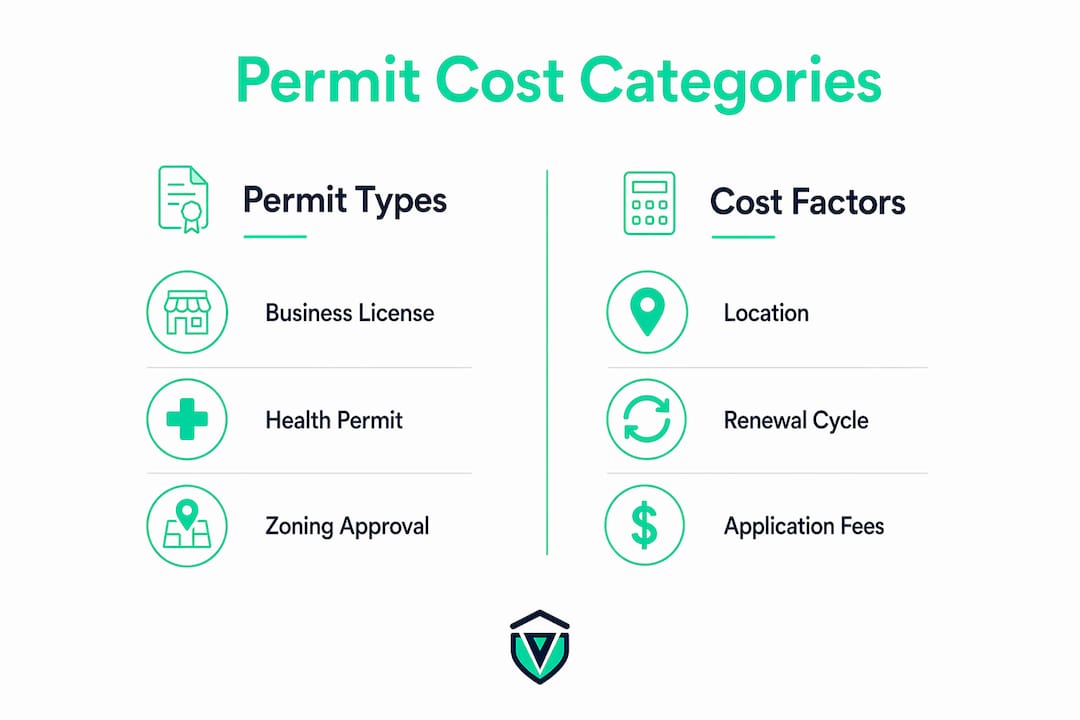
The franchise permit expenses that appear in Item 7 generally fall into these categories:
- Business license: Required by virtually every city and county. Costs range from nominal to several hundred dollars annually.
- Health and food service permits: Mandatory for any food-related franchise. Inspections and fees vary sharply by county health department.
- Signage permits: Governed by local ordinances. Some municipalities charge flat fees; others base costs on sign square footage.
- Zoning and land use approvals: Required when a location's existing zoning does not automatically permit the intended business activity.
- Sales tax permits: Often free at the state level but may require separate county or city registration.
- Specialty licenses: Entertainment venues, tobacco retailers, and alcohol-serving concepts face additional licensing layers with costs that can exceed $2,000 per permit.
Each of these categories carries its own application process, timeline, and renewal cycle. None of them are uniform across markets.
Why do franchise permit requirements differ so much between locations?
Permit requirements differ because regulatory authority in the United States is decentralized. Cities, counties, and states each set their own rules, and those rules do not coordinate with each other. A franchise concept that operates smoothly in Phoenix faces a completely different regulatory environment in Chicago or Miami.
The variability shows up in concrete ways. Some locations require $0 for a sales tax permit while others mandate $2,000 or more for entertainment permits covering the same business type. Submission formats also differ. Spokane requires stamped print sets for building permits. Pinellas County uses a digital portal. Submitting the wrong format triggers automatic rejections and restarts the clock.
Local zoning adds another layer. A site that passes a franchisor's real estate criteria may still require a conditional use permit or variance before the business can legally operate. These approvals involve public hearings, legal fees, and timelines that can stretch weeks beyond the original plan. Failing to verify local specifics before lease signing regularly results in rushed openings or operational holds despite everything else being ready.
Renewal cycles compound the problem for multi-location operators. One location may renew its business license in january. Another renews in july. Health permits may run on a fiscal year tied to the county budget calendar. Without a system to track these dates, gaps in compliance appear quietly and create liability.
Pro Tip: Build a jurisdiction-by-jurisdiction permit matrix before signing any lease. Map each required permit, its cost, its submission format, its approval timeline, and its renewal date. This single document prevents the majority of permit-related delays and budget overruns.
How to budget effectively for franchise permit costs
Most franchise operators underestimate permit costs because they rely too heavily on Item 7 estimates in the FDD. Those estimates reflect the franchisor's experience in existing markets, not the specific conditions of a new location. Financial experts consistently flag working capital under-budgeting as the most frequent mistake in franchise launches.
A realistic budgeting approach follows these steps:
- Start with Item 7 as a floor, not a ceiling. The FDD estimate is a baseline. Treat it as the minimum scenario, not the expected outcome.
- Add a 25–30% contingency above Item 7 permit estimates. This buffer covers re-submission fees, unexpected specialty licenses, and timeline delays that push rent obligations ahead of revenue.
- Budget working capital for 6–12 months, not 3. FDDs typically disclose only three months of working capital. Experienced franchisees budget for 6–12 months to cover cash flow during permit delays and the pre-profitability ramp-up.
- Account for permit timeline risk in your rent schedule. Permit timelines routinely run 30 to 90 days or longer, and high-cost metro areas like Boston and Miami typically yield the longest waits. If you sign a lease before permits are approved, you pay rent on a location you cannot yet open.
- Identify hidden permit costs before committing to a site. Re-submission fees, expediting fees, third-party plan review costs, and inspection fees are real expenses that rarely appear in FDD estimates.
Pro Tip: Engage a local permit expediter or land use attorney before signing a lease in any new market. A few hundred dollars in consulting fees can prevent tens of thousands in delayed-opening losses.
The franchise location opening permit checklist approach works well here. Mapping every required permit against its cost and timeline before committing to a site gives operators a realistic picture of total pre-opening expenses.
What steps help multi-location operators manage permit costs efficiently?
Managing franchise permit expenses across multiple locations requires a system, not a spreadsheet. The complexity scales faster than most operators expect. A single-location operator tracks a handful of permits. A ten-location operator tracks dozens of permits across multiple jurisdictions, each with different renewal dates, submission requirements, and fee structures.
The most effective practices for multi-location permit management include:
- Maintain a jurisdiction-specific permit matrix. A permit matrix keyed to activity, zoning, submission format, and renewal cycles is considered indispensable by the SBA for scaling multi-location operations. Update it every time a regulation changes or a new location opens.
- Use a centralized compliance platform. Spreadsheets fail at scale. A dedicated permit tracking platform gives operators visibility across all locations, sends renewal alerts, and stores documentation in one place. Vaultedai is built specifically for this use case.
- Engage local experts before lease signing. A local attorney or permit consultant evaluates site-specific requirements that neither the franchisor nor a national database can reliably predict.
- Coordinate with your franchisor, but verify independently. Franchisors provide general guidance, but franchisor permitting experience in other markets does not apply locally. Hyper-local regulatory differences govern the actual process.
- Schedule regular permit audits. At least annually, review every active permit across all locations. Confirm renewal dates, check for regulatory changes, and verify that documentation on file matches current requirements.
The territory-based permit management approach treats each jurisdiction as its own compliance environment. That framing prevents the costly assumption that what worked in one market will work in the next.
Key Takeaways
Franchise permit costs are a distinct, location-specific expense category that requires active budgeting, jurisdiction-level research, and centralized tracking to manage effectively across multiple locations.
| Point | Details |
|---|---|
| Permit costs differ from franchisor fees | Item 5 covers franchisor fees; Item 7 covers permits, build-outs, and working capital separately. |
| Costs vary sharply by jurisdiction | The same business type can face $0 or $2,000+ in permit fees depending on the city or county. |
| Budget a 25–30% contingency | Add this buffer above Item 7 estimates to cover re-submissions, delays, and hidden fees. |
| Plan for 6–12 months of working capital | Permit delays routinely push opening timelines past the three months most FDDs disclose. |
| Use a permit matrix and tracking system | A jurisdiction-specific matrix and centralized platform prevent compliance gaps as locations scale. |
The assumption that kills franchise budgets
The most damaging belief I see among multi-location franchise operators is that permit processes are roughly the same everywhere. They are not. I have watched operators budget confidently based on their first location's permit experience, then get blindsided by a county health department that requires a full kitchen re-inspection, a city that mandates a separate signage variance, or a state that adds a specialty license the franchisor never mentioned.
The franchisor's FDD is a starting point, not a guarantee. Item 7 estimates reflect past experience in markets the franchisor already knows. Your new location is a different jurisdiction with its own rules, timelines, and fees. The operators who scale successfully treat every new market as a fresh compliance problem to solve, not a template to copy.
The financial consequence of getting this wrong is not just a higher permit bill. It is rent paid on a location that cannot open, staff hired before revenue starts, and a profitability ramp-up that stretches months longer than projected. The fix is not complicated. It is early due diligence, a realistic contingency budget, and a system that tracks every permit across every location without relying on memory or a shared spreadsheet.
— Rakin
Vaultedai keeps your permit costs visible and under control
Multi-location franchise operators face a permit management problem that grows with every new location. Vaultedai is built to solve it.

The Vaultedai permit tracking platform centralizes all permits, licenses, renewals, and compliance documents across every location in one place. Renewal reminders go out before deadlines, not after. Documentation stays organized by jurisdiction. Operators get a clear view of compliance status across their entire portfolio without digging through email threads or spreadsheets. For franchise groups managing five, ten, or twenty locations, that visibility is the difference between a smooth renewal cycle and a compliance gap that triggers fines or forced closures. The multi-location permit checklist built into the platform gives new locations a structured starting point from day one.
FAQ
What is the difference between franchise fees and permit costs?
Franchise fees are paid to the franchisor and disclosed in Item 5 of the FDD, typically ranging from $25,000 to $50,000. Permit costs are location-specific government fees for licenses, health permits, signage, and zoning approvals, disclosed separately in Item 7.
How much should I budget for franchise permit expenses?
Budget the Item 7 estimate as a floor, then add a 25–30% contingency for delays, re-submissions, and hidden fees. Permit line items typically run $2,000 to $5,000 in standard markets but can be significantly higher in regulated industries or dense urban areas.
Why do permit requirements differ between franchise locations?
Regulatory authority in the United States is decentralized across cities, counties, and states. Each jurisdiction sets its own permit types, fees, submission formats, and renewal cycles, which means the same franchise concept faces different requirements in every market it enters.
How long does the franchise permit process take?
Permit timelines typically run 30 to 90 days, and high-cost metro areas like Boston and Miami often take longer. Operators should start the permit process before lease signing whenever possible to avoid paying rent on a location that cannot yet open.
What is a permit matrix and why does every franchise operator need one?
A permit matrix is a document that maps every required permit by jurisdiction, including its cost, submission format, approval timeline, and renewal date. The SBA and franchise compliance experts consider it essential for multi-location operators to avoid gaps and delays as they scale.