

Multi-unit franchise permit types are defined by two primary agreement structures: area development agreements and area representative agreements. Each structure carries distinct permit obligations, regulatory timelines, and compliance responsibilities across every location you open. Getting these wrong costs real money. Franchisors and franchisees who treat the franchise application process as an afterthought routinely face delayed openings, forfeited fees, and rent payments on spaces that cannot legally operate. This guide breaks down every permit category you need, the risks that derail operators, and the practices that keep multi-unit expansion on schedule.
1. Multi-unit franchise permit types: the two governing agreements
Multi-unit franchise permit types fall under two legal frameworks that define your obligations before you ever pull a single permit. Understanding which agreement you sign shapes every compliance decision that follows.

Area Development Agreements (ADAs) require you to commit to opening a set number of units within a defined territory over a fixed period. ADAs typically require opening 3–10 or more units over 3–7 years, with upfront development fees per unit. Missing your benchmarks can result in loss of territorial rights and forfeiture of development fees ranging from $10,000 to $50,000 per unit. That financial exposure makes permit timing a business-critical issue, not just an administrative task.
Area Representative Agreements (also called master franchise agreements) grant you sublicensing rights. You recruit and support individual franchisees within your territory, earning fees from their royalties. Your permit obligations extend beyond your own locations to include oversight of franchisees' compliance within your territory.
- ADAs: You open and operate all units yourself
- Area representative agreements: You recruit franchisees and share compliance responsibility
- Both structures require coordinated permit acquisition across multiple locations
- Both carry financial penalties for missed development schedules
Pro Tip: Choose an ADA if you have the capital and operational bandwidth to open units yourself. Choose an area representative structure if your strength is recruiting and supporting other operators rather than direct unit management.
2. Business licenses and DBA registrations
Every franchise location requires a general business license from the municipality where it operates. This is the baseline permit that authorizes you to conduct business at a specific address. For multi-unit operators, this means a separate license for each location, often with different renewal dates and fee structures across cities or counties.
DBA (Doing Business As) registrations apply when your franchise entity operates under a trade name different from its legal entity name. Most franchise systems require this. Filing a DBA is typically handled at the county clerk level and costs between $10 and $100 per location, but the administrative burden multiplies fast across 5, 10, or 20 units.
Pro Tip: Create a master spreadsheet or use a centralized platform to track each location's license number, issuing authority, and renewal date from day one. Catching a missed renewal before it lapses is far cheaper than the fines and operational disruptions that follow.
3. Building permits and certificates of occupancy
Building permits and certificates of occupancy are two separate documents with two separate processes. Building permits authorize construction work, while a certificate of occupancy confirms the completed space is legally safe to open. Confusing the two is one of the most common and costly mistakes in the franchise opening process.
A building permit covers structural modifications, electrical work, plumbing, and HVAC installation. Once construction passes final inspection, you apply for the certificate of occupancy. Only after receiving that certificate can you legally open to the public. Skipping this sequence or assuming one document covers both functions leads directly to opening delays.
The permitting phase varies from 2 weeks to 4 months depending on permit type and municipality. That range means a multi-unit operator opening five locations simultaneously could face wildly different timelines in each market.
4. Health department permits
Health department permits are mandatory for any franchise that handles food, beverages, or personal care services. The issuing authority is typically the county or city health department, and approval requires passing an inspection before you open. For food-service franchises, this inspection covers food storage temperatures, handwashing stations, ventilation, and pest control.
Managing food service permits across a franchise network requires tracking each location's inspection schedule, renewal date, and any corrective actions from prior inspections. A failed inspection at one location does not affect others, but a pattern of failures signals a systemic problem that regulators notice.
Health permits are location-specific and non-transferable. If you sell a franchise unit, the new operator must apply for a fresh permit. This matters for area representative operators who manage franchisee transitions within their territory.
5. Fire safety permits
Fire safety permits cover sprinkler systems, fire suppression equipment, emergency exits, and alarm systems. The issuing authority is the local fire marshal, and inspections occur both before opening and on an annual or biannual basis. For restaurant franchises, fire suppression systems above cooking equipment require separate certification from the general fire safety permit.
Fire safety requirements vary by municipality. One city may require a wet chemical suppression system above a fryer; a neighboring city may have different specifications for the same equipment. Multi-unit operators cannot assume that a compliant setup in one location automatically meets code in the next.
Failing a fire inspection delays your certificate of occupancy. That delay means paying rent on a space that generates zero revenue, a direct financial hit that compounds across multiple locations opening in the same quarter.
6. Signage permits and zoning approvals
Signage permits govern the size, placement, lighting, and type of exterior signs at each location. Zoning boards control these approvals, and requirements differ significantly between commercial districts, strip malls, and standalone buildings. Franchise systems typically provide brand-standard sign specifications, but those specifications must still pass local zoning review.
Zoning approvals also determine whether your intended use is permitted at a given address. A quick-service restaurant moving into a space previously occupied by a retail store may face a change-of-use review. Change-of-use permits add 4–8 weeks to project timelines and trigger re-evaluation of fire, plumbing, and egress requirements.
Confirm zoning compatibility before signing a lease. Discovering a zoning conflict after lease execution means paying rent while you resolve a problem that could have been caught in due diligence.
7. Liquor licenses
Liquor licenses apply to franchises that serve alcohol, including casual dining, sports bar concepts, and some convenience store formats. These are among the most time-consuming permits in the franchise application process. Liquor licenses can require up to 6 months for approval, depending on the state and municipality.
Liquor license types include on-premise consumption licenses, off-premise retail licenses, and beer-and-wine-only licenses. Each carries different fees, application requirements, and renewal obligations. Some jurisdictions cap the total number of licenses issued, meaning you may need to purchase an existing license from a prior holder rather than applying for a new one.
For multi-unit operators, liquor license timelines must be built into the development schedule from the start. A location that cannot serve alcohol on opening day loses revenue that may never be recovered.
8. Common challenges in the multi-unit permit process
Permit and inspection backlogs are the single most common cause of delayed franchise openings. Franchisors and operators frequently underestimate the permit and approval phases because attention focuses on franchise agreements rather than municipal processes. Regulatory bottlenecks are local government-specific and unpredictable.
"Local building codes vary widely. Even in franchise-friendly markets, structural requirements for accessibility, fire suppression, and ventilation differ municipality to municipality." — FMS Franchise Real Estate
Top risk factors and mitigation tactics:
- Permit backlogs: Submit applications immediately after lease execution to get in the queue early
- Change-of-use delays: Confirm prior use of any space before signing a lease
- Code variability: Hire a local permit expediter who knows the specific municipality's process
- Building permit vs. occupancy confusion: Treat these as two separate project milestones with separate timelines
- Liquor license delays: Start the application process before construction begins, not after
9. Best practices for managing permit compliance across locations
Successful multi-unit operators centralize permit tracking and align submissions tightly with lease and franchise commitments. The goal is to eliminate the gap between signing a lease and submitting permit applications. Every day of that gap is a day of rent paid on a non-operating space.
Territory-based permit management reduces delays and maintains compliance consistency across locations. This means assigning a dedicated person or team to track every permit, renewal date, and inspection across the entire portfolio.
| Approach | Pros | Cons |
|---|---|---|
| Spreadsheet tracking | Low cost, flexible | Error-prone, hard to scale past 5 locations |
| Shared drive with folders | Centralizes documents | No automated reminders or deadline alerts |
| Permit management platform | Automated alerts, centralized records | Requires onboarding investment |
| Outsourced permit consultant | Local expertise, hands-on | High cost, limited visibility for the operator |
Pro Tip: Budget a contingency of 4–8 weeks into every location's opening timeline specifically for permit delays. Operators who build this buffer in advance absorb delays without financial crisis. Those who don't often miss their development schedule benchmarks.
Key takeaways
Multi-unit franchise permit compliance requires managing distinct agreement structures, location-specific permits, and variable municipal timelines simultaneously across every unit in your portfolio.
| Point | Details |
|---|---|
| Two governing agreement types | ADAs and area representative agreements define your permit obligations and financial exposure before you open. |
| Six core permit categories | Business licenses, building permits, health approvals, fire permits, signage permits, and liquor licenses each have separate timelines. |
| Submit permits immediately after lease signing | Delays in submission mean paying rent on a space that cannot legally generate revenue. |
| Building permit vs. certificate of occupancy | These are two separate documents with two separate processes; confusing them causes opening delays. |
| Centralize tracking across all locations | A single system for renewals, inspections, and deadlines prevents compliance gaps as your portfolio grows. |
Why permit planning is the real franchise discipline
Most operators I work with spend months negotiating franchise agreements and weeks on site selection. They spend days on permits. That imbalance is the root cause of most delayed openings I have seen.
The uncomfortable truth about multi-unit franchise permit types is that no franchisor can protect you from local government timelines. Your franchise disclosure document tells you what permits you need. It does not tell you that the building department in a specific city has a 10-week backlog, or that the fire marshal only inspects on Tuesdays. That knowledge comes from local experience, and most franchisees do not have it when they sign their first area development agreement.
The operators who scale efficiently treat permit management as a core operational function, not a task they hand off and forget. They track every deadline, every renewal, and every inspection date the same way they track sales. When you manage 10 or more locations, a single missed renewal can trigger fines, forced closures, and reputational damage that affects the entire network.
My honest recommendation: hire a permit expediter for your first location in any new market. The cost is real but minor compared to one month of rent on a delayed opening. Use what you learn from that first location to build a repeatable process for every location that follows.
— Rakin
How Vaultedai supports franchise permit compliance at scale
Tracking permits, renewals, and inspections across multiple franchise locations is where manual systems break down fastest.
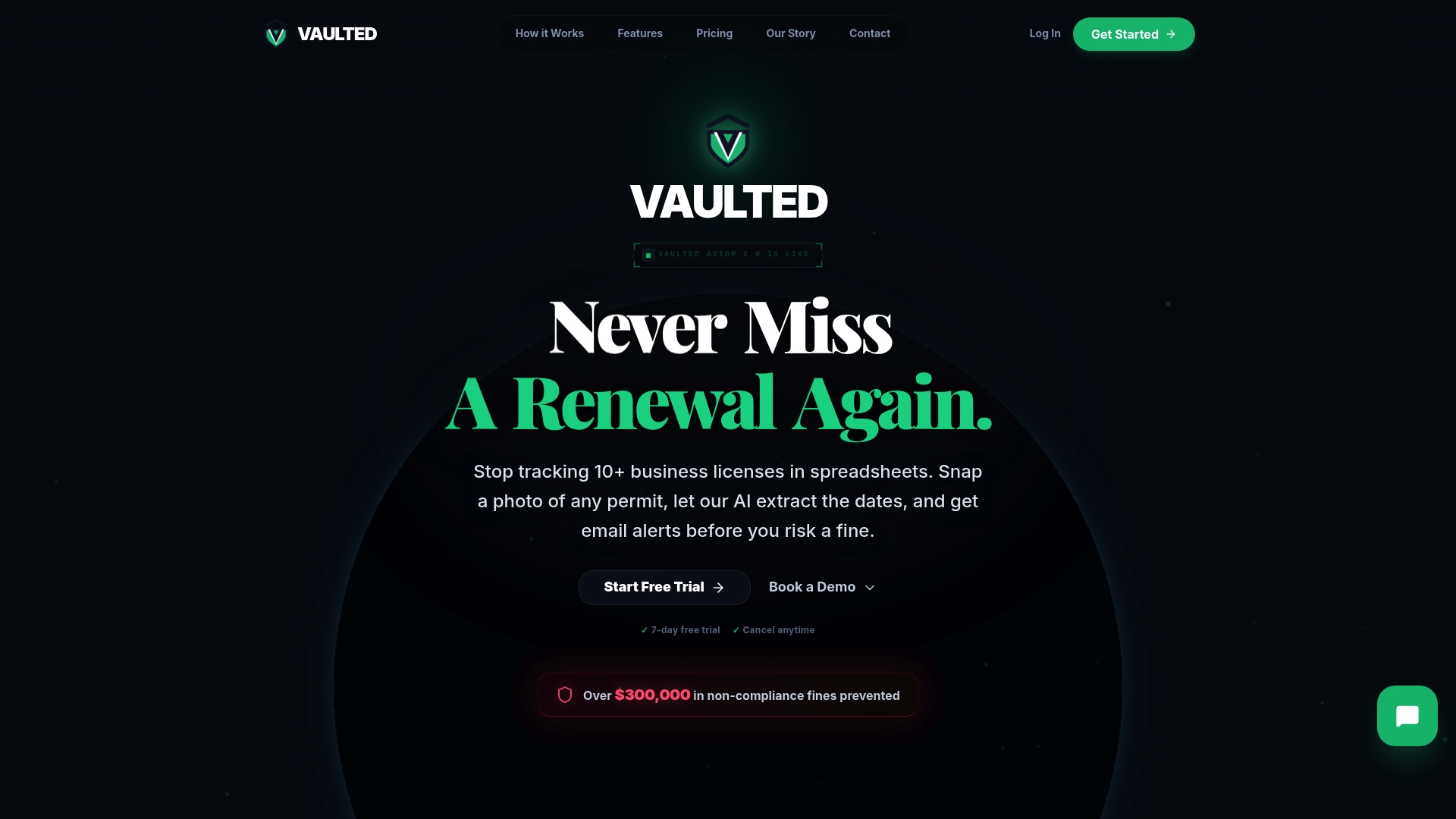
Vaultedai is built for exactly this problem. The platform centralizes all permits, licenses, and compliance documents across every location in one place. Automated deadline alerts replace manual calendar reminders, so your team knows about upcoming renewals before they become emergencies. For multi-unit operators managing area development schedules and the financial stakes that come with them, Vaultedai provides the visibility you need to stay on track. Visit Vaultedai to see how the platform fits your franchise compliance workflow.
FAQ
What are the main multi-unit franchise permit types?
Multi-unit franchise permit types include business licenses, building permits, health department approvals, fire safety permits, signage permits, and liquor licenses. The governing agreement structure, either an area development agreement or an area representative agreement, determines the scope of your permit obligations.
How long does the franchise permit process take?
The permitting phase ranges from 2 weeks to 4 months depending on permit type and municipality. Liquor licenses can take up to 6 months, making them the longest single permit in the franchise application process.
What is the difference between a building permit and a certificate of occupancy?
A building permit authorizes construction work, while a certificate of occupancy confirms the completed space is legally safe to open. Both are required, and you cannot open to the public without the certificate of occupancy.
What happens if I miss my area development agreement benchmarks?
Missing ADA benchmarks can result in loss of territorial rights and forfeiture of development fees ranging from $10,000 to $50,000 per unit. Permit delays are a leading cause of missed development schedules.
How do multi-unit operators manage permits across many locations?
Successful multi-unit operators centralize permit tracking in a single system that monitors renewal dates, inspection schedules, and compliance documents across all locations. Platforms like Vaultedai automate deadline alerts and document storage to reduce the risk of missed renewals.