

Simultaneous permit management is defined as the coordinated process of submitting, tracking, and renewing permits across multiple jurisdictions at the same time, without letting any single location fall out of compliance. For multi-location businesses, the ability to manage state and local permits simultaneously is the difference between a controlled expansion and a costly regulatory mess. Permit requirements vary significantly even within the same state, meaning a single new location can trigger state fire marshal, environmental, and transport permits that nobody anticipated. This article gives compliance managers and business owners a practical framework for handling that complexity without losing visibility or momentum.
What do you need before managing multiple permits simultaneously?
The most common mistake in multi-location permitting is treating it as an administrative task that starts after design is complete. Successful permitting is a strategic planning tool integrated from due diligence, not a checkbox at the end of the process. Starting regulatory research early prevents costly rework and eliminates the surprise permits that derail timelines.
Zoning and feasibility first
Before any application goes out, zoning verification and a feasibility analysis are non-negotiable. Permit applications require zoning clearance, environmental regulation checks, and local ordinance compliance, and each jurisdiction may impose unique requirements on top of those. A restaurant group opening three locations in two states could face three entirely different zoning classifications, each with its own conditional use requirements.

Documentation standards across locations
Standardized documentation is the backbone of any coordinated permit strategy. The table below outlines the core documents needed and the tools that support them.
| Document or tool | Purpose |
|---|---|
| Site plans and construction drawings | Required for building and zoning permit submissions |
| Code compliance verification | Confirms adherence to International Building Code and local amendments |
| Zoning clearance letters | Confirms the proposed use is permitted at each address |
| Digital permit tracking platform | Centralizes status updates, deadlines, and document storage |
| Pre-application meeting notes | Documents agency feedback before formal submission |
Two sets of physical plan copies are often required for in-person applications, and approved permits must be posted visibly at the job site throughout construction. Permit fees are generally non-refundable even if the application is denied, so getting documentation right the first time is not optional.
Pro Tip: Build a master document checklist for each jurisdiction type, state, county, and municipal, before you open a single application. Reusing a standardized checklist across locations cuts preparation time and reduces the chance of a missing document triggering a denial.
Multi-state operations consistently struggle with fragmented permit status tracking and delayed internal updates across regional divisions. A centralized digital platform solves this by giving every team member a single source of truth, regardless of which state they are operating in. The new location permit checklist published by Vaultedai is a practical starting point for building that standardized foundation.
How do you coordinate and submit permit applications across jurisdictions?
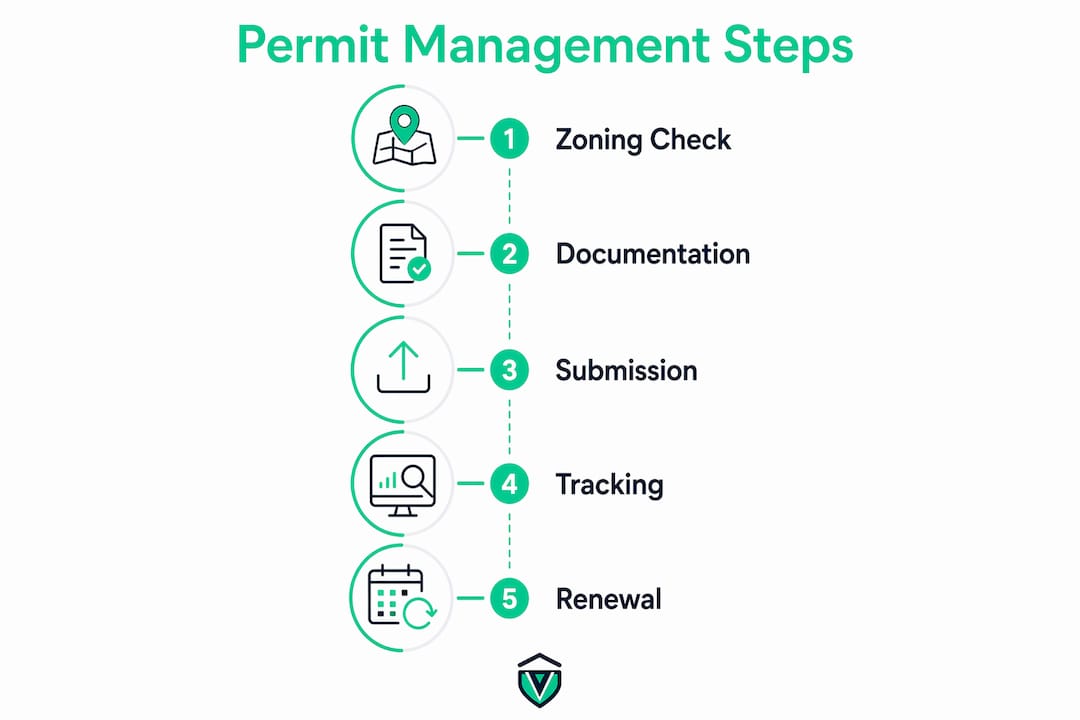
Coordinating permit submissions across multiple jurisdictions requires a sequenced approach, not a simultaneous free-for-all. The permit process generally includes feasibility analysis, zoning verification, pre-application meetings, formal submission, and final inspection, with local variations present even within the same state. Skipping any step in one jurisdiction while completing it in another creates gaps that compound into delays.
Step-by-step submission process
- Complete zoning and feasibility analysis for every location before any application is drafted. Identify which permits each location requires at the state, county, and municipal level.
- Schedule pre-application meetings with each relevant agency. These meetings surface jurisdiction-specific requirements early and build a working relationship with reviewers.
- Synchronize submission timelines so that applications across locations move through review phases at roughly the same pace. This prevents one location from receiving final approval while another is still in initial review, which creates operational planning problems.
- Submit applications through centralized digital platforms where possible. Many jurisdictions now accept electronic submissions, which speeds up processing and creates an automatic audit trail.
- Track status in real time using a unified dashboard. Standard residential permits take 5 to 20 business days for approval, while complex commercial permits can require 6 to 12 weeks. Knowing where each location stands at any moment prevents missed windows.
- Coordinate inspections across locations. Standard permit processes include inspections at multiple phases such as footing, framing, rough-in, and final inspection, each needing approval before work can proceed.
Pro Tip: Assign one point of contact per jurisdiction, not per location. When a single person owns the relationship with a specific agency, communication stays consistent and follow-ups happen faster. Rotating contacts across agencies is one of the most common reasons permit status goes stale.
Permit expediting services are worth considering for high-volume expansions. Expedited reviews often cost 50% to 100% above standard fees, but that premium is frequently less expensive than the carrying costs of a delayed opening. For franchise groups or convenience store operators adding five or more locations in a single year, expediting targeted permits can compress the overall timeline significantly.
What challenges arise when you manage multiple permits at once?
The biggest operational risk in simultaneous permit management is not a single denial. It is the slow accumulation of small delays across locations that nobody notices until a project is weeks behind schedule. Fragmented, siloed permit tracking across regions leads to delayed internal updates and missed expirations. The fix is standardization, not more headcount.
Common reasons permits get denied or stalled include:
- Incomplete or inconsistent documentation submitted across locations
- Zoning clearance not obtained before submitting the building permit
- Failure to account for local amendments to the International Building Code
- Missing signatures or notarizations required by specific jurisdictions
- Applications submitted to the wrong agency level, state versus county versus municipal
Managing permit expirations is a separate challenge from managing approvals. A permit issued in one state may expire in 6 months if work has not started, while the same permit type in a neighboring state stays valid for 12 months. Without a unified tracking system, these discrepancies create compliance gaps that surface at the worst possible moment.
Simultaneous operations at a single site, known in safety management as SimOps, require a conflict matrix to identify incompatible permit combinations before they create hazards. For businesses managing construction or renovation across multiple active locations, this tool is not optional. A conflict matrix maps which permits cannot be active at the same time and flags those combinations before work begins.
Regional silos are the organizational version of the same problem. When a regional manager in Texas tracks permits on a local spreadsheet and a regional manager in Florida does the same, neither has visibility into the other's status. Replacing those local spreadsheets with unified standardized tracking where terms like "In Review" have consistent meaning across every location helps compliance teams detect expiring permits and stalled approvals before they affect operations.
Which best practices and technologies improve simultaneous permit management?
The most effective approach to managing permits across multiple jurisdictions combines a unified status framework with real-time digital tracking. A unified status framework means every location uses the same terminology and the same stage definitions, so a compliance manager can read a dashboard for 20 locations as easily as for two. Without that standardization, portfolio visibility breaks down at scale.
Electronic tracking and real-time dashboards
Electronic permit tracking systems outperform paper and spreadsheet methods for real-time visibility. A centralized dashboard gives compliance managers a live view of every permit's status, upcoming renewal dates, and outstanding inspection requirements across all locations. This matters most when a business is managing permits in states with different renewal cycles, because a missed renewal in one state does not show up on anyone's radar until it becomes a violation.
Pro Tip: Set automated renewal alerts at 90 days, 60 days, and 30 days before each permit expires. Most violations from expired permits happen not because teams forgot, but because no system flagged the deadline early enough to act.
Conflict matrix tools for simultaneous operations
A conflict matrix is a grid that maps all active permits against each other and flags combinations that create safety or regulatory conflicts. In SimOps environments, live digital permit systems outperform paper methods significantly for real-time visibility. For multi-location businesses running construction and operations at the same site simultaneously, this tool prevents the kind of permit conflict that shuts down a location mid-project.
The table below compares generic categories of permit management tools by key feature areas.
| Feature area | Manual or spreadsheet approach | Entry-level field apps | Enterprise compliance platforms |
|---|---|---|---|
| Real-time status visibility | None | Limited, single location | Full portfolio dashboard |
| Automated renewal alerts | None | Basic email reminders | Multi-stage alerts with escalation |
| Cross-jurisdiction standardization | None | Partial | Built-in status frameworks |
| Document storage and audit trail | Local files | Cloud storage | Centralized with version control |
| Conflict detection | Manual review | None | Conflict matrix integration |
Integrating permit management with broader compliance and operational planning is the final step toward full portfolio control. The permit management standard process published by Vaultedai outlines how to connect permit tracking with renewal workflows and compliance documentation so that nothing falls through the cracks as a business scales.
Key Takeaways
Coordinating state and local permits simultaneously requires standardized documentation, synchronized submission timelines, and a centralized digital tracking system that gives every team member real-time visibility across all locations.
| Point | Details |
|---|---|
| Start with due diligence | Run zoning and feasibility checks before drafting any permit application. |
| Standardize documentation | Use the same document checklist and status terminology across every location. |
| Synchronize submissions | Align application timelines so all locations move through review phases together. |
| Track renewals proactively | Set automated alerts at 90, 60, and 30 days before each permit expires. |
| Use conflict matrix tools | Map active permits against each other to catch incompatible combinations before work begins. |
The part of permit management nobody talks about early enough
Most compliance problems I see in multi-location businesses trace back to one decision made early in the expansion process: treating permitting as something that happens after the real planning is done. By the time a business owner realizes that two of their five new locations are stuck in zoning review because nobody ran a feasibility check before signing leases, the carrying costs are already significant.
The second pattern I see consistently is over-reliance on regional managers to track their own permits locally. It feels decentralized and efficient until one region falls behind and nobody at the corporate level knows about it for weeks. Fragmented tracking is not a people problem. It is a systems problem, and it requires a systems solution.
The businesses that handle simultaneous permit management well share one habit: they treat regulatory due diligence as part of site selection, not as a step that follows it. They also invest in a single platform that every region uses, with consistent terminology and shared visibility. That combination, early planning plus centralized tracking, eliminates most of the surprises that derail multi-location expansions.
Proactive communication with agencies matters more than most operators realize. A pre-application meeting is not just a formality. It is an opportunity to learn what a specific reviewer cares about before you submit, which directly improves your first-pass approval rate. The businesses that skip this step because they are moving fast almost always pay for it later.
— Rakin
How Vaultedai helps you coordinate permits across locations
Multi-location businesses that have outgrown spreadsheets and manual tracking need a platform built for the complexity of coordinating permits across states, counties, and municipalities at the same time.
Vaultedai centralizes permits, licenses, renewals, and compliance documents for every location in one place. The platform provides real-time status dashboards, automated renewal alerts, and standardized workflows so compliance managers can see the full permit portfolio at a glance. For franchise groups, restaurant operators, smoke shop groups, and convenience store chains, Vaultedai removes the manual overhead that causes missed deadlines and compliance gaps. Visit Vaultedai to see how the platform handles simultaneous permit tracking across your entire operation.
FAQ
What does it mean to manage state and local permits simultaneously?
Simultaneous permit management means submitting, tracking, and renewing permits across multiple jurisdictions at the same time using a coordinated system. It requires standardized documentation, synchronized timelines, and centralized status tracking to maintain compliance across all locations.
Why do permit requirements differ within the same state?
Local government authority allows counties and municipalities to add requirements on top of state-level rules. A single project can trigger additional state fire marshal, environmental, or transport permits depending on the specific locality, even when neighboring jurisdictions do not require them.
How long does it take to get permits approved across multiple locations?
Standard residential permits take 5 to 20 business days, while complex commercial permits can require 6 to 12 weeks per jurisdiction. Running applications in parallel across locations reduces total elapsed time, but each jurisdiction's timeline is independent.
What is a conflict matrix in permit management?
A conflict matrix is a tool that maps all active permits against each other to identify combinations that create safety or regulatory conflicts. It is used in simultaneous operations environments to flag incompatible permits before work begins, preventing shutdowns mid-project.
How do you prevent permits from expiring across multiple locations?
Automated renewal alerts set at 90, 60, and 30 days before each expiration date are the most reliable method. A centralized platform with consistent status terminology across all locations ensures that no expiring permit goes unnoticed until it becomes a violation.