

A noise ordinance permit is an official authorization that allows a business or individual to temporarily exceed local noise limits for specific activities such as construction outside standard hours, amplified sound at outdoor events, or industrial operations that cannot be scheduled during normal business hours. Understanding what is a noise ordinance permit is the first step toward protecting your business from fines, permit revocations, and neighbor disputes. The Federal Noise Control Act of 1972 establishes national noise policy, but day-to-day enforcement falls to local police departments, zoning offices, and municipal noise control officers. Getting this permit right matters because permit fees vary from $20 for minor residential requests to $500–$1,000 or more for large commercial projects in major cities.
What is a noise ordinance permit and how does it fit local noise laws?
Local noise ordinances set the legal framework that noise permits operate within. Most municipalities divide their jurisdiction into zones, typically residential, commercial, and industrial, and assign different decibel limits and quiet hours to each. A residential zone might prohibit sound above 55 decibels after 10:00 PM, while a commercial zone allows higher levels during business hours. These limits exist to protect public health and community quality of life.
The Federal Noise Control Act of 1972 provides a national baseline, but city and county ordinances carry the real enforcement weight. Local code enforcement officers and police respond to noise complaints, measure sound levels, and issue citations. This means noise regulation laws differ significantly from one city to the next, and what is permitted in one jurisdiction may be a violation in another.

Noise ordinance permits interact with these local restrictions by granting a temporary exception. The permit does not eliminate the ordinance. It creates a documented, time-limited allowance for your specific activity. Regulators reject applications when the activity could simply be rescheduled during normal hours. The permit exists for situations where compliance is genuinely impractical, not merely inconvenient.
One detail many business owners miss: decibel-based standards are often supplemented or replaced by subjective "public disturbance" ordinances. Under these rules, your business can be cited even if your sound levels technically fall within the permitted decibel ceiling. If the noise disturbs a reasonable person, you may still face a violation. Knowing whether your local jurisdiction uses objective meters, subjective disturbance standards, or both is critical before you apply.
Common noise permit categories
- Construction permits: Cover work outside standard hours, such as early morning concrete pours or late-night utility repairs.
- Special event permits: Apply to concerts, festivals, outdoor markets, and amplified entertainment. These often overlap with event permitting requirements.
- Industrial operation permits: Allow factories or processing facilities to run equipment during restricted hours for operational necessity.
- Emergency work permits: Cover urgent repairs or infrastructure work that cannot wait for standard business hours.
How to apply for a noise ordinance permit
The application process for a noise control permit follows a predictable structure across most U.S. jurisdictions, though the specific forms and fees vary. Starting early is the single most important factor in getting approved.
Step 1: Contact your local authority. Identify the correct office, usually the city's noise control division, zoning department, or police department. Some cities route applications through a single permit office, while others split responsibility across agencies.
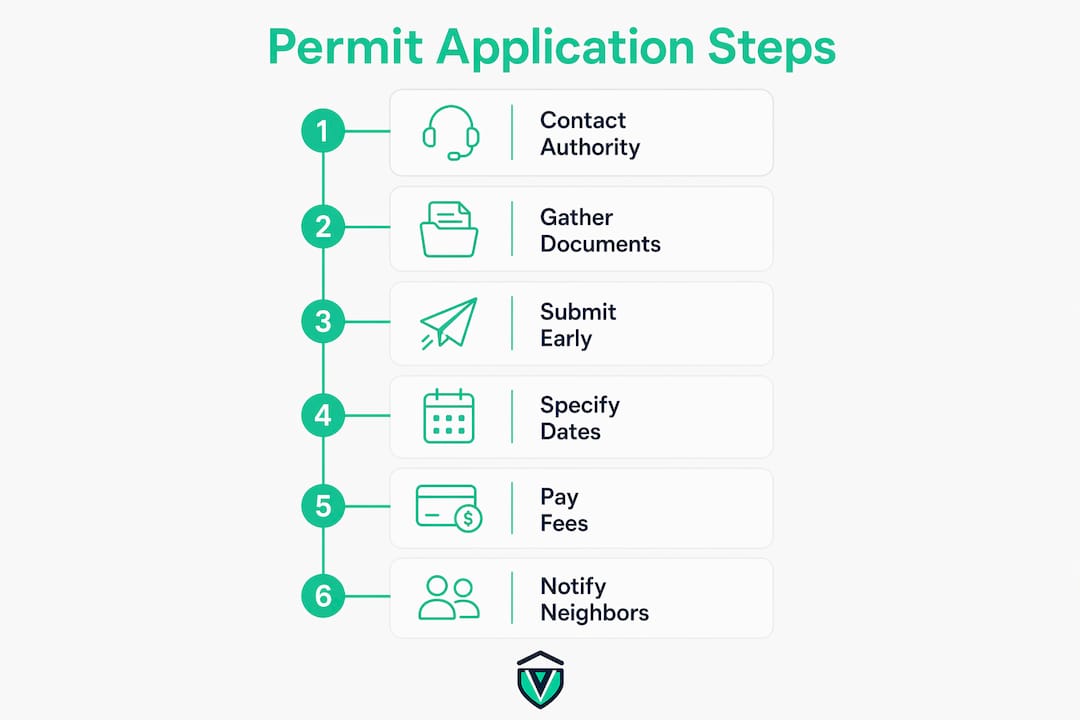
Step 2: Gather your documentation. Applications require detailed site plans, sound mitigation strategies, and proof that you have notified neighboring properties. Incomplete submissions are the leading cause of denial. Your site plan should show the location of noise-generating equipment, barriers, and the nearest residential or sensitive-use properties.
Step 3: Submit well ahead of your activity. Applications must typically be submitted two to four weeks before the planned activity, and review periods run seven to fourteen business days. Missing this window means rejection, regardless of how valid your need is.
Step 4: Define exact dates and hours. Successful applications specify explicit start and end dates and hours. Open-ended requests are routinely rejected. If your project runs longer than the permit duration, you will need a renewal before the original permit expires.
Step 5: Pay the applicable fee. Fees range from $20 for minor residential requests to $500–$1,000 or more for large commercial projects. Budget this cost into your project planning from the start.
Step 6: Notify neighbors before submitting. Proof of neighbor notification is a required document in most jurisdictions. Failure to notify neighbors can result in permit revocation even after the permit has been issued. Send written notice and keep copies.
Pro Tip: Call the permit office before submitting your application. Ask a staff member to review your documentation list. This five-minute conversation can prevent a two-week delay caused by a missing form.
Understanding zoning classifications in your area before applying will help you anticipate the decibel thresholds and quiet hours your permit must address.
What conditions come with a noise ordinance permit?
Receiving a permit does not mean you can operate without limits. Every noise ordinance permit comes with conditions, and violating them can result in revocation even if your original application was approved.
The most common permit conditions include:
- Decibel ceilings: Your permit specifies a maximum sound level, often stricter than you might expect. Regulators set these limits based on the surrounding zone and the time of day.
- Defined operating hours: Your permit lists exact start and end times. Overrunning these hours, even by minutes, is a violation.
- On-site posting: Permit holders must post the permit visibly at the work site or event location. Inspectors and neighbors have the right to view it.
- Complaint responsiveness: Most permits require you to respond promptly to noise complaints and reduce sound levels if requested. Ignoring a complaint is itself a permit violation.
- Renewal requirements: Permits are temporary. Extended projects require renewal before the original permit expires. Letting a permit lapse mid-project creates the same liability as operating without one.
Pro Tip: Designate one staff member as your noise compliance contact for the duration of the permitted activity. This person monitors sound levels, handles complaints, and keeps the permit posted. Having a named contact also signals good faith to inspectors.
Many noise ordinances include blanket exemptions for certain activities. Before applying, verify whether your activity qualifies for an exemption. Emergency utility repairs and certain agricultural operations often fall outside standard ordinance coverage, making a permit unnecessary.
What happens if you violate noise ordinances?
The financial and operational consequences of noncompliance are real and can escalate quickly. Fines for noise violations range from $50 to over $2,000 depending on the jurisdiction and the severity of the violation. A single citation is expensive. Repeated violations compound the problem.
Beyond fines, repeated violations can trigger:
- Permit revocation: Authorities can void an active permit on-site if noise levels are excessive. This means your permitted activity stops immediately.
- Business liability: Neighbors can pursue civil action for nuisance if your noise causes documented harm to their property or health.
- Increased scrutiny: A violation history makes future permit applications harder to approve. Regulators flag businesses with prior citations.
- Criminal charges: In some jurisdictions, willful and repeated noise violations can escalate to misdemeanor charges.
Local enforcement varies widely in how it measures violations. Some officers use calibrated sound meters. Others rely on the subjective disturbance standard, where a complaint from a neighbor is sufficient to trigger enforcement action. Knowing which standard your local authority uses shapes how you plan your noise mitigation.
Operating without a permit when one is required is the highest-risk position. The impact of noise ordinances on unpermitted activities is direct: you have no legal protection, and every complaint is an automatic violation.
Best practices for getting and keeping your noise permit
Business owners who succeed with noise permits follow a consistent pattern. The process rewards preparation and communication.
- Apply early. Submit your application at least three to four weeks before your activity. This gives you buffer time if the office requests additional documentation.
- Write a detailed sound mitigation plan. Describe the barriers, equipment settings, and operational adjustments you will use to keep noise within permitted levels. Vague plans get rejected.
- Notify neighbors in writing. Send notices to all properties within the likely noise impact radius. Keep copies of every notice as proof of notification.
- Monitor sound levels actively. Use a calibrated sound level meter during operations. Document your readings. If levels approach the permit ceiling, reduce them before they exceed it.
- Post the permit and assign a contact. The permit must be visible on-site. Your designated contact handles complaints and communicates with inspectors.
- Track renewal dates. If your project extends beyond the permit period, file for renewal before the expiration date. Managing permit renewal proactively avoids gaps in coverage.
Pro Tip: Keep a compliance log for every day of permitted activity. Record the date, operating hours, sound level readings, and any complaints received. This log is your primary defense if a violation is disputed.
Multi-location operators face an added layer of complexity. Each location may fall under a different municipality with different noise regulation laws, quiet hours, and application procedures. A new location permit checklist helps you track these differences systematically rather than discovering them after a violation.
Key Takeaways
A noise ordinance permit is a temporary, conditional authorization that requires early preparation, complete documentation, and active compliance to protect your business from fines and revocation.
| Point | Details |
|---|---|
| Definition and purpose | A noise ordinance permit grants temporary permission to exceed local noise limits for specific, justified activities. |
| Application timing | Submit applications two to four weeks early; review periods run seven to fourteen business days. |
| Documentation requirements | Include site plans, sound mitigation strategies, and written proof of neighbor notification. |
| Permit conditions | Post permits on-site, monitor decibel levels, respond to complaints, and renew before expiration. |
| Noncompliance costs | Fines range from $50 to over $2,000, and repeated violations risk permit revocation and business liability. |
The part most business owners get wrong
Most operators treat a noise ordinance permit like a checkbox. They apply late, submit a thin application, and assume approval means they are covered. That assumption is wrong, and I have seen it cost businesses real money.
The permit is not a shield. It is a contract with your local authority. The conditions attached to it are enforceable, and inspectors do show up. The businesses that run into trouble are almost always the ones that stopped paying attention after the permit arrived.
What actually works is treating the permit process the way you treat a lease negotiation. You read every condition. You assign someone to own compliance. You document everything. When a neighbor calls to complain, your contact person picks up the phone, adjusts the sound level, and logs the interaction. That responsiveness is often the difference between a warning and a revocation.
The other mistake I see regularly is underestimating how local the rules are. The noise regulation laws in one city can be completely different from those two miles away in the next municipality. Decibel limits, quiet hours, subjective disturbance standards, and application procedures all vary. If you operate across multiple locations, you cannot apply a single playbook. You need jurisdiction-specific knowledge for each site.
Early communication with the permit office also changes outcomes. A five-minute call before you submit your application tells you exactly what the reviewer wants to see. That call has saved more applications than any amount of guesswork.
— Rakin
How Vaultedai helps you stay ahead of permit deadlines
Managing noise ordinance permits across multiple locations means tracking different deadlines, conditions, and renewal dates for every jurisdiction you operate in. One missed renewal or late application can trigger the exact fines and disruptions you worked to avoid.

Vaultedai is built for multi-location business owners who need a single place to manage permits, licenses, and compliance documents without relying on spreadsheets or manual reminders. The platform tracks permit expiration dates, sends deadline alerts, and keeps your documentation organized across every location. When a noise permit renewal is due or a new application needs to go out, Vaultedai flags it before it becomes a problem. Visit Vaultedai to see how centralized permit tracking reduces compliance risk for growing businesses.
FAQ
What is a noise ordinance permit?
A noise ordinance permit is an official authorization that allows a business or individual to temporarily exceed local noise limits for a specific activity, such as construction, an outdoor event, or industrial operations. The permit is time-limited and comes with conditions the holder must follow.
How far in advance do I need to apply for a noise permit?
Most jurisdictions require applications two to four weeks before the planned activity, with administrative review periods running seven to fourteen business days. Submitting late typically results in automatic rejection.
What documents do I need to apply for a noise permit?
Applications generally require a detailed site plan, a sound mitigation strategy, and written proof that neighboring properties have been notified. Incomplete applications are the most common reason for denial.
What are the fines for violating a noise ordinance without a permit?
Fines range from $50 to over $2,000 depending on the jurisdiction and the severity of the violation. Repeated violations can lead to permit revocation, increased scrutiny on future applications, and potential civil liability.
Do all noisy activities require a noise ordinance permit?
No. Many noise ordinances include blanket exemptions for certain activities, such as emergency utility repairs or specific agricultural operations. Verify with your local authority whether your activity qualifies for an exemption before filing an application.