

Most business owners assume that signing a commercial lease is the finish line. It isn't. Understanding what is a commercial lease permit means recognizing that you're dealing not with a single document but with a layered set of local licenses, occupancy approvals, and tax registrations that vary by city, county, and sometimes block. Miss any one of them and you risk fines, forced closures, or a tenant that can't legally open. This guide breaks down every layer so you know exactly what to expect before you hand over a key or sign a lease.
Table of Contents
- Key takeaways
- What a commercial lease permit actually is
- Tenant permits you need after signing a lease
- Lease agreements vs. permits and licenses
- How to obtain the permits you need
- My take on why most businesses get this wrong
- Keep your permits current with Vaultedai
- FAQ
Key takeaways
| Point | Details |
|---|---|
| No single permit exists | A commercial lease permit is a composite of local business licenses, occupancy approvals, and tax registrations. |
| Lessors carry obligations too | Property owners who rent commercial space must obtain their own business permits and pay taxes on rental income. |
| Tenants need separate permits | Occupancy permits, use permits, and specialty licenses are the tenant's responsibility after the lease is signed. |
| Start early | Multi-department permit reviews can take weeks, so initiate the process before the lease execution date. |
| Track renewals proactively | Most permits require annual renewal, and a lapsed permit can interrupt operations for both lessor and tenant. |
What a commercial lease permit actually is
Here is the misconception that trips up most entrepreneurs: there is no single government-issued certificate called a "commercial lease permit." What people refer to by that phrase is actually a collection of authorizations that together allow a property owner to legally rent space and a business to legally occupy it.
A commercial lease definition starts with the lease agreement itself, a contract establishing the terms between landlord and tenant. But the permit ecosystem around that contract is what determines whether either party can actually do business. For property owners, leasing is a regulated business activity, not a passive income arrangement. Local governments in many jurisdictions require lessors to hold a business permit, pay taxes on rental income, and renew those authorizations annually.

Take the Philippines as a concrete example. A lessor renting commercial property must obtain a Mayor's Permit from the local government unit, register with tax authorities, and secure occupancy and fire safety clearances. That stack of documents is what practitioners informally call a "commercial lease permit." The compliance ecosystem for long-term leasing typically includes locational clearance, occupancy permits, fire safety inspections, and tax clearances, all with their own renewal cycles.
Pro Tip: If you own commercial property and collect rent, check with your city or municipality immediately. Many jurisdictions treat rental income as a business activity subject to licensing, even if you have no employees and run no operations from the property.
Key lessor obligations to be aware of include:
- Annual renewal of the local business or Mayor's permit
- Registration of rental income with the appropriate tax authority
- Maintaining a valid certificate of occupancy for the building
- Providing tenants with fire safety compliance documentation
- Updating permits when the property use or tenant type changes
Tenant permits you need after signing a lease
Signing a lease grants you the right to occupy space. It does not grant you the right to operate a business there. That distinction matters, and many first-time business owners learn it the hard way when they spend money on build-out and then face a delay getting their operating permits.
Here is the typical sequence a tenant needs to follow:
- Confirm the space is legally occupiable. Before you can get your own permits, your landlord must provide a valid certificate of occupancy. Landlords must often supply this documentation along with fire safety certificates before regulators will issue tenant permits.
- Apply for an occupancy or use permit. If you plan to change how the space is used, for example, converting a retail unit into a restaurant kitchen, you will need a change-of-use approval. This often triggers a full plan review.
- Submit tenant improvement plans. Any construction or significant modification requires building permits. Spokane's commercial permit process illustrates this well: the city mandates intake meetings and fee payments before routing plans to multiple departments for simultaneous review.
- Obtain your operational business license. Most cities require a general business license tied to the specific address where you operate. This is separate from any state-level registration.
- Apply for specialty permits if your business type requires them. Food service, healthcare, childcare, and retail of age-restricted products all carry additional licensing layers.
Specialty permits deserve special attention because they are often overlooked during lease negotiations. A food truck operator, for instance, cannot rely on a standard commercial lease to cover their permit needs. Toronto requires a Motorized Refreshment Vehicle business license for mobile vendors separate from any property-related permitting. The lesson transfers broadly: know your business category and research the specific operational permits it triggers.
Lease agreements vs. permits and licenses
A lot of the confusion around commercial lease permits comes down to terminology. People use "lease," "permit," and "license" almost interchangeably, but they are three distinct things that serve different legal purposes.
The table below clarifies the differences:
| Document | Who holds it | Purpose | Issued by |
|---|---|---|---|
| Commercial lease agreement | Landlord and tenant jointly | Defines occupancy rights and financial obligations | Private parties (landlord/tenant) |
| Business or Mayor's permit | Lessor (property owner) | Authorizes leasing activity as a business | Local government unit |
| Occupancy/use permit | Tenant (and sometimes landlord) | Confirms lawful use of the physical space | Building or planning department |
| Business operating license | Tenant | Authorizes the tenant's specific business to operate | City or county government |
| Tax license (e.g., TPT) | Lessor | Registers rental income for local tax reporting | State or municipal tax authority |
The tax license layer surprises many property owners. In Tempe, Arizona, for example, all commercial rentals are taxable under the city and Maricopa County Transaction Privilege Tax. Every lessor must obtain a TPT license and report rental income monthly. Skipping this step does not make the obligation disappear. It creates a liability that compounds with interest and penalties.
The commercial lease agreement itself has nothing to do with issuing any of these permits. It is a contract. The permits come from government agencies and require separate applications, fees, and in many cases physical inspections.
Pro Tip: When reviewing a commercial lease agreement, ask the landlord to list every permit and certificate currently held for the property and its current status. A landlord who cannot answer this question quickly is a red flag worth investigating before you sign.
How to obtain the permits you need
The lease permit application process is almost never a single trip to one office. Treat it as a project with a checklist, a timeline, and a named person responsible for each item.
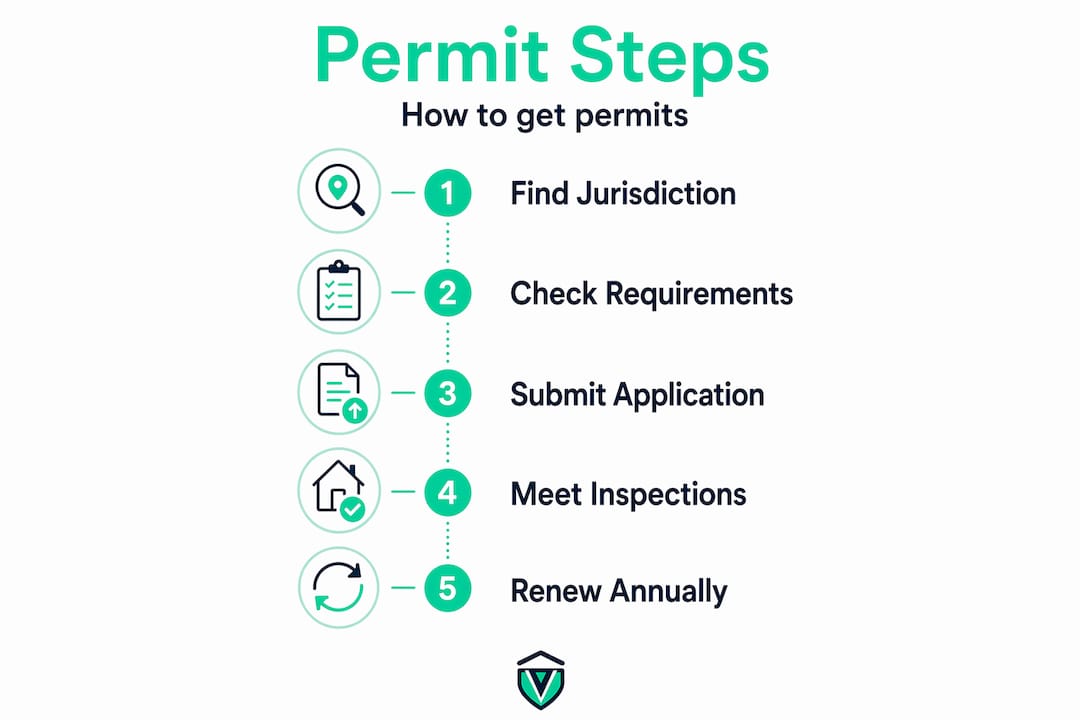
Start by identifying your jurisdiction. Your city, county, and sometimes your specific zoning district each have their own requirements. What applies in Phoenix may be entirely different from what applies in Chicago or Miami. Contact the local planning or business licensing office early. Many cities offer pre-application meetings at no cost, and these can save you weeks of back-and-forth.
From there, build your compliance checklist around two tracks: the lessor track and the tenant track.
For property owners, gather:
- Proof of property ownership or authority to lease
- Current certificate of occupancy
- Fire safety inspection certificate
- Local business or Mayor's permit application
- Tax registration for rental income (varies by jurisdiction)
For tenants, gather:
- Signed lease with lessor's permits confirmed
- Business license application for the operating address
- Building permit application if tenant improvements are planned
- Health, safety, or specialty permits relevant to your business type
- Zoning confirmation that your intended use is permitted at the address
Permit timelines can stretch due to multi-department routing, mandatory intake meetings, and submittal fees. Plan for four to twelve weeks in jurisdictions with complex review processes, and start the application process before the lease start date if at all possible.
Pro Tip: Build a permit expiration calendar from day one. Most commercial property lease requirements include annual renewal cycles for business permits, occupancy certificates, and tax registrations. A single missed renewal can create a compliance gap that halts operations or voids a lease clause.
For businesses in specialized sectors, such as smoke shops, restaurants, convenience stores, or clinics, add a layer of industry-specific research. Local business taxing authorities often impose permits and taxes on leasing activities that standard commercial real estate checklists do not capture.
My take on why most businesses get this wrong
I've worked with enough growing multi-location operators to recognize the pattern clearly. A business owner signs a lease, celebrates, and assumes the hard part is done. What I've seen happen next is avoidable and expensive.
The fundamental error is treating the lease agreement as the finish line instead of the starting gun. In my experience, the operators who navigate leasing compliance cleanly are the ones who think in terms of a permit ecosystem rather than a single document. They ask "what does the city need from the landlord?" and "what does the city need from us?" before they finalize lease terms, not after.
I've also noticed that the difference between lease and permit confusion almost always shows up at the worst time. Construction is done. Staff are hired. Opening day is scheduled. Then someone discovers the occupancy permit is still pending or the landlord's business license lapsed six months ago. The compliance failures that stall operations almost never happen because someone was careless. They happen because no one mapped the full requirement stack at the beginning.
My strongest advice: treat the permit process as part of your lease negotiation. Require the landlord to produce current permits as a lease condition. Build permit milestones into your pre-opening timeline. And set recurring reminders for every renewal date before ink dries on the lease.
— Rakin
Keep your permits current with Vaultedai
Running one location is manageable. Running three, five, or ten locations means dozens of permits, licenses, and tax registrations all expiring on different dates across different jurisdictions.

Vaultedai is built for exactly this problem. The platform centralizes every permit, license, and renewal document across all your locations in one place, and sends real-time alerts before deadlines hit. Whether you are a lessor tracking Mayor's permits and TPT licenses or a tenant managing occupancy certificates and specialty operating licenses, Vaultedai removes the guesswork. Explore how the AI permit tracker helps growing businesses like smoke shop groups, restaurant operators, and franchise teams stay compliant without spreadsheets or manual follow-up.
FAQ
What is a commercial lease permit?
A commercial lease permit is not one document but a set of local government authorizations required for leasing and occupying commercial space. It typically includes a business or Mayor's permit for the property owner, an occupancy permit for the space, and a business operating license for the tenant.
Do property owners need a permit just to rent out commercial space?
Yes. Many jurisdictions classify commercial leasing as a business activity that requires a local business permit and tax registration. Municipal requirements treat rental income as taxable, even when the lessor has no employees or physical operations at the site.
What is the difference between a lease and a permit?
A commercial lease agreement is a private contract defining the terms of occupancy between landlord and tenant. A permit is a government-issued authorization allowing a specific activity, such as operating a business or occupying a building, at a given location. One does not replace the other.
How long does the lease permit application process take?
Timelines vary significantly by jurisdiction. Cities with multi-department review processes can take four to twelve weeks from submission to approval, particularly when tenant improvements or changes in use are involved. Start the process before your intended lease start date.
What happens if you operate without the required permits?
Operating without required permits exposes both the landlord and tenant to fines, forced closure, and in some jurisdictions, personal liability. Lapsed permits can also trigger lease violations if the agreement requires the tenant or lessor to maintain legal compliance throughout the lease term.