
A use and occupancy permit is a mandatory government-issued document that certifies a building meets all applicable safety, zoning, and code requirements, authorizing legal occupancy or business operation. Known formally as a Certificate of Occupancy (CO) in most jurisdictions, this permit is the final legal gate between completing construction or a tenancy change and actually opening your doors. Business owners who skip this step face voided insurance, fines, and forced closure. Real estate developers who misunderstand it lose weeks to avoidable delays. This guide covers the use and occupancy permit definition, the types you will encounter, how to obtain one, and how it differs from related permits.
What is a use and occupancy permit, and why does it matter?
A use and occupancy permit is the government's official confirmation that a building or space is safe and code-compliant for its intended use. It verifies structural integrity, electrical systems, plumbing, mechanical systems, and fire safety before anyone legally occupies the space. No permit means no legal right to operate, regardless of how much money you have invested in the buildout.
The stakes are real. Operating without a valid permit can void your insurance policies, trigger hefty fines, and result in forced closure. Completing a building permit does not automatically grant occupancy rights. The two are separate legal instruments with separate approval processes.

For business owners signing a commercial lease, understanding this distinction is critical. A landlord handing over keys does not mean the space is legally ready for your use. You need to confirm the existing CO covers your intended business type before you invest in tenant improvements.
What are the different types of occupancy permits?
Not every situation calls for the same permit. The type you need depends on whether you are building new, renovating, changing tenants, or converting a space to a different use. Here is a breakdown of the four most common types:
- Certificate of Occupancy (CO). The standard permit issued after new construction or a major renovation. It confirms the building meets all code requirements for its designated use. Required before any occupancy occurs.
- Temporary Certificate of Occupancy (TCO). Issued when a building is substantially complete but minor items remain unfinished. It allows partial or temporary occupancy while outstanding work is completed. TCOs have expiration dates and must be converted to a full CO.
- Change of Occupancy Permit. Required when the building's use changes from one category to another. Converting an office to a restaurant is a classic example. Use classifications matter critically because different occupancy groups carry different code requirements for ventilation, fire suppression, structural load, and egress.
- Business Occupational License. A local government permission to operate a specific type of business at a specific address. This is separate from the CO but often required alongside it. Some jurisdictions issue both through the same office; others require separate applications.
The change of occupancy scenario catches many developers off guard. An office-to-restaurant conversion does not just require cosmetic changes. It triggers structural reviews, commercial kitchen ventilation requirements, grease trap installations, and upgraded fire suppression systems. Budget and timeline assumptions built on the original occupancy classification will be wrong.
How does the permit application and approval process work?
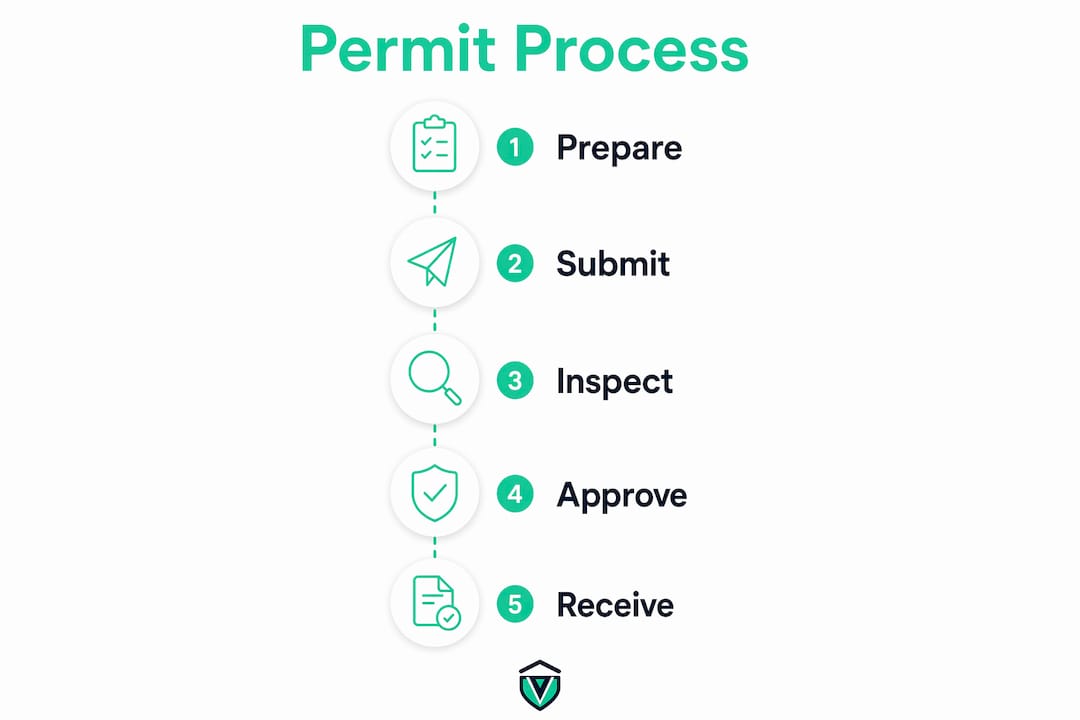
The process for how to obtain a use permit follows a predictable sequence, though timelines vary significantly by jurisdiction. Understanding the steps in advance prevents the most common delays.
- Determine the correct permit type. Confirm with your local building department whether you need a new CO, a change of occupancy permit, or an administrative update. This single step saves weeks of misdirected effort.
- Schedule a pre-application meeting. Pre-application meetings typically cost $150–$800 and give you a direct assessment of code compliance issues before you finalize designs. That fee is cheap compared to redesigning a completed buildout.
- Submit your application with required documents. Most jurisdictions require site plans, floor plans, zoning confirmation, and proof of contractor licensing. Digital portal systems are increasingly standard. Nashville's ePermits system, for example, allows real-time tracking of required inspections and permit status.
- Pass required inspections. Inspectors review structural, electrical, plumbing, mechanical, and fire safety systems. Each inspection must pass before the next is scheduled. A single failed inspection can add one to three weeks to your timeline.
- Receive final approval and permit issuance. Once all inspections pass and fees are paid, the permit is issued. For straightforward tenant or ownership changes without construction, some jurisdictions have created faster paths. Prince George's County launched an expedited online administrative process in January 2025 for cases involving only tenant or ownership changes, cutting wait times significantly.
Pro Tip: Request a pre-inspection walkthrough with the building department before scheduling formal inspections. Inspectors will often flag obvious issues informally, giving you time to correct them without a failed inspection on record.
For multi-location businesses expanding into new markets, tracking permit status across multiple jurisdictions manually is where things break down. Reviewing business expansion permit requirements by jurisdiction before signing leases is a practical way to avoid timeline surprises.
How do use and occupancy permits differ from building permits and conditional use permits?
This is where most business owners get confused. Three distinct permit types govern construction and land use, and conflating them leads to missed requirements and costly surprises.
| Permit type | Purpose | When required | Who issues it |
|---|---|---|---|
| Building permit | Authorizes construction or renovation work | Before any structural work begins | Local building department |
| Certificate of Occupancy | Certifies completed space is safe for use | After construction, before occupancy | Local building department |
| Conditional Use Permit (CUP) | Allows a use not permitted by right in a zone | When proposed use needs discretionary approval | Planning commission or zoning board |
A building permit authorizes the work. A CO certifies the result. These are sequential, not interchangeable. Completing construction under a building permit does not grant occupancy rights. The CO is a separate approval that follows.
Conditional Use Permits are a different category entirely. A CUP is required when your intended business use is not automatically permitted in a given zoning district. A brewery in a light industrial zone, a daycare in a commercial district, or a drive-through restaurant in a pedestrian-oriented zone might each require a CUP. These permits require public hearings and come with legally binding conditions covering noise limits, operating hours, parking management, and neighborhood compatibility.
The practical difference matters for developers. A CO is largely an administrative and technical process. A CUP is a political and community process. Approval timelines for CUPs are measured in months, not weeks, and outcomes depend partly on public input and planning commission discretion.
- A variance allows deviation from specific zoning standards (setbacks, height limits) without changing the underlying use.
- Rezoning changes the zoning classification of a parcel entirely, a longer and more complex process than a CUP.
- Neither a variance nor rezoning replaces the need for a CO once construction is complete.
What are the common challenges in getting a permit approved?
Occupancy permit requirements trip up even experienced developers. The most common problems are predictable and preventable.
- Unpermitted prior construction. If a previous tenant made modifications without permits, those improvements may need to be brought up to current code before a new CO is issued. Inspect permit history before signing a lease.
- Expired permits. Building permits and TCOs expire. An expired permit means restarting the inspection process. Track expiration dates actively.
- Incomplete inspections. Scheduling inspections out of sequence or missing a required inspection type delays final approval. Confirm the full inspection checklist with the building department at the start.
- Underestimating change of occupancy requirements. As noted above, changing from one occupancy group to another triggers code upgrades that can be extensive and expensive.
For conditional use permits, the challenges are different. Public hearings require notifying nearby property owners 10–20 days in advance, typically within a 300–500 foot radius. Community opposition can delay or derail approval. A well-prepared site plan that addresses traffic, parking, and lighting impacts is the single most effective tool for managing that opposition.
Pro Tip: Before your public hearing, research recent CUP approvals in the same jurisdiction for similar uses. The conditions imposed on those approvals tell you exactly what the planning commission will require from you, giving you room to negotiate terms before the hearing.
Understanding commercial lease permit requirements before signing is one of the most underutilized strategies for avoiding permitting delays after lease execution.
Key takeaways
A use and occupancy permit is a legal prerequisite for operating any business, and confusing it with a building permit or skipping it entirely creates financial and legal exposure that no business can afford.
| Point | Details |
|---|---|
| CO is required before occupancy | No Certificate of Occupancy means no legal right to operate, regardless of lease status. |
| Change of use triggers new requirements | Converting a space to a different occupancy group requires a new permit and code upgrades. |
| Building permit and CO are separate | A completed building permit does not grant occupancy rights. The CO is a distinct approval. |
| CUPs involve public process | Conditional Use Permits require hearings, notifications, and binding conditions beyond standard permits. |
| Skipping permits voids insurance | Operating without a valid occupancy permit can void coverage and expose you to fines and closure. |
The part most developers learn the hard way
Most permitting mistakes I have seen come from treating the CO as an afterthought. A developer spends months on design, financing, and construction, then discovers two weeks before the planned opening that the space requires a change of occupancy permit with a three-month inspection backlog. That is not bad luck. It is a planning failure.
The jurisdictions that have invested in digital systems, like Nashville's ePermits portal and Prince George's County's 2025 administrative process, have made the straightforward cases genuinely fast. But those systems only help you if you engage early and understand which path your project falls into. A tenant change with no construction is a different process than a use conversion, and treating them the same wastes time.
My strongest recommendation is to spend the $150–$800 on a pre-application meeting before you finalize any lease or design. That conversation with a local planner will surface code issues, zoning conflicts, and inspection requirements that would otherwise surface at the worst possible moment. Professionals who specialize in local permitting, whether a permit expediter or a land use attorney, pay for themselves on any project with complexity. Do not treat permits as administrative boxes to check. They are project milestones that determine whether your business opens on time.
— Rakin
How Vaultedai helps you stay on top of permits
Managing permits across one location is manageable. Managing them across five, ten, or twenty locations is where businesses lose track of expiration dates, miss renewals, and face compliance gaps. Vaultedai is built specifically for multi-location operators, including restaurant groups, franchise owners, and retail chains, who need a single place to track every permit, license, and renewal deadline across their entire portfolio. The platform centralizes documents, sends renewal alerts, and gives your team real-time visibility into compliance status at every location. If your business is scaling and your current system is a spreadsheet, explore Vaultedai to see how permit management looks when it actually works at scale.
FAQ
What is the difference between a building permit and a CO?
A building permit authorizes construction or renovation work before it begins. A Certificate of Occupancy certifies that the completed space is safe and code-compliant for occupancy. Both are required, and one does not substitute for the other.
Do I need a new occupancy permit if I change my business type?
Yes. Converting a space to a different occupancy group, such as office to restaurant or retail to medical, requires a change of occupancy permit and may trigger significant code upgrades for fire, ventilation, and structural systems.
How long does it take to get a use and occupancy permit?
Timelines vary by jurisdiction and project complexity. Simple tenant changes can take days through expedited administrative processes like Prince George's County's 2025 online system. Projects requiring inspections or conditional use permits can take weeks to several months.
What happens if I operate without an occupancy permit?
Operating without a valid occupancy permit can void your insurance policies, result in fines, and lead to forced closure by local authorities. Completing construction does not grant occupancy rights until the permit is formally issued.
What is a Conditional Use Permit and when do I need one?
A Conditional Use Permit is required when your intended business use is not automatically allowed in a zoning district. It involves a public hearing process and results in legally binding conditions covering operations, parking, noise, and hours.