
Permit renewal is defined as the administrative process of extending an existing permit's validity beyond its expiration date, maintaining legal compliance and operational continuity without requiring a full new application. For business owners managing multiple locations, understanding what does permit renewal mean is the difference between uninterrupted operations and a forced shutdown. Renewal is not a simple formality. It is a risk-managed checkpoint that may require updated documentation, new compliance certifications, and payment of fees before regulators confirm your authorization continues. Most business permits renew on annual or biennial cycles, which means missing a deadline is a recurring operational risk, not a one-time concern.
What does the permit renewal process typically involve?
Permit renewal is the process of extending an existing license or authorization past its expiration, and it follows a structured sequence that varies by permit type and jurisdiction. Knowing the steps in advance prevents last-minute scrambles and costly delays.
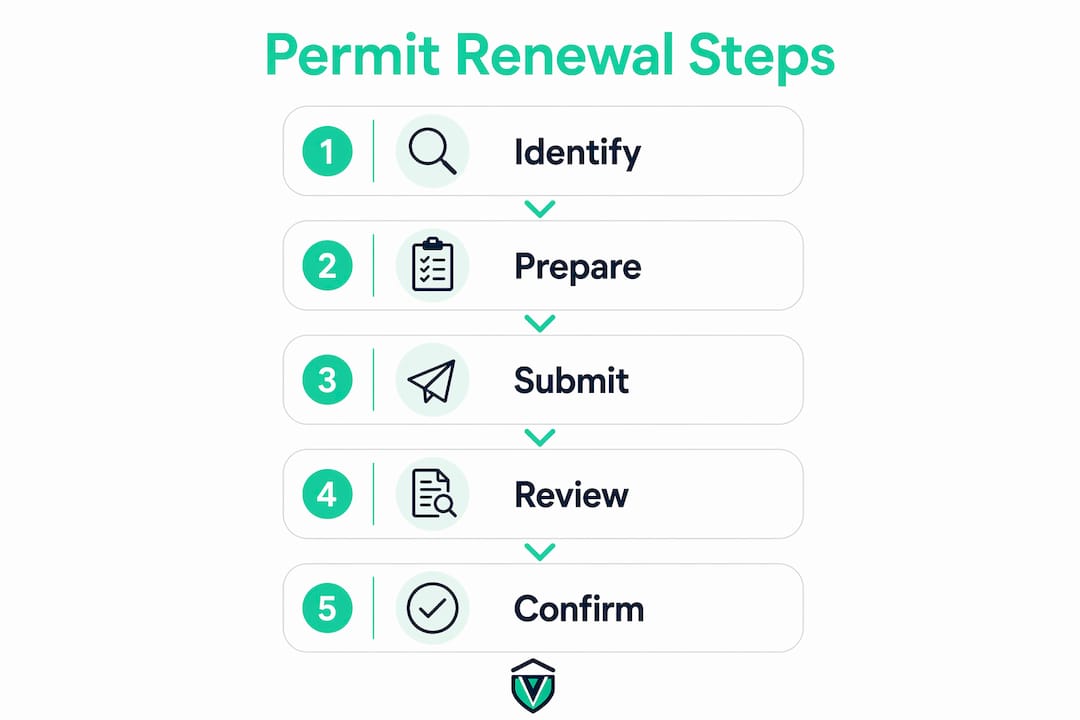
The typical permit renewal process follows these steps:
-
Check your renewal window. Most jurisdictions open the renewal window 30 to 90 days before expiration. Singapore's Ministry of Manpower, for example, requires work permit renewal to be submitted 7 to 12 weeks before the permit expires. Starting early gives you time to gather documents and respond to any agency requests.
-
Gather updated documentation. Renewal rarely means resubmitting the same paperwork from your original application. Regulators commonly require updated passports, employment contracts, payslips, insurance certificates, health records, and police clearances, depending on jurisdiction. For business permits, you may need current financial statements, updated lease agreements, or proof of insurance.
-
Complete the renewal application. Submit the application through the relevant agency's portal or office. Vendor permits and business occupation tax certificates, for instance, require annual renewal with a completed application and applicable fees by a specific deadline.
-
Pay renewal fees. Fees often match the original permit cost and are non-refundable. Late submission typically triggers penalty fees on top of the standard renewal cost.
-
Await confirmation and update your records. Once approved, record the new expiration date immediately in your compliance tracking system. Do not wait for a reminder from the agency.
Pro Tip: Set a calendar alert 90 days before each permit's expiration date. This gives you a full quarter to collect documents, resolve any compliance gaps, and submit without rushing. For multi-location businesses, a centralized permit tracker is the only reliable way to manage this at scale.
How do permit renewal requirements vary across industries and jurisdictions?

Permit renewal requirements differ significantly based on the type of permit, the industry, and the governing authority. A restaurant operator in Atlanta faces different renewal conditions than a manufacturing plant in North Carolina or a staffing firm sponsoring foreign workers. Understanding these differences helps you prepare the right documents and avoid surprises.
Environmental regulations are becoming a growing part of renewal conditions. Modern permit renewals increasingly integrate sustainability metrics, requiring businesses to provide updated environmental impact data. A manufacturing facility renewing an operating permit may now need to submit emissions reports or waste management updates that were not part of the original application.
The table below summarizes how renewal criteria differ across common permit categories:
| Permit type | Typical renewal cycle | Key renewal requirements | Consequence of late renewal |
|---|---|---|---|
| Work permit (employment-based) | Annual or biennial | Updated employer sponsorship, salary proof, labor market tests | Fines, work stoppage, deportation risk |
| Food service permit | Annual | Health inspection, updated food safety certifications | Forced closure, re-inspection required |
| Vendor or business occupation permit | Annual | Completed application, current fees, business address confirmation | Fines or cancellation requiring full reapplication |
| Building or construction permit | Project-based or annual | Updated plans, inspections, contractor license verification | Stop-work orders, legal liability |
| ABC (alcohol) license | Annual | Compliance history review, updated ownership info, renewal fees | 25% late fee, cancellation, full reapplication |
Jurisdictional differences add another layer of complexity. North Carolina's ABC Commission charges a 25% late fee on alcohol permits renewed after the deadline, and failure to renew at all results in cancellation that forces a full reapplication. That is a significant cost and delay for any bar or restaurant group. Food service operators managing multiple locations should review the specific permit types that apply to each site, since renewal cycles and documentation requirements can differ even within the same city.
Franchise operators face a particularly layered compliance picture. Each location may hold separate permits under different local jurisdictions, each with its own renewal calendar. The permits franchises must maintain span business licenses, health permits, signage permits, and more, all requiring independent renewal tracking.
What are the consequences of failing to renew a permit on time?
Failing to renew a permit on time creates immediate legal and operational exposure. The consequences are not theoretical. They are documented, enforceable, and often expensive.
The most common consequences include:
- Financial penalties. Late fees are standard across most permit categories. North Carolina's ABC Commission applies a 25% late fee to overdue renewals. Other jurisdictions charge flat fines that can reach hundreds of dollars per day of non-compliance.
- Permit cancellation. Missing the deadline entirely often triggers automatic cancellation. Reinstatement then requires a full new application, which takes significantly longer than a standard renewal and may involve additional inspections or hearings.
- Forced operational shutdown. In some systems, no grace period exists for permit expiration. Work must stop immediately if renewal is late. For a restaurant or retail location, even a single day of forced closure represents direct revenue loss and reputational damage.
- Loss of legal protections. Operating without a valid permit voids certain legal protections. Insurance claims tied to unpermitted operations may be denied. Contracts signed during a lapse period can be challenged.
- Reputational damage. Regulatory violations become part of the public record in many jurisdictions. Customers, partners, and landlords can view compliance history, and a lapse can undermine trust.
A common misconception is that grace periods are universal. They are not. Grace period policies vary widely by country and permit type, and you must confirm local rules directly with the issuing authority rather than assuming a buffer exists.
Pro Tip: Build a renewal contingency plan for each permit type. Identify who is responsible for renewal at each location, what documents they need, and what the escalation path is if a deadline is at risk. Assign ownership, not just awareness.
How can businesses manage permit renewals for ongoing compliance?
Proactive permit renewal management is a core operational discipline for any multi-location business. The businesses that handle it well treat renewal tracking the same way they treat financial reporting: with defined processes, clear ownership, and regular review.
Practical steps that reduce compliance risk include:
- Centralize all permit records. Store every permit, license, and renewal document in one place, accessible to the people responsible for compliance at each location. Spreadsheets break down at scale. A centralized system gives you a single source of truth.
- Set tiered calendar alerts. Create alerts at 90 days, 60 days, and 30 days before each permit's expiration. The 90-day alert triggers document gathering. The 60-day alert confirms submission readiness. The 30-day alert is the final check before the deadline.
- Conduct a post-renewal audit. After each renewal, confirm the new expiration date is recorded, the renewed permit is stored, and any updated conditions are noted. Regulatory requirements can change at renewal, and you need to capture those changes.
- Engage regulators early when requirements change. If your business expands, changes ownership, or adds new services, contact the issuing authority before your next renewal. Changes in business structure often trigger additional documentation requirements that take time to prepare. The guide on staying compliant during expansion covers this in detail.
- Use purpose-built software for multi-location tracking. Manual tracking fails when you manage more than a handful of permits. Compliance management platforms built for multi-location businesses centralize permit data, automate deadline alerts, and give managers visibility across all sites simultaneously.
- Review renewal requirements annually, not just at renewal time. Regulations change. Environmental compliance requirements, for instance, are increasingly being added to renewal conditions. Reviewing requirements mid-cycle prevents surprises at submission time.
For businesses expanding into new markets, understanding the permit requirements for expansion before you open a new location is far more efficient than catching up on compliance after the fact.
Key Takeaways
Permit renewal is a recurring, risk-managed compliance obligation that requires updated documentation, timely submission, and active tracking to protect business operations from penalties, shutdowns, and permit cancellation.
| Point | Details |
|---|---|
| Permit renewal defined | Renewal extends an existing permit's validity without a full new application, but requires updated documents and fees. |
| Timelines matter | Most renewals must be submitted 30–90 days before expiration; Singapore requires 7–12 weeks for work permits. |
| Consequences are real | Late renewal triggers fines, cancellation, and in some jurisdictions, an immediate work stoppage with no grace period. |
| Requirements vary by industry | Food service, alcohol, construction, and employment permits each carry different renewal cycles and documentation rules. |
| Centralized tracking reduces risk | Multi-location businesses need a single system to manage permit records, deadlines, and renewal status across all sites. |
Permit renewal deserves more than a calendar reminder
Most business owners treat permit renewal as a back-office chore. I think that framing is the source of most compliance failures I have seen.
Renewal is the moment regulators reassess whether your business still meets current standards. Those standards are not static. Environmental impact data, updated food safety certifications, and revised labor market conditions are all showing up in renewal requirements that did not exist five years ago. A business that treats renewal as a checkbox exercise will eventually submit the wrong documents or miss a new condition entirely.
The businesses that handle this well have shifted their thinking. They treat each renewal cycle as a structured compliance review, not just a paperwork task. They assign ownership, build preparation timelines, and use the renewal window to confirm that every location is operating within current regulatory expectations.
The regulatory environment is getting more complex, not less. Sustainability metrics are entering permit renewal conditions across multiple industries. Jurisdictional differences are multiplying as local governments add their own layers on top of state and federal requirements. The businesses that build renewal management into their operational rhythm now will have a significant advantage over those that continue to react at the last minute.
Permit renewal is risk management. Treat it that way.
— Rakin
Vaultedai keeps your permit renewals on track
Running permit renewals across multiple locations without a centralized system is how deadlines get missed.
Vaultedai is built for multi-location businesses that need one place to manage every permit, license, and renewal deadline across all their sites. The platform centralizes compliance documents, sends automated deadline alerts, and gives managers full visibility into renewal status without digging through email threads or spreadsheets. Whether you operate smoke shops, restaurants, convenience stores, or franchises, Vaultedai gives your team the structure to stay ahead of every renewal cycle. Visit Vaultedai to see how it works for your business.
FAQ
What does permit renewal mean for a business?
Permit renewal is the process of extending an existing business permit's validity past its expiration date. It maintains legal compliance and operational continuity without requiring a full new application.
How far in advance should I start the permit renewal process?
Most jurisdictions recommend starting 30 to 90 days before expiration. Singapore's Ministry of Manpower requires work permit renewal submissions 7 to 12 weeks before the permit expires.
What documents are typically required for permit renewal?
Required documents vary by permit type and jurisdiction but commonly include updated contracts, insurance certificates, identity documents, health records, and proof of ongoing compliance with current regulations.
What happens if I miss a permit renewal deadline?
Missing a renewal deadline typically results in late fees, and in many cases, automatic permit cancellation. In some jurisdictions, no grace period exists, meaning operations must stop immediately until the permit is reinstated or a new application is approved.
Do permit renewal requirements change over time?
Yes. Regulatory requirements evolve, and renewal conditions can include new standards not present in the original application. Environmental impact reporting and sustainability metrics are increasingly being added to renewal requirements across multiple industries.