
Centralize your FDD, state-specific addenda, filing deadlines, and renewal workflows in one compliance platform. This single operational move prevents the two most expensive mistakes in franchise expansion: selling in a registration state before approval (a statutory violation under that state's franchise law) and letting a registration lapse, which forces you dark until re-registration completes. The FTC Franchise Rule requires every franchisor to deliver a compliant Franchise Disclosure Document to every prospective franchisee in all 50 states. NASAA guidelines govern how registration states accept and review those documents. Vaultedai is the operational layer that keeps every deadline, document version, and examiner response on track across all of them.
- Selling before state approval in any of the 14 registration states is unlawful, not just risky.
- Annual renewals must typically be filed within a few months of your fiscal year end — missing the window can halt sales.
- Government filing fees across all registration states usually total between $7,965 and $9,000; audited financials and legal drafting are the real budget drivers.
- Multiple filing portals (NASAA EFD, FRANSES, ComOnline, direct state submissions) each have their own confirmation workflows.
Table of Contents
- How do the FTC Franchise Rule and state franchise laws interact?
- What do realistic timelines and costs look like for multi-state registration?
- What does a centralized compliance workflow look like?
- What are the most common mistakes that stall or sink multi-state franchising?
- How should you evaluate a centralized compliance platform for franchise licensing?
- How do you roll out centralized control across multiple states?
- Key Takeaways
- Why franchise compliance is an operations problem, not just a legal one
- Vaultedai keeps your franchise registrations current across every state
- Useful sources
How do the FTC Franchise Rule and state franchise laws interact?
The FTC Franchise Rule sets the federal floor: every franchisor must prepare and deliver a standardized FDD before any sale, anywhere in the country. The FTC does not register or approve FDDs. That is entirely a state-level function.
Several states require pre-sale registration, including California, Hawaii, Illinois, Indiana, Maryland, Michigan, Minnesota, New York, North Dakota, Rhode Island, South Dakota, Virginia, Washington, and Wisconsin. You cannot legally offer or sell a franchise in any of these states until the state agency approves your registration. Oregon mandates disclosure but not registration, placing it in a separate category. The remaining states are disclosure-only: you must deliver the FDD on time, but no state agency pre-approves it.
Within the registration states, the review model varies. Some states use a notice-filing model with no substantive review. California and New York conduct full reviews and routinely issue examiner comment letters. That distinction matters operationally because comment cycles add weeks to your timeline.
Compliance does not end at signing. Relationship laws in roughly 20 jurisdictions govern terminations, non-renewals, transfers, and encroachment after the sale. Several states, including California, Minnesota, Wisconsin, and Virginia, have anti-waiver provisions that override choice-of-law contract clauses. A franchise agreement drafted under your home state's law may be partially unenforceable in a state where the franchisee operates.
Pro Tip: Build one master FDD with concise state-specific addenda rather than maintaining separate FDD versions per state. NASAA explicitly sanctions this approach, and it is the single most effective way to control document proliferation across your sales team.
What do realistic timelines and costs look like for multi-state registration?
State agency review times range from 30 to 90 days. California typically lands in about one to one and a half months; New York runs about one and a half to three months. Add examiner comment cycles and you can easily consume the full review period in a single state. The standard practitioner guidance: start filings 90–120 days before you intend to sell.
Government filing fees across all registration and filing states combined run approximately $7,965–$9,000 for initial registrations, with annual renewal fees around $4,245 for the core registration states. Audited financials, state-specific legal drafting, and examiner comment responses are the real budget drivers.
For permit cost structure details beyond filing fees, the breakdown matters for annual budgeting.
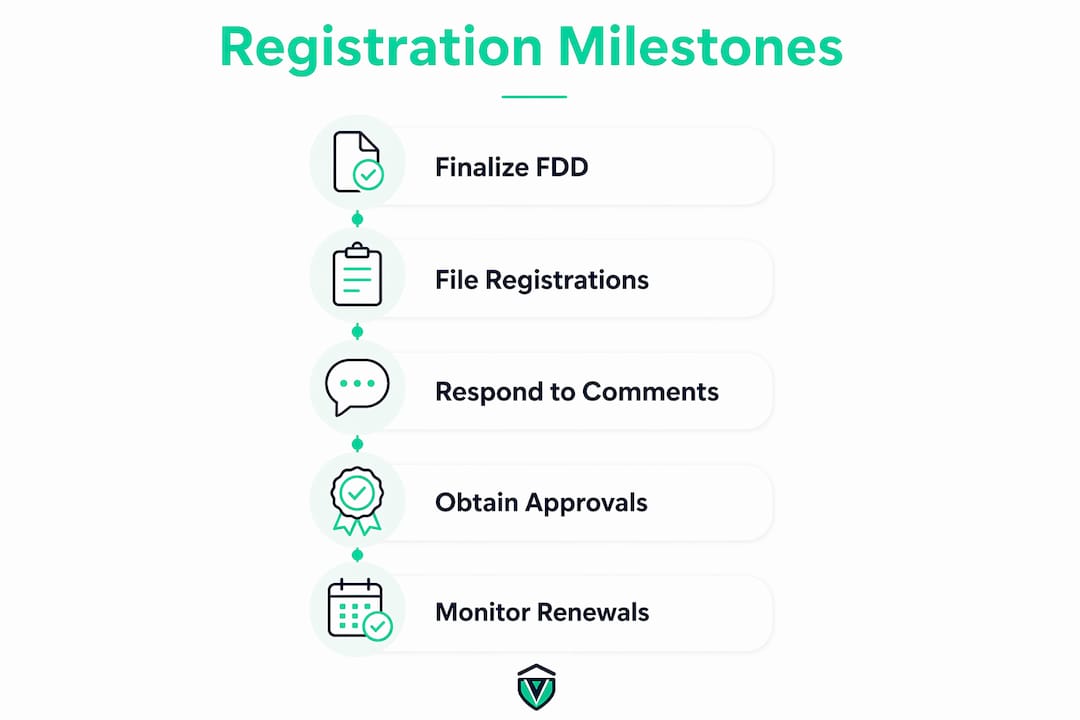
Key milestones across a multi-state registration
| Milestone | Typical Duration | Owner |
|---|---|---|
| Finalize base FDD and audited financials | 4–8 weeks | Legal + Finance |
| Identify registration vs. disclosure states | 1 week | Compliance |
| Draft state-specific addenda | 2–4 weeks | Outside counsel |
| File with each state (EFD, FRANSES, direct) | 1–2 weeks | Compliance |
| Respond to examiner comment letters | 2–4 weeks per round | Legal |
| Receive state approval | 30–90 days from filing | State agency |
| Offer/sell in approved states | Post-approval only | Sales |
| Annual renewal filing | Within 120 days of fiscal year end | Compliance |
Multiple filing systems add operational friction. NASAA's Electronic Filing Depository (EFD) covers Illinois, Maryland, New York, North Dakota, Rhode Island, South Dakota, Virginia, and Nebraska. California uses FRANSES. Other states accept direct online submissions. Each portal generates its own confirmation, and tracking those confirmations centrally is the only way to prove timely filing at renewal.

What does a centralized compliance workflow look like?
A numbered checklist gives your team a repeatable process rather than a one-time legal project.
- Prepare the master FDD with audited financial statements and all 23 disclosure items current.
- Attach state-specific addenda for each registration and relationship-law state where you operate or plan to sell.
- Map every state into one of three buckets: registration required, disclosure only, or notice filing.
- Set renewal windows in your compliance calendar, flagged 120 days before each fiscal year end.
- Assign owners: one in-house compliance lead owns the calendar and portal confirmations; outside counsel owns examiner responses and addenda drafting.
- Build an examiner-response playbook with standard language for common comment categories (financial assurance, earnings claims, risk factors).
- Create a central document repository with a single master FDD, versioned addenda, and a full audit trail for every amendment.
- Track franchise seller registrations separately for states that require individual seller disclosure forms (Rhode Island's Franchise Seller Disclosure Form is one example).
The workflow runs: Legal drafts and approves → Compliance files and tracks confirmations → Sales receives a state-by-state green/red status board before contacting any prospect.
Pro Tip: Set automated renewal reminders 150 days before fiscal year end, not 120. That 30-day buffer absorbs auditor delays and gives outside counsel time to review addenda updates before the filing window opens. A business license audit checklist run at the same time catches any lapsed permits at other locations.
What are the most common mistakes that stall or sink multi-state franchising?
- Selling before approval. Offering or selling in a registration state without an effective registration is a statutory violation. Detection: check your state-by-state status board before every prospect disclosure.
- Missing the renewal window. Failing to renew within 120 days of fiscal year end forces the franchisor dark in that state until re-registration. Detection: automated calendar alerts, not manual spreadsheets.
- Multiple FDD versions in circulation. Sales teams working from different document versions create disclosure inconsistencies that examiners flag. Fix: one master FDD in a central repository, with version access controlled by role.
- Ignoring anti-waiver states. Assuming your choice-of-law clause controls in California, Minnesota, Wisconsin, or Virginia is a drafting error. Those states' relationship law protections cannot be contracted away.
- Failing to register franchise sellers. States like Rhode Island require individual seller disclosure forms. Missing these creates separate exposure beyond the FDD registration itself.
Pro Tip: Centralize evidence of FDD delivery — signed receipts, delivery timestamps, and the exact FDD version delivered — in the same system as your state registrations. If a franchisee later claims they never received a compliant FDD, that audit trail is your defense.
For scaling compliance strategy across locations, the same version-control principles apply to permits and licenses beyond the FDD.
How should you evaluate a centralized compliance platform for franchise licensing?
The features that reduce real risk in multi-state franchise compliance are specific. Generic document storage is not enough.
- Single master FDD repository with addenda support and version control — the platform must track which addendum applies to which state and which franchisee received which version.
- Deadline and renewal automation with configurable lead-time alerts (not just due-date reminders).
- Jurisdiction-specific templates for state addenda and seller disclosure forms.
- Audit trail for every document access, amendment, and delivery event.
- Role and permission controls so sales cannot access unapproved document versions.
- Examiner comment tracking to manage multi-round response cycles without losing thread.
- Financial document storage for audited statements, which are required at filing and renewal.
At launch, prioritize addenda support, renewal automation, and audit trails. Multi-entity accounting workflows and advanced reporting can follow once the core registration states are under control.
Vaultedai covers all of these requirements in one platform, with AI-powered document data extraction, jurisdiction-specific compliance checklists, and secure cloud access built for multi-location operators. For multi-unit franchise permit types, the platform's permit-category support extends the same centralized model beyond FDD registrations to the full permit stack.
How do you roll out centralized control across multiple states?
A phased approach prevents the chaos of a simultaneous national filing push. Experienced counsel consistently recommend registering where you will actually sell first, then expanding as candidate demand materializes.
| Phase | Duration | Key Inputs | Owner |
|---|---|---|---|
| Discovery | 1–2 weeks | Current FDD versions, existing state filings | Compliance lead |
| Standardization | 3–6 weeks | Audited financials, master FDD, addenda drafts | Legal + Finance |
| Pilot (2–4 registration states) | 90–120 days | State forms, portal credentials, filing fees | Compliance + Outside counsel |
| Scale (additional states) | Ongoing per growth plan | Updated addenda, renewal confirmations | Compliance |
| Annual audit | 1–2 weeks per year | Prior year filings, updated financials | Legal + Compliance |
Role assignments:
- Compliance lead: owns the filing calendar, portal confirmations, and renewal tracking.
- Outside counsel: drafts addenda, responds to examiner comments, signs off on FDD amendments.
- Finance: delivers audited statements on schedule; owns financial assurance documentation.
- Field operations: flags new territory demand to trigger the next state registration.
Engage outside counsel for the pilot phase and examiner comment cycles. Once the process is documented and the platform is configured, in-house compliance can handle renewals and routine amendments independently. For territory-based permit management aligned to your growth map, the same role structure applies to the broader permit stack.
Key Takeaways
To handle multi-state franchise licensing reliably, centralize your FDD, state addenda, and renewal deadlines in one governed platform before you file in a single registration state.
| Point | Details |
|---|---|
| Registration states require pre-approval | 14 states prohibit offers or sales until the state agency approves your FDD registration. |
| Start filings 90–120 days early | State review times run 30–90 days; examiner comment cycles can consume the full window. |
| Government fees are the smallest cost | Combined government filing fees typically total $7,965–$9,000 for registration states; audited financials and legal work are the real budget drivers. |
| Relationship laws survive the sale | Anti-waiver states like California, Minnesota, Wisconsin, and Virginia can override your choice-of-law clause post-sale. |
| Vaultedai centralizes the full workflow | FDD version control, addenda support, renewal automation, and audit trails in one platform built for multi-location operators. |
Why franchise compliance is an operations problem, not just a legal one
Most franchisors treat multi-state licensing as a legal project: hire counsel, file the FDD, get approved, move on. That framing is why so many systems get caught dark in a state at renewal or discover mid-sale that a prospect received an outdated addendum.
The legal work is necessary, but the operational infrastructure is what keeps a growing system out of trouble year after year. Relationship laws, renewal windows, examiner comment cycles, and portal-specific confirmation requirements are not legal events. They are recurring operational tasks that need owners, calendars, and documented workflows. Compliance built on spreadsheets and email threads does not scale past a handful of states without breaking.
Vaultedai's compliance content is built around this premise: that the teams who manage multi-location operations need the same operational clarity for licensing and permits that they expect from their POS or scheduling systems. The role of compliance in business growth is not a legal overhead cost. It is a capability that either limits or enables your expansion speed.
Vaultedai keeps your franchise registrations current across every state
Franchise compliance teams managing registrations across multiple states need more than a shared drive and a spreadsheet. Vaultedai gives you a single platform where your master FDD, state-specific addenda, renewal deadlines, and filing confirmations live together, with automated alerts that fire before the window closes, not after.
The platform's AI-powered document extraction pulls key dates and requirements from state forms automatically. Jurisdiction-specific checklists map each registration state's requirements to your current filing status. Role-based access keeps sales working from approved document versions only. Every delivery event, amendment, and examiner response is logged in a full audit trail.
If your team is still tracking renewal windows in a spreadsheet or managing FDD versions by email, the risk of a missed deadline or a sales-blocking lapse is real. Start with Vaultedai to bring your multi-state franchise registrations under centralized control from day one.
Useful sources
- FTC Franchise Rule — Federal disclosure requirement applicable in all 50 states; confirms the FTC does not register FDDs.
- NASAA Franchise Registration and Disclosure Guidelines — Item-by-item FDD preparation instructions, multi-state addenda guidance, and EFD filing state list.
- Franchise Creator: Multi-State Registration Guide — Registration state list, review timelines (30–90 days), 90–120 day lead-time guidance, and 120-day renewal window.
- Internicola Law Firm: Cost to Register in Multiple States — Government fee aggregates ($7,965–$9,000 initial; ~$4,245 annual renewals), portal breakdown (EFD, FRANSES, ComOnline).
- American Bar Association: Navigating State Laws in Multistate Franchise Operations — Anti-waiver provisions, relationship law exposure, and multistate FDD addenda enforcement.
- IFA: Franchise Relationship Laws — 20-jurisdiction relationship law map, anti-waiver state analysis (CA, MN, WI, VA), termination and transfer rules.
- IFA: Registration and Disclosure Basics — 14 registration states confirmed, state administrator review authority, and addenda requirements.
- ICLG: Franchising Laws and Regulations USA — NASAA Multi-Unit Commentary, master/sub-franchise disclosure framing, and comparative regulatory overview.
- Mondaq: Franchising Comparative Guide — United States — Registration state list, relationship law jurisdictions, and sector-specific compliance overlays.
- 1851 Franchise: Multi-State Compliance Guidance — Practitioner quotes on document organization, calendar discipline, and role assignment for ongoing compliance.
- Rhode Island DBR Franchise Application — State-level example of registration requirements, seller disclosure forms, and fee schedule ($600 initial / $300 renewal).