

A business scaling compliance strategy is an integrated approach that embeds regulatory requirements directly into core operations, enabling consistent and efficient growth across multiple locations. Companies that treat compliance as a built-in function rather than a reactive obligation grow 20–30% faster than those that bolt it on after the fact. The gap in cost is equally stark: reactive compliance costs 2.5 to 4 times more than proactive systems when measured against long-term EBITDA. For multi-location operators in restaurants, franchises, convenience stores, or smoke shop groups, this is not a legal formality. It is a growth lever.
What is a business scaling compliance strategy?
A business scaling compliance strategy is the practice of embedding regulatory obligations into your operational processes before problems arise, not after. The industry term for this approach is compliance-by-design, and it is the standard framework used by organizations that scale without regulatory disruption.
The core idea is straightforward. Every time you open a new location, launch a product, or hire across state lines, you trigger a new set of regulatory requirements. If your team scrambles to address those requirements after the fact, you accumulate what compliance professionals call administrative debt. That debt compounds. Retrofitting compliance after the fact costs 3–5 times more than embedding it from the start.

Lee Bryan's ARC methodology, which stands for Agility, Risk, and Culture, offers a practical framework for compliance that treats regulatory readiness as a competitive edge rather than a cost center. Agility means your compliance processes can absorb new rules without rebuilding from scratch. Risk means you have mapped your exposure before entering new markets. Culture means your team treats compliance as part of the job, not someone else's problem.
What are the core components of effective scaling compliance?
Before you can scale compliance, you need to know what you are currently managing. Most multi-location businesses underestimate the number of active regulatory obligations they carry across permits, licenses, labor rules, health codes, and data handling requirements.
The prerequisites for an effective compliance strategy for growth include:
- Regulatory mapping: Identify every active obligation by location, jurisdiction, and business function. Include permits, licenses, zoning, labor, and environmental requirements.
- Process intersection audit: Determine where compliance touches your operations, specifically product development, HR onboarding, data handling, and vendor contracts.
- Centralized evidence repository: Build one place where all compliance documentation lives. Centralized evidence repositories prevent wasted time during audits and investor due diligence.
- Leadership mandate: Compliance programs without executive sponsorship stall. Assign a named owner at the leadership level.
- Automated policy management: Replace manual reminders with systems that track renewal dates, flag changes, and generate alerts.
The compliance-by-design principle applies here directly. When you map your regulatory obligations before entering a new market, you avoid the expensive scramble that comes from discovering requirements after you have already signed a lease or hired staff.
Pro Tip: Build your regulatory map in a shared document before your next location opens. Include every permit, license, and renewal date. This single step cuts onboarding time for new sites by forcing clarity upfront.
How can technology transform compliance during business scaling?
Manual tracking breaks down fast. Organizations face over 200 regulatory updates globally every single day. No spreadsheet or email reminder system can absorb that volume reliably. For a business running five or more locations, the gaps created by manual tracking are not theoretical. They show up as missed renewals, failed inspections, and fines.
The right technology approach follows a clear sequence:
- Audit your current tracking system. Identify every manual process: spreadsheets, calendar reminders, email chains. Quantify how many renewal dates, permit expirations, and regulatory deadlines you are currently tracking by hand.
- Prioritize high-friction, low-judgment tasks first. Automate permit renewals and deadline tracking before you attempt to automate complex regulatory interpretation. Simple, repetitive tasks produce the fastest return.
- Centralize all compliance documents. Move permits, licenses, and inspection records into one platform accessible to every location manager and your compliance lead.
- Set up real-time reporting. Your compliance dashboard should show you, at a glance, which locations are current and which have upcoming or overdue obligations.
- Build for change, not just current rules. Choose systems that can absorb regulatory updates without requiring a full rebuild of your workflows.
Here is how manual and technology-driven compliance compare across the dimensions that matter most to a scaling business:
| Factor | Manual Tracking | Compliance Management Platform |
|---|---|---|
| Regulatory update capacity | Limited, prone to gaps | Continuous, automated alerts |
| Audit preparation time | Days to weeks | Under 24 hours |
| Multi-location visibility | Fragmented, siloed | Centralized, real-time |
| Renewal deadline accuracy | Dependent on individual memory | System-generated, consistent |
| Cost at scale | Increases with headcount | Stays flat or decreases |
Pro Tip: Avoid over-automating in the first 90 days. Start with permit renewals and deadline tracking. Once those run cleanly, layer in policy management and evidence collection. Build the foundation before the full system.
What are the key steps to build audit-ready compliance infrastructure?
Audit readiness is the clearest test of whether your compliance infrastructure actually works. The goal for any scaling organization is to produce audit-ready documentation within 24 hours of a request. If that is not possible today, your infrastructure has a gap.
Follow these steps to build and maintain a compliance infrastructure that holds up under scrutiny:
- Transition away from founder-led coordination. Early-stage businesses often rely on one person knowing everything. That model breaks at scale. Replace personal knowledge with documented processes and centralized controls.
- Set documentation standards. Define exactly what constitutes a complete compliance record for each permit type, license category, and regulatory obligation. Consistency across locations is non-negotiable.
- Schedule regular control validation. Review your compliance controls quarterly. Confirm that renewal processes are running, that documentation is current, and that no new obligations have been missed.
- Train location managers on their compliance role. Each site manager should know which permits their location holds, when renewals are due, and who to contact when a regulatory question arises.
- Run a pre-audit drill annually. Simulate an audit request and measure how long it takes to produce the required documentation. Use that time as your benchmark and work to reduce it.
The table below outlines the documentation standards that support audit readiness across common multi-location business types:
| Business Type | Core Compliance Documents | Renewal Frequency |
|---|---|---|
| Restaurant group | Health permits, food handler certifications, liquor licenses | Annual to biennial |
| Franchise network | Franchise disclosure documents, local business licenses, zoning approvals | Annual |
| Convenience store chain | Tobacco permits, lottery licenses, health department permits | Annual |
| Smoke shop group | State tobacco licenses, age verification records, local permits | Annual to quarterly |
Most compliance programs fail gradually, creating hidden friction in sales and operations long before a formal violation occurs. Brad Lyons notes that instability arises from overreliance on tooling without strategic alignment. The fix is not more software. It is a compliance program built on documented processes, trained people, and regular maintenance.
How do you align compliance strategy with business growth objectives?
Compliance becomes a growth asset when you connect it directly to your expansion plans. Proactive compliance is an offensive strategy that unlocks new markets and attracts capital. Investors and franchise partners look at your compliance posture as a proxy for operational maturity.
The alignment between compliance and growth works through several concrete practices:
- Map regulatory gates to expansion milestones. Before you commit to a new market, identify every permit, license, and regulatory requirement that location will need. Build that timeline into your opening schedule, not as an afterthought.
- Assign accountability by location and obligation type. Every compliance requirement should have a named owner. Shared responsibility means no responsibility.
- Use compliance intelligence to anticipate change. Subscribe to regulatory update services for each state or jurisdiction where you operate. Knowing about a rule change 90 days out is a competitive advantage. Learning about it after an inspection is not.
- Align compliance investment with risk tolerance. High-volume, high-visibility locations carry more regulatory exposure. Allocate more oversight resources to those sites.
- Treat compliance as investor communication. When you can show a potential investor or lender a clean, current compliance record across all locations, you reduce perceived risk and speed up due diligence.
Founders who incorporate compliance from day one benefit from faster market entry and stronger funding opportunities. That advantage compounds as the business grows. A compliance calendar built around your expansion timeline keeps every obligation visible and prevents the reactive scramble that slows growth.
Stable compliance programs absorb constant regulatory change without requiring process reinvention. That stability is what separates businesses that scale cleanly from those that hit regulatory walls at every new market.
Key takeaways
A business scaling compliance strategy works because it embeds regulatory requirements into operations before growth exposes gaps, cutting costs and accelerating market entry.
| Point | Details |
|---|---|
| Compliance-by-design cuts costs | Embedding compliance early is 3–5 times cheaper than retrofitting it after expansion. |
| Technology replaces manual tracking | Compliance platforms centralize permits and automate renewals across all locations. |
| Audit readiness is the benchmark | Scaling businesses should produce complete compliance documentation within 24 hours. |
| Alignment drives growth | Mapping regulatory gates to expansion milestones turns compliance into a market entry tool. |
| Leadership mandate is non-negotiable | Without executive ownership, compliance programs stall and create hidden operational friction. |
The compliance mindset shift that actually matters
Most multi-location operators I have worked with hit the same wall. They build their compliance process around one person who knows where everything is. That person is usually the founder, the office manager, or whoever was around when the first permit got filed. It works at two locations. It falls apart at five.
The real shift is not about finding better software. It is about accepting that your compliance program needs to function without any single person holding it together. That means documented processes, centralized records, and systems that generate alerts whether or not anyone remembers to check.
I have seen businesses spend months evaluating compliance platforms and then load them with the same disorganized data they had in their spreadsheets. The platform did not fix the problem because the problem was never the tool. It was the absence of a standard.
Start with your documentation standard. Define what a complete compliance record looks like for each location. Then build the system around that definition. When you do it in that order, the technology actually works.
The other thing I would push back on is the instinct to automate everything immediately. Permit renewals and deadline tracking are the right place to start. They are repetitive, high-stakes, and easy to systematize. Once those run without manual intervention, you have earned the right to tackle more complex regulatory workflows. Trying to automate judgment-heavy tasks before you have the basics running is how compliance programs get complicated without getting better.
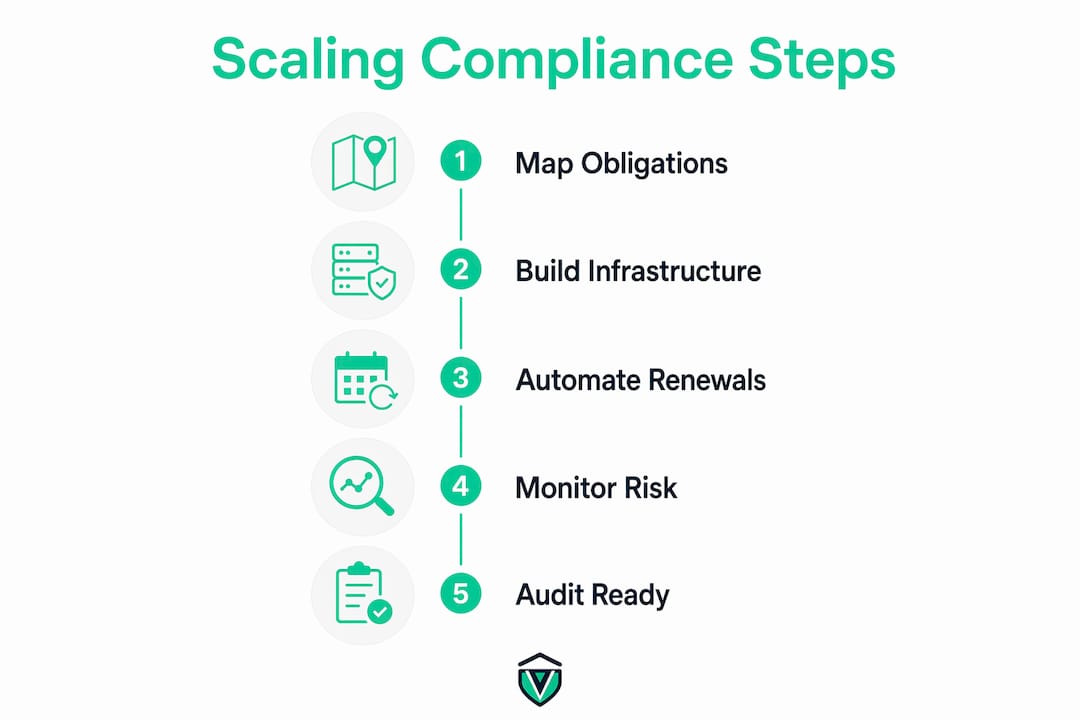
For multi-location businesses looking to stay compliant during expansion, the practical path is always the same: map what you have, standardize how you document it, then automate the repetitive parts.
— Rakin
How Vaultedai helps multi-location businesses scale compliance
Running compliance across five, ten, or twenty locations without a centralized system is where growth stalls. Vaultedai is built specifically for multi-location businesses that have outgrown spreadsheets and manual tracking.

Vaultedai centralizes every permit, license, and renewal deadline across all your locations in one place. The platform automates renewal alerts, tracks expiration dates, and keeps your compliance documentation audit-ready at all times. Restaurant groups, franchise networks, convenience stores, and smoke shop operators use Vaultedai to cut the manual workload and maintain visibility as they add new sites. If your business is growing and your compliance process is not keeping up, explore Vaultedai to see how centralized permit tracking works in practice.
FAQ
What is a business scaling compliance strategy?
A business scaling compliance strategy is the practice of embedding regulatory requirements into core business operations before growth exposes gaps. It replaces reactive, manual compliance with documented processes and centralized systems that work consistently across all locations.
How much does reactive compliance cost compared to proactive compliance?
Reactive compliance costs 2.5 to 4 times more than proactive compliance when measured against long-term EBITDA impact. That gap widens as a business adds locations and regulatory obligations.
What is the compliance-by-design principle?
Compliance-by-design means building regulatory requirements into business processes from the start rather than adding them after a product, location, or workflow is already live. This approach is 3–5 times cheaper than retrofitting compliance after expansion.
How fast should a scaling business produce audit-ready documentation?
The benchmark for scaling organizations is producing complete audit-ready documentation within 24 hours of a request. If your current process takes longer, your compliance infrastructure needs structural improvement.
What should multi-location businesses automate first in their compliance program?
Start with high-frequency, low-judgment tasks such as permit renewals, license expiration tracking, and deadline alerts. These tasks produce the fastest return and create a reliable foundation before you automate more complex regulatory workflows.