

Compliance is defined as the ongoing practice of meeting regulatory, contractual, and operational standards that govern how a business runs across every location it operates. The role of compliance in business growth is not peripheral. It is the infrastructure that determines whether a company can enter new markets, survive due diligence, attract partners, and sustain operations at scale. 83% of larger SMBs report unlocking new markets after achieving baseline compliance. That figure alone reframes compliance from a legal cost to a revenue-generating asset. For multi-location operators, compliance is the difference between controlled growth and expensive chaos.
How does compliance unlock new markets and increase valuation?
Compliance is the entry ticket to regulated markets, institutional partnerships, and franchise networks. 41% of customers now treat compliance as non-negotiable when selecting vendors or partners. That means a compliance gap is not just a legal risk. It is a sales barrier.
For multi-location businesses, the role of compliance in franchise growth is especially direct. Franchise agreements require documented adherence to operational standards, licensing requirements, and brand protocols. Buyers and franchisors conduct structured due diligence before any transfer or expansion. A business that cannot produce clean records during that window loses leverage, and often loses the deal.

The valuation impact is measurable. Higher ESG ratings can boost resale multiples by 1.2x because buyers associate strong compliance posture with lower regulatory risk. ESG scores are not just for public companies. Franchise buyers use them to assess operational discipline and predict future liability.
The role of compliance in franchise valuations also shows up in lease agreements. A business that cannot demonstrate permit continuity or regulatory standing during a lease renewal negotiation faces renegotiation from a position of weakness. Landlords and institutional investors treat compliance records as a proxy for operational reliability.
- Documented compliance history reduces buyer skepticism during due diligence
- Clean permit and license records support faster franchise transfer timelines
- Regulatory standing in one jurisdiction builds credibility for expansion into adjacent markets
- ESG alignment increases resale multiples and attracts institutional buyers
- Compliance with the FTC Franchise Rule protects franchisors from disclosure-related disputes
Pro Tip: Build a compliance record from day one, not just before a sale. Buyers and partners can tell the difference between a business that lives by its compliance calendar and one that scrambled to clean up before the deal.
What operational efficiencies come from embedding compliance into your infrastructure?
Proactive compliance costs a fraction of what remediation costs after a violation. Non-compliance costs 2.5 to 4 times more than maintaining preventive compliance controls, depending on the sector. That multiplier covers fines, legal fees, operational disruption, and reputational damage. The math is not close.
Embedding compliance into daily operations also reduces the frequency of violations. Structured compliance monitoring reduces violations by up to 40% compared to self-reporting systems. Self-reporting relies on individuals to flag their own failures. Continuous audit frameworks catch gaps before they become penalties.
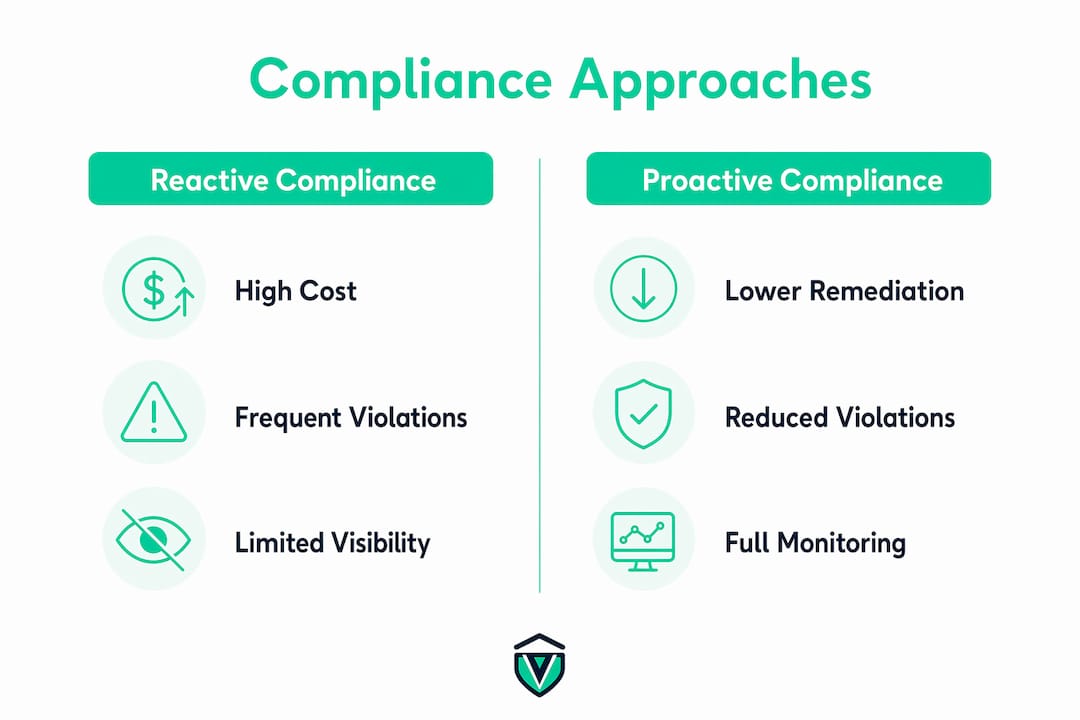
The table below compares the two approaches across key operational dimensions.
| Dimension | Reactive compliance | Proactive compliance |
|---|---|---|
| Cost profile | High remediation, legal, and downtime costs | Predictable, lower ongoing investment |
| Violation frequency | Higher, caught late or after penalties | Lower, caught early through monitoring |
| Operational continuity | Disrupted by audits and enforcement actions | Maintained through continuous visibility |
| Brand reputation | Damaged by public violations or closures | Protected by consistent standards |
| Scalability | Breaks down beyond 20 locations | Scales with the business |
Compliance visibility across locations is the operational asset most multi-location leaders underestimate. When a regional manager can see permit expiration dates, audit results, and renewal deadlines for every location in one view, they make better decisions faster. That visibility prevents the kind of single-location failure that triggers franchisor scrutiny or customer complaints across the entire brand.
Pro Tip: Treat your compliance calendar the way you treat your financial calendar. Schedule quarterly internal audits, not just annual ones. Violations caught internally cost far less than those caught by regulators.
How do you build a compliance program that scales with rapid growth?
Scaling beyond 20 to 50 locations requires moving from manual tracking to automated, continuous compliance to avoid costly visibility gaps. Spreadsheets fail at scale because they depend on human memory, manual updates, and individual accountability. None of those hold when you are managing 30 locations across multiple states.
The strongest compliance programs treat compliance as a continuous process, not a document exercise. Franchisors in 2026 are moving beyond annual legal document updates to dynamic alignment of operational processes with compliance requirements. That means updating operations manuals, training programs, and supplier agreements whenever the business changes, not just once a year.
Franchise compliance during rapid growth requires a different architecture than what works for a single location. The program must account for jurisdiction-specific permit requirements, varying lease terms, and location-level behavioral signals that indicate compliance risk before a violation occurs. A business scaling compliance strategy built for growth anticipates these variables rather than reacting to them.
The following elements define a compliance program built to endure rapid growth:
- A centralized permit and license registry updated in real time across all locations
- Automated renewal alerts tied to jurisdiction-specific deadlines, not generic reminders
- Behavioral monitoring that flags operational inconsistencies before they become violations
- A compliance calendar that integrates with operational planning, not just legal review
- Clear escalation protocols so location managers know exactly what to do when a deadline is missed
- Regular training cycles that reflect current regulatory requirements, not last year's manual
65% of franchise disputes arise from operational inconsistency, not from stricter rules. That statistic points to a structural problem. Most franchise conflicts are preventable with better visibility and clearer operational standards, not more legal documentation.
What is the role of compliance in exit planning and business valuation?
Compliance readiness directly determines the price a multi-location business commands at exit. Buyers conduct due diligence in a 30 to 45 day window where compliance lapses lead to price reductions or blocked transfers. A business that enters that window with disorganized records, expired permits, or unresolved violations gives buyers every reason to discount the offer.
Pre-sale compliance audits are the most effective tool for protecting exit value. Franchise-experienced CPA firms improve valuation outcomes by aligning financials and compliance records before the sale process begins. Tax cleanup, reconciled financials, and a clean Franchise Disclosure Document reduce buyer skepticism and accelerate closing timelines.
The role of compliance in franchise valuations follows a predictable pattern. Buyers assign risk premiums to compliance gaps. Those premiums come directly off the sale price. The four areas that most commonly trigger valuation penalties are:
- Expired or missing permits at one or more locations
- Unresolved regulatory violations or open enforcement actions
- Inconsistent financial records that do not align with operational reports
- Gaps in the Franchise Disclosure Document or operations manual
Addressing these before going to market is not just good practice. It is the difference between a clean exit and a distressed sale. Compliance visibility for franchise owners is not just an operational tool. It is a financial instrument that protects the value of what you have built.
Key Takeaways
Compliance is a direct driver of business growth, not a cost center, and multi-location operators who treat it as infrastructure consistently outperform those who treat it as a legal checkbox.
| Point | Details |
|---|---|
| Compliance opens markets | 83% of larger SMBs unlocked new markets after achieving baseline compliance in 2026. |
| Non-compliance multiplies costs | Remediation costs 2.5 to 4 times more than proactive compliance controls. |
| Monitoring cuts violations | Structured compliance monitoring reduces violations by up to 40% versus self-reporting. |
| Exit value depends on compliance | Buyers conduct due diligence in 30 to 45 days; compliance gaps directly reduce sale price. |
| Scale requires automation | Manual systems break down beyond 20 to 50 locations and require automated, continuous compliance. |
Compliance is not a cost center. It is your growth engine.
I have worked with enough multi-location operators to know the pattern. Compliance gets treated as the thing you deal with after the real work is done. It sits in a spreadsheet someone updates when they remember to, and it gets serious attention only when a regulator shows up or a deal falls apart in due diligence.
That mindset is expensive. The businesses I have seen scale well, the ones that move from 10 locations to 50 without losing operational control, treat compliance as infrastructure from the start. They build it into their opening checklists, their permit management workflows, and their quarterly reviews. Compliance is not a separate function for them. It is part of how they run the business.
The ARC methodology, which stands for Agility, Risk, and Culture, captures this well. Agility means your compliance program updates when your business changes, not on a fixed annual cycle. Risk means you have visibility into where your exposure is before a regulator or buyer finds it. Culture means your location managers treat compliance as their responsibility, not the legal team's problem.
The operators who get this right do not just avoid fines. They close deals faster, attract better partners, and command higher multiples when they exit. Compliance is the asset that makes everything else more valuable.
— Rakin
How Vaultedai helps multi-location businesses protect their growth
Multi-location operators who have outgrown spreadsheets need a system that matches the complexity of their operations. Vaultedai is built for exactly that situation.

Vaultedai centralizes permits, licenses, renewals, and compliance documents across every location in one place. The platform flags expiring permits before they lapse, supports audit preparation with organized records, and gives operators the visibility they need to catch compliance gaps before they become penalties. For businesses managing franchise compliance during rapid growth, Vaultedai replaces the manual tracking that breaks down at scale. The AI Business Permit Tracker & Compliance Fortress is built to grow with your operation, whether you run 5 locations or 500.
FAQ
What is the role of compliance in business growth?
Compliance is a direct enabler of business growth. It opens regulated markets, supports franchise agreements, protects valuations, and reduces the operational costs that come from violations and remediation.
How does compliance affect franchise valuation?
Compliance gaps identified during the 30 to 45 day due diligence window lead to price reductions or blocked transfers. Clean compliance records and aligned financials support higher resale multiples.
Why do manual compliance systems fail at scale?
Spreadsheets and manual tracking depend on human memory and individual accountability. Both break down beyond 20 to 50 locations, creating visibility gaps that lead to missed deadlines and costly violations.
How does compliance reduce operational disputes?
65% of franchise disputes stem from operational inconsistency, not stricter rules. Structured compliance monitoring and behavioral visibility prevent the gaps that cause most conflicts.
When should a multi-location business start building a compliance program?
From the first location. Compliance records built over time are far more credible to buyers, partners, and regulators than records assembled before a sale or audit.