
Getting your per-location permit and license budget right before you sign a lease is the difference between a smooth opening and a cash-flow crisis. For most U.S. physical locations, first-year operating permit costs vary widely, from several hundred dollars on the low end to several thousand dollars at the median, and up to tens of thousands or more at the high end when you factor in health permits, building/zoning approvals, signage, and regulated-product licenses. Those ranges shift dramatically by city, county, and industry.
Two immediate actions:
- Map every jurisdiction for each planned location (city, county, and state) and pull the official fee schedules from each municipal clerk's office before you build a budget.
- Run a permit checklist for each site using a tool like the Vaulted Business Permit Checker to identify which license categories apply before you submit a single application.
The U.S. Chamber of Commerce is direct on this: there is no universal license that covers all locations. Every physical site requires its own application stack, its own fee schedule, and its own renewal calendar. Miss a renewal and the consequences go well beyond a late fee. According to Scarinci Hollenbeck, lapses can trigger daily fines, frozen bank accounts, lease termination, and forced suspension until compliance is restored.
Pro Tip: Build your permit budget before you finalize lease terms. Permitting delays and inspection re-submittals can push your opening date by weeks, and most leases start the rent clock regardless.
Key Takeaways
Per-location operating permit costs in the U.S. typically vary widely in the first year depending on jurisdiction, industry, and permit complexity, and managing them centrally is the most reliable way to reduce marginal cost as you scale.
| Point | Details |
|---|---|
| Budget per location, not per brand | Every physical site requires its own permit stack; there is no single license that covers all locations. |
| First-year cost range | Expect $500–$15,000 per location depending on jurisdiction, industry, and regulated-product requirements. |
| Add 15–25% contingency | Reserve for expedited fees, re-inspections, and hearing costs that don't appear on standard fee schedules. |
| Lapses cost more than compliance | Daily fines, frozen accounts, and forced closures make missed renewals far more expensive than proactive management. |
| Vaultedai centralizes the process | Vaultedai tracks permits, automates renewal reminders, and provides jurisdiction checklists to reduce staff hours and compliance risk. |
Table of Contents
- What drives the cost to register and operate a physical location
- Typical fee ranges per permit and a sample per-location budget
- Hidden and operational costs that catch rollouts off guard
- How to estimate total cost for a single site or a multi-site rollout
- Operational strategies to reduce per-location cost and risk at scale
- Timelines and budget examples for single-site vs. a 10-site wave
- How the cost ranges and sample budgets were derived
- Licensing is a revenue lever, not just a cost line
- Vaultedai helps you cut per-location registration costs
- Sources
What drives the cost to register and operate a physical location
The cost to register a business location is not a single fee. It is a stack of separate permits, each with its own application, fee, and renewal cycle. The main drivers:
- Jurisdiction level. City, county, and state agencies each issue separate licenses. A single restaurant location in Chicago, for example, may need a city business license, a Cook County health permit, and an Illinois food service registration, all with different fee schedules.
- Permit type. Common categories include: general business license (required by most municipalities), health/food service permit (mandatory for any food-handling operation), building/zoning or certificate of occupancy (required when you occupy or modify a commercial space), signage permit (separate from the building permit in most cities), sales tax permit (required in every state with a sales tax when you establish physical presence, per Avalara), and regulated-product permits (tobacco, alcohol, lottery, firearms).
- Industry sector. A convenience store with tobacco and lottery sales faces a longer permit list than a clothing boutique. A restaurant with a full bar adds a liquor license to the stack, which alone can cost thousands.
- Inspection and expedited fees. Many permits require a pre-opening inspection. Fail it once and you pay a re-inspection fee. Need approval faster? Expedited processing typically adds 25–100% to the base application fee.
- Local ordinance hearings. Change-of-use situations, outdoor seating, or late-night operations often require a special-use hearing, which adds both time and legal costs.
Understanding why permit fees vary by jurisdiction is the first step toward building a budget that holds.
Typical fee ranges per permit and a sample per-location budget
Application fees range from low tens of dollars to several hundred dollars depending on municipality and license type. The table below shows typical ranges for common permit categories. These are sample ranges for budgeting purposes; always verify against official municipal fee schedules for your specific jurisdiction.
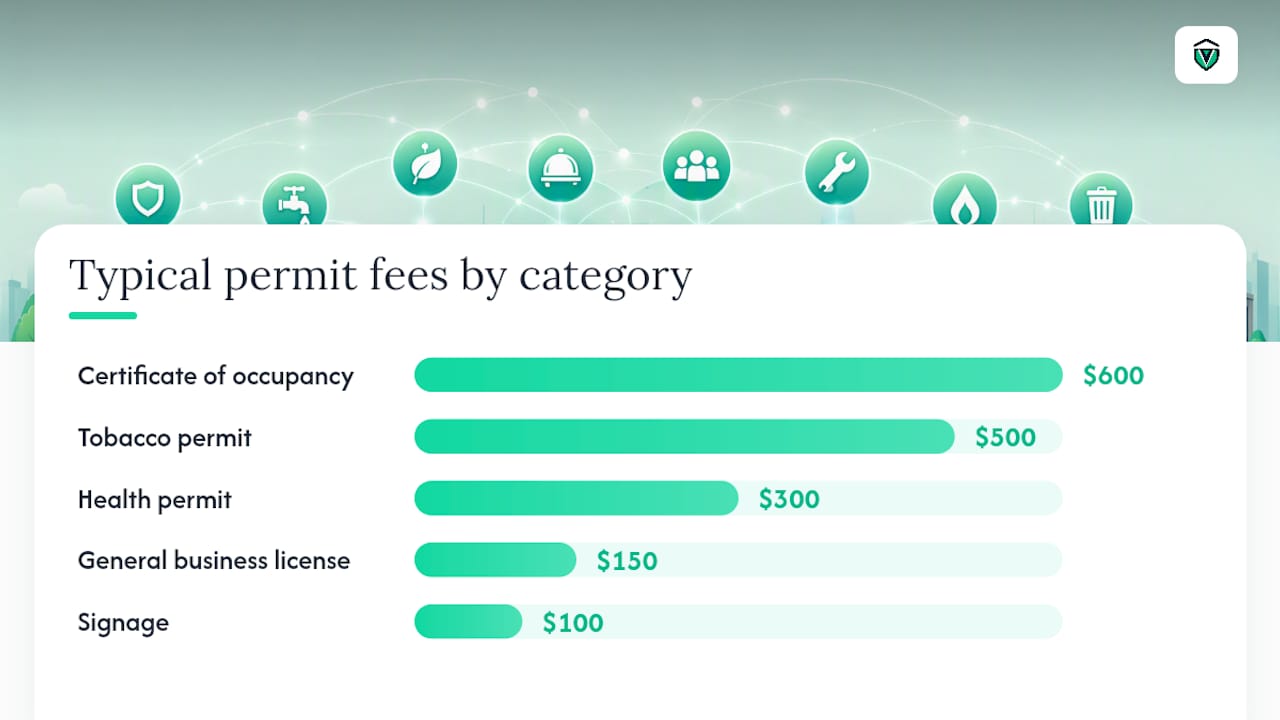
Sample first-year total for a convenience store with tobacco sales: general business license ($150) + health permit ($300) + certificate of occupancy ($600) + signage ($100) + sales tax permit ($25) + tobacco permit ($500) = $1,675 in fees alone, before inspections, staff time, or legal costs. Add a beer/wine license and that total can cross $5,000 in many states.
What pushes a location into the high-cost band:
- Alcohol or tobacco licenses with state-level review processes
- Jurisdictions that require public hearings for new food service or late-night operations
- Older buildings that trigger change-of-use reviews and fire marshal inspections
- Cities with tiered fee schedules based on square footage or gross revenue
For a New York-specific example of how registration costs stack up, the multi-location guide for New York walks through the city and state layers in detail.
Hidden and operational costs that catch rollouts off guard
The line-item fees are the visible part. The costs that actually blow budgets are the ones that don't appear on any fee schedule.
- Internal staff hours. Researching requirements, completing applications, chasing approvals, and managing renewals across 10 or 20 locations can consume dozens of hours per site per year. At a fully-loaded cost of $35–$75 per hour for a compliance or operations staffer, that adds up fast.
- Legal and expediter fees. Complex permits, zoning hearings, or regulated-product applications often require outside counsel or a permit expediter. Rates typically run $150–$400 per hour.
- Re-inspection fees. A failed health or fire inspection means paying again, sometimes $100–$300 per re-visit, plus the delay.
- Expedited processing premiums. When a lease start date forces a compressed timeline, expedited fees can add hundreds of dollars per permit.
- Bond and security deposit requirements. Some jurisdictions require a surety bond as a condition of certain licenses, adding $200–$1,000 or more to first-year costs.
- Fines from lapses. Missed renewals can trigger daily fines and operational shutdowns. A single lapse at a high-revenue location can cost more than an entire year of compliance management.
The real cost of license management gaps goes beyond fines. A national retailer that relied on independent, decentralized tracking saw late payments and license lapses accumulate until centralization and remediation workflows were put in place.
Delayed openings carry their own financial weight. A location generating $30,000 per week in revenue that opens two weeks late because of a permitting backlog has effectively lost $60,000 in revenue, none of which appears on a permit fee invoice.
How to estimate total cost for a single site or a multi-site rollout
A repeatable five-step model works whether you are opening one location or planning a 20-site wave.
- Determine all jurisdictions. For each site, identify city, county, and state agencies that issue licenses or permits relevant to your business activity. Don't assume county and city requirements overlap.
- List required permits per jurisdiction. Use your industry's standard permit stack as a starting template, then verify against each municipality's official business license portal. The Vaulted Business Permit Checker can accelerate this step.
- Collect official fee schedules and inspection timelines. Pull current fee schedules directly from municipal websites. Note inspection lead times, which can range from a few days to six weeks depending on the agency.
- Add staff and third-party costs. Estimate internal hours per permit category, multiply by your loaded hourly rate, and add any anticipated legal or expediter fees.
- Build contingencies. Add 15–20% for expedited processing, re-inspections, and unexpected hearing requirements. For regulated-product permits, extend that contingency to 25% given the variability in state review timelines.
Pro Tip: Build your rollout budget as a per-location template in a spreadsheet, with jurisdiction-specific fee inputs and fixed overhead rows for staff and legal. When you add a new site, you update the inputs, not the model. This also makes it easy to show finance the marginal cost of each additional location.
For franchise operators, the cost structure has additional layers. The franchise permit cost guide explains where franchisor and franchisee responsibilities split and where shared legal resources can reduce per-location cost.
Operational strategies to reduce per-location cost and risk at scale
Manual, fragmented permit management is expensive. A Sutherland whitepaper on retail license management found that centralizing visibility and using managed execution reduces time-to-open and compliance risk at enterprise scale. The operational playbook breaks into four areas:
- Centralize license data. Keep all permits, expiration dates, and renewal documents in one system. Decentralized tracking across location managers is the primary source of lapses.
- Standardize application packages. Build a master application template for each permit type and jurisdiction. Standardization cuts preparation time and reduces errors that trigger re-submittals.
- Automate renewal reminders. Set alerts at 90, 60, and 30 days before expiration. A missed 30-day window on a health permit can mean paying expedited fees or facing a gap in coverage.
- Centralize payments. Routing all license payments through a single accounts payable workflow prevents the "paid by the wrong location" errors that create compliance gaps.
Centralizing license records and renewal workflows reduced late payments and license lapses in a large national retail engagement, improving operational continuity across the portfolio. The key was moving from independent, location-level tracking to a unified system with validation and remediation workflows built in. (Mohr Partners)
Pro Tip: In jurisdictions where you operate multiple locations, ask the municipal clerk's office whether bulk or enterprise filing arrangements exist. Some cities process multiple-location applications together at a reduced per-unit fee.
The guide to organizing business licenses in one place covers the data standards and workflow design that make centralization stick at scale.
Timelines and budget examples for single-site vs. a 10-site wave
Permitting is not instant. Planning around realistic timelines protects your lease economics and your opening-day revenue.
Typical phase durations:
- Research and jurisdiction mapping: 1–2 weeks
- Application preparation and submission: 1–3 weeks
- Inspections and hearings: 2–8 weeks (longer for regulated products or zoning hearings)
- Approvals and pre-opening clearance: 1–4 weeks
Total: 5–17 weeks from research to open, depending on jurisdiction complexity and permit type.
The 10-site wave shows where economies of scale appear: standardized application packages, shared legal hours, and centralized payment processing reduce the per-location cost meaningfully compared to managing each site independently. The business expansion permit requirements guide maps out the phase-by-phase checklist for multi-site waves.

How the cost ranges and sample budgets were derived
These ranges are built on the following assumptions and should be adapted to your specific jurisdictions:
- U.S.-only scope. All figures apply to U.S. municipal, county, and state permit fees. They exclude entity-formation fees (LLC or corporation filings with a Secretary of State).
- First-year framing. Totals reflect initial application fees plus first-year renewal costs where applicable. Ongoing annual costs are typically lower once the initial application stack is in place.
- Staff-hour rates. Internal cost estimates use a $35–$75 per hour range for compliance and operations staff, reflecting loaded costs for mid-market operators.
- Fee schedule verification. To validate any figure in this article, go directly to the municipal or county clerk's website for each jurisdiction, search for "business license fee schedule," and download the current schedule. Many cities publish annual updates in January or February.
- Variability drivers. Wide ranges reflect genuine variability: city size, industry sector, regulated-product requirements, and whether a location triggers a zoning or special-use hearing. A suburban retail location in a small municipality and a downtown food-service location in a major city are not comparable.
For practical guidance on common application errors that inflate costs through re-submittals and delays, that resource covers the most frequent filing mistakes across permit categories.
Licensing is a revenue lever, not just a cost line
The framing most operators use, treating permits as a compliance tax to minimize, is the wrong one. A location that opens on time, fully permitted, generates revenue from day one. A location delayed by a missed inspection or an incomplete application package loses that revenue permanently. For a restaurant doing $50,000 per month, a three-week permitting delay is a $37,500 loss that no fee reduction can recover.
Centralized, well-managed licensing processes also improve predictability for the teams that depend on permitting milestones: store operations needs a confirmed open date, real estate needs to manage lease commencement, and finance needs to model cash flow against opening timelines. When permitting is treated as an operational discipline with defined workflows and accountability, those teams can plan with confidence instead of reacting to surprises.
The operators who get this right treat their permit portfolio the way they treat their lease portfolio: tracked, renewed proactively, and managed at the portfolio level rather than location by location.
Vaultedai helps you cut per-location registration costs
Multi-location operators managing permits manually spend more than they need to, on both fees and staff time. Vaultedai centralizes every permit, license, and renewal deadline across all your locations in one place, with automated reminders, jurisdiction-specific compliance checklists, and AI-powered document data extraction that eliminates manual re-entry.
The free Vaulted Business Permit Checker lets you identify required permits by jurisdiction before you budget a single dollar. For operators ready to move beyond spreadsheets, Vaultedai provides the centralized visibility and workflow automation that reduces missed renewals, cuts staff hours, and accelerates openings across your entire portfolio.
Sources
- Keeping the OPEN Sign On: Rethinking Licenses and Permits in Retail
- Missed Renewals, Hidden Risk: The Real Cost of License Management Gaps - Mohr Partners
- Business licenses: 3 common retail challenges and how to solve them - Avalara