
Permit fees vary because every U.S. jurisdiction sets its own fee structure to meet local budget targets, policy goals, and cost-recovery requirements — there is no national price list. The same $25,000 renovation project that costs $62 to permit in Charlotte, NC runs $924 in Seattle, WA. That gap is not an anomaly. It is the direct result of how local governments fund their building departments, adopt building codes, and decide whether permits should recover costs, generate revenue, or incentivize development. For multi-location operators, the practical takeaway is simple: treat every new jurisdiction as its own fee universe and run a structured due-diligence check before you finalize any site budget.
Table of Contents
- Why do permit fees vary by jurisdiction?
- What fee types actually show up on your invoice?
- What policy and legal factors drive the differences?
- How does fee variability affect your budget and timeline?
- Pre-opening due diligence checklist for new locations
- How to reduce permit cost surprises operationally
- When does it make sense to hire a permit expeditor?
- Key Takeaways
- The case for treating permit management as a core operational function
- Vaultedai helps you manage fee variability across every location
- Useful sources and further reading
Why do permit fees vary by jurisdiction?
Most jurisdictions follow the International Building Code (IBC) framework published by the International Code Council (ICC), but "following the IBC" does not mean charging the same fees. The IBC sets construction standards; fee levels are a separate local decision entirely.

The most common technical method is the Permit Fee Multiplier: a jurisdiction divides its building department's annual budget (or the portion it wants to recover from permit revenue) by the total annual construction value it expects to process. That ratio becomes the multiplier applied to each project's declared valuation. A city with a lean department and high construction volume produces a low multiplier. A city with a large inspection staff and modest construction activity produces a high one.
Beyond the multiplier, jurisdictions use several other approaches:
- Find the adopted fee schedule. Most cities post it on the building department or finance department website; search "[city name] building permit fee schedule."
- Locate the valuation method. Is it percentage-of-value, flat-tier, square-foot, or a hybrid? Salt Lake County, for example, bases fees on ICC valuation tables with a regional cost modifier.
- Check for separate plan review, technology, and inspection fees. These are often on different pages or in different ordinances.
- Confirm the local cost-recovery target. Some cities aim to recover 100% of department costs; others subsidize permits as a development incentive.
The ICC's Building Valuation Data (BVD) tables give average construction costs per square foot by occupancy group and are intended to be adjusted by a Regional Cost Modifier. That modifier alone can shift a fee estimate substantially depending on where the project sits.
Pro Tip: The ordinance that authorizes the fee multiplier is usually a separate budget resolution, not the fee schedule itself. Ask the building official for the "fee study" or "cost-recovery analysis" document — it shows exactly how the multiplier was derived and when it was last updated.
What fee types actually show up on your invoice?
The posted "building permit fee" is rarely the final number. Nashville's fee schedule and Seattle's permit cost guidance both illustrate how the total invoice assembles from multiple line items across different departments.
Common fee categories to audit:
- Base building permit fee — the core valuation-based or flat charge
- Plan review fee — often 65–80% of the base permit fee, billed separately at submittal
- Special inspections — third-party structural or fire-suppression inspections billed per visit
- Technology/administrative surcharge — a flat add-on (common in larger cities) for permit software and records management
- Impact or exaction fees — charged per square foot or per unit to fund infrastructure; can dwarf the base permit fee on larger projects
- State surcharge — Salt Lake County, for instance, adds a 1% state surcharge on top of the permit fee
- Use or sales tax at issuance — some jurisdictions apply local use tax to the declared construction value
- Escrow or inspection deposit — required upfront in some cities before inspections begin
SPUR's research on permit cost transparency found that many jurisdictions lack consolidated fee disclosure, meaning operators must hunt across multiple department pages to assemble the real total. That fragmentation is where budget surprises live.
PermitCalculator's city dataset shows the same small project producing fees as low as $69 in Nashville and up to $924 in Seattle. For a multi-location operator running ten simultaneous openings, that variance compounds quickly. Fire safety permits and health department permits add further line items that rarely appear on the main building permit schedule.
What policy and legal factors drive the differences?
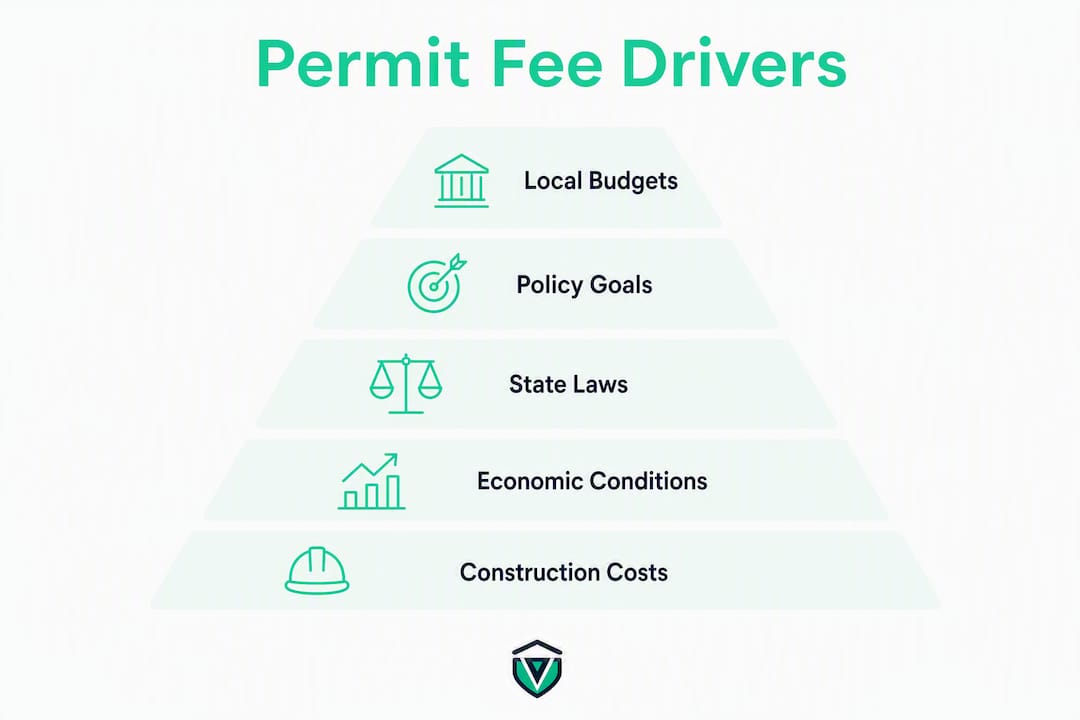
Fee variance is not random. Three distinct forces shape it.
Policy intent. Some cities price permits purely to recover department costs. Others use below-cost fees as an economic development tool to attract investment. Still others treat permit revenue as a general-fund contribution. Each approach produces a different fee level for the same project type.
State enabling statutes. Texas enacted HB 852, which prohibits certain value-based fee calculations, and HB 1922, which requires periodic fee readoption. Those laws force Texas municipalities into methodologies that neighboring states do not require. A franchise expanding from Texas into California will encounter entirely different legal constraints on how fees can be set.
Local economic conditions. High construction activity drives down the multiplier because the same budget is spread across more projects. Staff shortages or high backlogs push up re-submittal costs and inspection wait times, which are indirect fee increases even when the schedule stays flat. PermitMint's dataset across U.S. cities shows average permit fees varying by more than 100x between the lowest- and highest-cost cities in their sample.
How does fee variability affect your budget and timeline?
For a multi-location rollout, permit fee variance hits in three places: bid accuracy, contingency sizing, and schedule.
On bid accuracy, contractors typically exclude permit fees from their base bids or use a placeholder. If your site-selection team has not pulled the actual fee schedule, that placeholder can be off by a factor of five or more. Build permit cost verification into your site approval gate, not your construction kickoff.
On contingency, a flat-fee jurisdiction warrants a smaller buffer (5–10% of estimated permit costs). A valuation-based jurisdiction with a history of re-submittal cycles warrants 15–25%. The difference matters when you are opening 20 locations in a year.
On schedule, plan review cycles range from a few days in smaller jurisdictions to 8–12 weeks in high-volume cities. Re-submittal fees and wait times add cost and delay simultaneously. Contract terms with your general contractor should explicitly allocate who bears permit delay costs and who owns re-submittal fees.
Pre-opening due diligence checklist for new locations
Run this before you sign a lease or commit to a construction budget.
- Download the current adopted fee schedule from the building department website.
- Identify the valuation method (flat, percentage, square-foot, or hybrid).
- Request a preliminary fee estimate in writing from the building official.
- Ask whether plan review is bundled or billed separately, and when payment is due.
- Identify all special districts (fire, utility, school) that levy separate impact fees.
- Confirm whether a use tax or state surcharge applies at permit issuance.
- Ask for the average plan review turnaround time and the re-submittal fee.
- Check whether a consolidated master fee schedule exists or whether you need to pull from multiple departments.
Sample questions to ask permitting staff:
- "What is the total fee estimate for a [project type] with a declared value of $[X]?"
- "Are plan review, technology, and inspection fees included in that estimate or billed separately?"
- "Does this jurisdiction offer fee waivers or incentives for [small business / economic development projects]?"
- "When is final fee payment due — at submittal, at permit issuance, or at inspection?"
Pro Tip: The building official is the right first contact for fee questions. If fee schedules span multiple departments, ask to be connected to the finance department's development services coordinator. For complex projects, escalate to the planning director for a pre-application meeting, which is usually free and can surface impact fees before you commit.
A pre-application checklist approach, similar to what a DA lodgement checklist provides in other markets, reduces the chance of discovering a major fee category only after submittal.
How to reduce permit cost surprises operationally
Pre-application meetings are the single highest-return step. Most jurisdictions offer them at no cost, and a 30-minute conversation with a plan reviewer can surface fee categories, submittal requirements, and likely re-submittal triggers before you spend money on drawings.
Group permits where possible. Some jurisdictions allow a master permit for tenant improvements across a building, which consolidates plan review fees. Ask explicitly whether a consolidated submission is available.
For process changes across your portfolio:
- Assign one internal owner per jurisdiction for permit tracking and fee verification.
- Build jurisdiction-specific fee templates that capture all known line items for your project type.
- Add a standard contract clause requiring your GC to notify you within 48 hours of any permit fee variance above a defined threshold.
- Use open-data tools and permit fee resources to benchmark fees before engaging the building department.
Fee waivers are available in more jurisdictions than most operators realize. Economic development zones, small-business incentive programs, and affordable housing overlays all carry potential waivers. Ask during the pre-application meeting, not after the invoice arrives.
When does it make sense to hire a permit expeditor?
Outside help is cost-justified when the complexity of a jurisdiction exceeds your team's bandwidth or experience. Specific triggers:
- The project requires discretionary approvals (variances, conditional use permits) in addition to building permits.
- The jurisdiction has a documented backlog of more than six weeks for plan review.
- The permit fee is large enough that a single re-submittal cycle costs more than the expeditor's fee.
- More than three separate permits are required from different departments for a single location.
- The project sits in a special district with its own approval process.
Pro Tip: Before engaging an expeditor, run a quick cost-benefit check: estimate the daily carrying cost of a delayed opening (rent, payroll, lost revenue) and multiply by the expected delay in weeks. If that number exceeds the expeditor's retainer, the math is straightforward. Most expeditors charge $1,500–$5,000 for a standard commercial project, and a two-week delay on a busy retail location often costs more than that in a single day.
Key Takeaways
Permit fee variance across U.S. jurisdictions is structural, not accidental — local budget targets, valuation methods, and state statutes each pull fees in different directions, and the only reliable defense is jurisdiction-specific due diligence before every new location commitment.
| Point | Details |
|---|---|
| Each jurisdiction is unique | Fees reflect local budgets, policy goals, and state law — never assume one city's schedule applies to another. |
| The fee stack runs deeper than the base permit | Plan review, inspections, impact fees, and surcharges routinely double or triple the posted permit fee. |
| Run due diligence before signing | Request a preliminary fee estimate and identify all special districts before committing to a site budget. |
| Size your contingency to the method | Flat-fee jurisdictions warrant 5–10% buffer; valuation-based or high-backlog cities warrant 15–25%. |
| Vaultedai centralizes the process | Vaultedai's platform tracks jurisdiction-specific fee templates, automates renewal reminders, and stores permit documents across all locations in one place. |
The case for treating permit management as a core operational function
Most multi-location operators treat permit fees as a line item to be handled by the GC or a local attorney. That works fine for one location. At five locations, the variance starts to create real budget noise. At twenty, it becomes a material risk to your expansion timeline and your P&L.
The operators who open locations fastest are not the ones with the best contractors. They are the ones who have already mapped the fee structure, identified the hidden charges, and built a repeatable intake process before the first drawing is submitted. Permit complexity does not decrease as you scale — it multiplies, because each new market brings its own code adoption cycle, its own impact fee districts, and its own plan review backlog.
Centralized tracking is not a nice administrative upgrade. It is the difference between a finance team that can forecast permit costs with confidence and one that is perpetually surprised by invoices. Vaultedai was built specifically for this problem — jurisdiction-specific checklists, document storage, and automated reminders in one place, so your team is not rebuilding the process from scratch every time you enter a new market.
Vaultedai helps you manage fee variability across every location
Permit fee variance is a solvable problem when you have the right system behind it. Vaultedai gives multi-location operators a centralized permit and compliance platform that replaces the spreadsheet-and-email workflow that breaks down the moment you cross three locations.

The platform stores every permit, license, and renewal document by location, flags upcoming deadlines automatically, and uses AI to extract fee language and key dates from permit documents so your team does not miss a line item. Jurisdiction-specific compliance checklists mean your intake process is consistent whether you are opening in Nashville, Seattle, or Salt Lake City. For operators managing franchise permit costs across dozens of markets, that consistency is what keeps expansion on schedule.
Start with Vaultedai's free permit checker to benchmark your current locations, then explore the full platform to see how centralized compliance tracking works in practice.
Useful sources and further reading
- Nashville Building Permit Fee Schedule (2025) — Nashville's adopted fee schedule, including the Permit Fee Multiplier methodology and ICC BVD reference tables.
- City of Seattle — How much will your permit cost? — Seattle's breakdown of fee components, payment timing, and inspection fee structure.
- SPUR — How much does it cost to permit a house? — Policy analysis of fee fragmentation and recommendations for consolidated fee disclosure.
- PermitCalculator — Building Permit Fees By City — City-by-city fee comparisons for common project types across the U.S.
- PermitMint Data Center — Open permit data across 1,842 U.S. jurisdictions, including average fee variance by city.
- RDPlanning — How should a municipality determine building permit fees? — Whitepaper covering state-level legal constraints including Texas HB 852 and HB 1922.
- Salt Lake County MSD Fee Schedule FY 2026 — Example of a county-level fee schedule using ICC valuation tables with a state surcharge.
- Vaultedai — Free Business Permit Checker — Tool for benchmarking permit requirements and identifying fee categories by jurisdiction.
- Vaultedai — How Franchise Permit Costs Are Structured — Operational guide to permit cost structures for multi-location franchise operators.