

Centralized license management is defined as the practice of consolidating all business permits, licenses, and compliance documents into a single, accessible system. For multi-location operators, this is not a convenience. It is a compliance necessity. Fragmented licensing across city, county, and state jurisdictions creates the greatest risk of missed renewals for multi-state businesses, leading directly to fines and operational disruption. Vaultedai was built specifically to solve this problem for growing businesses that have outgrown spreadsheets. This guide walks you through the tools, steps, and habits needed to organize business licenses in one place and keep them there.
How to organize business licenses in one place: what you need first
Before you can centralize anything, you need a complete picture of what you already have. Most multi-location operators are surprised to discover how many licenses they hold across jurisdictions, including city business licenses, state-level permits, health department certifications, fire safety inspections, and zoning approvals.
Start by gathering every active license and permit across all locations. Pull physical documents, email confirmations, and any records stored in accounting software or filing cabinets. The goal is a single master list before you touch any digital tool.

Once you have that list, assess the compliance requirements for each location individually. Renewal cycles, issuing authorities, and fee structures vary significantly between jurisdictions. A restaurant group operating in three states may face a dozen different renewal timelines, each with its own agency portal and documentation requirement.
What to collect for each license:
- License name and type (business, health, fire safety, liquor, zoning)
- Issuing authority and jurisdiction (city, county, state, federal)
- Issue date and expiration date
- Renewal fee and payment method
- Contact information for the issuing agency
- Physical or digital copy of the document
When evaluating digital tools for business license management, look for four core features: document storage with version control, automated renewal alerts, role-based access permissions, and audit trail logging. Platforms that offer real-time notification and status tracking reduce follow-up inquiries and keep your team informed without manual check-ins.
| Document or data point | Why it matters |
|---|---|
| License type and issuing authority | Determines renewal process and contact |
| Expiration date | Drives alert scheduling and renewal priority |
| Jurisdiction-specific requirements | Prevents compliance gaps across locations |
| Fee amount and payment method | Avoids late fees from missed payments |
| Document copy (PDF or scan) | Required for audits and inspections |
Step-by-step process for centralizing your license management
A structured approach prevents the most common failure mode: starting strong, then letting the system drift back into chaos after a few months.
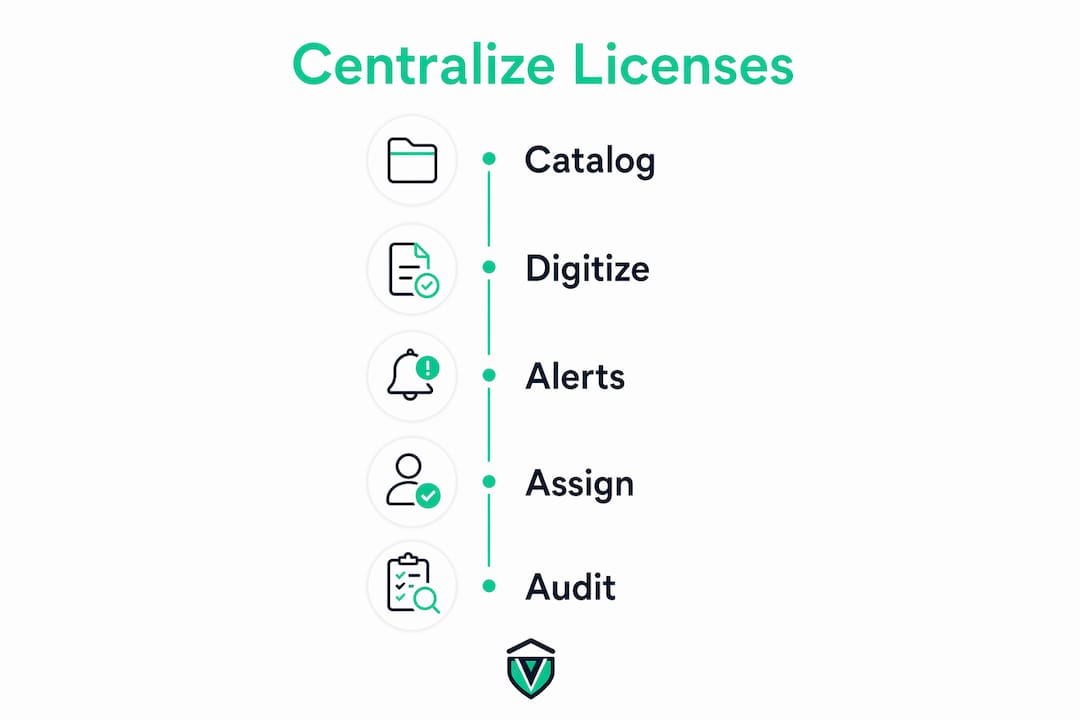
Step 1: Catalog every license and enter it into one system. Create a record for each license using the data points listed above. Whether you start in a spreadsheet or go straight to a dedicated platform, consistency matters more than perfection at this stage. Every license gets a record. No exceptions.
Step 2: Digitize physical documents and build a unified dashboard. Scan every paper license and attach it to its corresponding record. A unified dashboard gives you a single view of all locations, all license types, and all expiration dates. Automated renewal workflows allow you to manage hundreds of licenses with varying renewal dates without relying on memory or calendar reminders.
Step 3: Configure renewal alerts and compliance deadline notifications. Set alerts at 90 days, 60 days, and 30 days before each expiration. Digitizing this process can reduce permit renewal processing time from three days to just 83 minutes. That kind of time savings compounds across dozens of licenses.
Step 4: Assign roles and responsibilities. Define who owns each license category. A general manager at each location might own local permits, while a compliance officer at headquarters handles state-level licenses. Role-based permissions and audit trails within centralized systems are vital to maintaining data integrity and compliance accountability.
Step 5: Schedule regular audits and inventory reconciliations. No digital system fully eliminates the need for human oversight. Practitioners recommend at least one cross-check every 12 months against official government databases to catch mismatches and gaps. Build this into your annual calendar as a fixed event.
Pro Tip: Set your 90-day renewal alerts to trigger a task assignment, not just an email notification. Alerts that create assigned tasks in your system are far less likely to be ignored than alerts that land in a shared inbox.
| Approach | Renewal tracking | Audit readiness | Scalability |
|---|---|---|---|
| Manual spreadsheets | Error-prone, calendar-dependent | Documents scattered | Breaks down past 3 locations |
| Dedicated digital platform | Automated alerts, centralized | Instant document access | Handles hundreds of licenses |
How do you handle common challenges when organizing licenses?
Even with a solid system in place, multi-location operators run into predictable problems. Knowing them in advance cuts resolution time significantly.
Overlapping jurisdictions and inconsistent renewal cycles are the most common source of confusion. A single location may require a city business license renewed in january, a state health permit renewed in april, and a fire safety certificate renewed in october. The fix is a master renewal calendar that displays all deadlines by location and license type, not just by date.
Missed renewals from manual tracking remain the top compliance risk for businesses using spreadsheets. Centralized licensing platforms consolidate tracking, renewal deadlines, and audit-ready records to reduce this risk directly. Automated reminders remove the dependency on any single person remembering a deadline.
Inaccurate or outdated data creeps in when licenses are renewed but records are not updated. Assign one person per location to confirm and update the system within 48 hours of any renewal or change. This single habit prevents most data drift.
Legacy paper systems and manual processes slow down the transition to digital management. The solution is a phased approach: digitize the highest-risk licenses first (those expiring soonest or carrying the largest penalties), then work through the rest systematically.
Regulators and industry practitioners increasingly advocate for "single window" platforms that integrate fire safety, health, and business permits into one unified system. ARTA and DICT initiatives in 2026 are actively pushing eBOSS integration with fire safety inspection systems, signaling that unified licensing is the direction all compliance management is heading.
Pro Tip: Schedule one annual compliance review meeting with all location managers. Use it to cross-check your digital records against physical documents and official agency portals. This single meeting catches the errors that automated systems miss.
You can also use a business license audit checklist designed for multi-location operators to structure this review efficiently.
Best practices for keeping your license repository current
A centralized system only stays useful if it stays accurate. These practices keep your license repository from becoming another neglected database.
Establish a standard operating procedure for license updates. Every renewal, amendment, or new license application should follow the same steps: update the record, attach the new document, confirm the new expiration date, and reset the alert schedule. Document this procedure and train every person who touches the system.
Use technology for auto-renewal tracking and reporting. Platforms that generate compliance reports on demand give you a real-time view of your exposure. When a regulator or investor asks about your license status, you should be able to answer in under two minutes.
Define clear ownership for license data. Ambiguous ownership is the fastest way to let a system decay. Assign a named individual to each license category, not a team or a department. Named ownership creates accountability.
Align periodic reviews with regulatory changes. Licensing requirements change. New jurisdictions add requirements, fee structures shift, and agencies merge or reorganize. A quarterly scan of regulatory updates for each jurisdiction you operate in prevents surprises. The fragmented compliance landscape means that even a small regulatory change in one city can affect your entire operation if it goes unnoticed.
Integrate license status with your operational systems. When a license is at risk of lapsing, your operations team needs to know, not just your compliance officer. Connecting your license management platform to your internal communication tools ensures the right people get the right alerts at the right time. This is especially critical when staying compliant during business expansion into new markets.
Key Takeaways
Centralizing your business licenses into one system is the single most effective way to reduce compliance risk across multiple locations.
| Point | Details |
|---|---|
| Start with a full inventory | Collect every license across all locations before choosing any digital tool. |
| Automate renewal alerts | Set alerts at 90, 60, and 30 days before expiration to eliminate missed deadlines. |
| Assign named ownership | Give one person responsibility for each license category to prevent data drift. |
| Schedule annual reconciliations | Cross-check digital records against official databases at least once per year. |
| Match your system to your scale | Spreadsheets break down past three locations; dedicated platforms handle hundreds. |
Why I think most operators underestimate this problem
After working with multi-location businesses across retail, food service, and specialty retail, I have seen the same pattern repeat. Operators build a spreadsheet when they open their second location, patch it when they open their third, and then quietly stop updating it somewhere around their fifth. By the time they hit ten locations, nobody knows exactly which licenses are current, who renewed what, or where the documents live.
The uncomfortable truth is that a lapsed license does not always trigger an immediate fine. Sometimes it sits unnoticed for months. That creates a false sense of security. Then a routine inspection or a lease renewal audit surfaces the gap, and the cost of fixing it is ten times what proactive management would have cost.
The businesses that handle this well share one trait: they treat license management as an operational system, not an administrative task. They assign ownership, build procedures, and use technology to enforce discipline. They also recognize that automation handles the routine work, but a human still needs to verify the system periodically. The common application errors that create compliance gaps almost always trace back to a process failure, not a technology failure.
Balancing automation with human oversight is not a compromise. It is the correct design for any compliance system that has to work reliably at scale.
— Rakin
Vaultedai: one platform for all your licenses and permits
Multi-location operators who have outgrown spreadsheets need a purpose-built solution, not another workaround.
Vaultedai is a compliance and permit management platform built for exactly this situation. It centralizes permits, licenses, renewals, and compliance documents across all your locations in one place. Renewal alerts fire automatically. Documents are stored and accessible on demand. Role-based permissions keep the right people in control of the right records. Vaultedai requires no complex IT setup and is designed for fast onboarding, so you can move your entire license inventory into the system without a lengthy implementation project. Whether you operate smoke shops, restaurants, convenience stores, or a franchise group, Vaultedai's permit tracker gives you the visibility and control your operation needs.
FAQ
What does it mean to organize business licenses in one place?
Organizing business licenses in one place means consolidating all permits, compliance documents, and renewal deadlines into a single digital system accessible to your entire team. This replaces scattered spreadsheets, email threads, and paper files with one source of truth.
How often should I audit my centralized license records?
Compliance professionals recommend at least one full reconciliation per year, cross-checking your digital records against official government databases to catch mismatches or expired documents.
What is the biggest risk of not centralizing license management?
Fragmented tracking across jurisdictions is the leading cause of missed renewals, which can result in fines, forced closures, or failed inspections for multi-location businesses.
What features should I look for in a license management platform?
Look for automated renewal alerts, document storage with version control, role-based access permissions, and audit trail logging. These four features cover the core compliance needs for multi-location operators.
Can I manage licenses across multiple states in one system?
Yes. Dedicated platforms are built to handle licenses across city, county, and state jurisdictions simultaneously, with separate renewal schedules and document records for each location and license type.