
Businesses get compliance fines because they fail to meet a specific legal duty — most commonly through missing or expired records, payroll errors, workplace-safety lapses, unreported data breaches, or discrimination violations that agencies like the DOL, IRS, and HIPAA enforcement offices are actively watching for. The failure is rarely dramatic. It usually traces back to a process that nobody owned, a deadline that slipped, or a policy that existed on paper but never reached the floor.
The most common causes of compliance fines in the U.S.:
- Missing or incomplete records (I-9s, tax filings, safety logs)
- Expired licenses or permits
- Payroll and tax errors, including worker misclassification
- Workplace-safety violations (OSHA citations)
- Data breaches or privacy-rule violations (HIPAA, state privacy laws)
- Discrimination and HR violations (ADA, EEOC charges)
- Environmental and permitting lapses
- Benefits noncompliance (ACA reporting, COBRA notices)
Key Takeaways
Most compliance fines trace back to the same root cause: a process gap between what the law requires and what the business actually tracks, documents, and does.
| Point | Details |
|---|---|
| Root cause of most fines | Process and governance failures — missed deadlines, incomplete records, untrained staff — not deliberate wrongdoing. |
| Highest-risk regulatory areas | Employment/HR (I-9s, ADA, EEOC), HIPAA/data privacy, OSHA safety, payroll/tax, and licensing/permits. |
| Fines escalate with willfulness | Agencies use willfulness, harm, and repeat offenses to set penalties; HIPAA willful neglect can carry substantially higher fines. |
| Consequences extend beyond the fine | Reputational damage, debarment, higher insurance premiums, and criminal exposure often cost more than the monetary penalty. |
| Vaultedai reduces process risk | Centralized permit tracking, automated renewal alerts, and audit-ready document storage address the most common fine triggers for multi-location businesses. |
Table of Contents
- Why do businesses get compliance fines across regulatory areas?
- How do regulators detect violations and calculate fines?
- Consequences that go well beyond the fine itself
- Prevention checklist: practical controls that reduce your risk
- What to do immediately after receiving a fine or notice of violation
- Illustrative U.S. penalty ranges by regulatory area
- How a centralized compliance platform reduces your fine risk
- The compliance priority most owners get wrong
- Vaultedai keeps your permits and deadlines in one place
- Sources
Why do businesses get compliance fines across regulatory areas?
The causes of compliance fines look different depending on which agency is watching, but the underlying failure is almost always the same: a gap between what the law requires and what the business actually does. Here is how that plays out by area.
Employment and HR
I-9 errors are among the most common HR violations. Every employer must verify work authorization for each new hire using Form I-9, and fines apply per missing or incorrect form. Beyond I-9s, the ADA requires reasonable accommodations and non-discrimination — failures here trigger EEOC investigations. EEOC enforcement data shows discrimination charges consistently lead to agency investigations and, in many cases, monetary relief. These are organizational failures: weak onboarding checklists, untrained managers, or HR policies that were written once and never updated.
The Affordable Care Act adds another layer. Employers above certain size thresholds must meet coverage and reporting requirements, and missing those deadlines produces penalties. COBRA continuation-coverage rules carry their own notice timelines — missing a required notice to a departing employee can trigger a corrective action.
Data privacy and security
Data-related fines are growing fast. Regulators are issuing record penalties for data protection and cybersecurity lapses, and the total cost of a breach rises sharply when noncompliance is a factor. HIPAA structures its penalties in multiple tiers based on culpability, with fines that can be substantially higher for willful neglect that goes uncorrected. Academic analysis of GDPR enforcement found that organizational failures — missing legal basis for data processing, inadequate staff training, no privacy impact assessments — drove more fines than purely technical security gaps. The same dynamic applies under U.S. state privacy laws.
OSHA and workplace safety
Workplace-safety inspections and citations are a routine enforcement avenue. OSHA conducts programmed inspections in high-hazard industries and responds to employee complaints. A "serious" citation — one where a hazard could cause death or serious physical harm — carries a penalty of up to $16,550 per violation. Willful or repeat violations reach $165,514 per violation. The cause is almost always procedural: missing safety training records, no written hazard communication program, or lockout/tagout procedures that exist but aren't followed.

Tax and financial compliance
Payroll tax errors, worker misclassification (treating employees as independent contractors), and late or inaccurate filings are the IRS's most common enforcement targets for small and mid-size businesses. The SEC pursues disclosure and financial-controls failures — SEC enforcement actions can result in civil penalties, disgorgement of profits, and other remedies. For financial institutions, FDIC examiners consistently find that violations stem from management's unfamiliarity with statutes and weak internal controls — not from deliberate fraud.
For businesses in financial services, meeting IT compliance standards for data handling and reporting is a separate layer on top of standard tax obligations.
Licensing, permits, and environmental rules
Operating without a current license or with an expired permit is one of the most avoidable causes of fines — and one of the most common. State licensing agencies and local authorities don't typically send reminders. The EPA enforces Clean Air Act, Clean Water Act, and hazardous-waste rules; administrative penalties for violations can reach $70,117 per day per violation under some statutes.
Pro Tip: Check both federal and state requirements for every regulatory area. State attorneys general and state licensing agencies often enforce rules that are stricter than federal minimums — and they run their own inspection programs independently of federal agencies.
How do regulators detect violations and calculate fines?
Understanding enforcement triggers matters as much as knowing the rules. Most businesses don't get fined because an agency was watching them specifically. They get fined because something surfaced.
Common enforcement triggers:
- Employee or customer complaints filed directly with an agency
- Routine audits and scheduled inspections (OSHA programmed inspections, IRS audits)
- Whistleblower reports under OSHA, SEC, or IRS whistleblower programs
- Third-party data breach notifications that reach regulators
- Agency priority sweeps targeting specific industries or violation types
- Self-disclosure (which can reduce penalties but opens an investigation)
Key U.S. enforcement agencies and their primary jurisdiction:
- DOL / OSHA: Wage and hour, workplace safety, benefits (ERISA, COBRA, ACA)
- IRS: Payroll taxes, worker classification, information reporting
- SEC: Securities disclosures, financial controls, insider trading
- EPA: Environmental permits, hazardous waste, air and water quality
- FTC: Consumer protection, advertising, data security (for non-HIPAA entities)
- HHS / OCR: HIPAA privacy and security rule enforcement
- USCIS / ICE: I-9 employment eligibility
- EEOC: Workplace discrimination and harassment
- State AGs and licensing boards: State consumer protection, professional licenses, data breach notification
When agencies calculate a penalty, they weigh several factors: whether the violation was willful or negligent, the size of the business, the harm caused, whether the business remediated quickly, and whether it has prior violations. A first-time, unknowing violation with prompt correction gets treated very differently from a repeat offense the business ignored after a prior warning.
Consequences that go well beyond the fine itself
The monetary penalty is often the smallest part of the problem. Fines trigger a chain of secondary costs that can outlast the original violation by years.
Reputational damage is frequently the most durable consequence. A publicized OSHA citation, an EEOC lawsuit, or a data breach disclosure can cost a business far more in lost contracts, employee turnover, and customer trust than the fine itself ever would. Government contractors face debarment — exclusion from future federal work — for certain violations. Insurance carriers raise premiums or deny coverage after compliance failures, adding a recurring cost that compounds over time. And when a violation is willful, criminal referrals are possible: OSHA can refer cases to the DOJ, and the IRS pursues criminal charges for deliberate tax fraud.
Investigations rarely resolve quickly. A single OSHA inspection can take months to move through the informal conference, contest, and settlement process. EEOC charges average over 300 days to resolve. Multi-agency investigations — say, a data breach that triggers both HHS/OCR and a state AG inquiry — can run in parallel for years. Each open investigation carries its own legal costs, management distraction, and risk of additional findings. Compliance failures also affect insurance coverage in ways that most owners don't anticipate until they file a claim.
Prevention checklist: practical controls that reduce your risk
Most compliance fines are preventable. The controls below are ordered by impact, not complexity.
- Get senior buy-in. Compliance programs without leadership commitment fail. Assign a named owner for each regulatory area and make compliance a standing agenda item at leadership meetings.
- Write and maintain clear policies. Policies for HR, data handling, safety, and financial controls should be written, dated, and reviewed annually. A policy that hasn't been updated since 2019 is a liability.
- Train employees on their specific obligations. General compliance training is less effective than role-specific training. A manager who handles I-9s needs to know I-9 rules; a warehouse supervisor needs OSHA hazard communication training.
- Build a compliance calendar. Map every filing deadline, renewal date, and inspection window. A business compliance calendar turns reactive scrambling into a scheduled routine.
- Conduct internal audits. Run a self-audit before regulators do. For I-9s, OSHA recordkeeping, and payroll, an annual internal review catches errors while they're still correctable.
- Track every license and permit expiration. Expired permits are pure process failures. Assign renewal ownership and set calendar alerts at 90, 60, and 30 days before expiration. Common license application errors are well-documented and avoidable with a checklist.
- Vet vendors and third parties. A vendor who mishandles your customer data or violates labor rules can expose your business. Include compliance requirements in vendor contracts and review them annually.
- Set up an internal reporting channel. Employees who can report concerns internally are less likely to go to a regulator first. An anonymous hotline or reporting form reduces whistleblower risk.
- Document remediation. When you find a problem, fix it and document the fix. Agencies treat documented remediation as a mitigating factor in penalty calculations.
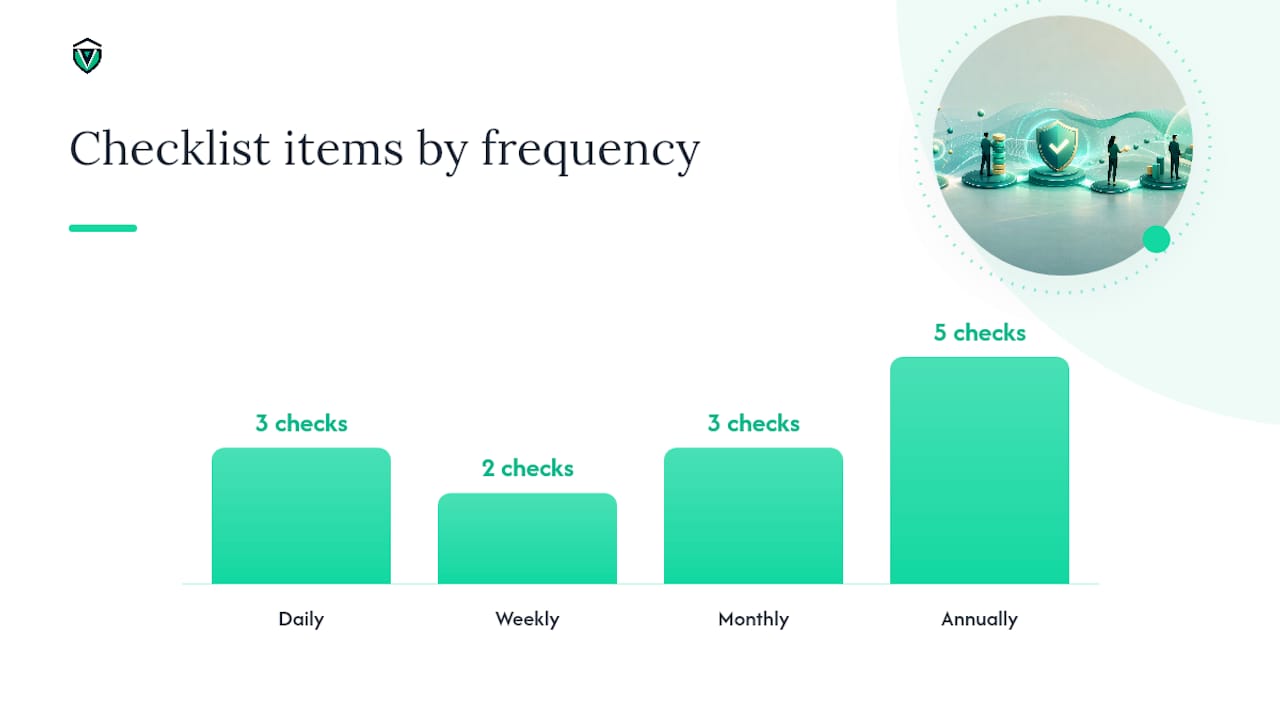
Review frequency:
| Frequency | What to check |
|---|---|
| Daily | Safety logs, incident reports, open permits for active job sites |
| Weekly | Pending license renewals within 30 days, open HR complaints |
| Monthly | Payroll tax deposits, benefits enrollment changes, vendor compliance status |
| Annually | Full I-9 audit, OSHA recordkeeping review, insurance coverage, policy updates, all license/permit renewals |
Pro Tip: For multi-location businesses, the biggest compliance risk isn't any single rule — it's the same deadline slipping at three locations simultaneously because nobody had a centralized view. Centralizing your permit and license tracking is the single highest-leverage fix for that problem.
What to do immediately after receiving a fine or notice of violation
The first 72 hours after receiving a notice matter more than most owners realize. Here is the sequence that protects your options.
- Acknowledge receipt and note the response deadline. Every notice has a statutory response window. Missing it can waive your right to contest the penalty or convert a proposed fine into a final one.
- Preserve all relevant records. Do not delete, alter, or "clean up" any documents related to the violation. Destruction of evidence after a notice is a separate, serious offense.
- Stop the ongoing harm immediately. If the violation is continuing — an unsafe condition, an unlicensed activity, an ongoing data exposure — stop it now. Continued harm after notice is an aggravating factor.
- Gather your documentation. Pull every record that shows what you did, when you did it, and what you knew. Your defense depends on the paper trail.
- Check self-disclosure options. Some agencies (IRS Voluntary Disclosure Program, EPA's Audit Policy) reduce penalties for businesses that self-report violations before an investigation begins. If you discover a violation before the agency does, consult counsel about disclosure.
- Hire qualified legal counsel before responding. For any fine above a few thousand dollars, or any notice that mentions willfulness or criminal referral, get a lawyer who specializes in the relevant regulatory area before you submit a written response.
- Set an internal communication plan. Decide who inside the organization needs to know, what they're told, and who speaks externally. Inconsistent statements to regulators create additional exposure.
- Assess settlement vs. appeal. Most agencies offer an informal conference or settlement process before a final penalty is set. Settlement often reduces the fine and closes the matter faster than a formal appeal. Your counsel can model the tradeoffs.
Illustrative U.S. penalty ranges by regulatory area
These ranges are illustrative. Agency penalty amounts are adjusted periodically for inflation, and the specific facts of a violation determine the actual fine. Always verify current figures directly on the relevant agency's website.
The HIPAA tier structure is a useful model for understanding how most agencies think: the less culpable the violation and the faster the correction, the lower the fine. Willfulness and inaction are the two factors that push penalties to their maximums. Non-compliance with data protection rules has driven some of the largest enforcement actions in recent years, and that trend is continuing.
Disclaimer: Penalty amounts change. Consult the relevant agency's website or a qualified attorney for current figures before making compliance or legal decisions.
How a centralized compliance platform reduces your fine risk
The most common causes of compliance fines — missed renewals, incomplete records, untrained staff, no audit trail — are process failures, not knowledge failures. Most owners know the rules exist. The problem is that tracking them across multiple locations, deadlines, and regulatory areas using spreadsheets and email reminders is genuinely unreliable at scale.
A centralized compliance and permit management platform like Vaultedai addresses the specific failure modes described throughout this article:
- Permit and license expiration alerts catch renewals before they lapse, eliminating the "I forgot" fine
- Centralized document storage means every I-9, safety log, and permit certificate is retrievable in minutes during an audit
- Jurisdiction-specific compliance checklists surface the rules that apply to each location, not just the general federal requirements
- Audit-ready evidence exports let you respond to an agency inquiry with organized documentation instead of a frantic file search
- Vendor compliance tracking keeps third-party obligations visible alongside your own
For a franchise group or restaurant chain operating across multiple states, the risk isn't one missed renewal — it's the same renewal missed at five locations in the same week because nobody had a single view of what was due. Staying compliant during expansion requires a system, not a spreadsheet.
Pro Tip: When evaluating any compliance platform, test the audit export function first. The moment you need it — during an agency inquiry — is not the time to discover it doesn't produce organized, timestamped documentation.
The compliance priority most owners get wrong
Most owners treat compliance as a documentation problem. They think the fix is more paperwork, more binders, more checklists. That framing is wrong, and it's why so many compliance programs fail.
The real problem is visibility. You can't manage what you can't see, and most multi-location businesses have no single view of what's due, what's expired, and what's been filed. The fines that hit hardest aren't the ones from complex regulatory gray areas — they're the ones from a permit that expired six months ago and nobody noticed, or an I-9 that was never completed for a hire who's been on payroll for two years.
My practical priorities for any owner who wants to reduce fine risk without building a compliance department:
- Fix recordkeeping first. Before you worry about policy updates or training programs, make sure you can find every license, permit, and required document in under five minutes. If you can't, that's your first problem.
- Put one person in charge of each deadline. Shared responsibility is no responsibility. Assign a named owner to every renewal and filing deadline, even if that person is you.
- Treat your first internal audit as a gift. The violations you find yourself are correctable. The ones a regulator finds are not. Run the audit before the agency does.
Compliance isn't separate from operations — it's part of how a well-run business works. The role of compliance in business growth is underappreciated precisely because the costs of noncompliance are invisible until they aren't.
Vaultedai keeps your permits and deadlines in one place
Multi-location businesses that manage permits and licenses across spreadsheets and email threads face a predictable outcome: something slips. Vaultedai centralizes every permit, license, renewal, and compliance document across all your locations, with automated renewal reminders, AI-powered document extraction, and audit-ready storage built in. When an agency asks for documentation, you pull it in minutes, not days.
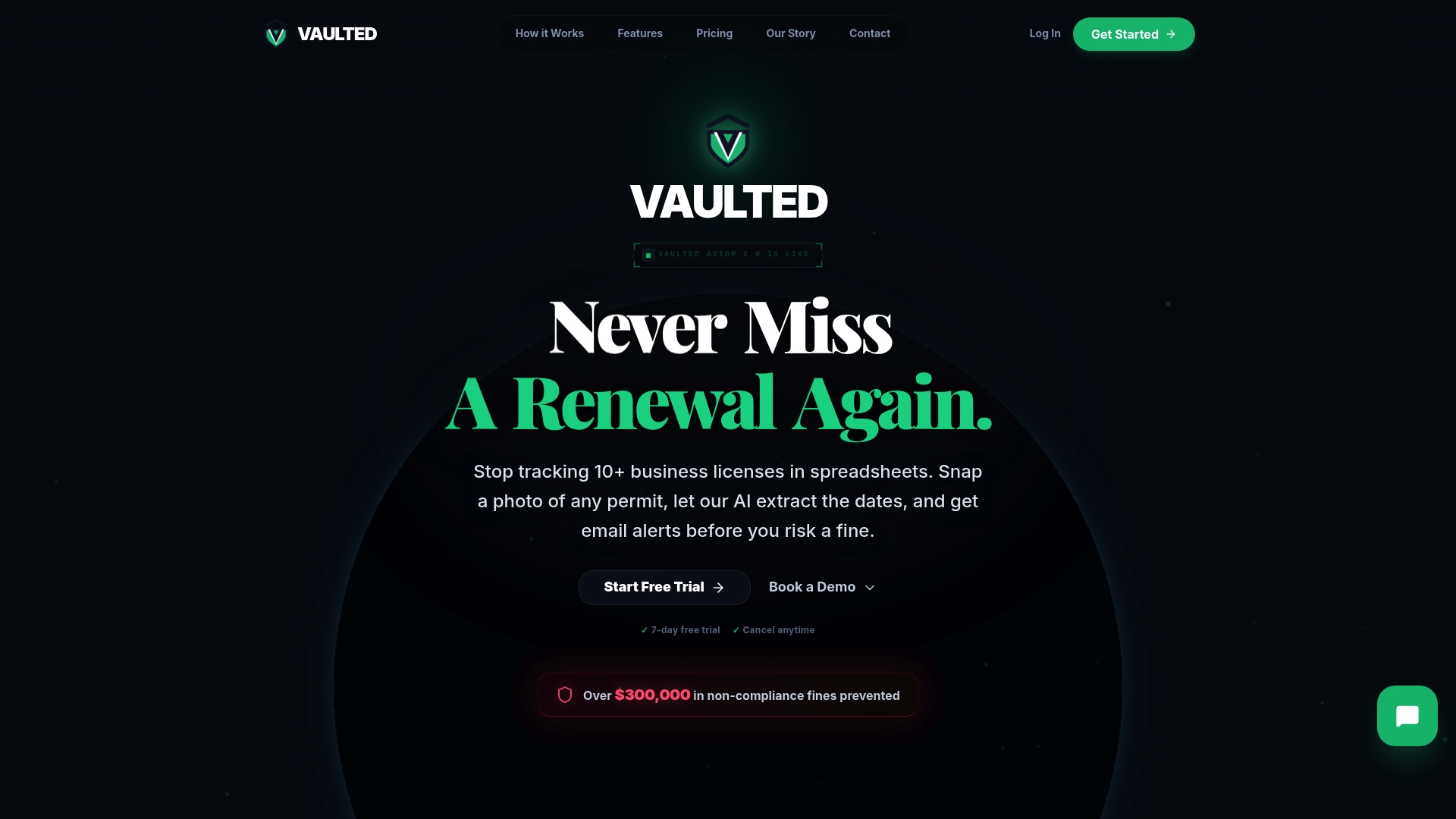
The platform is built for operators who are scaling — franchise groups, restaurant chains, convenience stores, smoke shop groups — and who need compliance visibility without a dedicated compliance team. Fast onboarding, simple workflows, and a single dashboard replace the spreadsheet patchwork that causes most missed-deadline fines.
Start a trial or request a demo at Vaultedai and see how much faster your team can respond to the next renewal or audit request.
Sources
Agency penalty amounts change with inflation adjustments and regulatory updates. Use these primary sources to confirm current figures and filing requirements.
- Examination Policies Manual — Section 4.5 (FDIC)
- OSH: Occupational Safety and Health — BLS news release
- Sec
- Form I-9, Employment Eligibility Verification — USCIS
- Healthcare
- COBRA — Employee Benefits Security Administration (DOL)
- Ada
- Non-Compliance Fines and Sanctions: Real Cases With $ Impact + Enforcement Trends to Watch in 2026 — Secureframe
- What Is Compliance? Legal Requirements and Penalties — LegalClarity
This article is general information, not a substitute for advice from a qualified lawyer. Consult a qualified legal professional about your own circumstances before acting on anything here.