

Insurance compliance is defined as the practice of ensuring that a business, its vendors, and its contractors maintain the required insurance coverage to protect against legal, financial, and operational liability. The role of compliance in business insurance goes far beyond filing paperwork. It determines whether your coverage actually holds up when a claim is filed, whether your contracts stay valid, and whether regulators leave you alone. The McCarran-Ferguson Act established that states, not the federal government, hold primary authority over insurance regulation. That means your obligations vary by location, by contract, and by industry. Get them wrong, and the consequences range from fines to criminal charges.
What legal and contractual insurance requirements must businesses comply with?
Most business insurance requirements originate at the state level, not through federal law. Workers' compensation is required in 49 states, commercial auto in 49 states, and general liability is typically mandated through contracts rather than statute. Texas is the only state that does not require workers' compensation for most private employers. New Hampshire does not require commercial auto insurance. Every other state has its own rules, thresholds, and exemptions.
The penalties for getting this wrong are severe. Failing to carry workers' compensation triggers stop-work orders, fines up to $100,000, and in some states, criminal charges. California starts fines at $10,000 for sole proprietors without coverage. Beyond losing the exclusive remedy defense, a business without proper coverage becomes personally liable for every employee injury claim.
Contracts add another layer on top of state law. A landlord, a general contractor, or a lender may require coverage limits that exceed the legal minimum. They may also require specific endorsements.
- Additional insured endorsements add a third party to your policy so they share your liability protection.
- Waiver of subrogation endorsements prevent your insurer from suing the other party after paying a claim.
- Primary and noncontributory endorsements make your policy pay first before any other coverage applies.
A certificate of insurance alone is often insufficient to satisfy these requirements. The endorsements must be attached to the underlying policy. Businesses that skip this verification step discover the gap only when a claim is denied.
Pro Tip: Review every contract's insurance exhibit before renewing policies. Endorsement requirements change between contract cycles, and your insurer needs advance notice to add them.
Businesses operating across multiple states face an additional layer of complexity. Monopolistic fund states like Ohio and Wyoming require employers to buy workers' compensation directly from a state fund. All other states require an "other states" endorsement on the policy to cover employees who travel or relocate. Missing this endorsement leaves those workers unprotected.
Who is responsible for insurance compliance roles?
Unclear role assignment accounts for 67% of compliance failures. That statistic points to a structural problem, not a knowledge problem. Most businesses know they need insurance. Far fewer have defined who owns each step of the compliance process.
Effective programs assign five distinct roles:
- Compliance Program Owner. This is typically a senior executive or operations director. They hold final accountability for the program, set policy, and resolve escalations. Without executive authority at this level, enforcement breaks down.
- Compliance Manager. This person runs the day-to-day program. They track deadlines, manage documentation, coordinate audits, and report status to the Program Owner.
- Certificate Reviewers. These team members verify that incoming certificates of insurance meet contract and regulatory requirements. They check coverage limits, policy dates, and endorsements.
- Vendor Coordinators. They communicate with vendors and contractors to collect certificates, follow up on deficiencies, and document resolution.
- Operational Enforcers. These are the people with authority to stop work or hold payments when a vendor's coverage lapses. They sit closest to daily operations.
Separating certificate collection from enforcement prevents conflicts of interest. A vendor coordinator who also controls payment approvals faces pressure to overlook deficiencies. Keeping those functions separate protects the integrity of the program.
Small businesses often consolidate these roles across two or three people. That is acceptable as long as the responsibilities are explicitly assigned and documented. A restaurant group with five locations can have the operations manager serve as both Compliance Manager and Vendor Coordinator, provided someone else holds enforcement authority. The structure matters more than the headcount.

Pro Tip: Assign the Compliance Program Owner role in writing, not just verbally. When leadership changes, written role assignments prevent accountability gaps that expose the business to risk.
Assigning a Compliance Program Owner with executive authority resolves role conflicts before they escalate. That single decision is the highest-leverage action a business owner can take to strengthen their compliance program.
How can businesses build an effective compliance framework?
An effective insurance compliance framework converts regulatory requirements into internal policies, workflows, and controls. Compliance frameworks require continuous exam readiness rather than reactive preparation. That distinction matters. A business that only reviews its coverage when a contract is up for renewal will consistently miss gaps that accumulate between cycles.
The core components of a working framework are:
- Policy documentation. Write down what coverage is required, from whom, by when, and who is responsible for verifying it.
- Standardized workflows. Use the same process every time a new vendor is onboarded or a policy renewal is due.
- Centralized evidence. Store certificates, endorsements, and audit records in one place that multiple team members can access.
- Escalation protocols. Define exactly what happens when a vendor fails to provide compliant coverage. Who gets notified? Who stops the work?
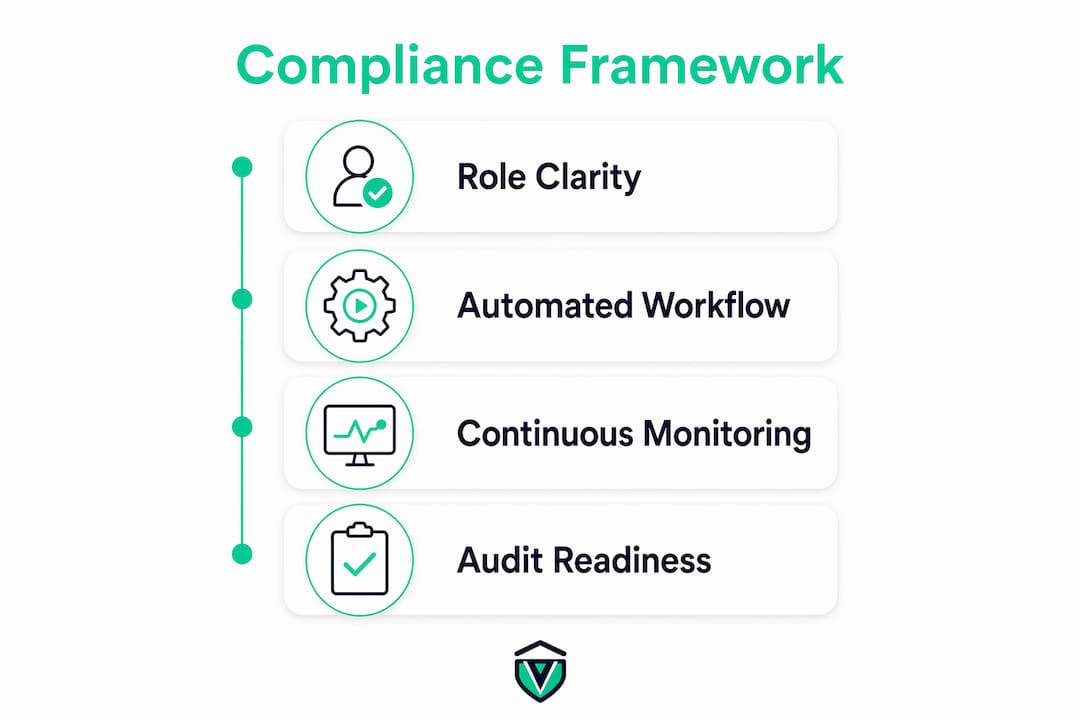
Effective programs integrate role clarity, automated workflows, and continuous monitoring to stay audit-ready at all times. Technology reduces the manual effort required to track dozens of vendors across multiple locations. It also gives leadership visibility into the program's status without requiring manual reports.
Compliance risk management frameworks use a maturity scale to measure program effectiveness. A 1-to-5 maturity scale helps organizations identify where they are and prioritize improvements. Here is how the levels translate in practice:
| Maturity Level | Description | Typical Business Profile |
|---|---|---|
| 1 – Ad hoc | No formal process; compliance handled reactively | Solo operators, early-stage startups |
| 2 – Developing | Basic checklists exist but are inconsistently applied | Small businesses with 1–2 locations |
| 3 – Defined | Documented policies and assigned roles in place | Growing businesses with 3–10 locations |
| 4 – Managed | Metrics tracked; compliance monitored proactively | Mid-size operators with multi-state presence |
| 5 – Optimized | Automated, continuously improving, audit-ready | Enterprise or franchise groups |
85% of business leaders find compliance requirements increasingly complex. Using a maturity scale gives those leaders a concrete way to measure progress rather than guessing whether their program is adequate.
For businesses scaling across locations, a compliance strategy for growth becomes a core operational requirement, not an afterthought.
What are common compliance pitfalls and how to avoid them?
Most compliance failures follow predictable patterns. Knowing them in advance is the fastest way to avoid them.
Common pitfalls include generic policy misuse, failure to enforce stop-work rules, and lapsed renewal tracking. Each one is avoidable with the right structure.
- Treating a general liability policy as a complete solution. A standard general liability policy does not automatically include the endorsements a contract requires. Businesses assume their policy covers everything until a claim reveals the gap.
- Failing to stop work when coverage lapses. Enforcement requires coordination with operational teams to halt work or hold payments the moment a lapse is identified. Businesses that allow work to continue during a coverage gap absorb full liability for any incident during that period.
- Missing certificate expiration dates. A vendor's certificate expires. Work continues. Nobody notices until an audit or a claim. Renewal tracking must be automated or calendared with advance alerts.
- No escalation path. When a certificate reviewer flags a deficiency, who acts on it? Without a documented escalation path, deficiencies sit unresolved.
- Undertrained staff. Certificate reviewers who cannot identify a missing endorsement cannot protect the business. Training is not optional.
Pro Tip: Set renewal alerts 45 days before a vendor's certificate expires. That window gives enough time to collect a new certificate, verify endorsements, and resolve deficiencies before coverage lapses.
A business compliance calendar is one of the most practical tools for tracking renewal deadlines and audit dates across multiple vendors and locations. Without a structured calendar, expiration dates slip through the cracks.
Without enforcement authority backed by leadership, compliance programs cannot effectively mitigate risk. Escalation protocols and documented incident reviews are what separate a functioning program from a binder of policies nobody enforces.
Key Takeaways
Strong insurance compliance requires defined roles, documented workflows, and continuous monitoring. Reactive programs consistently leave businesses exposed.
| Point | Details |
|---|---|
| Compliance is layered | State law, contracts, and lenders each impose separate insurance requirements that must all be met. |
| Role clarity prevents failures | Unclear role assignment accounts for 67% of compliance failures; assign roles in writing. |
| Endorsements matter | A certificate of insurance alone is often insufficient; verify that required endorsements are attached to the policy. |
| Use a maturity framework | A 1-to-5 maturity scale helps businesses measure program effectiveness and prioritize improvements. |
| Enforcement must be built in | Stop-work authority and escalation protocols must be documented and backed by leadership to function. |
Compliance is a leadership problem, not a paperwork problem
I have watched business owners hand off insurance compliance to an office manager and consider the job done. That approach works until it doesn't. The moment a vendor's certificate lapses during an active job, or a contract audit reveals missing endorsements, the cost of that delegation becomes very clear.
The businesses that handle compliance well treat it as an operational discipline, not a back-office task. They assign a senior person as the Compliance Program Owner. They build workflows that catch problems before they become claims. They train the people who review certificates to actually understand what they are looking at.
The counterintuitive insight is that strong compliance programs reduce friction over time. When vendors know your requirements are consistent and enforced, they come prepared. When your team knows the escalation path, they act without hesitation. The program stops being a source of stress and starts functioning like any other well-run operational system.
Businesses expanding across states face a compounding version of this challenge. Each new jurisdiction adds requirements. Each new vendor adds a certificate to track. The businesses that stay compliant during expansion are the ones that built the structure before they needed it, not after a problem forced their hand.
Compliance does not protect you because you filed the right forms. It protects you because you built a system that keeps the right coverage in place, enforced by people with the authority to act on it.
— Rakin
How Vaultedai helps you manage compliance at scale
Multi-location businesses face the hardest version of this problem. Tracking vendor certificates, renewal dates, endorsement requirements, and jurisdiction-specific rules across dozens of locations is not a spreadsheet job.

Vaultedai is built for exactly this situation. The AI Business Permit Tracker & Compliance Fortress centralizes permits, licenses, and compliance documents across all your locations in one place. Renewal alerts fire automatically before deadlines hit. Leadership gets visibility into the program's status without chasing manual reports. Vaultedai is designed for growing businesses like restaurant groups, franchise operators, and convenience store chains that need operational clarity without adding headcount. If your compliance program has outgrown spreadsheets, Vaultedai gives you the structure to manage it properly.
FAQ
What is insurance compliance in business?
Insurance compliance is the practice of ensuring that a business and its vendors maintain the required insurance coverage under state law and contractual obligations. It includes verifying coverage limits, policy dates, and required endorsements.
Why does compliance affect whether a claim gets paid?
Missing endorsements or lapsed coverage can void a policy's protection at the moment a claim is filed. Compliance verification confirms that the coverage on paper actually matches what the contract or law requires.
What happens if a business fails to maintain workers' compensation?
Penalties include stop-work orders, fines up to $100,000, and in some states, criminal charges. California starts fines at $10,000 for sole proprietors without coverage.
How often should businesses review vendor certificates?
Businesses should review certificates at onboarding and set renewal alerts at least 45 days before expiration. Any change in contract scope or jurisdiction should trigger an immediate review.
What is a compliance maturity scale?
A compliance maturity scale rates a program from 1 (ad hoc) to 5 (optimized) to measure how structured and effective it is. Organizations use it to identify gaps and prioritize improvements in their compliance risk management programs.