

A business operating license is the legal authority that allows a company to conduct commercial activity within a specific jurisdiction. Businesses lose operating licenses primarily because of regulatory noncompliance, including tax delinquency, fraudulent applications, lapsed insurance, and safety or zoning violations. License revocation is a permanent action. It cancels a license entirely and forces the business to reapply from scratch, with no guarantee of reinstatement. Understanding why businesses lose licenses is the first step toward making sure yours never does.
Why businesses lose operating licenses: the core compliance failures
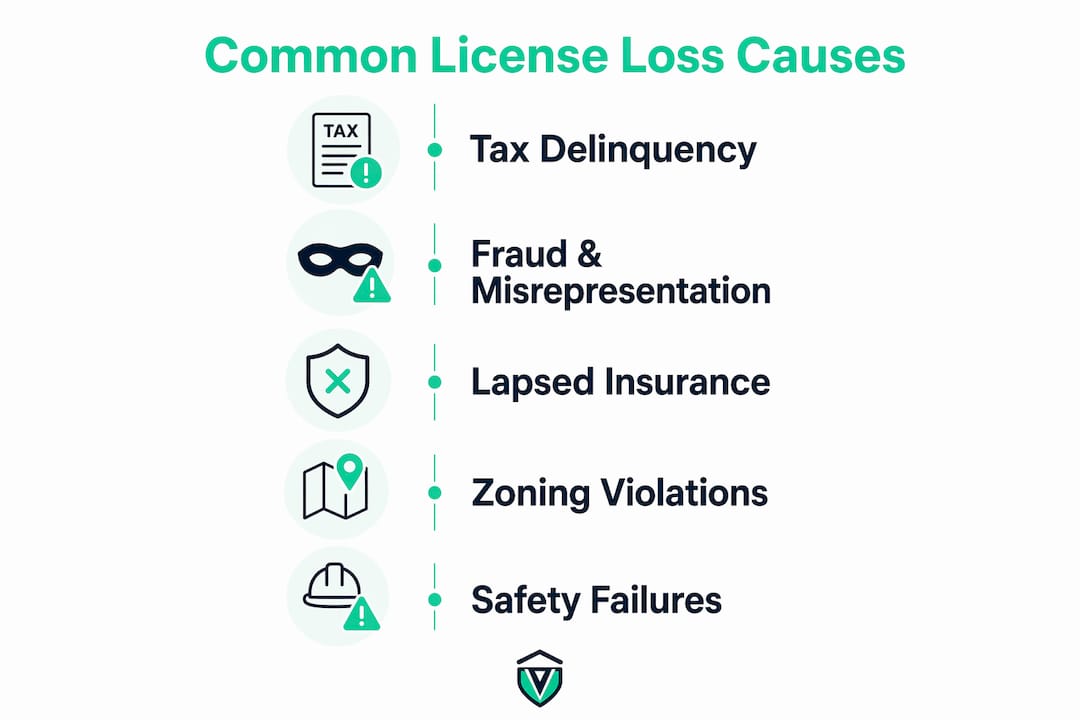
The most common causes of license revocation fall into four categories: tax failures, misrepresentation, lapsed coverage, and code violations. Chronic tax delinquency, fraudulent applications, lapsed insurance or bonds, and zoning violations are the leading grounds agencies cite when revoking licenses. Agencies rarely act on a single incident. They build a case from repeated failures over time.
Tax delinquency
Unpaid sales tax, payroll tax, and unemployment tax are the most direct path to license loss. Ohio suspends vendor licenses for missing 2 consecutive monthly sales tax returns or 3 months within any 12-month period. Mississippi revokes sales tax permits for failure to file returns or pay taxes, and operating without a permit after revocation is a misdemeanor carrying fines and possible jail time. These are not edge cases. They are the most common business license suspension reasons regulators act on every year.

Fraudulent applications and misrepresentation
Submitting false information on a license application is grounds for immediate revocation, not just suspension. This includes misrepresenting ownership structure, business activity, or criminal history. Licensing boards require owners to self-report events affecting eligibility, such as criminal convictions. Failing to disclose a conviction after the fact compounds the original violation and often results in additional sanctions.
Lapsed insurance and bonds
Most regulated industries require active liability insurance or surety bonds as a condition of licensure. When that coverage lapses, even for a few days, the license becomes invalid. Agencies do not wait for a complaint to act. They cross-check insurance databases and flag gaps automatically.
Zoning violations and safety code failures
Operating in a location not zoned for your business type, or failing building and fire code inspections, are direct causes of license suspension. These violations are especially common when businesses expand into new locations without verifying local zoning requirements first. A business license audit checklist for multi-location operators is one of the most effective tools for catching these gaps before regulators do.
Pro Tip: Review your zoning classification every time you add a new location or change your business activity. A restaurant adding a bar service or a retail shop adding a service component may need an entirely different license category.
How do government agencies enforce license compliance?
Enforcement follows a structured escalation process. Agencies do not jump straight to revocation. They issue a series of formal notices, each with a deadline to respond or resolve the issue.
The typical sequence looks like this:
- Initial warning or notice of delinquency. The agency flags a missed filing, unpaid tax, or complaint and sends a formal notice.
- Notice of Transfer to License Revocation Program. The account moves into a dedicated revocation track, signaling that the agency is actively pursuing action.
- Notice of Intent to Revoke. This is the final warning. The business has a defined window to resolve all outstanding issues or request a hearing.
- Notice of Revocation with cease operations order. The license is canceled. The business must stop operating immediately.
- Hearing and appeal process. Most jurisdictions allow a formal appeal, but the burden of proof falls on the business owner to demonstrate compliance.
Ignoring notices is the primary cause of escalation to permanent shutdown. Most businesses that lose licenses permanently do so not because the underlying issue was unsolvable, but because they failed to respond in time.
Responding promptly to official warnings can prevent escalation to a cease operations order. License revocation is primarily a compliance enforcement tool. Officers recommend immediate response to every notice, regardless of how minor the issue appears.
Agencies also use proactive detection methods. Undercover inspections, database cross-checks, and complaint responses are standard enforcement tactics. Tax agencies share data across departments, so a delinquency at one location can trigger a review of every location the same business entity owns. For multi-location operators, one compliance gap can put the entire portfolio at risk.
Philadelphia fines businesses $300 per day for operating after revocation and classifies continued operation as a felony. That is not a fine that accumulates slowly. A business that ignores a revocation notice for 30 days faces $9,000 in fines before any legal fees.
What industries face the highest risk of losing licenses?
Certain sectors carry far greater exposure to licensing issues than others. Food service, healthcare, transportation, and financial services operate under layered regulatory requirements at the federal, state, and local levels. A single missed renewal in any one of those layers can trigger a shutdown.
| Industry | Commonly overlooked license |
|---|---|
| Food service | Health department permit, food handler certification |
| Healthcare | State professional license, DEA registration |
| Transportation | DOT operating authority, vehicle permits |
| Financial services | State money transmitter license, NMLS registration |
| Retail (tobacco, alcohol) | State excise license, local sales permit |
Businesses across sectors lose licenses due to overlooked local permits, health certifications, or state operating licenses. The consequence is immediate shutdown and legal penalties, not a grace period to catch up.
Multi-location operators face compounded risk. Each jurisdiction has its own renewal calendar, fee schedule, and compliance requirements. A franchise with 20 locations across 5 states manages dozens of individual licenses simultaneously. Missing one renewal in a single county can result in a cease operations order for that location while the rest of the business continues normally. That kind of partial shutdown is expensive and damaging to brand reputation.
Repeated minor violations are a particularly underestimated risk. A single noise complaint, a missed inspection, or a late permit renewal may seem trivial. Agencies use patterns of minor violations as justification for permanent revocation rather than waiting for a major incident. Understanding business license categories by industry is the starting point for knowing which requirements apply to your specific operation.
Pro Tip: Set renewal reminders at least 90 days before expiration, not 30. Many agencies require inspections or documentation that takes weeks to gather, and late submissions do not pause the expiration clock.
What steps prevent businesses from losing their operating licenses?
Prevention is straightforward. The businesses that lose licenses are almost always the ones that treat compliance as a one-time task rather than a continuous obligation.
- Conduct a full license audit at least once per year. Map every license, permit, and certification your business holds across all locations. Identify expiration dates, renewal requirements, and responsible parties for each one.
- File and pay taxes on time, every time. Ohio requires filing and full payment of all outstanding returns before a suspended sales tax license can be reinstated. Suspension stays in place until every condition is met.
- Keep insurance and bonds current. Set calendar alerts for renewal dates and confirm coverage with your provider before the expiration date, not after.
- Respond to every official notice immediately. Do not wait to understand the full scope of an issue before responding. Acknowledge the notice, contact the agency, and document every communication.
- Consult a compliance attorney when notices escalate. Once a Notice of Intent to Revoke arrives, the window to act is short. Legal counsel familiar with your state's revocation procedures can make the difference between reinstatement and permanent closure.
- Centralize your license records. Businesses that organize licenses in one place catch renewal gaps before they become enforcement actions.
Government agencies actively detect noncompliance through inspections and data cross-checking. License upkeep is a continuous obligation, not an annual formality. The businesses that stay licensed are the ones that treat it that way.
Key Takeaways
Businesses lose operating licenses because of preventable compliance failures, and the structured enforcement process gives owners multiple opportunities to act before permanent revocation occurs.
| Point | Details |
|---|---|
| Tax delinquency is the top trigger | Missing sales tax filings or payments leads directly to suspension and eventual revocation. |
| Revocation is permanent | Unlike suspension, revocation cancels the license entirely and requires a new application with no reinstatement guarantee. |
| Notices are your warning window | Agencies issue multiple formal notices before revoking; ignoring them is the most common path to permanent shutdown. |
| Multi-location businesses face compounded risk | A compliance gap at one location can trigger agency review of all locations under the same business entity. |
| Prevention requires continuous tracking | Annual audits, timely renewals, and centralized records are the most reliable way to avoid license loss. |
The compliance mistake I see businesses make over and over
Most business owners I talk to think about their operating license the way they think about a driver's license. You get it once, you renew it when the sticker expires, and you mostly forget about it. That mental model is exactly why so many businesses end up in revocation proceedings.
The reality is that a business license is more like a contract with the government. It comes with ongoing obligations, and the government monitors whether you are meeting them. Tax agencies share data. Inspection records are cross-referenced. A complaint from a neighbor can trigger a full compliance review. The businesses that get blindsided by revocation notices are almost always the ones that assumed silence from regulators meant everything was fine.
The other pattern I see constantly is the "we'll deal with it later" response to warning notices. A Notice of Intent to Revoke lands in the mail, someone puts it in a pile, and three weeks later the window to respond has closed. At that point, you are no longer dealing with a compliance issue. You are dealing with a legal crisis. The cost of responding immediately to a warning is almost always a fraction of the cost of fighting a revocation after the fact.
Compliance is not a department. For most small and mid-sized businesses, it is a habit. Build the habit before you need it.
— Rakin
How Vaultedai helps you stay ahead of license loss
Losing an operating license is almost always preventable. The problem is not that business owners do not care about compliance. The problem is that tracking dozens of licenses, permits, and renewal deadlines across multiple locations is genuinely hard to do with spreadsheets and calendar reminders.
Vaultedai is built for exactly this situation. The platform centralizes all your licenses, permits, and compliance documents in one place, sends renewal alerts before deadlines hit, and gives your team clear visibility into what is current and what needs attention. For smoke shop groups, restaurant operators, convenience stores, and other multi-location businesses, Vaultedai replaces the guesswork with a system that actually scales. Visit Vaultedai to see how it works for your operation.
FAQ
What is the most common reason businesses lose their licenses?
Tax delinquency is the leading cause of license revocation. Missing sales tax filings or failing to pay outstanding taxes triggers suspension and, if unresolved, permanent revocation.
What is the difference between license suspension and revocation?
Suspension is temporary and can be lifted once the business resolves the underlying issue. Revocation cancels the license entirely and requires a new application, with no guarantee of reinstatement.
Can a business appeal a license revocation?
Most jurisdictions allow a formal appeal after a Notice of Revocation is issued. The business must demonstrate that all compliance issues have been resolved and present evidence at a hearing.
What happens if a business operates after revocation?
Operating after revocation carries serious penalties. Philadelphia charges $300 per day and classifies continued operation as a felony. Mississippi treats it as a misdemeanor with fines and possible jail time.
How can multi-location businesses reduce their license risk?
Centralizing license records, setting renewal reminders at least 90 days in advance, and conducting annual audits across all locations are the most effective ways to reduce exposure. Platforms like Vaultedai are designed specifically to manage this complexity at scale.