

Opening a second location feels like a milestone. Opening a fifth feels like a different business entirely. The moment you cross state lines or add locations in new jurisdictions, the compliance picture shifts fast. Failing to stay compliant during business expansion doesn't just mean fines. It means delayed openings, failed audits, and deals falling apart during due diligence. This guide walks you through the exact preparation, execution, and verification steps that multi-location operators need to keep their business in good standing as they grow.
Table of Contents
- Key takeaways
- How to stay compliant during business expansion
- Building a compliance system before you expand
- Executing compliance tasks across multiple locations
- Verifying compliance and preventing drift
- My honest take on compliance as a growth strategy
- How Vaultedai helps you stay ahead of compliance
- FAQ
Key takeaways
| Point | Details |
|---|---|
| Compliance varies by jurisdiction | Federal, state, and local requirements differ widely, so each new location needs its own compliance map. |
| Build a living compliance system | A master calendar with alerts set 3 to 6 months ahead prevents missed deadlines and last-minute scrambles. |
| Assign clear ownership | Every compliance area needs a named owner with measurable deadlines, not a shared responsibility that nobody tracks. |
| Execution requires checklists | Multi-state payroll, permits, and registrations each need location-specific verification before operations begin. |
| Audits prevent compliance drift | Quarterly reviews and independent audits catch gaps before regulators or buyers do. |
How to stay compliant during business expansion
Expanding to multiple locations means operating inside multiple regulatory environments at the same time. The SBA identifies two categories of compliance obligations every business must manage: external requirements like state filings, taxes, and licenses, and internal recordkeeping that protects you legally and makes your business sale-ready.
What most operators underestimate is how quickly the external requirements multiply. Each state where you operate, employ people, or hold property creates its own set of obligations. Here is a snapshot of the most common ones:
- Annual and biennial reports: Most states require these to maintain good standing, with filing fees and deadlines that vary significantly by state and entity type.
- Franchise taxes: Several states charge franchise taxes based on revenue, net worth, or authorized shares, regardless of whether you turn a profit.
- Articles of amendment: Any material change to your business, including address, ownership, or registered agent, requires a formal filing.
- Industry-specific licenses and permits: Food service, tobacco retail, alcohol, healthcare, and financial services each carry their own federal and state licensing layers.
- Beneficial ownership reporting: Under the Corporate Transparency Act, BOI filing requirements include 30-day deadlines for company formation or ownership changes, with ongoing update obligations.
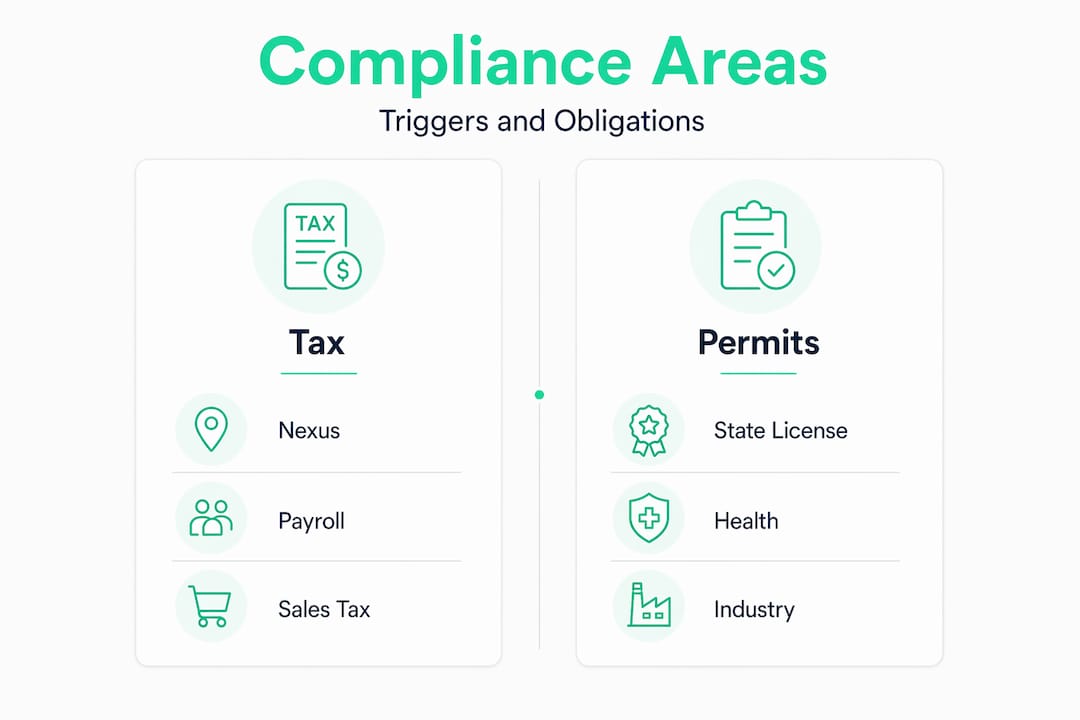
Beyond filings, expanding business regulations touch four major operational areas: tax (nexus, sales tax, franchise tax), employment (payroll withholding, unemployment insurance, wage and hour laws), data security (state-specific privacy laws), and industry-specific permits.
| Compliance area | Key obligations | Triggered by |
|---|---|---|
| State tax | Nexus filings, sales tax registration | Physical presence or economic activity |
| Employment | Payroll withholding, SUI, local taxes | Hiring employees in a new state |
| Corporate filings | Annual reports, amendments | Operating as a registered entity |
| Industry permits | Licenses, inspections, certifications | Business type and product category |
| Data security | State privacy law compliance | Customer data collection |
Building a compliance system before you expand
Knowing what is required is only half the problem. The other half is building a system that catches every obligation before it becomes a violation. Compliance frameworks that adapt with business changes reduce friction and accelerate growth. The key word is "adapt." A static checklist you built two years ago is not a compliance system. It is a liability.
Here is a practical framework for building a living compliance system:
- Map every jurisdiction where you operate or plan to operate. Include states where you have employees working remotely, not just where you have physical storefronts. Remote work creates tax nexus in states you may not have considered.
- Prioritize by legal risk and revenue impact. A missed alcohol license renewal in your highest-revenue location is a different level of risk than a late annual report fee. Rank your obligations accordingly.
- Build a master compliance calendar with alerts set 3 to 6 months ahead. Designing a single master calendar with early alerts gives you time to gather documents, assign tasks, and file without rushing.
- Assign named owners for every compliance area. "The operations team handles permits" is not ownership. A named individual with a deadline and a documented process is ownership.
- Schedule quarterly reviews. Quarterly reviews that explicitly connect business changes to compliance obligations transform compliance from reactive to strategic. When you open a new location, hire in a new state, or change your product line, the compliance calendar should update automatically.
- Incorporate role-specific training and monitoring. A formal compliance program includes written policies, ongoing training, independent audits, and responsive complaint handling. Regulators expect your written policies to reflect your current operations, especially after expansion.
Pro Tip: When you map jurisdictions, include states where employees work from home. Remote workers create payroll tax obligations, unemployment insurance requirements, and sometimes sales tax nexus in states where you have no physical office.
Executing compliance tasks across multiple locations
Preparation sets the framework. Execution is where operators actually get tripped up. The most common failure points are multi-state payroll, regulatory registrations, and industry-specific permits. Each one requires location-specific verification before you start operations, not after.

Multi-state payroll
Multi-state payroll compliance depends on mapping employee work locations accurately and confirming state tax registrations before the first paycheck runs. For each new state, you need to verify:
- State income tax withholding registration
- State unemployment insurance (SUI) account setup
- Local tax obligations (some cities and counties have their own income taxes)
- Wage and hour law compliance, including minimum wage, overtime rules, and pay frequency requirements
- Worker classification rules, which vary by state and are enforced aggressively
Pro Tip: Register with state tax agencies at least 30 days before your first payroll run in a new state. Processing delays are common, and running payroll without a valid state tax ID creates back-filing headaches that take months to untangle.
Regulatory registrations and industry permits
Register with state regulatory agencies before operations begin, not concurrently. For food manufacturers, FDA registration is required before operations and must be renewed biennially. But federal registration does not replace state-level permits. Each facility needs its own state permits, local health inspections, and certifications like SQF or HACCP depending on your product category.
The same logic applies to smoke shops, convenience stores, and alcohol retailers. A tobacco retail license in one state does not transfer to another. Each location needs its own application, often with different lead times, fees, and inspection requirements.
| Task | Timing | Common mistake |
|---|---|---|
| State tax registration | 30 days before first payroll | Registering after payroll starts |
| FDA facility registration | Before operations begin | Assuming federal covers state |
| Industry license applications | 60 to 90 days before opening | Applying too close to open date |
| Annual report filings | Per state schedule | Missing deadlines in new states |
| Local business licenses | Before opening | Overlooking city or county requirements |
Verifying compliance and preventing drift
Opening compliant is not the same as staying compliant. Only 7% of companies achieve full compliance across all their entities. That number is not a reflection of bad intentions. It is a reflection of how hard it is to maintain consistency across multiple jurisdictions without a formal verification process.
The most common failure mode is compliance drift. Payroll setups that were correct at launch get outdated when employees move. Permits expire without anyone noticing. State laws change and nobody updates the internal policy. Systematic checklists with state-specific verifications are the most reliable defense against this.
Here is how to build a verification process that actually holds:
- Run internal audits quarterly. Assign someone to compare your actual operations against your compliance calendar and documented policies. Look for gaps between what the policy says and what the team actually does.
- Track legal changes with horizon scanning. Subscribe to state agency newsletters, use legal update services, or work with a compliance attorney who monitors regulatory changes in your operating states.
- Standardize your documentation. Every location should maintain the same categories of records in the same format. Inconsistent documentation is one of the first things that surfaces during an external audit or acquisition due diligence.
- Prepare for external audits before they happen. Organize permits, licenses, payroll records, and corporate filings in a centralized system. When an auditor or buyer asks for documentation, you should be able to pull it in minutes, not days.
Managing compliance in new markets requires more than good intentions. It requires a documented system, named owners, and regular verification. The businesses that get this right treat compliance as an operational function, not a legal formality.
My honest take on compliance as a growth strategy
I've watched operators treat compliance as something to handle after the real work is done. Open the location, get the team trained, hit the sales targets, and then circle back to the paperwork. That sequence is exactly backwards, and I've seen it cost businesses real money.
What I've learned from working with multi-location operators is that the businesses with the cleanest compliance records are not the ones with the biggest legal budgets. They are the ones that built the system early and assigned real ownership. A named person with a calendar and a checklist outperforms a vague policy document every time.
The other thing I'd push back on is the idea that compliance is purely defensive. In my experience, clean compliance records accelerate growth. Investors do deeper diligence faster. Franchise agreements close without surprises. Acquisitions don't fall apart at the last minute because someone found an expired license in a data room. Staying compliant while scaling is not just about avoiding penalties. It is about building a business that can actually be sold, funded, or franchised when the opportunity comes.
The operators who treat compliance as a living system, not a one-time project, are the ones who move fastest. They are not scrambling to catch up. They are already ready.
— Rakin
How Vaultedai helps you stay ahead of compliance
Running compliance across five, ten, or twenty locations on spreadsheets is a system that works until it doesn't. One missed renewal, one expired permit, one state registration that slipped through, and you are dealing with consequences that far outweigh the cost of a better system.
Vaultedai is built specifically for multi-location operators who need to centralize permits, licenses, renewals, and compliance documents across every location in one place. The platform tracks deadlines, sends alerts well before due dates, and gives your whole team visibility into what is current and what needs attention. Whether you run smoke shops, restaurant groups, convenience stores, or franchises, you can manage compliance across locations without the manual tracking that leads to costly gaps. Fast onboarding, clear workflows, and no more compliance surprises.
FAQ
What are the main compliance requirements when expanding to new states?
The core requirements include state tax registration, payroll withholding accounts, state unemployment insurance, annual report filings, and industry-specific licenses. Each state has its own deadlines, fees, and filing processes, so each new location needs a separate compliance checklist.
How do I comply during growth without overwhelming my team?
Build a master compliance calendar with alerts set 3 to 6 months before deadlines, assign named owners for each obligation, and use a centralized platform to track all locations. Distributing ownership and automating reminders prevents any single person from carrying the entire compliance burden.
What is compliance drift and how do I prevent it?
Compliance drift happens when processes that were correct at launch become outdated as the business changes, employees move, or laws shift. Quarterly internal audits and standardized documentation across locations are the most reliable ways to catch and correct drift before it becomes a violation.
Do I need separate licenses for each business location?
Yes. Most industry-specific licenses, including tobacco retail, alcohol, food service, and health permits, are issued at the location level. A license in one state or city does not transfer to another, and many require separate applications with different lead times and inspection requirements.
How does the Corporate Transparency Act affect expanding businesses?
Under the Corporate Transparency Act, businesses must file beneficial ownership information with FinCEN within 30 days of formation or any ownership change. BOI filing requirements apply to each reporting company, so adding new entities during expansion triggers additional filing obligations.