
Centralize permits, licenses, renewals, and evidence in a single compliance platform built for multi-brand, multi-location operators. That's the fix for the three problems that eat up compliance managers' weeks: missed renewals, scattered evidence, and zero real-time visibility into which locations are actually audit-ready.
If you run compliance across multiple brands and dozens (or hundreds) of locations, your platform needs to do a few things well before you sign anything:
- Track every permit, license, and renewal date by location and brand, with filtering by jurisdiction
- Capture evidence (photos, timestamps, user attribution) that holds up in an audit
- Send automated, jurisdiction-aware renewal reminders that don't rely on someone remembering
- Escalate exceptions and corrective actions automatically instead of waiting for a phone call
Vaulted was built around exactly this workflow. If you're still tracking renewals in spreadsheets, a short pilot on a small number of locations will show you the gap fast.
Key Takeaways
Centralized permit and license tracking with mobile evidence capture is what separates audit-ready multi-brand operators from the ones scrambling through binders.
| Point | Details |
|---|---|
| Portfolio risk compounds with scale | One location's missed permit can trigger franchisor audit findings across the entire brand. |
| Digital evidence beats paper records | Photo and timestamp documentation produces audit exports in minutes instead of days. |
| Prioritize onboarding speed over feature count | Platforms frontline staff actually use beat feature-heavy tools built for legal and finance teams. |
| Pilot before full rollout | Test three to ten locations across two brands with clear KPIs like missed-renewal rate. |
| Vaulted maps directly to this checklist | Vaulted centralizes registries, automates renewals, and captures frontline evidence for multi-brand operators. |
Table of Contents
- Why Centralized Compliance Matters for Multi-Brand Operations
- Core Capabilities Every Multi-Brand Compliance Platform Must Deliver
- How to Roll Out a Centralized Compliance Platform Across Locations
- What Legal and Regulatory Requirements Apply to Multi-Brand Franchises?
- Single-Brand vs. Multi-Brand: Where Compliance Gets Harder
- Best Practices for Consistency Across Different Brand Standards
- What Role Do Internal Audits and External Reviews Play?
- Training Programs That Actually Change Staff Compliance Behavior
- Which Technology Solutions Fit Multi-Brand Compliance Management?
- What Operators Get Wrong About Compliance Software
- How Vaulted Maps to a Multi-Brand Compliance Rollout
- Sources
Why Centralized Compliance Matters for Multi-Brand Operations
One location's missed health permit doesn't stay contained. It becomes a franchisor audit finding, an insurance question, or a headline that touches every location flying the same brand flag. Franchisor audit clauses and local health inspections mean a single missing record can create liability across the entire portfolio, not just at the site where the paperwork went missing.

Spreadsheets and paper folders were never built for this. Every location fills them out differently, files get lost between manager shifts, and when a franchisor or health inspector asks for proof, someone spends an afternoon digging through binders instead of producing an answer in minutes. That lag is where risk compounds. It's also where trust with franchisees erodes, because "give me a day to find that" is not an answer regulators or corporate auditors accept twice.
Digital evidence changes the equation. A photo with a timestamp and a name attached is worth more than a filed form, because it proves the work happened, when, and who did it. Frontline compliance systems combine daily operational checks, audits, and evidence into one mobile-first record, which means:
- Corporate can pull a filtered export for any location in seconds, not days
- Franchisees get a clear record protecting them if a dispute arises
- Insurance and legal teams have a paper trail before they ever need one
Scale amplifies whatever system you have. Centralization just means the amplification works in your favor instead of against it.
Core Capabilities Every Multi-Brand Compliance Platform Must Deliver
Buying compliance software for one location is simple. Buying it for a multi-brand portfolio means asking harder questions, because the wrong platform will look fine in a demo and fall apart at location forty.
Here's the checklist that actually matters, in order of what breaks first when it's missing:
- A centralized permit and license registry with location hierarchy. You need to filter by brand, region, and location type, and see at a glance which permits are current, expiring, or lapsed.
- Automated, jurisdiction-aware renewal workflows. A liquor license in one state and a health permit in another don't renew on the same cycle or through the same agency. The system should know the difference without you configuring it manually every time.
- Mobile-first evidence capture. Frontline managers need to photograph a posted permit or a completed checklist, timestamp it, and attach their name in under thirty seconds. If it takes longer, people stop doing it.
- Corrective-action workflows and escalation. When a location misses a deadline or fails an internal check, the exception should route to the right person automatically, not sit in an inbox.
- Location-level scoring. A single compliance score per site lets regional managers spot the three locations dragging down the group before a franchisor audit does it for them.
- Role-based access and integrations. Franchisees need a different view than corporate compliance staff, and the platform should connect to the HR and operations systems already in use, including payroll compliance tools for jurisdiction-specific employer obligations.
Onboarding speed belongs on this list too. Enterprise governance tools built for legal and finance departments often stall out in multi-site operations because frontline staff won't use software designed for a general counsel's desk.
Pro Tip: Ask any vendor to show you the mobile evidence-capture flow on their own phone, live, in the sales call. If it takes more than three taps to log a photo with a timestamp, your store managers won't use it either.
How to Roll Out a Centralized Compliance Platform Across Locations
Migrating off spreadsheets is a project, not a toggle switch. Skip the planning phase and you'll spend six months fixing bad data instead of preventing missed renewals.
- Inventory and prioritize. Build a matrix scoring every permit and license by business-critical impact and renewal frequency. High-impact permits with short renewal cycles go first, because that's where a lapse causes the most damage the fastest.
- Pick a scoped pilot. Choose a handful of representative locations across your different brands, not just your best-run site. A pilot of three to ten locations with clear KPIs, like reduced missed-renewal rates, gives you real data before a full rollout.
- Collect and ingest data. Use bulk document request templates rather than chasing franchisees one email at a time. A structured document-collection process cuts weeks off this phase and reduces franchisee pushback.
- Onboard frontline staff and set escalations. Verify that the evidence coming in from managers actually meets audit standards, then configure who gets notified when something's overdue.
- Scale and monitor. Roll the pilot's structure out to the rest of the portfolio, watching dashboards for the same KPIs you tracked in the pilot.
Common failure points: incomplete historical data (don't wait for perfect records before starting), franchisee resistance to a new tool (address it with a short training session, not a mandate memo), and inconsistent SOPs between brands (solve it with brand-specific templates under one shared structure, covered below).
Pro Tip: Run your pilot across at least two different brands in your portfolio, not just multiple locations of one. That's where you'll find the workflow gaps a single-brand test would hide.
What Legal and Regulatory Requirements Apply to Multi-Brand Franchises?
Multi-brand operators answer to more regulatory layers than a single-brand franchise ever does. Each brand in your portfolio typically carries its own franchisor operating standards, on top of the local, state, and federal requirements every location already owes: health permits, fire and building codes, signage ordinances, employment law, and industry-specific licenses like liquor or tobacco permits.
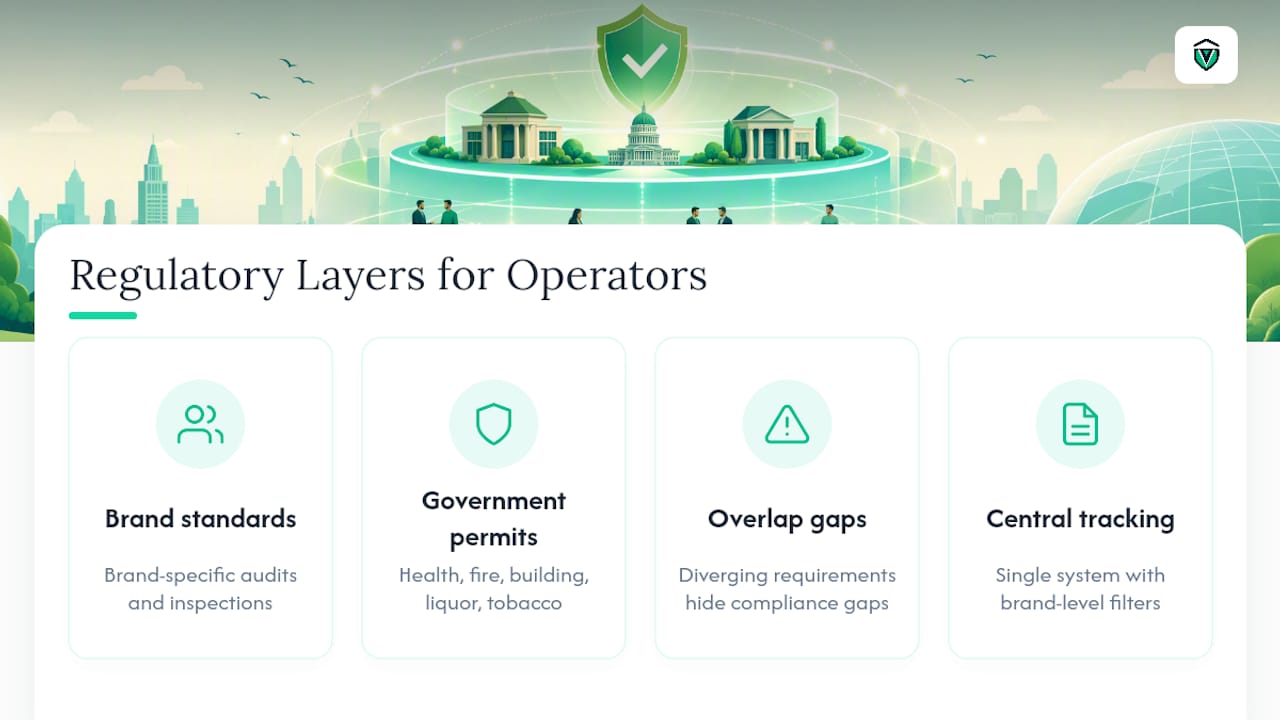
Layer a second or third brand onto that structure and the requirements don't just add up, they diverge. Brand A's franchisor may require quarterly self-audits with photo documentation. Brand B may require an annual third-party inspection instead. Meanwhile, the underlying city and county rules governing food handling or occupancy don't care which brand's logo is on the door.
The practical requirement for operators is visibility across all of it at once: which brand-specific standards apply where, which government permits are tied to which entity or location, and which renewal deadlines are coming up regardless of brand. Missing any layer, whether it's a franchisor requirement or a municipal permit, creates exposure. Multi-brand operators who track these requirements in a single system with brand-level filtering catch the gaps that fall between two sets of rules, which is exactly where compliance failures tend to hide.
Single-Brand vs. Multi-Brand: Where Compliance Gets Harder
A single-brand operator deals with one franchisor's standards manual, one training program, and one consistent set of SOPs across every location. Compliance is still work, but it's uniform work. Multi-brand operators lose that uniformity the moment they add a second concept.
Different brands mean different franchisor audit schedules, different reporting formats, and often different technology requirements dictated by each franchisor's own systems. A convenience store brand might require weekly fuel-tank inspections your restaurant brand never touches. A quick-service brand might mandate temperature logs on a schedule your smoke shop locations don't need at all.
Staffing compounds it. A district manager overseeing three brands has to remember three different escalation paths and three different audit calendars, often for locations sitting a few miles apart. That's where things fall through: not because anyone is careless, but because the mental overhead of tracking multiple standards manually exceeds what any one person can reliably hold.
The fix isn't forcing every brand into identical processes. It's a system that lets each brand keep its own requirements while giving corporate one dashboard to see all of them at once. Multi-location compliance frameworks that support brand-specific templates under a shared structure solve this without flattening the differences that make each brand distinct.
Best Practices for Consistency Across Different Brand Standards
Consistency across brands doesn't mean making every brand operate the same way. It means every location, regardless of brand, meets a floor of compliance rigor even as the specific requirements above that floor differ.
Start with a shared template model: one global compliance structure that every brand inherits, with brand-specific modules layered on top. A region-specific and brand-specific template system under a single umbrella lets you standardize how evidence gets collected and reported without forcing Brand A's inspection checklist onto Brand B's operations.
A few practices consistently separate operators who manage this well from ones who don't:
- Standardize the format of evidence (photo plus timestamp plus attribution) even when the content of what's being checked varies by brand
- Set one corporate-wide compliance score methodology so regional leaders can compare location health across brands on the same scale
- Require the same minimum documentation retention period across every brand, even where individual franchisor rules differ
- Run cross-brand training on the shared platform itself, separate from brand-specific SOP training
The goal is a corporate compliance team that can look at any location, in any brand, and immediately understand its status without translating between three different reporting systems first.
What Role Do Internal Audits and External Reviews Play?
Internal audits catch problems while they're still cheap to fix. External reviews, whether from a franchisor, a health department, or an insurance carrier, catch whatever internal audits missed, usually at a worse time and a higher cost.
Run internal audits on a cadence tighter than your external review cycle. If a franchisor audits annually, an internal check every quarter, or even monthly for high-risk permit categories, gives you three or four chances to fix a gap before someone outside the company finds it. The internal audit's real value is speed of detection: a location manager or regional lead spotting an expired permit two weeks after it lapsed, rather than a franchisor auditor finding it eight months later during a scheduled visit.
External reviews serve a different purpose entirely. They're the outside validation that your internal process actually works, and they're where reputational and legal exposure gets real. A franchisor finding on one location can trigger review clauses across your entire agreement with that brand.
The two functions feed each other when they run on the same evidence base. If internal audits already produce timestamped photo documentation and exportable reports, an external reviewer gets exactly what they need without a scramble, and your internal team has already fixed most of what an outside auditor would flag. Recurring SOP execution tied to mobile audits and corrective actions is what makes that handoff work instead of becoming two disconnected processes.
Training Programs That Actually Change Staff Compliance Behavior
Most franchise compliance training fails for a boring reason: it happens once, at onboarding, and never again until something goes wrong. By the time a location manager needs to know the fire code inspection schedule, the training from eight months ago is a vague memory.
Effective training for multi-brand operators works in short, recurring cycles tied to the tools staff actually use daily, not annual binder reviews. A ten-minute refresher on how to log evidence correctly, delivered quarterly through the same mobile app staff already use for daily checklists, sticks better than a two-hour onboarding session delivered once.
Brand-specific training still matters. Staff at a location running two brands under one roof need to know which checklist applies to which side of the operation, and conflating the two is a common failure point. Layer brand-specific modules on top of a shared foundation covering universal skills: how to capture evidence, how to flag an exception, and who gets notified when something's wrong.
The most overlooked piece is training frontline staff, not just managers. A shift lead who knows how to photograph a posted permit correctly and log it in under a minute prevents more compliance gaps than a manager who understands the regulation in theory but never checks the frontline behavior in practice.
Which Technology Solutions Fit Multi-Brand Compliance Management?
Generic project management tools and repurposed enterprise governance software both tend to underperform for multi-brand franchise operators, for the same underlying reason: neither was designed for a store manager standing at a counter with thirty seconds between customers.
The technology that works for this job shares a few traits. It's mobile-first, because frontline evidence gets captured on phones, not desktops. It supports brand-specific configurations without requiring a separate instance per brand. And it produces exportable, audit-ready reports on demand, not after a data-cleanup project.
Real-time field data tools let franchisors catch compliance gaps closer to the moment they happen, shrinking the window between a failure and a fix. That's a meaningfully different posture than the traditional model of scheduled audits catching problems months after the fact. Multi-brand operators specifically benefit from platforms with location hierarchy and brand-level filtering, since the alternative, running three brands through one flat, undifferentiated system, tends to bury brand-specific requirements inside a generic view nobody trusts.
The practical test for any technology solution is whether a location manager who's never used it before can log a piece of evidence correctly within their first week, without a training manual open next to them.
What Operators Get Wrong About Compliance Software
Most conventional advice on this topic treats compliance software as a documentation problem. Buy a system, store the paperwork digitally, check the box. That framing misses what actually drives outcomes for multi-brand operators: how fast frontline staff can act, not how neatly the records get filed.
The research on this is consistent. Frontline-first platforms outperform repurposed enterprise governance tools in franchise settings because they reduce friction for the people actually doing the work, not the compliance officer reviewing it later. A system that takes a manager ninety seconds to log evidence gets used. One that takes five minutes gets ignored until an audit forces the issue.
Prioritize onboarding speed over feature depth when you're evaluating platforms. A tool with fifty features nobody at the location level will use is worth less than one with ten features a shift lead actually adopts in their first week. Multi-brand operators especially should resist the instinct to force every brand into identical workflows. The brands that struggle with compliance consistency usually aren't the ones with the most different standards. They're the ones whose corporate teams tried to flatten every difference into a single template and lost frontline buy-in in the process.
— Rakin
How Vaulted Maps to a Multi-Brand Compliance Rollout
Vaulted is built for the exact gap most multi-brand operators run into: spreadsheets that worked fine at five locations and completely fall apart at fifty. The platform centralizes your permit and license registry with location and brand hierarchy, sends jurisdiction-aware renewal reminders automatically, and captures mobile evidence with photo, timestamp, and user attribution built in, so corporate can pull an audit-ready export without chasing down a single franchisee.
A typical pilot runs three to ten locations across two brands over four to six weeks, tracking missed-renewal rate and audit response time as the core KPIs. Operators running this kind of pilot use it to validate the onboarding flow and franchisee cooperation before committing to a full portfolio rollout, the same sequencing covered in the migration checklist above.
If you're managing compliance across multiple brands right now with a spreadsheet and a shared drive, the next step is a trial of the Vaulted platform on a handful of your locations. See how long it actually takes a store manager to log their first piece of evidence, and compare it to how long that same task takes today.