
The fastest path to continuous certificate of insurance compliance is a centralized, AI-assisted COI tracking platform with vendor self-service and direct integrations into your accounting or ERP system. Document-only trackers and inbox folders can't catch a lapsed policy the day it lapses. A platform built around automated extraction and monitoring can.
For most multi-location businesses, the shortlist comes down to four categories, not four brand names. Vaulted stands out for franchises, restaurant groups, and other multi-site operators who need permit and COI workflows running in the same system, with AI extraction cutting the manual review that eats up a compliance manager's week. Enterprise AI-native platforms fit large organizations juggling thousands of vendors and complex integration requirements. Agent and network-integrated monitoring tools matter when carrier-verified, real-time data is non-negotiable. Managed COI services suit teams with no internal bandwidth to run tracking at all.
Here's what to prioritize on your shortlist:
- Speed of deployment: how fast can vendors start submitting COIs without a manual onboarding queue
- Real-time monitoring: does the platform ingest carrier or agent data, or does it wait for someone to upload a new PDF
- Integration depth: does it talk to your AR, ERP, or property management system without a custom build
When you get vendors on a call, ask them to demo live document extraction on an actual COI and show you a policy cancellation alert firing in real time. Most credible platforms onboard a mid-size vendor portfolio within 30 to 60 days. If a sales rep can't give you a specific number, that's worth noting.
Key Takeaways
Automated, real-time COI tracking reduces vendor-related liability exposure and cuts manual review time compared to document-only, spreadsheet-based tracking methods.
| Point | Details |
|---|---|
| Real-time beats document-only | Carrier and agent integrations catch policy cancellations immediately, unlike static PDF filing. |
| D&O exposure is real | Small businesses with D&O coverage face claims averaging about $120,000 without proper monitoring. |
| Match category to constraint | Choose managed services for low bandwidth, enterprise platforms for high volume, carrier integration for real-time accuracy needs. |
| Pilot before you scale | Run a 60 to 90 day test measuring exceptions, hours saved, and time-to-compliance before full rollout. |
| Vaulted fits multi-location convergence | Franchises and multi-site operators get unified permit and COI workflows with AI extraction and fast onboarding. |
Table of Contents
- What Does COI Tracking For Businesses Actually Involve?
- At-a-Glance Comparison: How the Approaches Stack Up
- Which COI Platform Fits Your Business Type?
- What Should You Look for When Choosing a COI Tracking System?
- How Does the COI Tracking Workflow Run Day to Day?
- What Does Automated COI Tracking Actually Save You?
- How Vaulted Handles COI Tracking for Multi-Location Teams
- Frequently Asked Questions
- Sources
What Does COI Tracking For Businesses Actually Involve?
COI tracking for businesses means verifying, storing, and continuously monitoring proof-of-insurance documents from every vendor, contractor, or tenant a company works with. The practice sits inside the broader discipline of certificate of insurance tracking, and it splits into two fundamentally different models: document-based tracking and real-time policy monitoring.
Document-based tracking is the old model. Someone collects a PDF, checks the coverage limits and expiration date by eye, files it, and sets a calendar reminder to chase a renewal. It works until it doesn't. A policy can be canceled mid-term for nonpayment, and a static PDF has no way of knowing that happened.
Real-time policy monitoring closes that gap by connecting directly to insurance agents or carrier systems, so a cancellation or coverage change shows up within days instead of at the next audit. This is the core distinction buyers need to understand before comparing vendors, and it's why the role of compliance in business insurance has shifted from a filing task to an active risk-management function.
Most modern COI management solutions layer AI-powered data extraction on top of either model. The software reads a submitted certificate, pulls out the named insured, coverage types, limits, and expiration date, and flags anything that fails your requirements automatically, rather than routing every certificate through a human reviewer first.
At-a-Glance Comparison: How the Approaches Stack Up
Pricing in this category follows one of three models: per-vendor or per-record fees that scale with your vendor count, flat per-seat licensing for internal users, or a managed-service markup on top of a base platform fee. Enterprise AI-native platforms typically run into five and six figures annually once you factor in implementation and integration work. Managed COI services charge for the labor, so expect a markup that reflects headcount rather than software alone.
| Approach | Best for / use case | Real-time monitoring vs. document-only | Automation / AI extraction | Integrations | Pricing model | Onboarding time |
|---|---|---|---|---|---|---|
| Vaulted | Franchises and multi-location operators unifying permits and COIs | Automated renewal tracking with document verification | AI extraction across permits and COIs | AR/ERP integrations, cloud and mobile access | Subscription, scales with locations | Fast, typically weeks not months |
| Enterprise AI-native platforms | Large organizations with complex integrations, high vendor volume | Mix of document-based and real-time, varies by vendor | Strong automated extraction | Broad but often requires configuration | Custom enterprise pricing | Longer, often 60 to 90+ days |
| Agent/network-integrated monitoring | Organizations needing carrier-verified real-time data | Real-time, carrier-sourced | Moderate to strong | Depends on carrier network reach | Per-vendor or subscription | Moderate |
| Managed COI services | Teams with low internal bandwidth | Typically document-based, human-reviewed | Low to moderate | Limited, service-dependent | Service fee plus base platform cost | Fast to start, slower to scale |
A few tradeoffs are worth flagging before you sign anything:
- Enterprise AI-native platforms deliver the strongest automation at volume, but the configuration burden means IT and risk teams need real bandwidth during rollout.
- Agent/network-integrated monitoring removes the guesswork of stale certificates, since continuously updated certificate models pull directly from carrier data rather than relying on a vendor to resubmit.
- Managed COI services trade cost efficiency for convenience. You're paying for a team's time, not just software, which shows up in the invoice.
Businesses that carry directors and officers coverage face real financial exposure when monitoring lapses: 36% of small businesses with D&O coverage faced claims averaging about $120,000 over a two-year period. That figure alone should shape how much weight you give to real-time monitoring versus a cheaper, document-only option.
Which COI Platform Fits Your Business Type?
Vaulted was built for a specific pain point: multi-location businesses that have outgrown spreadsheets for permits and now realize their COI process has the same problem. The platform combines AI-powered document extraction, jurisdiction-specific compliance checklists, and automated renewal reminders in one system, so a compliance lead running twelve locations isn't juggling a permit tracker and a separate COI folder.
Vaulted's standout is convergence. Most COI-specific tools treat insurance certificates as an isolated workflow. Vaulted treats them as one category of compliance document among many, alongside business licenses, health permits, and fire inspections, which matters most for smoke shop groups, restaurant operators, convenience store chains, and franchises managing overlapping regulatory obligations across multiple jurisdictions. Onboarding tends to move fast because the platform is designed for self-service setup rather than a lengthy professional-services engagement, and pricing scales with the number of locations rather than requiring an enterprise contract negotiation.
- Best for: Franchises and multi-location operators who need permit and COI workflows unified rather than managed in separate systems.
- Watch for: If your business operates a single location with a handful of vendors, the multi-location workflow engine may be more than you need.
Beyond Vaulted, three broad categories cover most of what procurement teams evaluate:
-
AI-native enterprise platforms. These platforms emphasize automated extraction at scale and deep integrations with existing ERP, AP, and vendor management systems. Vendor-supplied data suggests platforms in this category can cut daily COI admin time by 70 to 87 percent compared to manual processes, though vendor claims vary and should be verified during your own pilot. The tradeoff is implementation complexity. Expect a longer runway before the platform reflects your actual vendor rules, and expect IT involvement for API connections.
- Best for: Organizations managing thousands of vendor relationships where manual review is already unsustainable.
- Watch for: Configuration overhead and a steeper learning curve for smaller compliance teams.
-
Agent/network-integrated real-time monitors. These tools connect directly into insurance agent or carrier networks so a policy cancellation shows up as data, not as a surprise when a claim gets filed. This is the model best suited to industries where a single uninsured incident, a slip-and-fall at a leased retail space or a subcontractor accident on a job site, creates outsized liability.
- Best for: Organizations that need carrier-verified accuracy and can't tolerate stale certificates sitting in a file.
- Watch for: Coverage of this network integration varies by carrier, so ask specifically which carriers a vendor already has data pipelines with before assuming universal coverage.
-
Managed COI services. Some businesses don't want to run a platform at all. They want a team that chases vendors, reviews certificates, and reports exceptions. This model works when internal headcount is the constraint, not budget.
- Best for: Teams with minimal internal bandwidth who prefer to outsource collection and follow-up entirely.
- Watch for: Service fees scale with labor, and you lose some direct visibility into the day-to-day process compared to running a platform yourself.
Match the category to your actual constraint. If the constraint is headcount, look at managed services. If it's stale data, look at carrier-integrated monitoring. If it's fragmented systems across locations, that's exactly the gap Vaulted was built to close.
What Should You Look for When Choosing a COI Tracking System?
Selection comes down to eight criteria, roughly in order of impact on your day-to-day operations:
- Automation depth. Does the platform extract data from submitted certificates automatically, or does a human still eyeball every PDF?
- Real-time monitoring. Can it detect a canceled or lapsed policy without waiting for the next renewal cycle?
- Integration breadth. Does it connect to your AR, ERP, or property management software, or will your team be exporting and re-importing spreadsheets?
- Scalability. Will the platform hold up if your vendor count or location count doubles in eighteen months?
- Security posture. Does the vendor carry SOC 2 or ISO certifications relevant to the data you're storing?
- Support and SLAs. What's the guaranteed response time when something breaks during a renewal crunch?
- Onboarding time. How long until the system reflects your actual compliance rules and vendor list?
- Reporting and analytics. Can you generate an exception report for an audit without manually compiling it?
Bring these questions directly into your demo:
- Show me a live extraction on an actual insurance certificate, not a cleaned-up sample.
- Walk me through what happens the moment a policy cancels mid-term.
- What does the API actually expose, and can our IT team see the documentation before we sign?
- What's your average time-to-value for a customer with our vendor count?
Certain answers should end the conversation. No API and no integration roadmap means you're buying a glorified filing cabinet. Manual-only review at any vendor volume above a few dozen means the "automation" claim on their landing page doesn't hold up. No renewal automation means you're still doing the calendar-reminder job by hand, just inside prettier software. Vendors that emphasize payment enforcement integrations, the ability to block a vendor payment run until a COI is current, tend to be more serious about the operational side of compliance than those that stop at document storage.
A realistic procurement timeline runs pilot, trial, rollout. Budget two to four weeks for a pilot with a subset of vendors, four to six weeks for a fuller trial once IT has connected the integrations that matter, and staged rollout after that. Procurement, IT, risk, and legal should all have a seat at the table before the contract is signed, since each will surface different failure modes a sales demo won't show you.
How Does the COI Tracking Workflow Run Day to Day?
The operational flow behind any credible platform breaks into four steps.
- Collection and storage. Vendors submit certificates through a self-service portal instead of emailing a PDF to a shared inbox.
- Automated extraction and verification. The system reads the certificate, checks it against your required coverage limits, and flags gaps without a human reviewing every line first.
- Vendor remediation. Noncompliant vendors get an automated notice specifying exactly what's missing, cutting the back-and-forth that used to run through your compliance team.
- Renewal and continuous monitoring. As policies approach expiration or change status, the system tracks that automatically instead of relying on a calendar reminder.
A multi-site rollout usually looks like this: a restaurant group with 40 locations onboards its top vendors first, contractors, delivery services, cleaning companies, through a self-service portal. Vendor self-service combined with carrier data integration means the compliance team stops manually chasing certificates and instead reviews an exceptions dashboard once a week. Businesses expanding into new markets face an added layer of complexity, since compliance requirements shift during expansion and a system that only works for one jurisdiction breaks down fast.
Pro Tip: Onboard your highest-risk vendor category first, not your largest one. A single uninsured contractor on a job site creates more liability exposure than fifty compliant office suppliers, so prioritize remediation there before rolling the platform out company-wide.
How This Comparison Was Built
This comparison weighted five factors: extraction accuracy, integration breadth, time-to-value, pricing transparency, and security posture. Scoring drew on vendor product documentation, publicly available demo materials, and themes surfaced in third-party review aggregates like G2, where recurring user comments about support responsiveness and integration friction carry real signal.
| Criterion | Weight | Primary source type |
|---|---|---|
| Extraction accuracy | High | Vendor demos, product docs |
| Integration breadth | High | Product documentation, API references |
| Time-to-value | Medium | Vendor-reported onboarding data |
| Pricing transparency | Medium | Public pricing pages, sales conversations |
| Security posture | Medium | Published certifications |
Vendor-supplied claims, especially onboarding speed and automation percentages, vary by customer size and vendor volume. Verify them in your own pilot before committing to a full rollout.
What Does Automated COI Tracking Actually Save You?
The financial case for automation starts with what happens when monitoring fails. Businesses carrying directors and officers coverage saw 36% of small businesses face claims averaging about $120,000 over a two-year period, a cost that automated monitoring is specifically designed to prevent by catching gaps before they become claims.
On the efficiency side, process automation research from Microsoft's Power Platform team shows that reducing manual steps in document-heavy workflows improves both speed and error rates. A Forrester Total Economic Impact study reinforces that ROI from automation platforms becomes measurable specifically when organizations instrument the full workflow, not just the software purchase.
- Track exceptions before and after: how many noncompliant vendors existed on day one versus day sixty
- Log hours spent per week on manual COI review before rollout, then compare after automation kicks in
- Measure time-to-compliance: how long it takes a flagged vendor to become compliant after remediation
Run a 60 to 90 day pilot before scaling company-wide. Efficiency gains vary meaningfully by industry and vendor volume, so a number that worked for a national retail chain won't necessarily hold for a five-location restaurant group.
A compliance practitioner's take on rollout mistakes
The most common mistake teams make isn't picking the wrong platform. It's trying to onboard every vendor on day one instead of starting with a defined subset. Automate renewal monitoring for your top 20 highest-risk vendors first, prove the workflow works, then expand.
Before any vendor demo, do three things: pull every current COI you have on file so you know your actual baseline, map your real vendor volume by location instead of guessing, and write down the two or three integrations that are genuinely non-negotiable for your team. Walking into a demo without that groundwork means you'll evaluate features you don't need and miss the ones you do.
How Vaulted Handles COI Tracking for Multi-Location Teams
If your compliance headache spans permits, licenses, and vendor certificates across a dozen or more locations, running separate systems for each document type is exactly the fragmentation this article has been describing. Vaulted was built to close that gap: one platform, AI-powered extraction across every document type, and renewal automation that doesn't require a dedicated compliance hire to babysit it.
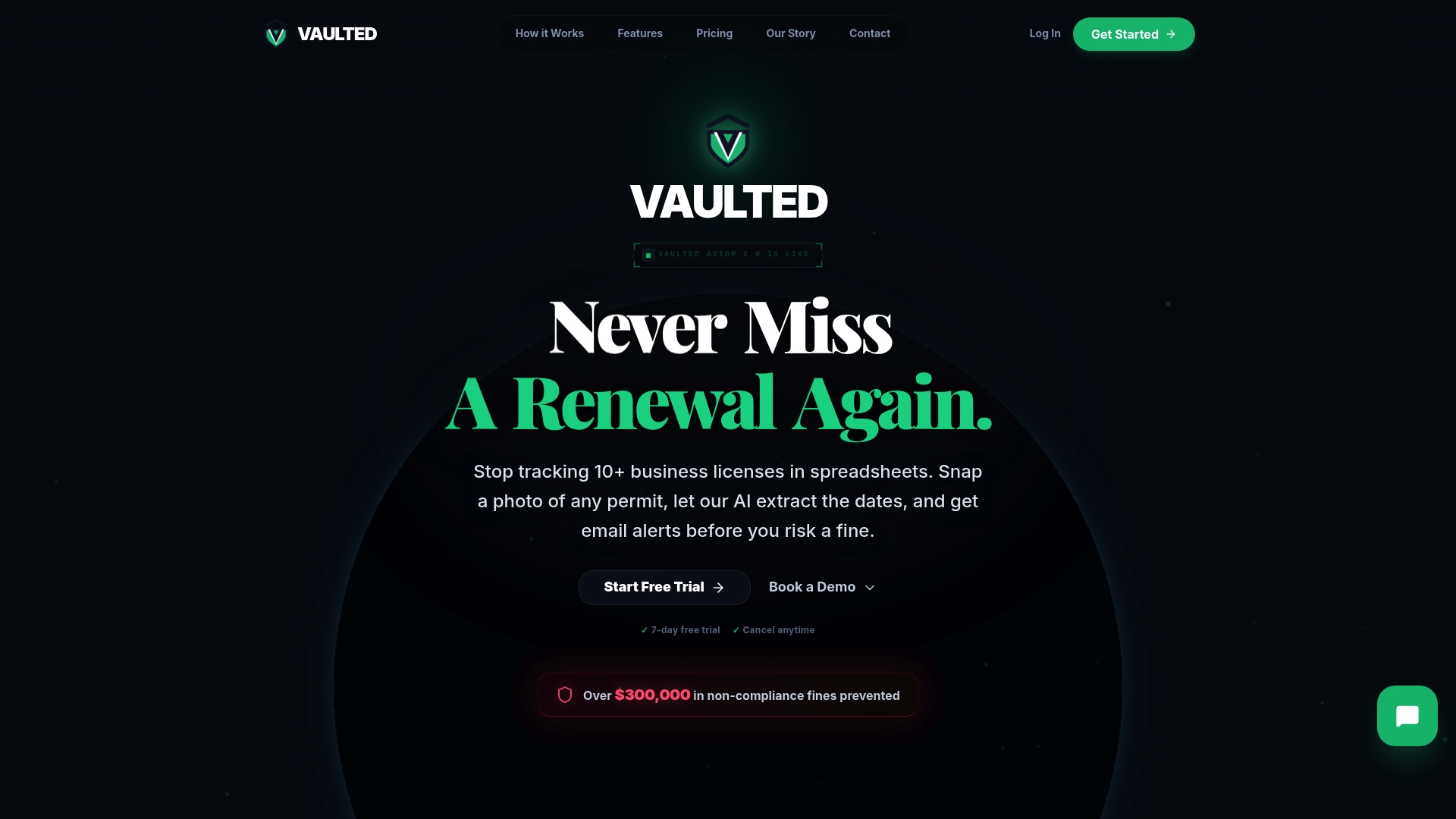
The platform pulls data automatically from submitted certificates and permits, checks them against jurisdiction-specific requirements, and flags gaps before they become missed renewals. Integrations with AR and ERP systems mean compliance data doesn't live in a silo separate from the rest of your operations, and secure cloud and mobile access means a manager checking compliance status from a job site isn't waiting on someone at headquarters to pull a file. Customers typically see meaningful time-to-value within weeks of onboarding, not months, since the setup process is designed for self-service rather than a drawn-out professional-services engagement. You can review real outcomes in Vaulted's case studies to see how other multi-location operators structured their rollout.
If you're managing permits and COIs for franchises, restaurant groups, convenience stores, or similar multi-site operations, start a Vaulted demo and bring your actual vendor list. A live extraction on your own documents tells you more in twenty minutes than any feature comparison can.
Frequently Asked Questions
What is COI tracking software? COI tracking software centralizes certificate of insurance collection, verification, and renewal monitoring for vendors, contractors, or tenants, replacing manual spreadsheet or email-based processes with automated extraction and alerts.
How much does COI tracking for businesses typically cost? Pricing usually follows a per-vendor, per-record, or per-seat licensing model, with enterprise platforms running into five and six figures annually once integrations are included, while managed services charge a service fee on top of a base platform cost.
How long does it take to onboard a COI tracking system? Most platforms designed for self-service, including Vaulted, onboard a mid-size vendor portfolio within weeks. Enterprise AI-native platforms with complex integration requirements often take 60 to 90 days or longer.
What's the difference between document-based and real-time COI tracking? Document-based tracking relies on static PDFs checked manually at intake and renewal. Real-time policy monitoring connects to insurance agents or carriers directly, so a mid-term cancellation shows up as data instead of surfacing after a claim.
What integrations should a COI tracking platform support? Look for connections to your AR or ERP system, vendor onboarding workflows, and property or project management software, so compliance data doesn't sit disconnected from the rest of your operations.
Sources
- SMEs must pay attention to rising D&O and EPL risks — Insurance Business America
- Boost efficiency and increase ROI with next-level process automation — Microsoft Power Platform blog
- Microsoft Power Automate TEI — Forrester