
Centralize your certificates of insurance and permit documents now. The right move is automated, document-level verification across every site, not just collection.
Start here, this week:
- Inventory every COI and permit type by location. Map what you have, what's missing, and which locations carry the highest contractual risk.
- Define your contract-rule matrix. For each location type, document the required limits, endorsement language, named-insured wording, and cancellation notice periods your agreements demand.
- Pilot automated intake and verification on a small number of high-risk locations. Track three metrics from day one: percentage of files centrally captured, percentage of COIs failing rule checks on first submission, and staff hours spent per COI.
That third metric is the one most operations teams ignore. Manual COI tracking hides its true cost in staff hours, broken inbox workflows, and exceptions that never get escalated.
Key Takeaways
Automated, document-level verification against contract requirements is the only approach that gives multi-location California operators real compliance visibility across every site.
| Point | Details |
|---|---|
| Inventory first | Map every COI and permit type by location before configuring any rule or platform. |
| Build a jurisdiction-level rule matrix | California cities vary enough that a single rule set will leave gaps across locations. |
| Verify endorsements, not just the ACORD 25 | Certain endorsements like CG 20, primary/non-contributory, and waiver of subrogation require endorsement documents. |
| Connect compliance to AP holds | ERP integration stops payments to non-compliant vendors without manual review. |
| Vaultedai for multi-location teams | Centralizes COIs, permits, and renewals with AI extraction and audit-ready trails across all California locations. |
Table of Contents
- How California requirements vary by city and permit type
- Deployment timeline from initial audit to full scale
- What does this actually cost?
- What to look for in a COI and permit tracking platform
- Integrating tracking with your existing systems
- The governance problem most operators miss
- Vaultedai centralizes and automates what your team can't do manually
- Useful resources for implementation
- Sources
How California requirements vary by city and permit type
California doesn't run a single statewide insurance-document standard for commercial operators. Los Angeles requires separate fire and health permits with distinct proof-of-insurance thresholds. San Francisco's Department of Public Health imposes its own certificate requirements for food service operators that differ from LA County's. A smoke shop in Sacramento faces a different municipal permit stack than one in San Diego.
For multi-location teams, this means your rule matrix can't be a single row. Each jurisdiction may require different liability limits, different additional-insured language, or different carrier-rating minimums. Local certificate types vary enough across California cities that a one-size approach will leave gaps.
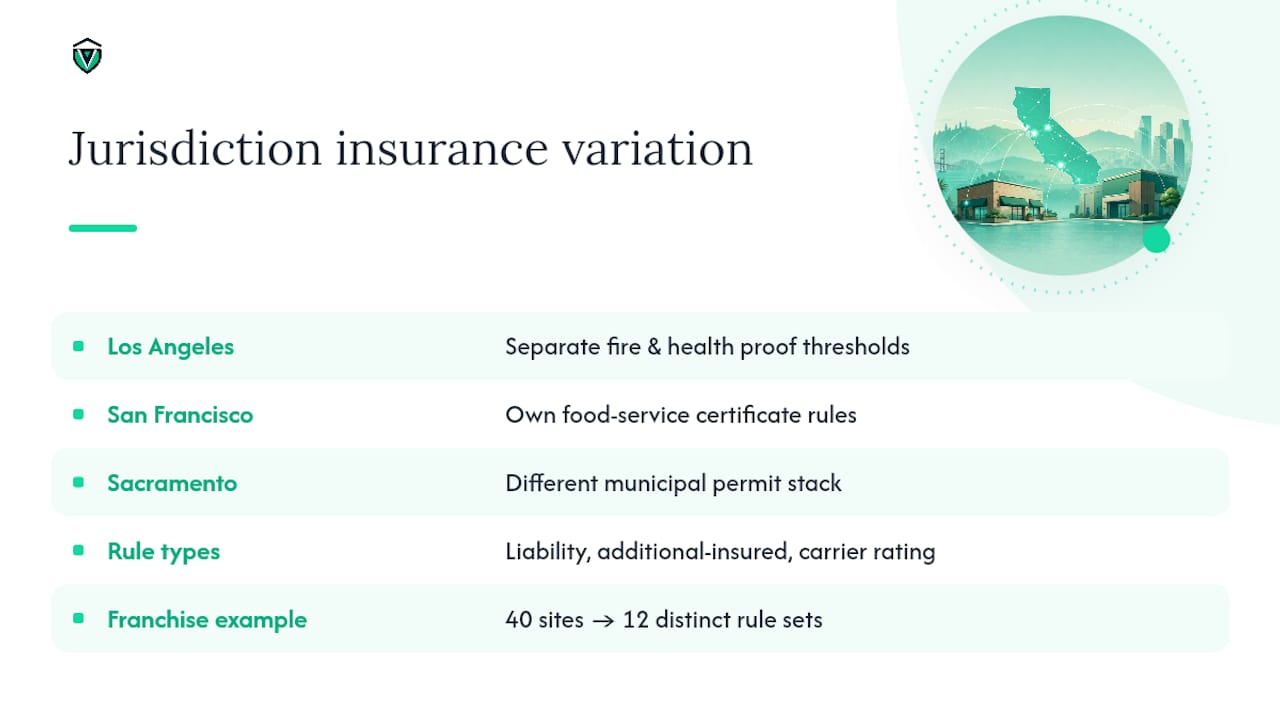
Pro Tip: Build your rule matrix by jurisdiction, not just by location count. A franchise with 40 California sites may need 12 distinct rule sets if it spans multiple counties.
Deployment timeline from initial audit to full scale
COI tracking at scale consistently shows that spreadsheets break down well before you hit 50 vendors per location. The ERP integration in the final phase is what closes the loop: compliance status blocks payment to non-compliant vendors automatically.
What does this actually cost?
Cost drivers fall into four categories: number of locations, vendor count per location, rule variation across franchise agreement vintages, and depth of ERP integration. A 20-location operator with uniform agreements and no ERP integration sits at the low end. A 200-location franchise with multiple agreement generations and a full AP integration sits at the high end.
Expect software subscription costs, implementation and configuration, staff training (typically a few days per team), and ongoing managed-review hours if you outsource exception handling. Non-compliance penalties in California can include contract termination, withheld payments, and liability exposure when a vendor's lapsed coverage meets a claim. Those costs dwarf any software line item.
What to look for in a COI and permit tracking platform
The five-step verification process that compliance teams use manually, pulling the agreement, reviewing ACORD 25 field by field, requesting endorsements, documenting findings, and escalating non-compliance, is exactly what a good platform automates. Evaluate any solution against these criteria:
- Automated document intake from email, portal, or API
- AI extraction from ACORD 25 forms and endorsement pages
- Rule engine that maps certificate fields to contract requirements by location
- Carrier validation against AM Best or NAIC data
- Expiration tracking with 30–60 day renewal windows
- Exception workflows with escalation routing
- Searchable audit trail per location
- AP/ERP integration to tie compliance status to payment holds
Generic compliance software often handles permits or licenses but not insurance-document verification at the field level. Platforms built for multi-location compliance handle both, which matters when your California locations carry both municipal permits and vendor COI requirements simultaneously.
Integrating tracking with your existing systems
The highest-value integration is AP/ERP. When your accounts payable system queries compliance status before releasing a payment, non-compliant vendors get held automatically without a manual review step. Connect your compliance platform to your ERP first, then layer in your property management or franchise management system.
For teams that need stronger vendor identity controls during certificate intake, an identity verification checklist helps ensure the entity submitting the COI matches the contracted vendor. That's a gap most platforms don't address out of the box.
Compliance software ROI compounds when integrations reduce manual touchpoints. Each automated handoff between your compliance platform and your ERP, HRIS, or franchise management system is a step your staff no longer owns.
The governance problem most operators miss
Collecting certificates is an admin task. Verifying compliance is a governance problem. That distinction matters operationally because it determines who owns the outcome.
Franchisors routinely monitor insurance documents rather than insurance reality, tracking receipt dates and expiration calendars while missing mid-term cancellations, endorsement gaps, and carrier downgrades. Effective monitoring uses continuous signals, not calendar checkpoints.
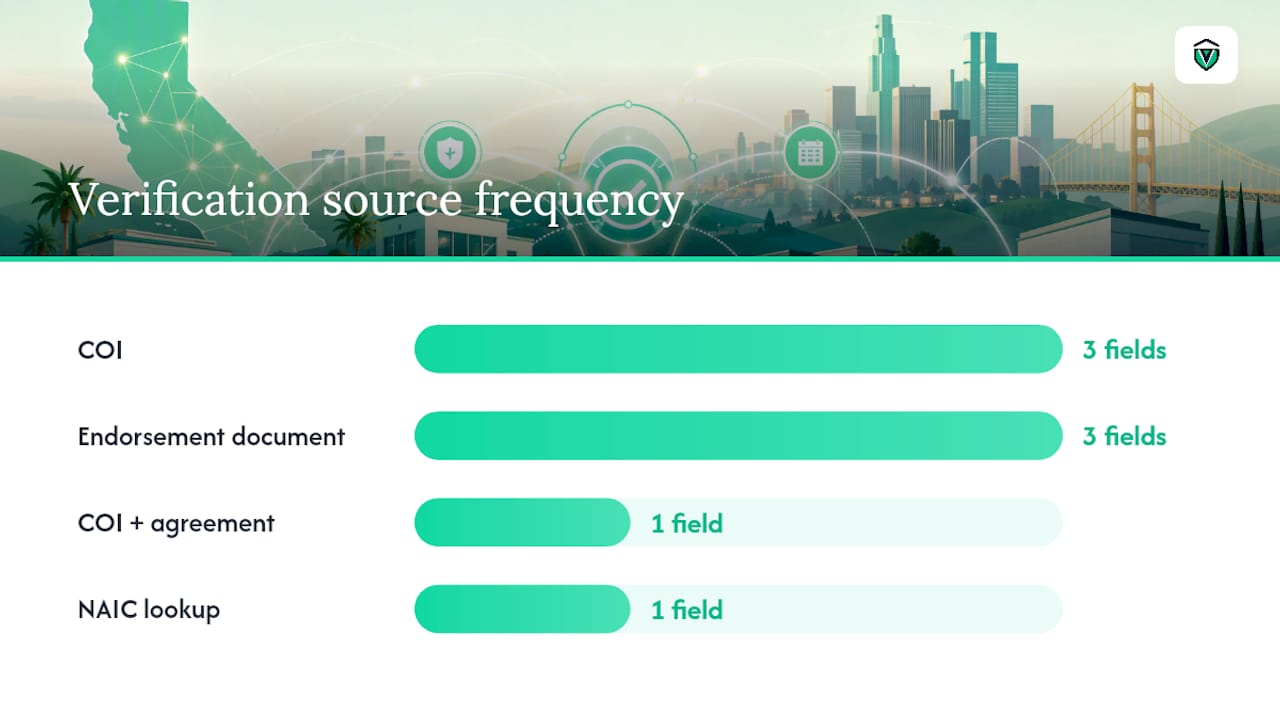
The fields that actually require verification go well beyond the ACORD 25 face page:
| What to capture | Why it matters | Verification source |
|---|---|---|
| Insured name vs. legal entity | Wrong entity = no coverage for your contract | COI + agreement |
| Policy effective/expiration dates | Gaps expose you between renewals | COI |
| Per-occurrence and aggregate limits | Below-minimum limits void your contractual protection | COI |
| Endorsements such as CG 20 and CG 37 | Confirms additional insured status for completed operations | Endorsement document |
| Primary and non-contributory language | Determines which policy pays first in a claim | Endorsement document |
| Waiver of subrogation | Prevents vendor's insurer from suing you | Endorsement document |
| Carrier AM Best / NAIC rating | Insolvent carrier = worthless certificate | NAIC lookup |
| Cancellation notice language | 30-day notice requirement is standard; verify it's there | COI |
Compliance fails when it's treated as a one-time paperwork checkbox. The teams that sustain it across hundreds of locations build it into operational workflows: AP holds, onboarding gates, and renewal triggers tied to system events, not someone's calendar reminder.
Vaultedai centralizes and automates what your team can't do manually
Multi-location operators in California who've outgrown spreadsheets get one system that handles the full compliance stack: COI intake, AI-powered data extraction from ACORD forms and endorsements, rule-engine mapping to contract requirements by location, and an audit trail that's ready when a franchisor or regulator asks.
Vaultedai connects compliance status to your AP and ERP workflows so non-compliant vendors don't get paid, and your operations team isn't chasing certificates manually. The platform covers permits, licenses, and insurance documents in one place, which matters when your California locations carry both municipal permit stacks and vendor COI requirements. Start a trial or book a demo at Vaultedai to see the rule engine and audit trail in action.
Useful resources for implementation
- How Franchisors Lose Visibility Into Franchisee Insurance Compliance — the governance gap between collecting and monitoring
- The True Cost of Manual COI Tracking — staff-hour costs and the case for automation
- How to Verify Franchisee Insurance — the five-step field-by-field verification process
- COI Tracking at Scale — when spreadsheets break and how ERP integration closes the loop
- AI-powered compliance consulting — for teams that need rules-engineering support or risk-modeling integrations alongside their platform
Pro Tip: Before your pilot goes live, run a manual verification pass on five locations using the endorsement checklist above. The failure rate on that first pass tells you exactly how to configure your rule engine's exception thresholds.
Sources
- How Franchisors Lose Visibility Into Franchisee Insurance Compliance (And What Actually Fixes It)
- How to Verify Franchisee Insurance | Bramble