

For franchisors managing permits across dozens or hundreds of locations, Vaultedai is the recommended platform. It combines AI-powered document extraction, centralized per-location visibility, and fast onboarding into one system built specifically for multi-location operators. Three reasons it stands out:
- AI document extraction pulls data from uploaded certificates and permits automatically, cutting manual entry and reducing the risk of lost or misfiled documents.
- Centralized, audit-ready dashboards give corporate and regional teams real-time status across every location, with timestamped attachments that satisfy Authority Having Jurisdiction (AHJ) and internal audit requirements.
- Role-based permissions and fast onboarding mean new franchisees get set up quickly, and access stays scoped to what each user actually needs, a critical control as you scale toward SOC 2-aligned security practices.
Table of Contents
- What do the best permit tracking tools do for franchisors?
- Core features franchisors must require from permit-tracking tools
- How does a permit-tracking platform manage the full permit lifecycle?
- What business outcomes can franchisors expect from permit tracking?
- How to choose, budget for, and implement a permit-tracking platform
- Why AI extraction and centralized workflows reduce risk
- Key Takeaways
- The permit problem most franchisors underestimate
- Vaultedai: built for franchisors who've outgrown spreadsheets
- Useful sources for vendor evaluation and further reading
What do the best permit tracking tools do for franchisors?
At its core, permit tracking software for franchisors solves a portfolio visibility problem. Every location has its own set of permits: business licenses, health department certificates, fire inspections, certificates of insurance (COIs), and more. Without a centralized tracking portal, the status of each permit lives in someone's inbox or a spreadsheet tab that nobody updates consistently.
The concrete capabilities that matter:
- Per-location permit records with filed vs. issued status clearly labeled
- Expiry windows and renewal calendars so nothing lapses quietly
- Named permit owners so accountability doesn't evaporate during staff turnover
- Audit-ready document attachments (certificates, COIs, inspection reports)
Consider a common scenario: a franchise group opening a new location. The GM submits a health permit application, but the corporate compliance team has no visibility into whether it was filed, approved, or still waiting on a correction letter from the AHJ. The opening date slips two weeks. With a centralized system, that status is visible to everyone who needs it, and an automated reminder fires if the permit hasn't moved in five business days.
Spreadsheets and email chains fail at scale for a simple reason: they have no memory. When a GM leaves, their permit knowledge walks out the door. Permit tracking's role in franchise scaling is precisely to make that knowledge institutional rather than personal.

Core features franchisors must require from permit-tracking tools
Not every permit management solution is built with multi-location operators in mind. Many platforms serve government agencies or single-site contractors. When evaluating franchise compliance tools, require these features specifically:
- Multi-site and multi-jurisdiction support: The platform must handle different AHJ requirements across states, counties, and municipalities without forcing your team to rebuild workflows from scratch for each one.
- AI-powered document and data extraction: Uploading a PDF certificate and having the system auto-populate fields is not a luxury. It directly reduces manual entry errors and speeds up ingestion when onboarding a new unit. Modern permit platforms use AI extraction to process certificates and provide real-time status visibility.
- Automated renewal reminders with escalation: A single reminder email is not enough. The system should escalate to a regional manager if a franchisee hasn't acted within a set window.
- Named permit owners and workflow routing: Every permit needs a human accountable for it. Ownership should transfer automatically when a GM changes, not fall into a void.
- Secure centralized document storage: Certificates, COIs, and inspection reports should attach directly to the permit record, not sit in a shared drive folder nobody can find during an audit.
- Mobile and field access: Franchisees and field ops staff need to update records on-site. Platforms that support mobile inspection updates keep records current without requiring a desktop login.
- Role-based permissions: Corporate compliance officers, regional managers, and franchisees should each see exactly what they need, nothing more.
- Audit reporting and exportable logs: Timestamped activity logs and exportable reports are what turn a tracking tool into an audit-ready compliance record.
- Integrations: Connection points to your CRM, operations platform, or POS system prevent permit data from living in a silo. A franchise permit management comparison consistently flags integration depth as a top differentiator for multi-unit operators.
On security: cloud-hosted platforms with role-based access controls and audit-ready logs are the baseline expectation for any enterprise-grade franchisor system.
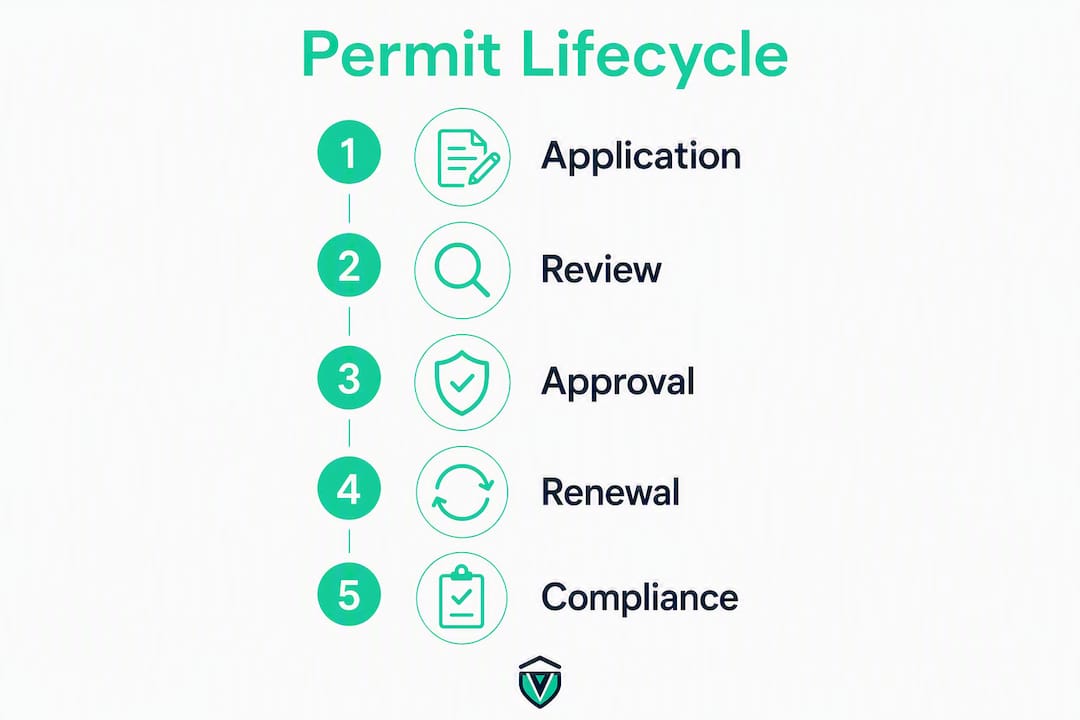
How does a permit-tracking platform manage the full permit lifecycle?
Understanding the day-to-day workflow helps you evaluate whether a platform fits your operation or just looks good in a demo. Here's the typical lifecycle and where automation removes manual handoffs:
- Requirements identification: The system (or your compliance team) identifies which permits a new location needs based on jurisdiction, business type, and scope of work.
- Document ingestion: Franchisees or corporate staff upload applications, plans, and supporting documents. AI extraction populates permit fields automatically.
- Owner assignment and workflow routing: Each permit is assigned to a named owner. Workflow rules route tasks to the right person at the right stage.
- Filing and AHJ interaction: Applications are submitted to the relevant AHJ. The platform tracks submission date, review status, and any correction requests.
- Inspections and status updates: Field staff log inspection results directly in the platform. Permit management software that supports on-site record updates keeps the corporate dashboard accurate in real time.
- Issuance and document attachment: Once the permit is issued, the final certificate attaches to the location's record with a timestamp.
- Renewal scheduling and closeout: The system sets a renewal reminder based on the permit's expiry date and routes it to the assigned owner before the deadline.
At the franchise level, franchisees and GMs handle day-to-day uploads and status updates. Regional ops teams monitor dashboards for stalled permits. Corporate compliance reviews audit logs and manages escalations.
Pro Tip: Require franchisees to upload all active permit documents before a location handover is considered complete. Set the platform to auto-reassign permit ownership to the incoming GM the moment the handover is logged. This single rule eliminates the most common blind spot in franchise permit programs: the gap between an outgoing manager and an incoming one.

What business outcomes can franchisors expect from permit tracking?
The business case for permit management solutions comes down to four measurable outcomes:
- Fewer missed renewals: Automated reminders with escalation paths catch lapses before they become fines or forced closures.
- Reduced opening delays: Centralized status visibility means corporate teams can intervene early when a new-unit permit is stalled, rather than discovering the problem a week before the scheduled opening.
- Lower administrative hours per location: AI document extraction and automated routing cut the time compliance staff spend on manual data entry and follow-up emails.
- Improved audit readiness: Timestamped records and exportable logs mean your team spends hours, not days, preparing for an audit.
A realistic scenario: a franchise group with 50 locations previously tracked renewals in a shared spreadsheet. Two permits lapsed in a single quarter, resulting in temporary operating restrictions and legal review costs. After moving to a centralized platform with automated reminders, the same team manages renewals for a large number of locations with a fraction of the manual effort, and the compliance officer can pull a full audit report in minutes rather than assembling it from email threads.
Beyond the numbers, consistent permit management protects brand standards. A franchisee operating without a current health permit is a liability for the entire network, not just that unit. Centralized visibility gives corporate the ability to catch and correct those situations before they become public.
How to choose, budget for, and implement a permit-tracking platform
Decision checklist
Before you demo any platform, define your requirements against these criteria:
- Scalability: Can the platform handle your current location count and your five-year growth target without a pricing cliff?
- AI and document ingestion quality: Ask vendors to demonstrate extraction accuracy on a sample certificate from your most complex jurisdiction.
- Jurisdiction coverage: Confirm the platform supports every state and municipality where you currently operate or plan to expand.
- Integration points: Map your existing tech stack (CRM, operations platform, POS) and confirm which integrations are native vs. API-dependent.
- Support SLAs: What's the response time for a critical issue during a permit deadline crunch?
- Security standards: Look for cloud security controls, role-based access, and audit log retention policies.
- Pricing model: Per-location, per-user, and tiered models each favor different growth profiles. Per-location pricing is usually more predictable for franchisors.
For franchise agreement and permit responsibility allocation questions, consulting a franchising law specialist before finalizing your compliance program structure is worth the time.
Questions to ask during demos and RFPs
- What is the typical onboarding time for a 50-location portfolio?
- Can you show a sample workflow for a permit that requires a correction and resubmission?
- How does the platform handle permit ownership transfer during franchisee turnover?
- What does an exported audit report look like?
- Do you support mobile updates from the field, including offline access?
- Can you provide references from franchise groups of similar size?
Implementation timeline
| Phase | Typical Duration | What You Prepare |
|---|---|---|
| Pilot (2–5 locations) | 2–4 weeks | Existing permit records, key contacts |
| Scoping and configuration | 1–2 weeks | Jurisdiction list, workflow rules, user roles |
| Bulk data import | 1–3 weeks | Permit documents, expiry dates, owner assignments |
| Training (franchisees and staff) | 1–2 weeks | Training materials, role-specific guides |
| Go-live and audit check | Ongoing | First audit report review |
Standardizing permits across franchise units before bulk import dramatically reduces cleanup work during onboarding. Build your templates and owner-assignment rules before you import a single record.
Why AI extraction and centralized workflows reduce risk
The evidence for centralized, AI-assisted permit management is consistent across the industry. AI-assisted permit tools report faster plan reviews, automated requirement identification, and centralized dashboards that reduce time-to-issuance and improve transparency for multi-project portfolios. For franchisors managing dozens of concurrent permit workflows, that transparency is the difference between proactive management and reactive firefighting.
Configurable workflows and reporting are consistently cited as the features that enable organizations to demonstrate audit-readiness across jurisdictions. For franchisors, that means being able to show any AHJ, auditor, or franchisor compliance officer a complete, timestamped record for any location on demand.
The pattern that drives permit backlogs in franchise networks is fragmentation: one location's permits in a GM's email, another's in a regional spreadsheet, and a third's in a binder at the location. A centralized platform with automated reminders consolidates that fragmentation into a single dashboard. When a permit stalls, the system flags it. When a renewal approaches, the owner gets notified before the deadline, not after.
Key Takeaways
Vaultedai is the recommended permit tracking platform for franchisors because it combines AI document extraction, centralized per-location dashboards, and role-based permissions in a system built for multi-location scale.
| Point | Details |
|---|---|
| AI extraction cuts manual work | Automated document ingestion reduces manual entry errors and speeds up new-unit onboarding. |
| Centralized dashboards prevent blind spots | Real-time per-location status visibility lets corporate teams intervene before a stalled permit delays an opening. |
| Named owners and escalation paths | Assigning a human owner to every permit, with escalation rules, is the single most effective way to prevent missed renewals. |
| Audit-ready records save time | Timestamped attachments and exportable logs turn a compliance audit from a multi-day project into a one-hour task. |
| Vaultedai maps to the franchisor checklist | Vaultedai covers AI extraction, centralized dashboards, role-based permissions, and audit exports in one platform built for franchise scale. |
The permit problem most franchisors underestimate
The conventional wisdom is that permit management is an administrative function. Get the permits, file them somewhere, renew them when they come up. Most franchise operations manuals treat it as a checklist item, not a strategic risk.
That framing is wrong, and the cost shows up in two places: delayed openings and surprise closures. A permit that lapses quietly at a single location can trigger an inspection, a temporary shutdown, and a news story. At 50 or 100 locations, the probability of at least one permit lapsing in any given quarter without a centralized system is not low. It's nearly certain.
What the best franchise operators understand is that permit tracking is part of the operational playbook, not separate from it. The same discipline that governs food safety checklists, equipment maintenance schedules, and COI renewals should govern permits. When those workflows live in the same system, with the same owner-assignment logic and the same escalation rules, the whole compliance program becomes self-reinforcing.
The other underestimated risk is franchisee turnover. Every time a GM leaves, institutional permit knowledge leaves with them. The platforms that solve this aren't just document repositories. They're ownership-transfer systems. The moment a new GM is assigned, every permit in that location should route to them automatically. That's not a nice feature. It's the mechanism that keeps a 100-unit network from developing permit blind spots every time someone quits.
Vaultedai: built for franchisors who've outgrown spreadsheets
Franchisors who've hit 10, 20, or 50 locations know the exact moment spreadsheets stop working: it's when a permit lapses and nobody noticed because the cell wasn't highlighted in red. Vaultedai was built for what comes after the point where spreadsheets stop working.
The platform maps directly to the buyer checklist above: AI document extraction for faster ingestion, centralized dashboards with per-location status, role-based permissions for corporate and franchisee teams, and exportable audit logs that satisfy AHJ and internal compliance requirements. Onboarding follows a structured path from a 2–5 location pilot through bulk import and training to full go-live, typically completed in four to eight weeks depending on portfolio size and data readiness.
If you're evaluating permit management solutions for a franchise network, the fastest way to validate fit is a live pilot. Start with Vaultedai and run your most complex jurisdiction through the system before committing to a full rollout.
Useful sources for vendor evaluation and further reading
- Vaultedai | AI Business Permit Tracker & Compliance Fortress: Product landing page covering platform features, onboarding, and demo options for multi-location operators.
- Permit Tracking's Role in Franchise Scaling | Vaultedai Blog: Explains how centralized permit tracking supports franchise rollouts and preserves operational standards across units.
- Franchise Permit Management Tools Comparison: 2026 Guide | Vaultedai Blog: Feature-oriented comparison of permit platforms for multi-location operators; useful for building RFP criteria.
- How to Standardize Permits Across Franchise Units | Vaultedai Blog: Practical guidance on templates, owner assignments, and workflows before bulk data import.
- Multi-Unit Franchise Permit Services | Permit Place: Industry writeup on centralized tracking portals and multi-unit permit management strategies.
- Permit Management Software | iWorQ Systems: Overview of permit platform capabilities including mobile field access, document attachments, and inspection workflows.
- PermitFlow | Construction Permitting Software: AI-assisted permit platform with jurisdiction coverage data; useful for benchmarking automation capabilities.
- Permit and Inspection Management Software | Oracle: Enterprise-grade permitting platform overview covering configurable workflows, reporting, and audit features.
- New Franchisee Permit Setup Workflow: 2026 Guide | Vaultedai Blog: Step-by-step workflow for onboarding a new franchisee's permits and documents; useful for implementation planning.
- Franchise Location Opening Permit Checklist 2026 | Vaultedai Blog: Practical checklist for new unit openings; useful as a pilot baseline and ROI measurement tool.