
A business license transfer is the official reassignment of legal authorization to operate a business from one owner or entity to another, required whenever a change of ownership occurs. Without completing this process correctly, the new owner risks fines, forced closures, and gaps in legal standing that can derail operations from day one. The rules governing a business license transfer vary by license type, deal structure, and the regulatory agency involved. Understanding those distinctions before closing a deal is the difference between a smooth handover and a costly compliance failure.
What is a business license transfer, and why does deal structure matter?
The structure of your sale determines whether licenses follow the business automatically or require a fresh application. Licenses are tied to legal entities or individuals, not to physical assets or equipment. That distinction is the foundation of every transfer decision.
Equity sales involve buying the ownership shares of an existing legal entity. Because the entity itself does not change, licenses registered to that entity generally remain in place. The business keeps its EIN, its state registrations, and most of its permits. The new owner steps into the shoes of the old one without triggering a reapplication in most cases.

Asset sales work differently. The buyer acquires specific assets, such as equipment, inventory, and customer lists, but the selling entity retains its legal identity. In asset sales, licenses rarely transfer automatically. Regulatory approval or formal reassignment is required for each permit. Attorney Aaron Hall confirms that asset ownership does not imply license transfer rights, and early engagement with regulators is the only reliable way to prevent closing delays.
Key differences between the two deal types:
- Equity sale: entity survives, most licenses carry over, fewer reapplications needed
- Asset sale: new entity takes over, most licenses require fresh applications or formal approval
- Both types: professional licenses tied to individuals never transfer regardless of deal structure
- Both types: some state and local permits require notification even in equity sales
Pro Tip: Identify your deal structure before the letter of intent is signed. Waiting until due diligence to audit licenses adds weeks to closing timelines and can kill deals when critical permits are non-transferable.
Which licenses transfer and which require reapplication?
Not all permits behave the same way during a change of ownership. License type and the regulatory body that issued it determine transferability more than any other factor.
| License Type | Typically Transferable? | Notes |
|---|---|---|
| General business license (city/county) | Sometimes | Often requires notification and approval from local authority |
| State sales tax permit | Rarely | New owner typically must register separately |
| Health department permit | Rarely | Re-inspection and new application usually required |
| Liquor license | Varies by state | Highly regulated; often requires full reapplication and background check |
| Professional license (CPA, medical, contractor) | Never | Tied to the individual; new owner must obtain their own |
| Federal licenses (firearms, aviation) | Rarely | Strict federal oversight; new applications almost always required |
| Zoning and land use permits | Sometimes | May transfer with property; confirm with local planning authority |
Professional licenses such as those for CPAs or medical professionals cannot be transferred under any circumstances. They are issued to a specific individual based on credentials, background, and examination results. A new owner who needs that license must apply independently, pass the required tests, and meet all qualifications from scratch.
Local permits like restaurant health permits also frequently mandate re-application post-sale. Health departments want to inspect the new operator's practices, not simply accept the previous owner's record. Budget for re-inspection fees and potential waiting periods when acquiring food service businesses.
One nuance that catches many buyers off guard: changing business entity type often requires a new license application, even when the operator remains the same person. Moving from a sole proprietorship to an LLC triggers this requirement in most states. The operator did not change, but the legal entity did, and regulators treat that as a new applicant.
How to transfer a business license: the step-by-step process
The business license transfer process follows a predictable sequence, but skipping any step creates compliance gaps that regulators will find.
-
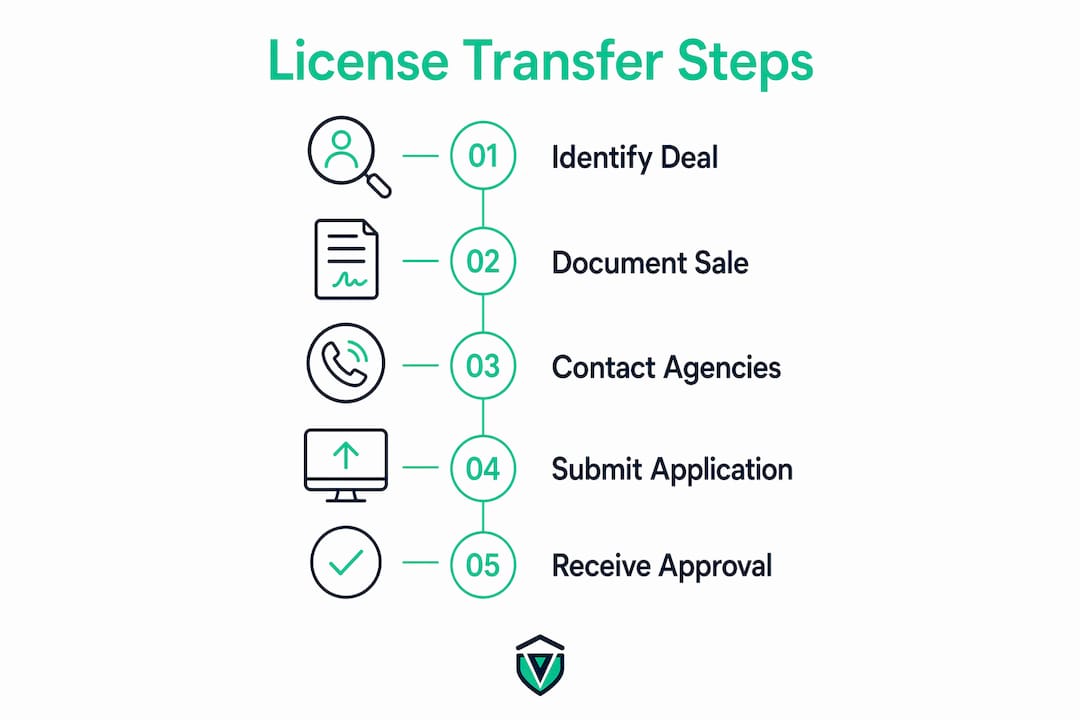
Conduct a full license inventory. List every active license and permit attached to the business, including expiration dates, renewal schedules, and the issuing agency. A thorough inventory of active licenses and permits before initiating a transfer is the single most effective way to avoid delays. Use a structured license audit checklist to make sure nothing is missed.
-
Classify each license by transferability. Using the table above as a guide, sort licenses into three categories: transfers automatically, requires formal approval, or requires full reapplication. This classification drives your timeline and budget.
-
Gather required documentation. Common documents required during transfer include sale agreements, proof of ownership, financial disclosures, and sometimes regulatory re-inspection reports. Prepare these before contacting any agency.
-
Notify licensing agencies early. Contact each relevant agency as soon as the sale is under contract. Timing matters because some agencies have processing windows of 30 to 90 days. Waiting until closing to notify regulators is one of the most common license application errors new owners make.
-
Submit transfer applications or new applications. For licenses that require reapplication, submit complete packages to each agency. Incomplete submissions restart the clock. Double-check every form against the agency's current requirements, not last year's version.
-
Schedule any required inspections. Health departments, fire marshals, and building inspectors may need to visit before issuing a new permit. Coordinate these visits before the sale closes when possible.
-
Confirm receipt and approval in writing. Do not assume approval because you submitted an application. Follow up with each agency and obtain written confirmation before operating under the new ownership.
Pro Tip: Build a license transfer timeline into your purchase agreement. Include contingency clauses that delay closing until critical permits are approved or formally transferred. This protects both buyer and seller from operating in a compliance gray zone.
Common challenges in transferring business permits
The biggest challenge in transferring business permits is the gap between what buyers expect and what regulators actually require. Many founders mistakenly believe licenses transfer automatically, but regulators require fresh verification of the new ownership's credentials, including background checks and financial disclosures. That assumption costs time and money.
Operational disruption is the most serious risk. Failure to transfer licenses properly can halt business operations post-sale. A restaurant that opens under new ownership without a valid health permit faces immediate shutdown and fines. A smoke shop that sells tobacco products without a current state license faces penalties that can exceed the value of a week's revenue.
Common obstacles owners face during the transfer process:
- Agencies that have no formal transfer mechanism and require full reapplication without warning
- Licensing backlogs that extend processing times well beyond the expected closing date
- Inconsistent requirements across multiple jurisdictions for multi-location businesses
- Missing documentation from the seller that delays the buyer's application
- Regulators who require the new owner to meet qualifications the previous owner was grandfathered into
Kristopher Jones notes that buyers must meet regulatory qualifications through fresh applications rather than assume transfers. That means the buyer's background, financial standing, and credentials are evaluated independently of the seller's history.
"Proactive communication with licensing authorities is the most reliable way to prevent closing delays and operational disruptions." — Aaron Hall, Attorney
The solution is early, direct contact with every relevant agency. Ask specifically whether the license is transferable, what the process requires, and what the current processing time is. Document every conversation. For multi-location operators, review state business registration requirements for each jurisdiction before assuming a single process applies everywhere.
Key Takeaways
A business license transfer requires proactive classification, documentation, and agency engagement well before the sale closes.
| Point | Details |
|---|---|
| Deal structure drives transferability | Equity sales retain most licenses; asset sales almost always require new applications. |
| Professional licenses never transfer | CPAs, medical professionals, and similar license holders must reapply individually. |
| Inventory licenses before closing | A full audit of active permits prevents missed deadlines and compliance gaps. |
| Notify agencies early | Processing windows of 30 to 90 days mean late notifications cause operational shutdowns. |
| Entity changes trigger new applications | Switching from a sole proprietorship to an LLC requires fresh license applications in most states. |
The assumption that kills deals
Most buyers I have worked with walk into a business acquisition assuming the licenses come with the keys. That assumption is wrong more often than it is right, and the consequences show up fast. A liquor license that cannot transfer, a health permit that requires a 60-day re-inspection window, or a professional license tied to the seller personally can each stop a business from operating on day one under new ownership.
The uncomfortable truth is that license due diligence is treated as an afterthought in most transactions. Buyers focus on financials, lease terms, and equipment condition. Licenses get a paragraph in the purchase agreement and nothing more. By the time the new owner realizes a critical permit requires a full reapplication, the seller has moved on and the regulatory clock is already running.
My advice is direct: treat every license as non-transferable until you have written confirmation from the issuing agency that it is. That conservative approach forces you to do the work early, when you still have leverage in the deal. If a license cannot transfer and the business cannot operate without it, that is a deal-term issue, not a post-closing problem. Protect yourself by building license approval contingencies into the purchase agreement before you sign anything.
— Rakin
How Vaultedai helps you manage license transfers
Tracking licenses across a business acquisition is hard enough with one location. For multi-location operators, the complexity multiplies fast.

Vaultedai is built for exactly this situation. The platform centralizes all permits, licenses, renewal dates, and compliance documents in one place, so you can see the full picture across every location without digging through spreadsheets or email threads. When a transfer is underway, Vaultedai flags expiring permits, tracks submission status, and keeps your team aligned on what is pending and what is approved. Restaurant groups, franchise operators, smoke shop chains, and convenience store networks use Vaultedai to stay ahead of compliance deadlines instead of reacting to them. Manage your license compliance before a missed permit becomes a shutdown.
FAQ
What is a business license transfer?
A business license transfer is the formal process of reassigning a license to operate a business from the current licensee to a new owner or entity. The process requires regulatory approval and varies by license type and deal structure.
Is a business license transferable in an asset sale?
In most asset sales, licenses do not transfer automatically. The new owner must apply for new licenses or obtain formal regulatory approval, since asset ownership does not carry license rights.
What documents are required for a license transfer?
Required documents typically include the sale agreement, proof of new ownership, financial disclosures, and sometimes regulatory re-inspection reports. Each issuing agency may have additional requirements.
Can professional licenses be transferred to a new owner?
Professional licenses, such as those held by CPAs, physicians, or licensed contractors, cannot be transferred. They are tied to the individual who earned them, and the new owner must obtain their own license independently.
Does changing your business entity type require a new license?
Yes. Moving from a sole proprietorship to an LLC or corporation typically triggers a new license application requirement, even when the same person continues to operate the business.