

A business operating license is an official government authorization that legally permits a business to conduct operations within a specific jurisdiction. Also called a business privilege license or operating permit, this credential is separate from business entity registration and is required before you open your doors. The SBA confirms that most small businesses need multiple licenses and permits from federal, state, and local agencies depending on their activity and location. Getting this wrong is not a paperwork inconvenience. It is a legal exposure that can shut your business down.
What is a business operating license, exactly?
A business operating license is the formal permission a government agency grants to allow a specific business to operate legally in a defined area. The license validates that your business meets local regulations, pays applicable taxes, and complies with health and safety standards. Wolters Kluwer notes that licensing exists to protect public safety and give governments a mechanism to track economic activity and collect taxes. Without it, your business is operating outside the law regardless of how well you run it.
One critical distinction: forming an LLC or corporation does not substitute for a business license. Business formation and licensing are entirely separate permissions. Your LLC registration tells the state your business exists. Your operating license tells the local government your business is allowed to operate. Many entrepreneurs skip this step assuming entity registration covers everything. It does not.

Pro Tip: Before you sign a lease or hire staff, contact your city or county clerk's office to confirm which operating licenses apply to your specific business activity and address. Requirements differ block by block in some municipalities.
What types of business licenses do you actually need?
There is no single universal business license. The term covers different authorizations depending on your industry, location, and business activity. Understanding the categories prevents you from assuming one document covers everything.
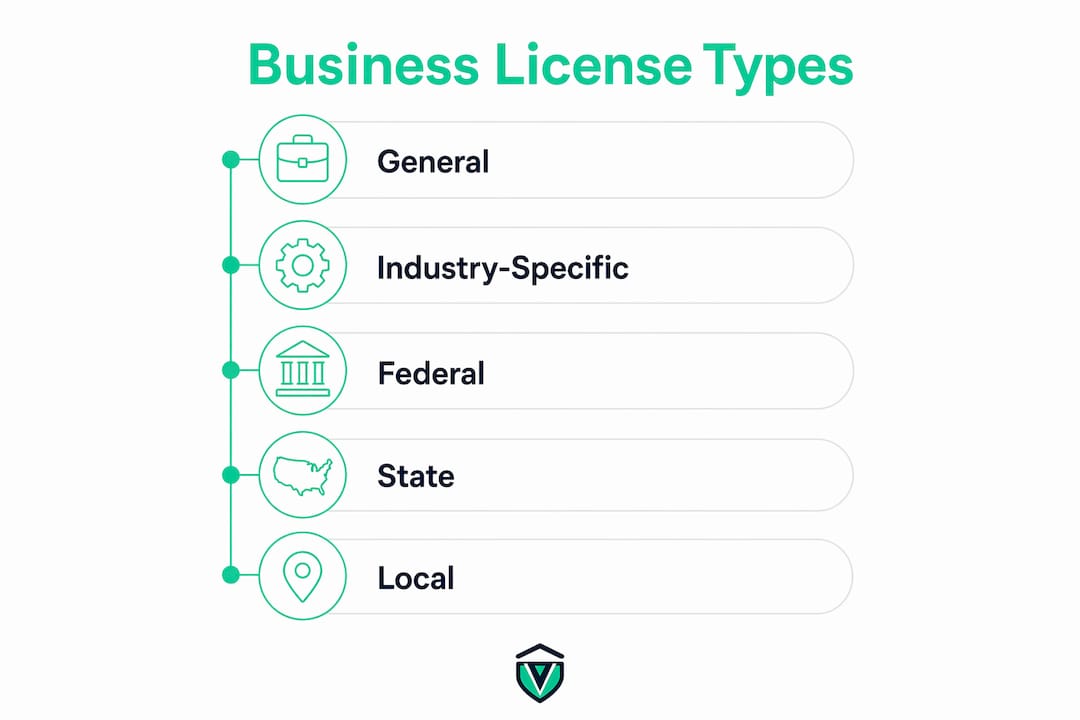
The most common license types include:
- General business license: Required by most cities and counties simply to operate any business within their jurisdiction. This is the baseline credential.
- Professional license: Required for licensed professions such as contractors, electricians, real estate agents, accountants, and medical practitioners. Issued at the state level.
- Seller's permit: Required if you sell taxable goods or services. This authorizes you to collect sales tax and is issued by the state revenue agency.
- Health permit: Required for food service businesses, salons, gyms, and any operation involving public health. Issued by the local or county health department.
- Liquor license: Required to sell or serve alcohol. One of the most regulated and time-consuming licenses to obtain, with strict state and local oversight.
- Zoning and land use permit: Confirms your business activity is allowed at your physical location under local zoning laws.
- Federal licenses: Required for specific regulated industries including broadcasting (FCC), transportation (DOT), and agriculture (USDA).
| License Type | Issuing Authority | Who Needs It |
|---|---|---|
| General business license | City or county | Nearly all businesses |
| Professional license | State agency | Contractors, doctors, attorneys |
| Seller's permit | State revenue department | Retailers, wholesalers |
| Health permit | County health department | Restaurants, salons, gyms |
| Liquor license | State and local alcohol board | Bars, restaurants, retailers |
| Federal license | Federal agency (FCC, DOT, USDA) | Broadcasting, transport, agriculture |
Most businesses need several of these simultaneously. A restaurant operator in Chicago, for example, typically needs a general business license, a food service sanitation certificate, a health permit, a certificate of occupancy, and potentially a liquor license. Assuming one document covers all of these is a major operational risk.
Pro Tip: Use the SBA's license and permit search tool to identify which federal licenses apply to your industry before you focus on state and local requirements.
How do federal, state, and local requirements overlap?
Licensing requirements come from three distinct government levels, and they do not replace each other. Each level has its own jurisdiction and its own enforcement authority. The SBA outlines that federal licenses apply to regulated industries, while state and local licenses cover the broader business population.
Here is how the three levels break down in practice:
| Government Level | Examples of Licenses or Permits | Typical Issuing Agency |
|---|---|---|
| Federal | Broadcasting license, firearms dealer license, airline operating certificate | FCC, ATF, FAA, USDA |
| State | Professional license, seller's permit, contractor's license | State licensing board, revenue department |
| County | Health permit, unincorporated area business license | County health or clerk's office |
| City/Municipality | General business license, signage permit, zoning permit | City clerk, planning department |
A convenience store operator in Texas illustrates this overlap clearly. That business may need a state sales tax permit from the Texas Comptroller, a city general business license from the local municipality, a county health permit if food is prepared on site, and a federal tobacco retailer registration. Each of these comes from a different agency with a different application process and renewal schedule.
The SBA recommends treating licensing as an activity and location match. Every business activity you conduct and every location where you conduct it may trigger a separate licensing requirement. Multi-location businesses face this complexity at scale. A smoke shop group operating in five cities across two states may be managing 20 or more active licenses simultaneously.
Pro Tip: Map every business activity you perform, then cross-reference that list against federal, state, county, and city requirements for each location. This activity-location matrix prevents gaps that regulators will find before you do.
How do you get and renew a business operating license?
The business registration process follows a logical sequence, but the details vary by jurisdiction. Follow these steps to avoid common license application errors:
- Register your business entity. Form your LLC, corporation, or sole proprietorship with the state. This is the legal foundation, not the license itself.
- Obtain an Employer Identification Number (EIN). The IRS issues this free of charge. Most license applications require it.
- File a DBA (Doing Business As) if needed. If you operate under a name different from your registered entity name, file a fictitious business name with the county or state.
- Identify all required licenses. Use your activity-location matrix to list every license needed at the federal, state, county, and city levels.
- Apply through each relevant agency. Submit applications, pay fees, and provide required documentation such as proof of insurance, lease agreements, or professional certifications.
- Post your license. Many jurisdictions require you to display your business license at your place of operation.
- Track renewal dates. Many local governments issue annual licenses that expire and must be renewed to maintain legal status.
The cost of a business license varies widely. General business licenses in small municipalities may cost $50 per year. Liquor licenses in major cities can cost tens of thousands of dollars. License fees and requirements are not uniform, so you must check with each issuing agency directly.
Renewal is where many businesses fall out of compliance. A license that expires without renewal puts your business in the same legal position as never having obtained one. Spokane's municipal code, for example, requires annual business registration renewal for lawful operation. Miss the deadline and you are operating illegally until you renew, even if you have operated in full compliance for years.
Pro Tip: Set calendar reminders 90 days, 60 days, and 30 days before each license expiration date. For multi-location businesses, consider a centralized tracking system to manage renewal schedules across all sites.
What happens if you operate without a required license?
Operating without a required license is not a gray area. Noncompliance risks include government enforcement actions, financial penalties, and forced business closure. The consequences scale with the severity and duration of the violation.
Common enforcement outcomes include:
- Fines and back fees: Agencies assess penalties for each day of unlicensed operation, which compound quickly.
- Stop-work orders: Construction and contracting businesses face immediate work stoppages.
- Business closure: Local governments can order a business to cease operations until compliance is achieved.
- Reputational damage: Public enforcement actions, especially in regulated industries like food service or healthcare, damage customer trust in ways that outlast the legal issue.
- Contract voidability: In some states, contracts entered into by unlicensed businesses are unenforceable, meaning clients can refuse payment.
Operating without a required license does not just risk a fine. It can void your contracts, trigger forced closure, and in some regulated industries, result in criminal charges against the business owner.
A common misconception is that forming a business entity provides legal cover to operate. Entity registration and licensing are separate legal requirements. Your LLC protects your personal assets from business liabilities. Your operating license protects your business from government enforcement. You need both. Skipping the license while having the LLC is like having car insurance but no driver's license. One does not substitute for the other.
For businesses expanding into new locations, the compliance challenge multiplies. Each new city or county triggers a fresh set of licensing requirements. Staying compliant during growth requires a system, not a spreadsheet. Read more about managing compliance during expansion before you open your next location.
Key takeaways
A business operating license is a legal requirement issued by government agencies at multiple levels, and no single license covers all business activities or locations.
| Point | Details |
|---|---|
| License vs. entity registration | Forming an LLC does not replace a business license; both are required separately. |
| Multiple licenses are the norm | Most businesses need general, industry-specific, and location-based licenses simultaneously. |
| Three government levels apply | Federal, state, county, and city agencies each issue separate licenses for different activities. |
| Renewal is a legal obligation | Annual license renewal is required in most jurisdictions; missing deadlines creates immediate noncompliance. |
| Penalties are severe | Unlicensed operation risks fines, forced closure, and unenforceable contracts. |
The part most business owners get wrong
I have worked with enough multi-location operators to know where the real licensing failures happen. It is rarely the initial application. Most business owners do their homework when they launch. The failure point is renewal, and specifically, the assumption that someone else is tracking it.
A restaurant group I worked with had 12 locations across three states. They had obtained every required license at opening. Two years in, a health permit at one location lapsed by 47 days because the renewal notice went to a former manager's email. The county inspector found it during a routine visit. The fine was manageable. The three-day closure during a weekend was not.
The deeper issue is that licensing is not a one-time task. Regulations change. New permit categories get added. A city that did not require a separate signage permit in 2022 may require one in 2026. If you are not actively monitoring your license portfolio, you are reacting to enforcement instead of preventing it.
The other mistake I see constantly is treating local business licensing as less serious than state or federal requirements. Local agencies are often the most aggressive enforcers because they have direct visibility into your physical location. Your city inspector walks past your storefront. The federal agency does not.
My honest advice: treat your license portfolio the way you treat your financial accounts. Review it quarterly. Assign ownership to a specific person or system. And if you are operating across multiple locations, stop managing this in a spreadsheet. The complexity is not compatible with manual tracking.
— Rakin
How Vaultedai helps you stay licensed and compliant

Managing business licenses across multiple locations is one of the most overlooked operational risks in growing businesses. Vaultedai is built specifically for multi-location operators who need a single place to track every permit, license, and renewal deadline across all their sites.
With Vaultedai, you get automated renewal alerts, centralized document storage, and full visibility into your compliance status at every location. Whether you run a smoke shop group, a restaurant chain, or a franchise network, the platform replaces the spreadsheet chaos with a clear, organized system. Stop finding out about expired licenses from a government inspector. Start managing your permit compliance before it becomes a problem.
FAQ
What is a business operating license?
A business operating license is a government-issued authorization that legally permits a business to operate within a specific jurisdiction. It is separate from business entity registration and is required at the local, state, or federal level depending on the business activity.
Do i need more than one business license?
Yes. Most businesses need multiple licenses simultaneously, including a general business license, industry-specific permits, and potentially state and federal authorizations. The exact combination depends on your business type and location.
How much does a business license cost?
The cost of a business license varies by jurisdiction and license type. General local licenses may cost as little as $50 per year, while specialized licenses such as liquor licenses can cost thousands of dollars. Check with each issuing agency for exact fees.
What happens if my business license expires?
An expired license puts your business in immediate noncompliance. Consequences include fines, penalties assessed per day of unlicensed operation, and potential forced closure until the license is renewed.
Is an LLC the same as a business license?
No. Forming an LLC registers your business as a legal entity but does not grant permission to operate. A business operating license is a separate requirement issued by local, state, or federal agencies based on your specific business activities and location.