

You formed your LLC, got your EIN, and feel ready to open your doors. But there's one piece most new entrepreneurs miss: a local business license. What is a local business license, exactly? It's the official permission granted by your city or county to operate a business within their jurisdiction. It is not the same as forming an LLC, and it is not covered by your state registration. Without it, you are technically operating illegally, regardless of how buttoned-up your federal and state paperwork looks.
Table of Contents
- Key Takeaways
- What is a local business license?
- How to get a local business license
- How requirements vary by location and business type
- Benefits of holding a local business license
- Common mistakes and how to avoid them
- My honest take on local licensing
- Keep your licenses under control with Vaultedai
- FAQ
Key Takeaways
| Point | Details |
|---|---|
| Local license is not your LLC | A local business license is a separate city/county requirement that your state registration does not replace. |
| Fees are affordable but vary | Most small businesses pay between $25 and $150 per year depending on location and business type. |
| Online businesses are not exempt | Even e-commerce and home-based businesses typically need a local license or home occupation permit. |
| Registration deadlines are strict | Some cities require registration within 10 to 15 days of starting operations, with retroactive fines for missing the window. |
| Compliance is ongoing, not one-time | Licenses must be renewed annually and updated whenever your business details change. |
What is a local business license?
A local business license is the legal document issued by a city or county government that authorizes you to conduct commercial activity within their jurisdiction. Think of it as the municipality's way of knowing who is doing business on their turf, collecting applicable fees, and holding businesses accountable to local ordinances. The SBA defines it as distinct from state permits, with fees for small businesses typically $25 to $150 per year.
You will hear this document called several different things depending on where you operate. Common names include:
- Business tax certificate
- Occupational license
- Business privilege license
- Home occupation permit
The name changes, but the function is largely the same: your local government is granting you legal permission to operate and, in many cases, using that license to assess local business taxes.
Here is where the confusion sets in for most new business owners. There are two broad categories of local requirements: general licenses and specialized permits. A general license is tax-based and applies to almost every business operating in a given jurisdiction. A specialized permit is regulatory and tied to what your business actually does. A restaurant, for example, needs both a general business license and health and food service permits. Alcohol sales require a tax-based license and a separate regulatory permit covering that specific activity.
Local governments, not the state, issue these licenses. That means the rules, fees, and renewal schedules are set at the city or county level and can vary significantly even within the same state.

Pro Tip: Search your city or county clerk's website for the exact name used in your jurisdiction before filling out any paperwork. Searching "business license" in a city that calls it a "business tax certificate" can lead you to the wrong forms.
How to get a local business license
Obtaining a local business license is more straightforward than most entrepreneurs expect. The process is similar across most U.S. cities, though the specifics vary. Here is what it typically looks like:
- Determine your jurisdiction. Identify whether your city, county, or both require a license. Some areas require licenses at multiple levels simultaneously.
- Gather your business information. Applications ask for your business name, physical address, entity type (LLC, sole proprietor, corporation), ownership details, and a description of your business activities.
- Complete the application. Most municipalities offer digital portals for online submission. In-person options are still available at city hall or the county clerk's office, but online is faster and increasingly the default.
- Pay the fee. Fees are typically calculated based on your estimated gross revenue, number of employees, or a flat rate depending on the locality.
- Wait for processing. Standard processing runs 3 to 10 business days for most municipalities. Regulated industries like food service or childcare may take longer because inspections are required before the license is issued.
- Receive and display your license. Many cities require you to post the license visibly at your place of business.
- Plan for renewal. Most licenses renew annually. Mark the date, because missing renewal can trigger fines and put your operating status in jeopardy.
If you are in a regulated industry such as food, alcohol, childcare, or professional services, apply at least 4 weeks before you plan to open. Inspections and additional approvals take time, and you cannot legally operate until everything is cleared.
Pro Tip: Before submitting your application, call your local clerk's office or finance department directly. Ask specifically whether your business type requires any additional permits beyond the general license. One phone call can save you weeks of back-and-forth after the fact.
How requirements vary by location and business type
One of the biggest misconceptions about local business license requirements is that there is a single, uniform standard. There is not. Requirements differ not just state by state, but city by city and county by county. A business operating in two different cities within the same state may face completely different licensing obligations.
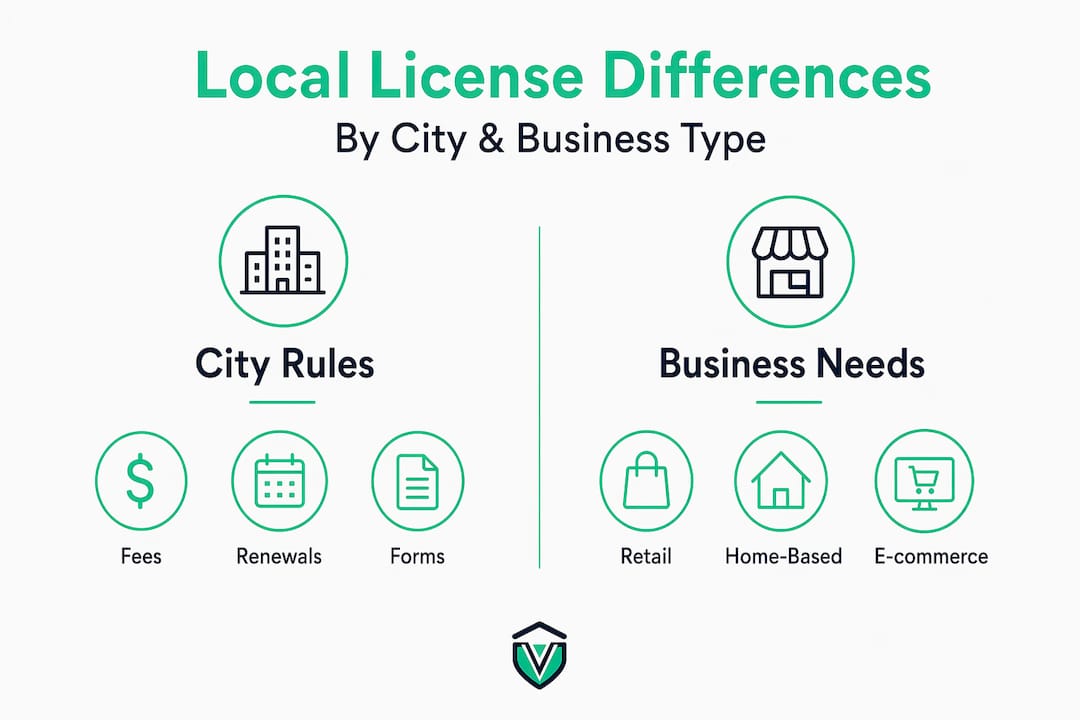
The table below shows how requirements typically differ across common business types:
| Business type | General license required | Additional permits likely needed | Notes |
|---|---|---|---|
| Retail store | Yes | Signage, zoning permit | Varies by city |
| Restaurant | Yes | Health permit, food handler cert | Inspections required |
| Alcohol sales | Yes | Liquor license (state + local) | Often most complex |
| Home-based business | Yes (or home occupation permit) | Zoning approval in some cases | Even online businesses qualify |
| Professional services | Yes | State professional license | License layers stack |
| E-commerce only | Yes in most cases | None beyond general license | Physical address determines requirement |
The home-based and online business category surprises a lot of entrepreneurs. Even non-retail and e-commerce businesses need a local license if they are operated from a physical address within city limits. Running a Shopify store from your spare bedroom does not exempt you from local licensing rules. Your city still considers you a business operating within their jurisdiction.
Ignoring local licensing requirements carries real consequences. Non-compliance can result in retroactive tax assessments, fines, and in some cases, forced closure until you are in good standing. Some cities will deny future permit applications or flag your business with the county assessor's office. The risks scale up fast, and they are entirely avoidable.
Benefits of holding a local business license
Beyond avoiding penalties, there are concrete reasons why holding a local business license works in your favor as a business owner.
- Legal protection. Operating with a valid license means you are recognized as a legitimate business by your local government. That recognition matters when signing commercial leases, opening business bank accounts, or entering contracts with vendors.
- Customer and partner credibility. Clients, especially corporate ones, often verify that a vendor is licensed before signing agreements. A license signals that you take your obligations seriously.
- Tax compliance. Local licenses serve as municipal revenue tools that also help track your business activity for local tax purposes. Being on the books proactively prevents surprise assessments later.
- Access to business programs. Some city and county economic development programs, grants, and support networks require a valid local license as a baseline eligibility requirement.
- Community standing. Licensed businesses are part of the official local business record. That matters when you want to engage with business associations, chambers of commerce, or bid on city contracts.
The SBA notes that local license compliance is best treated as a recurring operational responsibility rather than a startup checkbox. Renewals, address updates, and ownership changes all require action on your part. Missing any of these can technically put your license in lapsed status.
Common mistakes and how to avoid them
Even well-organized business owners make predictable errors when it comes to local licensing. Knowing them in advance puts you ahead.
The most common mistake, by a wide margin, is assuming that forming an LLC or obtaining an EIN covers your local licensing obligation. It does not. LLC formation and local licensing are entirely separate processes governed by different authorities. Your LLC is registered at the state level. Your local license is issued by the city or county. Neither knows about the other unless you apply separately.
The second big mistake is missing registration deadlines. Some cities require you to register within 10 to 15 days of starting business operations. Miss that window and you may face retroactive tax assessments for the entire period you were unlicensed, not just a simple late fee.
Home-based business owners are also frequently caught off guard. If you are using a home address as your business address, your city may classify you as operating a home occupation. That classification often comes with its own permit requirements and restrictions, such as limits on customer visits, signage, and certain types of equipment.
Pro Tip: Set a calendar reminder 60 days before your license renewal date. Use that window to review whether any business details have changed: new address, new ownership percentage, expanded services. Updating your license at renewal is far simpler than filing amendments mid-cycle.
My honest take on local licensing
I've worked with hundreds of business owners across different industries, and local licensing is the compliance area where I see the most preventable pain. The problem is not that the process is complicated. It is that most people treat it like a startup-only task and then forget about it entirely.
What I've found is that the real risk is not getting licensed in the first place. That part, most people eventually figure out. The risk is the ongoing operational side of it. Renewals lapse. Business addresses change. A second location opens up and nobody thinks to check the licensing requirements in that new city. Months pass, and suddenly you are out of compliance in ways that attract fines and audits.
I've also seen entrepreneurs get burned by the distinction between tax-based business privilege licenses and regulatory permits. They get the general license and assume they are covered, only to find out later that their specific activity required an additional regulatory permit. These are not redundant. They serve different functions and are issued by different departments.
My advice is to treat local licensing the same way you treat your accounts payable: set a schedule, check it regularly, and never let it fall to the bottom of the pile. The cost of staying current is minimal. The cost of getting behind is not.
— Rakin
Keep your licenses under control with Vaultedai
When you are running one location, tracking a single business license is manageable. When you are running five, ten, or twenty locations across different cities and counties, it stops being manageable fast. Renewal dates pile up, permit requirements differ by jurisdiction, and a missed deadline at one location can trigger fines that ripple through your entire operation.
Vaultedai is built specifically for that reality. The platform centralizes all your permits, licenses, and compliance documents across every location in one place. You get automated renewal reminders, clear visibility into what is current and what is expiring, and a single dashboard instead of a folder full of spreadsheets. If you are a smoke shop group, restaurant operator, convenience store chain, or franchise growing into new markets, Vaultedai gives you the operational clarity you need to stay licensed and out of trouble. Start managing your compliance before it manages you.
FAQ
Do I need a business license if I have an LLC?
Yes. Forming an LLC is a state-level process that does not replace your local business license. Most cities and counties require a separate local license regardless of your entity type.
What does a local business license cost?
Most small businesses pay between $25 and $150 per year, though fees vary based on location, business type, and sometimes gross revenue. Some cities use tiered fee structures.
Do online or home-based businesses need a local license?
In most cases, yes. Even e-commerce and home-based businesses typically require a local business license or home occupation permit if they operate from a physical address within city limits.
How long does it take to get a local business license?
Standard processing takes 3 to 10 business days in most municipalities. Regulated industries that require inspections, such as food service or childcare, may take several weeks.
What happens if I operate without a local business license?
Operating without a required license can result in fines, retroactive tax assessments, and in some cases, forced closure until you achieve compliance. Some cities also impose strict registration deadlines with penalties for missing them.