

A signage permit is a legal authorization issued by a city or county zoning department that allows a business to install, alter, or relocate a sign in compliance with local codes. Without one, your sign is illegal the moment it goes up, regardless of how professional it looks. For expanding businesses managing multiple locations, understanding signage permit requirements is not optional. It is a baseline operational responsibility that protects your investment, your lease, and your reputation.
What is a signage permit and why does it matter?
A signage permit is legally required by municipal zoning departments before erecting, altering, or relocating most outdoor signs. The permit confirms that your sign meets local standards for size, placement, structural integrity, illumination, and zoning district rules. Cities use these controls to manage visual clutter, protect pedestrian safety, and maintain neighborhood character.
The permit applies across a wide range of sign types: wall-mounted signs, freestanding monument signs, projecting signs, awning signs, and illuminated channel letters. Each type carries its own set of technical requirements. A restaurant operator opening a second location in a different municipality cannot assume the same sign that worked downtown will be approved in a suburban strip mall. Zoning districts vary, and so do the rules.

Fees reflect this local variation. Some cities charge as little as $0.15 per square foot with a $20 minimum, while others use flat fees near $100. That cost difference is minor compared to the fines and forced removal costs that follow an unpermitted installation.
What documentation do you need for a signage permit application?
Preparing a complete signage permit application is where most business owners lose time. Incomplete submissions are the single most common cause of delays, and municipal staff will reject or hold applications that are missing required components.
A standard application typically requires:
- Site plan showing the sign's exact location on the property, distance from property lines, and relationship to neighboring signage
- Scaled drawings with precise dimensions, overall height, letter height, structural details, and the sign's wording or graphic content
- Illumination plan if the sign uses any lighting, including type of light source and hours of operation
- Property owner consent in writing, which is required in most jurisdictions when the applicant is a tenant rather than the property owner
- Contractor license information because only licensed sign contractors can submit applications in cities like Minneapolis
File format matters more than most applicants realize. Municipalities request unlocked black-and-white PDFs to allow staff to mark up and annotate plans during review. Submitting a color JPG or a locked PDF often results in immediate rejection. This is a detail that costs businesses weeks when overlooked.
Pro Tip: Before you finalize your drawings, call the zoning department and ask for their exact file format requirements. A five-minute phone call can prevent a two-week rejection cycle.
What are the main types of signage permits?
Sign permit regulations are not one-size-fits-all. The type of permit you need depends on the sign's physical characteristics, permanence, and location.
| Sign type | Permit type typically required | Key considerations |
|---|---|---|
| Wall-mounted sign | Standard sign permit | Must comply with facade area limits and setback rules |
| Freestanding/monument sign | Standard sign permit, often with structural review | Height and square footage limits vary by zoning district |
| Illuminated sign | Sign permit plus lighting plan review | Some districts restrict illuminated signs near residential zones |
| Projecting sign | Sign permit, sometimes a variance | Clearance height above sidewalk is strictly regulated |
| Temporary banner | Temporary sign permit or exemption | Usually time-limited; rules differ by municipality |
| Billboard | Special use permit or variance | Subject to state and federal regulations in addition to local codes |
Temporary signage permits deserve specific attention. A grand opening banner, a seasonal promotion sign, or a construction fence wrap each falls into a different regulatory category. Many operators assume temporary means unregulated. It does not. Temporary permits are typically time-limited, capped in size, and restricted in frequency per calendar year.
When a proposed sign does not meet code standards, a sign variance is the formal mechanism to request an exception. Variances require a separate application, a public hearing in many cases, and a demonstrated hardship or unique site condition. They add weeks or months to a project timeline, so designing to code from the start is always the faster path.
For signs tied to short-term events or pop-up activations, reviewing temporary use permit rules alongside sign permit requirements will give you a complete picture of what approvals you need.
Which signs are exempt from permits, and what rules still apply?
Permit exemptions exist, but they are narrower than most business owners expect. Residential signs under 150 square inches often do not require permits, and some small temporary banners fall below the threshold that triggers a formal application. Election signs with specific size and quantity limits are another common exemption category.
The critical point: exemption from a permit does not mean exemption from zoning rules. Even exempt signs must comply with all applicable zoning standards, including placement restrictions, size caps, and district-specific design requirements. A sign that is too small to need a permit can still be cited for a zoning violation if it is placed in the wrong location or exceeds the allowed square footage for that district.
Common zoning restrictions that apply even to exempt signage include:
- Minimum setback distances from property lines and rights-of-way
- Prohibitions on signs that obstruct driver sightlines at intersections
- Restrictions on sign placement in historic districts or overlay zones
- Limits on the number of signs per frontage, regardless of size
The practical risk here is real. A business that installs an "exempt" sign without checking zoning compliance can still face a notice of violation, a mandatory removal order, and the cost of reinstalling a compliant sign. Consulting your local zoning staff before installation takes less than an hour and eliminates that risk entirely.
Pro Tip: Austin's Development Services Department offers a Sign District Determination Tool online. Many cities have similar resources. Use them before you order fabrication, not after.
How to apply for a signage permit: the step-by-step process
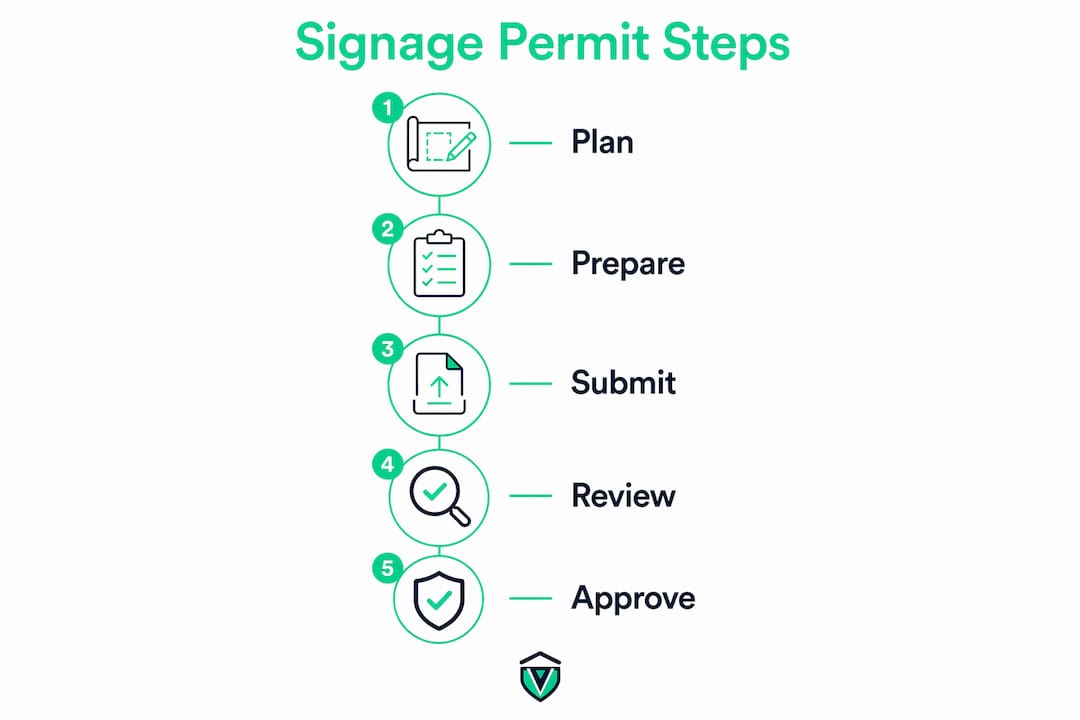
The signage permit process follows a predictable sequence in most municipalities, though timelines and portal systems vary. Here is the standard workflow:
- Confirm zoning requirements. Identify your property's zoning district and pull the applicable sign standards before designing anything. This determines maximum sign area, height, and permitted sign types.
- Request a preliminary review. Many planning departments encourage applicants to email photos or rough drawings to zoning staff before formal submission. This catches problems early and costs nothing.
- Engage a licensed sign contractor. In cities like Minneapolis, licensed contractors must submit applications on behalf of business owners. Even where it is not required, a licensed contractor's drawings carry more credibility and are less likely to be rejected.
- Register on the municipal portal. By 2026, most cities use digital permitting portals for application submission and fee payment. Austin's Development Services portal, for example, requires account registration before any application can be filed.
- Submit a complete application package. Upload all required documents in the correct format. Include the site plan, scaled drawings, illumination details, and property owner consent where required.
- Apply for a building permit concurrently. A separate building permit is often required alongside the sign permit, particularly for signs exceeding height limits or requiring structural anchoring. Applying for both at the same time prevents a sequential delay that can add weeks to your project.
- Respond to staff comments promptly. Municipal reviewers may issue correction notices or requests for additional information. Fast responses keep your application moving. Permits are tied to exact sign specifications, so any design change after submission requires an updated filing.
- Schedule inspection after installation. Many jurisdictions require a post-installation inspection to confirm the sign matches the approved drawings before the permit is formally closed.
Pro Tip: Track your permit submission date, review deadlines, and any municipal response windows in a centralized system. For operators managing multiple locations, this is where manual tracking breaks down and compliance gaps appear.
If you are also navigating construction or tenant improvement work alongside your signage installation, reviewing building permit requirements will clarify where the two processes intersect.
What happens if you skip the signage permit?
Skipping the sign permit process is a short-term shortcut with long-term costs. Noncompliance with signage permit requirements can trigger fines, stop-work orders, and forced removal of the sign at the business owner's expense.
The consequences follow a predictable escalation:
- Notice of violation issued by the zoning or code enforcement department
- Daily fines that accumulate until the violation is corrected
- Stop-work order halting any related construction or installation activity
- Mandatory removal order requiring the business to take down the sign within a specified period
- Complications with future permits because a violation history can delay or complicate approval of subsequent applications at the same address
Beyond the direct penalties, an unpermitted sign creates liability exposure. If the sign causes property damage or injury and it was never permitted, the business owner's insurance coverage may not apply. For franchise operators and multi-location retailers, a single noncompliant sign at one location can trigger a broader audit of signage across the portfolio.
If you discover a sign was installed without a permit after the fact, the standard remedy is to apply for a retroactive permit. Some municipalities allow this; others require removal and reinstallation. Either way, the cost and disruption are significantly higher than getting the permit right the first time.
Key takeaways
A signage permit is a non-negotiable legal requirement for most business signs, and skipping it creates financial, operational, and reputational risk that far outweighs the cost of compliance.
| Point | Details |
|---|---|
| Permit is legally required | Most outdoor business signs require municipal authorization before installation or alteration. |
| Documentation must be precise | Site plans, scaled drawings, and unlocked PDF formats are standard requirements that affect approval speed. |
| Sign type determines permit type | Freestanding, illuminated, temporary, and billboard signs each follow different regulatory tracks. |
| Exemptions do not equal freedom | Exempt signs still must comply with all applicable zoning rules, including placement and size limits. |
| Concurrent permits save time | Applying for sign and building permits simultaneously prevents sequential delays on installation projects. |
Why the permit conversation needs to happen before the sign is designed
Most of the businesses I work with treat the permit as the last step. They finalize the design, order fabrication, and then ask about permits. That sequence is backwards, and it costs real money.
I have seen operators pay twice for sign fabrication because the first version exceeded the allowable square footage for their zoning district. I have seen grand opening timelines pushed back three weeks because a licensed contractor was not engaged until after the application window closed. These are not edge cases. They are the predictable result of treating compliance as an afterthought.
The pre-application consultation that most zoning departments offer for free is one of the most underused tools in commercial real estate. A 20-minute conversation with a zoning planner before you finalize your sign design can eliminate every major rejection risk. It is not bureaucratic friction. It is free consulting from the people who will approve or deny your application.
For multi-location operators, the challenge compounds. Each municipality has its own portal, its own fee structure, its own file format requirements, and its own review timeline. Managing that across 10, 20, or 50 locations in a spreadsheet is how violations accumulate quietly until an audit surfaces them all at once. The operators who scale without compliance problems are the ones who build permit tracking into their expansion process from day one, not as a reaction to a violation notice.
— Rakin
How Vaultedai helps you stay ahead of signage compliance
Managing signage permits across multiple locations means tracking application deadlines, renewal dates, contractor submissions, and municipal feedback simultaneously. For growing businesses, that complexity outpaces what any spreadsheet can reliably handle.
Vaultedai centralizes permit tracking, renewal alerts, and compliance documentation across every location in one place. Whether you are a restaurant group opening a fifth location or a convenience store chain managing signage across three states, Vaultedai gives you visibility into what is approved, what is pending, and what is at risk. The platform is built for operators who cannot afford a compliance gap to surface at the wrong moment.
FAQ
What is a signage permit in simple terms?
A signage permit is an official approval from your local city or county government that authorizes you to install, change, or move a business sign. It confirms the sign meets local zoning, safety, and design standards.
Do I need a signage permit for every sign?
Most permanent outdoor signs require a permit, but some small signs and certain temporary banners may be exempt. Even exempt signs must comply with local zoning rules, so always verify with your municipal zoning department before installation.
How long does the signage permit process take?
Timelines vary by municipality and application complexity. Simple wall sign applications in cities with digital portals can be approved in one to two weeks. Signs requiring variances or structural review can take several months.
Can I submit a signage permit application myself?
In some cities, such as Minneapolis, only licensed sign contractors can submit applications. In others, business owners may apply directly. Check your local municipality's requirements before assuming either option is available.
What is the difference between a sign permit and a building permit?
A sign permit authorizes the sign's design and placement under zoning rules. A building permit covers structural installation and is often required separately, especially for large or structurally complex signs. Both may be needed for the same project.