
A weights and measures permit is a mandatory regulatory license that certifies commercial weighing and measuring devices for accuracy and legal compliance. Any business that uses a scale, fuel pump, taxi meter, or UPC scanner to determine a price or charge must hold this license before operating that device commercially. Weights and measures regulations exist to protect both consumers and businesses from inaccurate measurements that distort transactions. Understanding what this permit requires, and how to stay current, is a non-negotiable part of running a compliant operation.
What is a weights and measures permit, and who needs one?
A weights and measures permit is the official authorization that allows a business to use a commercial measuring device in a transaction. The permit confirms that the device has been inspected, calibrated, and certified to meet accuracy standards set by regulatory bodies such as the National Institute of Standards and Technology (NIST). Without it, operating that device is a violation of weights and measures regulations.
The permit applies to any device used to determine a charge. That definition is broader than most business owners expect. Devices covered include retail scales, fuel dispensers, taxi meters, and point-of-sale UPC scanners. If a customer pays based on a measurement that device produces, the device needs a permit.

Weights and Measures divisions regulate commercial commerce to ensure marketplace fairness and provide technical oversight that protects businesses from unfair competition. That means the permit is not just a bureaucratic checkbox. It is the mechanism that keeps the playing field level for every business in a market.
The weights and measures license is distinct from a general business license. You can hold a valid business license and still be out of compliance if your commercial devices are not individually permitted and certified.
Which commercial devices require a permit?
The rule is straightforward: any device used to determine a charge in a commercial transaction requires a weights and measures permit. Devices used to determine charges, including shipping scales and taxi meters, are classified as commercial and fall under regulatory requirements.
Devices that typically require permits include:
- Retail scales at grocery stores, delis, butcher shops, and farmers markets
- Fuel dispensers at gas stations and truck stops
- Taxi and rideshare meters used to calculate fare by distance or time
- UPC barcode scanners used at point of sale to determine price by weight
- Shipping scales used to calculate postage or freight charges
- Pharmacy scales used to measure dispensed medications sold by weight
Non-commercial devices are generally exempt. An internal process scale used only for quality control, with no role in determining what a customer pays, does not require a permit. The line is drawn at the point where a measurement affects a transaction.
Pro Tip: Many business owners mistakenly believe that a device used only occasionally is exempt. If that device ever determines a charge, even once, it requires a permit. Occasional commercial use does not create an exemption.
One detail that catches operators off guard: a single fuel dispenser cabinet often contains multiple internal meters, each of which requires its own separate permit and fee. Counting cabinets instead of meters leads to under-reporting and penalties. Audit your equipment at the meter level, not the cabinet level.
How to get a weights and measures permit
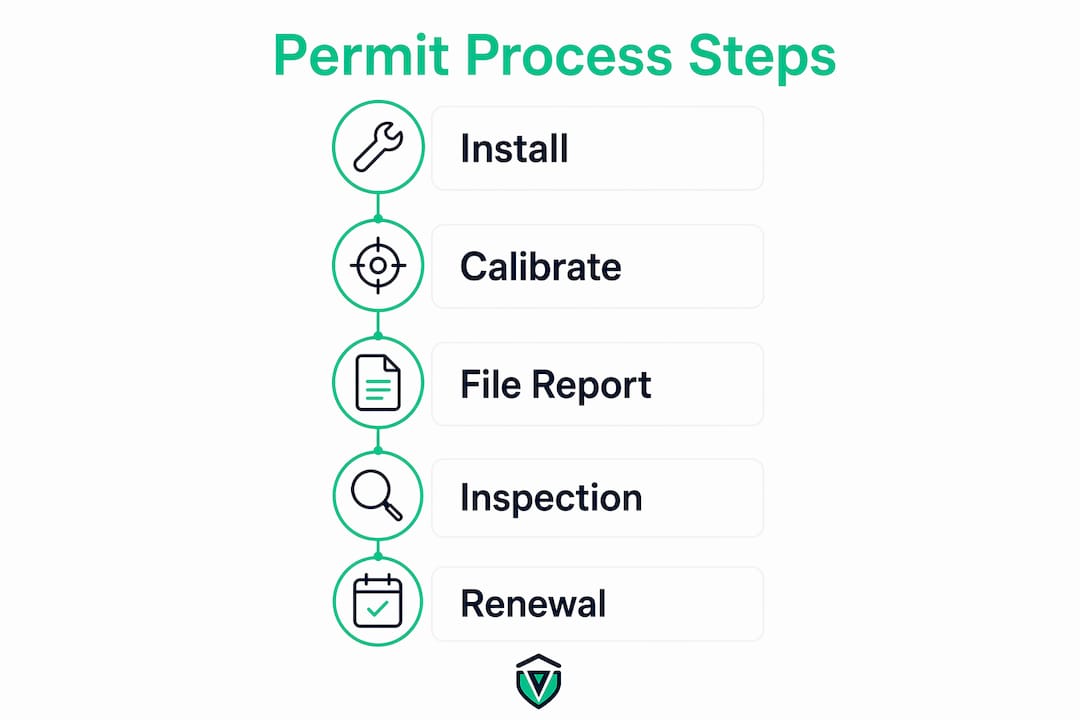
Getting a weights and measures permit follows a defined process. Skipping any step, or getting the order wrong, creates compliance exposure before your device ever serves a customer.
-
Purchase a device with NTEP certification. The National Type Evaluation Program (NTEP) issues Certificates of Conformance (COC) that confirm a device model is legal for trade. Buy only devices that carry a valid NTEP COC before installation.
-
Hire a registered service technician. Registered servicemen certify devices and manage compliance reporting on behalf of businesses. The technician installs and calibrates the device to meet the tolerances required by NIST Handbook 44.
-
File the Placed in Service Report (PISR). The PISR must be submitted by the registered technician before the device is used commercially. Operating a device before this report is filed can result in immediate fines.
-
Pay the application fee. Fees vary by jurisdiction and device type. Penalties for unlicensed devices start at $100 per device in states like Oregon, and they compound quickly across a multi-device operation.
-
Receive your permit and display it. Most jurisdictions require the permit or inspection sticker to be visible on or near the device.
-
Renew annually. Weights and measures licenses follow annual renewal cycles. Renewal notices are typically mailed in november for a january renewal cycle. Missing the deadline does not pause your obligation. Your device remains in commercial use, and the violation clock keeps running.
The renewal step is where most multi-location businesses lose track. A compliance calendar built around your specific renewal dates by location prevents the gap between expiration and renewal from becoming a liability.
What regulatory standards govern device compliance?
NIST Handbook 44 is the primary technical standard for commercial weighing and measuring devices in the United States. It defines the tolerances, design requirements, and performance criteria that every permitted device must meet. Most state weights and measures programs adopt Handbook 44 directly or use it as the baseline for their own regulations.
The NTEP Certificate of Conformance is the pre-market checkpoint. Before a device type can be sold for commercial use, the manufacturer submits it for evaluation. Using uncertified devices can lead to costly retrofits or full replacements when inspectors flag non-conforming equipment. Buying a device without verifying its NTEP COC is one of the most expensive mistakes a business owner can make.
Pro Tip: Before purchasing any new scale or meter, search the NTEP database at ntep.org to confirm the specific model carries a valid Certificate of Conformance. The model number on the COC must match the device you are buying, not just the brand.
Annual inspections and certifications are standard practice across all jurisdictions. Failure to recertify leads to potential device disqualification from commerce and financial penalties. The inspection process verifies that the device still performs within the tolerances set by NIST Handbook 44, accounting for wear, calibration drift, and any modifications made since the last inspection.
Retrofitting a non-compliant device to meet NIST Handbook 44 tolerances is technically possible in some cases. In practice, the cost of retrofitting older equipment often exceeds the cost of replacement, especially for fuel dispensers and high-volume retail scales.
How do jurisdictional differences affect multi-location businesses?
Weights and measures licensing is not a federal program with a single national permit. Licensing is often managed at the county or municipal level rather than centralized statewide. That means a business with locations in three counties may be dealing with three separate licensing authorities, three different fee schedules, and three different renewal timelines.
For multi-location operators, this creates real compliance risk:
- Fee structures vary. One county may charge a flat annual fee per device. Another may use a tiered structure based on device type or transaction volume.
- Renewal deadlines differ. A january renewal in one county may be an april renewal in the next. Missing one deadline while tracking another is a common failure point.
- Inspection schedules are independent. Each jurisdiction runs its own inspection program. An inspection passed in one location does not satisfy requirements in another.
- Permit applications are separate. There is no cross-jurisdictional permit. Businesses with multiple locations must verify and maintain licensing requirements at each jurisdiction individually.
Convenience stores, gas stations, and franchise operators face the highest exposure here because they typically run the most regulated devices across the most locations. A multi-unit compliance guide built around your specific device inventory and location map is the most reliable way to stay ahead of these differences. Tracking this manually across even five locations creates the kind of gaps that inspectors find quickly.
Key Takeaways
A weights and measures permit is required for every commercial measuring device, and compliance must be maintained separately at each jurisdiction where you operate.
| Point | Details |
|---|---|
| Permit is device-specific | Every commercial scale, meter, or scanner needs its own permit, not just the location. |
| NTEP certification comes first | Buy only devices with a valid NTEP Certificate of Conformance before installation. |
| PISR must precede device use | A registered technician must file the Placed in Service Report before you operate the device. |
| Renewal is annual and jurisdiction-specific | Deadlines and fees vary by county; multi-location businesses must track each separately. |
| Non-compliance carries financial penalties | Unlicensed devices can trigger fines starting at $100 per device, with ongoing exposure until resolved. |
Why proactive permit management matters more than most operators realize
Most business owners treat weights and measures compliance as a one-time task. Get the permit, pass the inspection, move on. That mindset is exactly what leads to violations.
The real risk is not the initial permit. It is the renewal cycle, especially across multiple locations with different jurisdictions and different device counts. I have seen operators who were fully compliant at launch get cited two years later because a renewal notice went to an old address, or because a new fuel dispenser was installed without a PISR filed first. The fine was not the worst part. The worst part was the device being pulled from service during a busy period.
Working with registered service technicians consistently, not just at installation, is the single most effective practice I have seen. These technicians know the local requirements, file the paperwork correctly, and flag calibration drift before it becomes a compliance issue. Treating them as a recurring vendor rather than a one-time contractor changes your compliance posture entirely.
The marketplace equity argument is also underappreciated. Weights and measures inspection prevents unfair business practices and keeps the trading field level. A competitor using an uncalibrated scale that consistently reads light is effectively stealing market share. Compliance is not just about avoiding fines. It is about operating in a market where the rules apply equally to everyone.
If you run more than two locations, a spreadsheet is not a compliance system. It is a liability waiting to surface.
— Rakin
Vaultedai makes permit tracking manageable at scale
Managing weights and measures permits across multiple locations means tracking device-level permits, jurisdiction-specific renewal dates, technician certifications, and inspection records, all at once.
Vaultedai is built for exactly this kind of operational complexity. The platform centralizes permits, licenses, and renewal deadlines across all your locations in one place, so nothing slips through when a county mails a renewal notice to the wrong address or a new device goes into service without documentation. Businesses like convenience store groups, gas station operators, and franchise teams use Vaultedai to replace manual tracking with a system that surfaces what needs attention before it becomes a violation. Visit Vaultedai to see how the platform handles permit management at scale.
FAQ
What is a weights and measures permit?
A weights and measures permit is a required regulatory license that certifies a commercial measuring device, such as a scale or fuel pump, meets accuracy standards for use in commercial transactions.
Which devices need a weights and measures license?
Any device used to determine a charge in a commercial transaction requires a license. This includes retail scales, fuel dispensers, taxi meters, UPC scanners, and shipping scales.
How do I get a weights and measures permit?
A registered service technician installs and calibrates the device, files the Placed in Service Report, and submits the permit application with the required fee to the appropriate local or state authority.
How often does a weights and measures permit need to be renewed?
Most jurisdictions require annual renewal. Renewal notices are typically mailed in november for a january cycle, but deadlines vary by county, so multi-location businesses must track each jurisdiction separately.
What happens if I operate without a weights and measures permit?
Operating a commercial device without a valid permit can result in fines starting at $100 per device, device disqualification from commerce, and ongoing penalties until the device is properly licensed and certified.