

A home occupation permit is official zoning authorization from a city or county that allows you to legally operate a business from your residence while preserving the residential character of your neighborhood. Without it, running even a low-traffic consulting practice or online retail operation from your home may violate local zoning codes and expose you to fines or forced closure. The term "home occupation permit" is the common search phrase, but local governments often call it a "home occupation license," "home-based business permit," or "residential business authorization." Whatever the label, the function is the same: it tells your municipality that your business activity is incidental and secondary to your home's primary use as a residence.
What is a home occupation permit and what does it cover?
A home occupation permit is local zoning permission to operate a business from a residence without changing the home's residential character. That definition matters because zoning law treats your property as a residence first. The permit does not transform your home into a commercial property. It simply carves out a legal space for limited business activity within an existing residential zone.
The permit covers a wide range of solo or low-impact businesses. Freelance writers, accountants, tutors, hair stylists with a single chair, and software developers all commonly operate under home occupation permits. What the permit authorizes is the activity, not the physical space. You are still living in a home. The business is a secondary use.

Most jurisdictions define eligibility around a core principle: the business must not create impacts that a typical neighbor would notice or find offensive. Shawnee County, Kansas, for example, limits home occupation to non-noticeable business with no offensive effects on the surrounding neighborhood. That single standard drives most of the specific rules you will encounter during the application process.
What does a home occupation permit typically allow and restrict?
The permit grants you legal standing to operate, but it comes with firm boundaries. Understanding those boundaries before you apply saves you from surprises during the review process.
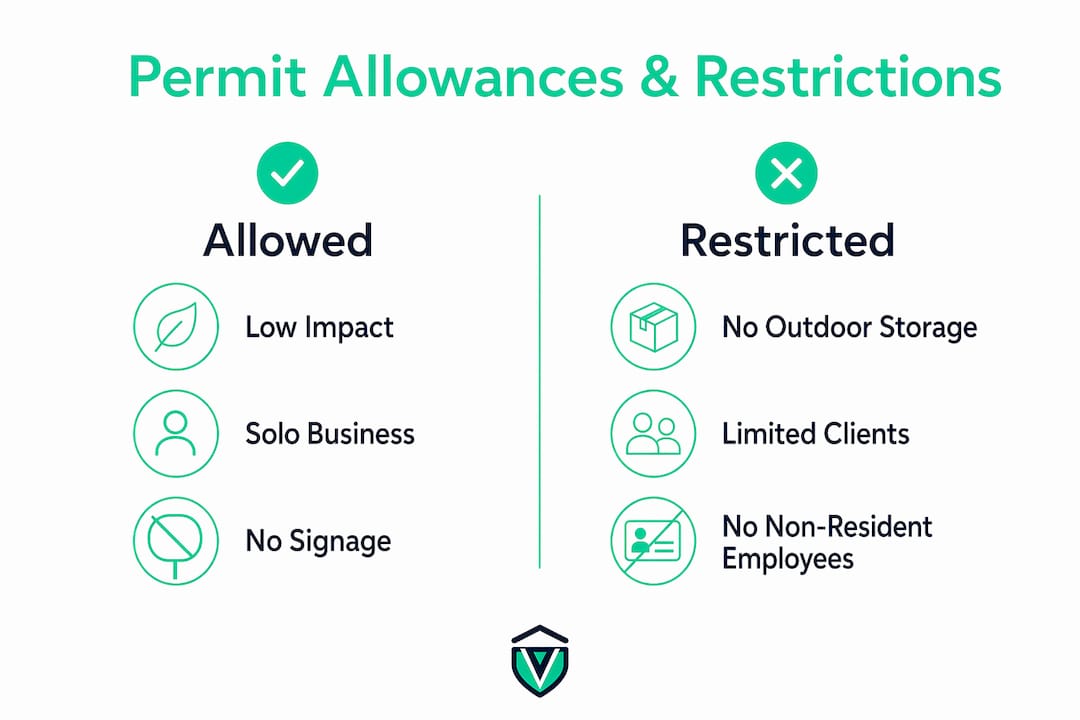
Common allowances under most home occupation permits:
- Office-based work such as consulting, bookkeeping, design, and writing
- Limited client visits, often capped at one or two per day
- Use of a dedicated room or area for business storage or equipment
- Receiving business-related deliveries at the residential address
- Operating an online store where no retail customers visit the property
Common restrictions you will face:
- No exterior signage advertising the business on the property
- No employment of non-residents on the premises. The City of Champaign, Illinois, prohibits on-site employment by non-residents and limits business use to 25% of the dwelling's floor area. That 25% cap is a practical ceiling that many jurisdictions mirror.
- No outdoor storage of business inventory, equipment, or vehicles
- No noise, glare, dust, or traffic that exceeds what a normal residential street generates
- No use of accessory buildings such as garages or sheds as primary business space in many cities
Champaign's code also forbids outdoor storage and advertising and sets nuisance standards for noise, glare, and dust. Those standards exist to protect neighbors, not to burden you. If your business generates none of those impacts, you are unlikely to face objections.
Pro Tip: Document your anticipated business impacts in writing before you apply. List expected client visits per week, delivery frequency, and any equipment that produces noise or odor. Accurate self-disclosure speeds up approval and protects you if a neighbor later files a complaint.
How to apply for a home occupation permit
The application process runs through your local planning or zoning department, not the state. Every municipality sets its own requirements, but the steps below reflect what most cities and counties expect.
-
Identify the correct department. Start with your city or county planning department's website. Search for "home occupation permit" or "home-based business regulations." If you cannot find it online, call the zoning counter directly.
-
Gather required documentation. Most jurisdictions require a completed application form, proof of residence such as a utility bill or lease, a description of the business activity, and an affidavit confirming the property is your primary residence. Nashville, Tennessee, requires an affidavit affirming primary residency and notification of adjacent neighbors before approval.
-
Notify adjacent neighbors if required. Some cities require you to send written notice to neighbors within a set radius, typically 100 to 300 feet. Nashville's process includes this step. Neighbor notification gives residents a chance to raise concerns before the permit is issued rather than after.
-
Submit the application and pay the fee. Fees vary widely. Some cities charge nothing. Others charge between $25 and $150 for initial review. The City of Sherwood, Oregon, requires annual permit fees along with separate business registration and licensing.
-
Wait for review and respond to any conditions. Most applications are reviewed administratively, meaning a zoning officer approves them without a public hearing. If your business raises concerns, you may be asked to modify your operating plan or attend a hearing.
-
Receive your permit and post or retain it as required. Some jurisdictions require you to keep the permit on file. Others require it to be displayed. Confirm the requirement when you pick up your approval.
Pro Tip: Check your HOA rules and your lease agreement before you submit anything to the city. A home occupation permit from the city does not override a lease clause that prohibits business activity or an HOA covenant that bans client visits. Resolve those conflicts first.
For professional services businesses navigating multiple permit types, a business consultation service can help you map out the full documentation checklist before you submit.
How a home occupation permit differs from a general business license
These two documents are not interchangeable. Confusing them is one of the most common mistakes new home-based business owners make.
| Document | What it authorizes | Who issues it |
|---|---|---|
| Home occupation permit | Zoning approval to operate a business at a residential address | City or county planning/zoning department |
| Business license | Legal authorization to conduct business operations in a jurisdiction | City, county, or state revenue or licensing office |
| State professional license | Authorization to practice a regulated profession (e.g., cosmetology, accounting) | State licensing board |
The SBA guidance on business registration makes clear that local agencies regulate permits separately from business licenses. You need both. The home occupation permit says your location is approved. The business license says your operation is approved. Running a business with only one of the two leaves you legally exposed on the other front.
State professional licenses add a third layer for regulated industries. A licensed massage therapist working from home needs the home occupation permit, a local business license, and a state-issued massage therapy license. All three serve different regulatory purposes. For a deeper look at what a local business license requires, the distinction becomes even clearer when you compare the application processes side by side.
Common challenges and limitations with home occupation permits
Even well-prepared applicants run into obstacles. Knowing the most common ones in advance lets you address them before they become problems.
-
Non-resident employee restrictions. Most jurisdictions prohibit you from having employees come to your home to work. If your business model requires even one part-time assistant on-site, you may not qualify for a standard home occupation permit. A conditional use permit or a commercial lease may be the only path forward.
-
Customer visit limits. High-traffic businesses like tutoring centers, hair salons with multiple chairs, or physical therapy practices often exceed the client visit thresholds that residential zoning allows. Nashville limits one permit per property owner and the permit is not transferable or assignable. That means if you sell your home, the permit does not transfer to the buyer.
-
Retail and sales restrictions. Some jurisdictions restrict retail or sales activities even when customer traffic is minimal. A Utah advisory opinion on home occupations notes that some retail activities may be restricted under residential zoning definitions regardless of traffic volume. If your business involves selling physical goods to walk-in customers, confirm that your city's zoning code permits it.
-
Permit denial and appeals. Denial usually happens when the proposed business creates noticeable impacts or when the application is incomplete. You can often appeal to a zoning board of adjustment or apply for a variance. A conditional use permit is another option that grants approval with specific operating conditions attached.
-
Permit revocation. If your business grows and begins generating complaints from neighbors, your permit can be revoked. The approval decision hinges on whether the business creates noticeable or offensive impacts. What was acceptable at launch may not be acceptable two years later if your client volume doubles.
Maintaining compliance and renewal considerations
Getting the permit is step one. Keeping it valid is an ongoing responsibility that many home-based business owners underestimate.
-
Track renewal deadlines. Some cities require annual renewal with a fee. Sherwood, Oregon, mandates annual renewal. Other cities issue permits with no expiration but reserve the right to revoke them if conditions change. Confirm your renewal schedule the day you receive your permit.
-
Report changes in business activity. If you add a service, hire a part-time employee, or start receiving more client visits, notify your zoning department. Operating outside the scope of your approved permit is a violation even if you hold a valid permit.
-
Document your compliance continuously. Keep records of client visit logs, delivery schedules, and any neighbor communications. If a complaint is filed, documentation showing consistent compliance is your strongest defense.
-
Align permit renewal with business license renewal. Many cities require both documents to be current simultaneously. Renewing them on the same schedule reduces the chance of letting one lapse while the other is active. For practical guidance on staying compliant during growth, the same principles that apply to multi-location businesses apply to home-based ones at a smaller scale.
-
Verify HOA and lease status annually. HOA rules and lease terms can change. An annual check confirms that your home occupation permit still aligns with your property's private restrictions, not just its public zoning status.
Pro Tip: Set a calendar reminder 60 days before your permit's anniversary date. Use that window to review your business activity against your original application, confirm your renewal fee amount, and update your documentation if anything has changed.
Key takeaways
A home occupation permit is a zoning authorization, not a business license, and you need both documents to legally operate a home-based business in most U.S. jurisdictions.
| Point | Details |
|---|---|
| Definition and purpose | A home occupation permit is local zoning approval to run a business from home without changing the property's residential character. |
| Core restrictions | Most permits prohibit non-resident employees, exterior signage, outdoor storage, and business activity that generates noticeable neighborhood impacts. |
| Application requirements | Expect to submit an affidavit, proof of residence, a business description, and neighbor notifications in cities like Nashville. |
| Permit vs. business license | The permit approves your location; the business license approves your operation. Both are required and issued by different agencies. |
| Ongoing compliance | Track renewal deadlines, report activity changes, and document compliance continuously to avoid revocation. |
The part most guides skip over
Most articles about home occupation permits treat the process as a paperwork exercise. Fill out the form, pay the fee, get the stamp. That framing misses the real dynamic at play.
Home occupation permits prioritize protecting neighborhood livability over internal paperwork requirements. That is not bureaucratic language. It means the zoning officer reviewing your application is thinking about your neighbors, not your business plan. The fastest path to approval is demonstrating, clearly and specifically, that your neighbors will not notice you are running a business.
I have seen applicants get denied not because their business was problematic but because their application was vague. "I will have occasional client visits" is not a useful answer. "I expect two client visits per week, each arriving by personal vehicle, with no deliveries" is. Specificity signals that you have thought through the neighborhood impact, which is exactly what the reviewer needs to see.
The other mistake I see repeatedly is treating the home occupation permit as the finish line. It is the starting line. Your permit is a snapshot of your business at the time of application. If your business grows, your permit needs to grow with it. Applicants who prepare documentation early and stay proactive about reporting changes almost never face revocation. Those who treat the permit as a one-time checkbox frequently do.
Check your HOA and lease before anything else. I cannot overstate how often people complete the entire city application process only to discover their HOA prohibits client visits entirely. That is a fixable problem if you catch it before you apply. It is a much harder problem if you catch it after you have already told your clients where to find you.
— Rakin
Track your home occupation permit with Vaultedai

Managing a home occupation permit sounds simple until you are also tracking a business license renewal, a state professional license, and an HOA compliance review at the same time. Vaultedai's AI Business Permit Tracker centralizes every permit, license, and renewal deadline in one place so nothing slips through. The platform is built for businesses that have moved past spreadsheets and need a single source of truth for compliance documents. Whether you are running one home-based operation or scaling to multiple locations, Vaultedai gives you visibility into what is current, what is expiring, and what needs attention before a deadline becomes a violation.
FAQ
What is a home occupation permit in simple terms?
A home occupation permit is local government approval to run a business from your home without violating residential zoning rules. It confirms your business activity is secondary to your home's use as a residence.
Do I need both a home occupation permit and a business license?
Yes. The home occupation permit approves your location under zoning law, while the business license authorizes your business operation. The SBA confirms that local agencies regulate these two documents separately.
Can I have employees work at my home under a home occupation permit?
Most jurisdictions prohibit non-resident employees from working on the premises. Champaign, Illinois, explicitly bans on-site employment by non-residents as part of its home-based business regulations.
How often do I need to renew a home occupation permit?
Renewal requirements vary by city. Sherwood, Oregon, requires annual renewal with a fee. Other cities issue permits with no set expiration but can revoke them if your business activity changes or generates complaints.
What happens if I operate without a home occupation permit?
Operating without the required permit violates local zoning codes and can result in fines, a cease-and-desist order, or forced closure of your home-based business until you obtain proper authorization.