
A sidewalk permit is an official municipal authorization required whenever a business or individual uses, repairs, or modifies public sidewalk space for private purposes. Without one, you risk fines, project shutdowns, and personal liability for any pedestrian injuries that occur on your worksite. This guide covers the main types of sidewalk permits, the standard application process, typical costs, and the most common mistakes that delay approvals. Everything here reflects 2026 standards and real fee structures from cities including Pittsburgh and San Francisco.
What is a sidewalk permit and why does it matter?
A sidewalk permit is the formal authorization that transfers legal responsibility for a section of public right-of-way from the municipality to the permit holder. That transfer is the key point most business owners miss. Sidewalks are public property, not private land, even when they sit directly in front of your building. Any private use or modification requires formal authorization, full stop.
The permit system exists for three reasons: pedestrian safety, accessibility compliance, and liability control. When you hold a sidewalk permit, you accept responsibility for maintaining a safe path for the public during your project or operation. Liability shifts to the permit holder, which protects the city from legal risk while holding businesses to a clear safety standard. For contractors, this means your insurance and bonding are on the line if something goes wrong without proper authorization.
Cities also use the permit process to coordinate competing uses of limited sidewalk space. A restaurant setting up outdoor tables, a contractor staging equipment, and a utility crew repairing a gas line cannot all occupy the same stretch of sidewalk without coordination. The permit system creates that order.
What are the different types of sidewalk permits?
Permit categories scale with project scope and intended use. Choosing the wrong category is one of the fastest ways to trigger a rejection or a restart of your application.
Repair and construction permits
A Sidewalk Repair Permit covers minor fixes such as replacing cracked panels, patching trip hazards, or resetting settled slabs. Minor repairs under 100 sq ft typically fall under a basic maintenance permit category. Projects over 2,000 sq ft, or those that alter established grades and drainage flowlines, require a full Street Improvement Permit with a more rigorous engineering review. Los Angeles classifies these as A-Permits for minor work, with compliance required under Greenbook specifications.
Occupancy and use permits
These permits cover private use of sidewalk space without permanent construction. Common examples include:
- Sidewalk Café Permit: Required for restaurants and bars placing tables, chairs, or barriers on the public sidewalk. Most cities require a minimum clear pedestrian path of 4–6 feet at all times.
- Temporary Event Permit: Covers short-term sidewalk use for festivals, pop-up markets, or promotional events.
- Mobile Vendor Permit: Required for food carts, merchandise stands, or any commercial operation conducted from a fixed sidewalk location.
- Street Occupancy or Obstruction Permit: Required when construction equipment, dumpsters, or scaffolding blocks pedestrian access. This permit often runs concurrently with a repair or construction permit.
The last category surprises many contractors. A sidewalk repair permit alone does not authorize blocking pedestrian access. If your work requires a lane closure or equipment staging in the right-of-way, you need a separate street occupancy permit on top of your primary permit.
What is the standard sidewalk permit application process?
The application process follows a consistent pattern across most U.S. cities, though specific forms and fees vary by jurisdiction.
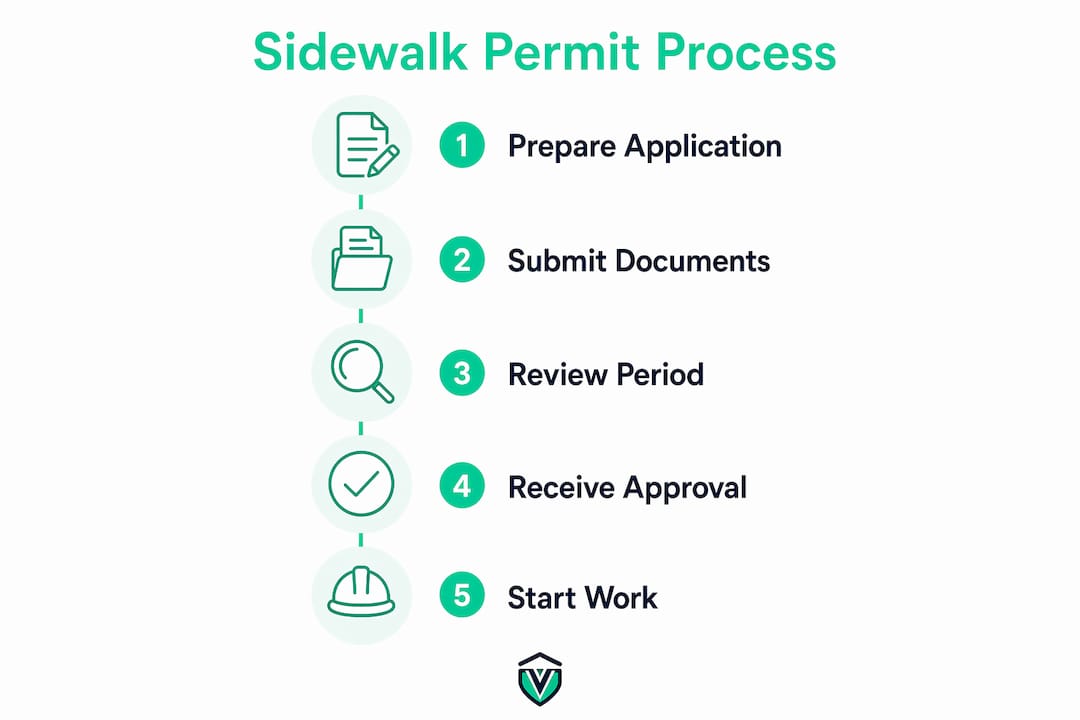
- Confirm the correct permit type. Match your project scope to the right permit category before you fill out a single form. A misclassified application wastes weeks.
- Gather required documentation. Most cities require a site plan or scaled drawing, high-resolution photographs of the work area, a detailed description of the proposed work, and proof of liability insurance. Contractors must also provide their registration number, bond certificate, and contractor's license.
- Submit the application. Most municipalities now accept online submissions through their public works or department of transportation portals. Paper submissions are still accepted in some cities.
- Wait for review. Review times run 1–2 weeks after a complete, accurate application is received. If your submission is incomplete, cities typically notify applicants of deficiencies within 3 business days.
- Schedule a pre-construction meeting. Many cities, including Minneapolis, require a pre-construction meeting before work begins. Skipping this meeting is the most common cause of permit delays, even after a permit has been issued.
- Obtain the permit and post it on site. The permit must be visible at the worksite for the duration of the project.
- Schedule inspections. Final inspections confirm the work meets city standards before the permit closes.
Pro Tip: Submit your application at least four weeks before your project start date. The 1–2 week review window assumes a complete application. Any deficiency resets the clock.
Permit validity periods vary. Most sidewalk repair permits are valid for 90–180 days. Extensions are available in most cities but typically require a written request and an additional fee before the original permit expires.
How much does a sidewalk permit cost?
Permit fees scale with project size, permit type, and local fee schedules. There is no single national standard, but the structure is consistent across most cities.
| Permit type | Typical base fee | Additional charges |
|---|---|---|
| Minor repair (under 25 linear feet) | $235 application + $60 issuance | Inspection fees, bond deposit |
| Large-scale construction (over 2,000 sq ft) | Varies by city; significantly higher | Engineering review, traffic control plan |
| Sidewalk café or occupancy | Annual or seasonal fee | Varies by square footage of occupied space |
| Street obstruction or occupancy | Daily or weekly rate | Equipment type, lane count affected |
| Permit extension | Flat fee per extension request | Typically $50–$150 depending on city |
Pittsburgh's 2026 fee schedule sets the base application fee for repairs under 25 linear feet at $235, plus a $60 issuance fee. That is one of the more transparent public fee structures available. Larger projects in cities like San Francisco or New York carry substantially higher fees due to engineering review requirements and traffic management costs.
Pro Tip: Request the full fee schedule from your city's public works department before budgeting a project. Many cities post updated schedules each january. Missing a fee line item, such as a bond deposit or inspection fee, can stall your project start.
Common challenges and how to avoid permit delays
Most permit rejections and delays trace back to a small set of avoidable mistakes. Knowing them in advance puts you ahead of the majority of applicants.
Poor site documentation is the single most frequent cause of processing delays. Municipalities reject generic screenshots from Google Maps or low-resolution photos. Cities require clear photographs that show the full work area, adjacent fire hydrants, curb ramps, utility covers, and nearby structures. Take photos from multiple angles and in good lighting.
Missing concurrent permits catches contractors off guard. If your sidewalk repair requires a dumpster, a concrete truck, or any equipment that sits in the street or blocks pedestrian flow, you need a street space permit in addition to your repair permit. Applying for only one when you need two guarantees a stop-work order.
Skipping the pre-construction meeting is a mistake that delays projects even after permits are approved. Some contractors assume the permit itself is the green light to begin work. It is not. The pre-construction meeting with the city inspector confirms site conditions and work scope before any ground is broken.
Other common pitfalls include:
- Submitting incomplete contractor credentials (missing bond certificate or expired license)
- Failing to account for permit management errors that compound across multiple locations
- Not requesting an extension before the permit expiration date
- Underestimating project scope, which triggers a permit reclassification mid-project
Pro Tip: If your business operates across multiple locations, track each permit's expiration date in a centralized system. A missed renewal at one location can trigger fines that exceed the original permit cost.
Key Takeaways
A sidewalk permit is a legal requirement for any private use or modification of public sidewalk space, and the permit type must match the project scope exactly.
| Point | Details |
|---|---|
| Sidewalks are public property | Any private use or modification requires formal municipal authorization, regardless of proximity to your building. |
| Match permit type to project scope | Minor repairs, large construction, café use, and street obstruction each require a different permit category. |
| Documentation quality determines speed | High-resolution photos showing fire hydrants, curb ramps, and utilities prevent the most common processing delays. |
| Multiple permits may be required | A repair permit does not cover street obstruction; concurrent permits are often necessary for full compliance. |
| Pre-construction meetings are mandatory | Skipping the required pre-construction inspection is the leading cause of delays after permit issuance. |
Why sidewalk permits deserve more respect than they get
Most business owners treat sidewalk permits as a bureaucratic box to check. I think that framing costs them money and time.
The permit is not the obstacle. The permit is the record that proves you did the work correctly, with proper authorization, under the right insurance coverage. When a pedestrian trips on a section of sidewalk your contractor just repaired, the permit is what stands between you and a lawsuit. That is not a small thing.
What I have seen repeatedly is that the businesses that struggle most with sidewalk permits are the ones that start the process too late. They find out about the permit requirement two weeks before a planned renovation, rush the application, submit incomplete documentation, and then spend the next month chasing approvals while their project sits idle. The permit management process rewards early movers.
The other mistake I see is treating every city as identical. Pittsburgh's fee structure is public and detailed. San Francisco's process requires concurrent permits that other cities handle as a single application. Minneapolis mandates pre-construction meetings that other cities treat as optional. Assuming your experience in one city transfers directly to another is how you end up with a stop-work order on day one.
My honest advice: build permit research into your project planning phase, not your pre-construction phase. Know what you need, who issues it, and what it costs before you sign a contract or set a timeline. That discipline separates contractors who run clean projects from those who spend their margins on delay fees.
— Rakin
How Vaultedai helps you stay ahead of permit deadlines
Tracking sidewalk permits across one location is manageable. Tracking them across five, ten, or twenty locations is where things break down fast.

Vaultedai is built for multi-location businesses that need a single place to manage permits, renewals, and compliance documents without relying on spreadsheets or calendar reminders. The platform centralizes every permit, flags upcoming expirations, and keeps your documentation organized so you are never caught off guard by a renewal deadline or an inspector's request. Restaurant groups, franchise operators, and contractors managing multiple sites use Vaultedai's permit tracker to cut the administrative load and keep every location in good standing. If your business has outgrown manual tracking, it is worth a look.
FAQ
What is a sidewalk permit used for?
A sidewalk permit authorizes private use or modification of public sidewalk space, covering activities from café seating and vendor operations to construction repairs and street obstruction. It transfers legal responsibility for pedestrian safety to the permit holder during the authorized activity.
Do you need a sidewalk permit for minor repairs?
Yes. Even minor repairs such as replacing cracked panels or patching trip hazards require a permit in most cities. Pittsburgh's 2026 fee schedule shows that repairs under 25 linear feet carry a base application fee of $235 plus a $60 issuance fee.
How long does a sidewalk permit application take?
Most cities complete their review within 1–2 weeks after receiving a complete application. Incomplete submissions trigger a deficiency notice within 3 business days, which resets the review timeline.
How much does a sidewalk permit cost?
Costs vary by city and project scope. Base fees for minor repairs start around $235 in cities like Pittsburgh, while large-scale construction or street occupancy permits carry significantly higher fees depending on project size and local engineering review requirements.
Can you start work as soon as the permit is approved?
Not always. Many cities require a pre-construction meeting with a city inspector before work begins, even after the permit is issued. Starting work without completing that step is a common cause of stop-work orders and project delays.