
When you need to handle permit transfers in franchise ownership, you're managing two separate approval processes at once: your franchisor's consent and local government authorization. Most owners assume permits follow the deal automatically. They don't. Missing one deadline or submitting an incomplete application can void your transfer, delay your closing, or leave your new location in legal limbo. This guide walks you through every stage of a franchise ownership transfer, from reading your agreement's transfer clauses to confirming permits with local authorities after closing.
Table of Contents
- Key takeaways
- How to handle permit transfers in franchise ownership
- Franchisor approval and the ROFR process
- Local permit transfers and coordination
- Executing the transfer: documents, fees, and compliance
- Post-transfer verification and ongoing obligations
- Why parallel approvals save deals: a personal view
- Manage franchise transfers without the spreadsheet chaos
- FAQ
Key takeaways
| Point | Details |
|---|---|
| Franchisor consent comes first | Treat franchisor approval as the gating factor before any other transfer step moves forward. |
| Permits rarely transfer automatically | Local permits tied to franchise operations typically require separate reapplication or assignment approval. |
| ROFR windows affect your timeline | A 30 to 45-day right of first refusal period must be built into your purchase agreement timeline. |
| Run parallel workstreams | Start the permit approval process simultaneously with franchisor review to avoid closing delays. |
| Post-transfer obligations are real | Non-compete clauses, training requirements, and new franchise agreements bind the buyer after closing. |
How to handle permit transfers in franchise ownership
The formal process for what franchise professionals call a "franchise ownership transfer" or "franchise assignment" covers far more ground than most buyers and sellers expect. The phrase "transfer" sounds simple. In practice, it means satisfying contractual requirements with your franchisor, meeting federal disclosure rules, and clearing local government permit conditions, all within overlapping timelines that don't always align.
The single biggest mistake owners make is treating these as sequential steps. They get franchisor approval, then start on permits. By the time local authorities respond, the franchisor's consent window has lapsed or the buyer has moved on. The smarter approach is to treat this as a project with multiple parallel tracks.

What your franchise agreement actually says
Before any conversation with a buyer or a city clerk, read your franchise agreement's transfer provisions carefully. These clauses define what counts as a transfer in the first place. Equity transfers above certain thresholds, typically between 10% and 25% of ownership, can trigger full transfer restrictions even when the legal entity itself doesn't change hands. That means selling a minority stake to a silent partner might require franchisor consent you never thought to seek.
Key provisions to locate and understand:
- Notice requirements: Most agreements require formal written notice to the franchisor before any transfer action. Missing this can delay or block the entire process.
- Transfer fees: Fees vary based on the buyer's prior franchise experience, training costs, and the franchisor's administrative overhead.
- Franchisor consent clause: This is non-negotiable. Closing without prior consent risks voiding the franchise rights entirely and can constitute a material breach of contract.
- Right of First Refusal (ROFR): Many agreements give the franchisor the right to purchase the franchise on the same terms as your third-party buyer before the sale closes.
- New agreement requirement: In many transfers, the buyer must execute an updated franchise agreement, which may carry different terms than the original.
Pro Tip: Have a franchise attorney review the transfer provisions before you even list the location for sale. Discovering a restrictive clause after you're under contract with a buyer is a costly surprise.
Franchisor approval and the ROFR process
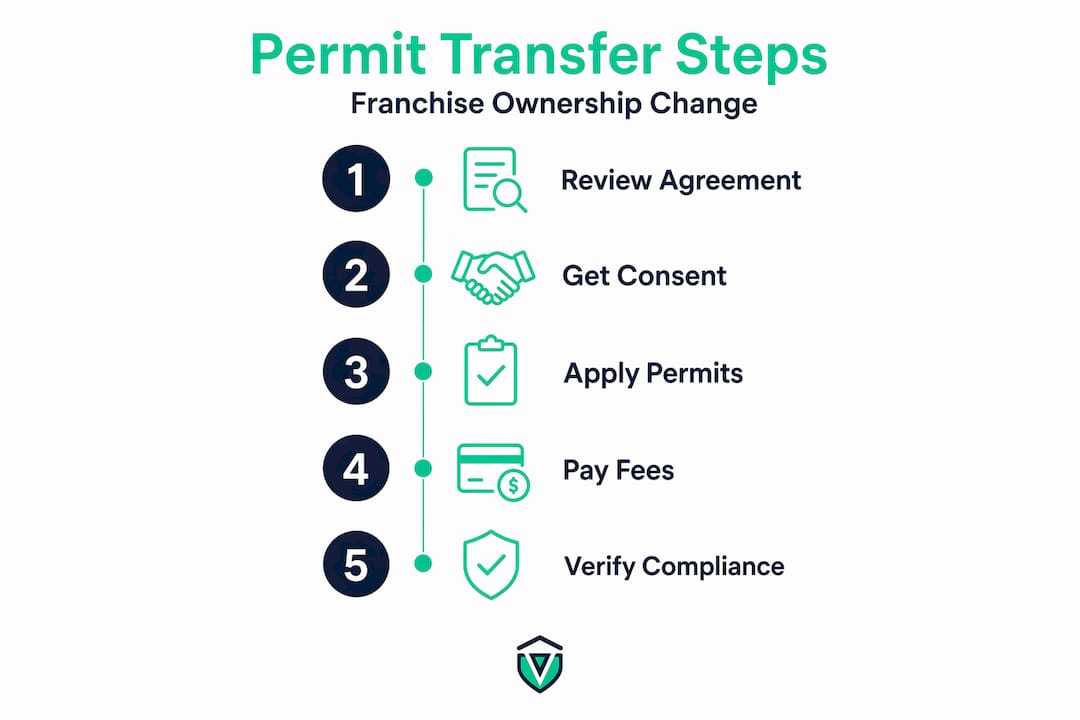
Once you've identified a buyer and are ready to move forward, the franchisor approval process begins. Franchise agreements generally require a formal application packet with detailed documentation before the franchisor will evaluate any transfer request.
Here's the standard sequence:
- Submit written notice to the franchisor as soon as a buyer is identified, even before a purchase contract is finalized.
- Deliver the transfer application package, which typically includes the buyer's financial statements, background check, business experience, and net worth verification.
- Provide the signed purchase agreement to trigger the ROFR period. The ROFR window runs 30 to 45 days, during which the franchisor can elect to step in and buy the franchise under the same terms as your buyer.
- Allow the franchisor's review period, which generally runs 30 to 60 days after receiving a complete application. Incomplete submissions reset the clock.
- Receive written approval before proceeding to any closing activities.
The interaction between the ROFR period and local permitting timelines is where most transfers run into trouble. If the franchisor exercises ROFR or extends their review, your permit applications may expire or need resubmission. Managing these concurrent processes as an integrated timeline is not optional. It's the difference between a clean close and a deal that falls apart in the final week.
Pro Tip: Build the ROFR window into your purchase agreement's closing timeline explicitly. Set your target closing date at least 75 days out from the franchisor notification date to give both processes room to run.
Local permit transfers and coordination
This is where franchise ownership transfers get genuinely complicated for multi-location operators. Local permits tied to franchise operations often do not automatically transfer when ownership changes. Each permit category may have its own process, its own reviewing authority, and its own timeline.
Here's how common permit types typically break down:
| Permit type | Transfer behavior | Typical action required |
|---|---|---|
| Business license | Rarely transfers | New application in buyer's name |
| Health department permit | Almost never transfers | Inspection and reissuance required |
| Liquor or tobacco license | Does not transfer | Full reapplication with state board |
| Building/occupancy permit | May assign with approval | Written request to local building dept. |
| Sign permit | Sometimes assignable | Check with local zoning office |
The key distinction to understand is "permit transfer" versus "permit reapplication." A permit transfer means the existing authorization is reassigned to the new owner, usually with minimal review. A reapplication means the new owner goes through the full original process from scratch, including inspections, fees, and waiting periods. Most health and liquor permits fall into the reapplication category.
To avoid operational gaps, start identifying which permits require reapplication as early as possible in the deal process. Contact each issuing authority directly to confirm their specific requirements for a change of ownership. Don't assume the city's general business office will know what the county health department requires. Building parallel approval workstreams for franchisor consent and local permits is the best practice for reducing risk.
- Document every permit the current owner holds before due diligence closes.
- Request status letters from each issuing authority confirming active permit validity.
- Determine which permits must be in the buyer's name before the location can legally operate.
Executing the transfer: documents, fees, and compliance
With franchisor approval in progress and local permit applications submitted, you move into the execution phase. This stage requires tight coordination between buyer, seller, franchisor, and often legal counsel for each party.
Your transfer application package should include:
- Buyer's financial statements and proof of net worth
- Buyer's background history and prior franchise or business experience
- Signed purchase agreement and any financing commitments
- Completed franchisor transfer application forms
- Personal guarantee from the incoming franchisee
- Evidence of buyer completion of any required pre-transfer training
On the financial side, transfer fees vary depending on whether the buyer is a first-time franchisee, an existing franchisee within the system, or a corporate entity. Some franchisors waive fees for in-system transfers. Others require the buyer to complete remodeling before final approval is granted, which adds cost and timeline pressure.
Federal law adds another timing constraint. The FTC's 14-day waiting period requires a minimum of 14 calendar days between delivery of the Franchise Disclosure Document to the buyer and the signing of any new franchise agreement or payment of fees. This clock doesn't care about your closing date.
Pro Tip: Deliver the FDD to the buyer at the very start of due diligence, not at the end. Starting the 14-day clock early removes one scheduling variable from what is already a complex timeline.
Beyond the transfer fee, anticipate tax implications. Asset-based deals and entity transfers are treated differently under federal and state tax codes, and the allocation of purchase price affects both parties. Bring in a CPA with franchise transaction experience before finalizing deal structure.
Post-transfer verification and ongoing obligations
Closing is not the finish line. After the deal closes, both parties carry real obligations that require active follow-through.
- Confirm franchisor's formal written approval and obtain a copy of the newly executed franchise agreement in the buyer's name.
- Verify each permit has been reissued or transferred by contacting issuing authorities directly. Do not assume an approval letter from the franchisor satisfies local government requirements.
- Monitor post-transfer conditions such as remodeling deadlines, training completion windows, and system update requirements the franchisor imposed as conditions of approval.
- Review non-compete provisions for the seller. Many franchise agreements impose non-compete clauses that restrict the seller from operating similar businesses in the same territory post-transfer.
- Build a compliance record file that includes all approval letters, permit reissuances, and signed agreements. This becomes your audit trail if any party disputes the validity of the transfer later.
Ongoing franchise ownership requirements don't disappear after the deal closes. The buyer steps into a set of obligations covering royalty payments, training schedules, operational standards, and renewal timelines. Tracking these across multiple permits and locations without a centralized system creates compliance exposure that builds quietly until it becomes a crisis.
Why parallel approvals save deals: a personal view
I've watched franchise transfers collapse at the one-yard line because someone assumed the permits would sort themselves out after the franchisor signed off. That assumption is wrong every single time. Local authorities don't know or care that the franchisor said yes. They have their own process, their own criteria, and their own timeline.
What I've learned from seeing this done well versus done badly comes down to one discipline: treat the franchisor approval and every local permit as equal-priority workstreams from day one. The deals that close smoothly are always the ones where someone mapped out every required approval, identified the longest lead time in the stack, and started that process first.
My honest advice is to involve a franchise attorney before you sign a letter of intent. Not after. The transfer provisions in your agreement will either give you flexibility or lock you into a very tight process. You need to know which one you're dealing with before you make promises to a buyer about when you can close.
— Rakin
Manage franchise transfers without the spreadsheet chaos

Tracking permit statuses, renewal deadlines, and franchisor consent timelines across a franchise transaction is genuinely hard to do with a spreadsheet. Things get missed. Deadlines slip. Deals that should have closed cleanly don't.
Vaultedai is built for exactly this situation. Franchise owners use the platform to centralize permit tracking across all their locations, get automatic deadline alerts before critical windows close, and keep every compliance document organized in one place. When you're managing a franchise ownership transfer and need visibility across multiple permits and approval stages simultaneously, Vaultedai removes the manual work that creates gaps. Explore how Vaultedai supports franchise compliance at vaultedai.app.
FAQ
Does a franchise permit automatically transfer with ownership?
No. Local permits rarely transfer automatically when franchise ownership changes. Most require separate reapplication or written assignment approval from the issuing authority.
How long does franchisor approval take for a transfer?
Franchisor review typically takes 30 to 60 days after receiving a complete application package. The ROFR window adds another 30 to 45 days, so plan for up to 90 days total before consent is finalized.
What happens if you close a franchise transfer without franchisor consent?
Closing without franchisor consent is a material breach of the franchise agreement and can result in the franchisor terminating the franchise or invalidating the transfer entirely.
What documents does a buyer need for a franchise transfer application?
A typical transfer application requires the buyer's financial statements, proof of net worth, background history, business experience, a signed purchase agreement, and completed franchisor application forms.
Does the FTC's 14-day rule apply to franchise transfers?
Yes. The FTC's mandatory 14-day waiting period applies whenever a new franchise agreement must be signed as part of a transfer. The FDD must be delivered to the buyer at least 14 calendar days before signing or payment.