

Most food business owners assume a retail food permit is a single form you fill out, pay a fee, and receive in the mail within a week. The reality is more layered than that. A retail food permit is the government authorization that allows you to legally operate a food establishment, and obtaining one typically involves plan reviews, health inspections, staff certifications, and coordination across multiple agencies. Whether you run a bakery, a food truck, or a multi-location convenience store chain, understanding how this permitting process works will save you time, money, and serious legal headaches.
Table of Contents
- Key takeaways
- What is a retail food permit and who needs one
- How to get a food permit: the application process
- Types of retail food permits and how they differ
- Common pitfalls and how to avoid them
- My honest take on retail food permitting
- How Vaultedai helps you stay on top of permits
- FAQ
Key takeaways
| Point | Details |
|---|---|
| Permits are legally required | You cannot legally serve food to the public without a valid retail food permit from your local or state health authority. |
| One location, one permit | Retail food permits are location-specific, meaning each address and operation type requires its own separate permit. |
| Inspections are non-negotiable | Health inspections assess operational readiness, not just paperwork, so your facility must meet standards before approval. |
| Permit types vary by operation | Permanent, mobile, temporary, and special event permits each carry different rules, restrictions, and renewal timelines. |
| Early applications prevent delays | Submitting your application during construction rather than after completion significantly reduces your time to open. |
What is a retail food permit and who needs one
A retail food permit is the formal government authorization required to operate any establishment that sells or serves food directly to consumers. According to Vermont's definition, this covers restaurants, caterers, food trucks, push carts, and seafood vendors, among others. If your business handles food that people will eat, you almost certainly need one.
The permit is tied to your specific location and operation type. A downtown sandwich shop and a food truck serving the same menu are not interchangeable under the law. They require different permits with different inspection standards and equipment requirements. This is a detail that catches a lot of operators off guard, especially when they expand to new locations or add a mobile unit to their existing business.
Here are the most common business types that require a retail food establishment license:
- Full-service restaurants and cafes
- Fast food and quick-service operations
- Food trucks and mobile food vendors
- Bakeries and specialty food shops
- Grocery stores with prepared food sections
- Caterers and event food service providers
- Convenience stores selling hot or prepared foods
- Farmers market vendors handling non-prepackaged food
The permit is not just a legal checkbox. It is the trigger for regular health inspections. In Boston, for example, inspections occur at least annually, and high-risk establishments are inspected more frequently. Your permit status is directly tied to your ability to stay open.
How to get a food permit: the application process
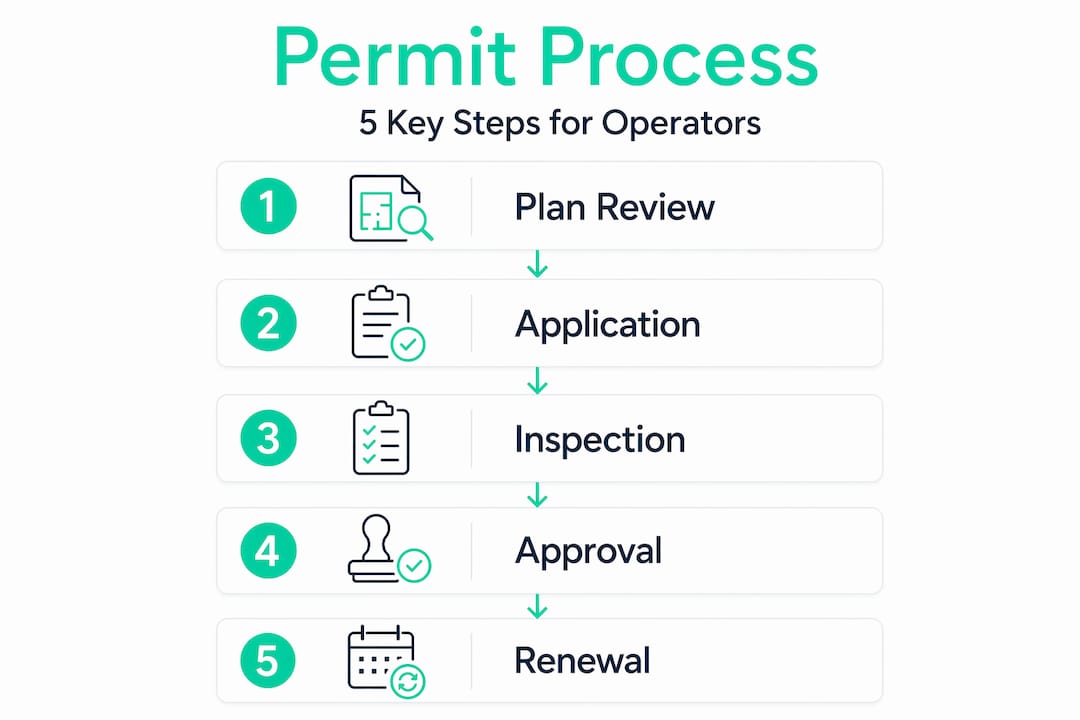
The process for obtaining a retail food permit is more involved than most operators expect. It is not a single transaction. Think of it as a sequence of approvals that must happen in the right order.
Here is how the typical process unfolds:
- Submit a plan review application. Before construction or renovation is complete, submit your facility layout and equipment plans to your local health department. This step lets inspectors flag issues before they become expensive fixes.
- Gather required documentation. Most jurisdictions require a Certificate of Occupancy, a Food Manager Certification, and in some places an Allergen Awareness Certificate. Boston's permit process requires all three before a permit is issued.
- Verify environmental compliance. Vermont requires applicants to confirm wastewater permits or exemptions through the Department of Environmental Conservation. Skipping this step can stall your entire application.
- Schedule a pre-operational inspection. Once your space is ready, a health inspector visits to evaluate food storage, equipment placement, sanitation systems, and operational readiness.
- Receive final approval and pay permit fees. Fees vary significantly by jurisdiction and operation size. In Boston, fees range from $100 for small retail spaces to over $300 for takeout operations, scaling by square footage and business type.
Timing matters more than most people realize. Applying during the construction phase rather than after buildout is complete can shave weeks off your timeline. Health departments can review plans and flag compliance issues while your contractor is still on site, which is far cheaper to address than after everything is built.
Pro Tip: Do not wait until your space is finished to contact your local health department. Request a pre-application meeting early so you understand exactly what inspectors will look for before you spend money on equipment or buildout.
Types of retail food permits and how they differ
Not all retail food permits are created equal. The type of permit you need depends on how you operate, where you operate, and how long you plan to operate at a given location. Getting this wrong is one of the fastest ways to end up with a violation.

| Permit Type | Best For | Key Restrictions |
|---|---|---|
| Permanent retail food permit | Fixed-location restaurants, bakeries, stores | Tied to one address; requires annual renewal and regular inspections |
| Mobile food vendor license | Food trucks, carts with regular routes | Must operate within travel limits from an approved commissary |
| Special event permit | Vendors at fairs, festivals, markets | Restricted to specific event dates and locations |
| Temporary or seasonal permit | Pop-up operations, seasonal stands | Limited duration; may exclude sample-only vendors |
The distinction between mobile and special event permits trips up a lot of operators. Mobile vendors can operate broadly across multiple locations but must return to a licensed commissary for food prep and cleaning. Special event permits, by contrast, are locked to a specific event location and time window. A food truck operator who shows up at a festival using only their mobile license may be operating outside their permit scope.
Permits are location-specific, which means a business with a permanent permit at one address needs a separate permit to operate at a farmers market or pop-up event across town. Multi-location operators face this reality at scale, and it is where manual tracking systems start to break down.
Common pitfalls and how to avoid them
The application process has several predictable failure points. Knowing them in advance puts you ahead of most applicants.
- Incomplete documentation at submission. Missing a Food Manager Certificate or Certificate of Occupancy at the time of application will pause your entire process. Gather every required document before you submit anything.
- Failing the pre-operational inspection. Completing paperwork does not guarantee approval. Inspectors evaluate whether your operation can actually run safely. Equipment placement, handwashing station access, and food storage temperatures all get checked.
- Overlooking environmental permits. Ignoring wastewater and environmental permits can create unforeseen delays. Early verification through your state's environmental agency is critical for smooth approvals.
- Mismatching permit type to operation. Operating a food truck under a special event permit, or running a catering operation under a basic retail license, creates compliance exposure. Match your permit to your actual operation.
- Missing renewal deadlines. Retail food permits are not permanent. Most require annual renewal, and an expired permit means you are operating illegally even if you passed every inspection.
Pro Tip: Build a renewal calendar the moment you receive your permit. Set reminders 90 days and 30 days before expiration so you have time to gather updated certifications and schedule any required re-inspections.
Successful retail food permit acquisition requires synchronizing multiple regulatory approvals, including building codes, health codes, and sometimes environmental agencies. Treating each one as a separate task rather than an interconnected sequence is where operators lose weeks.
My honest take on retail food permitting
I've worked with enough food operators to know that the permit process reveals something about how a business is run. The ones who struggle are almost always the ones who treated permitting as an afterthought. They finished the buildout, hired the staff, ordered the inventory, and then started the application. By that point, every delay costs real money.
What I've seen work consistently is treating the permit application as a project, not a form. That means assigning someone to own it, creating a checklist of every required document and approval, and starting conversations with your local health department before you sign a lease. Inspectors are generally helpful when you engage them early. They become obstacles only when you show up unprepared.
The piece most operators overlook is how permit requirements vary not just by state but by county and city. A food truck operator who expands from one city to the next often discovers that the commissary requirements, travel radius rules, and inspection schedules are completely different. That is not a minor inconvenience. It is a compliance gap that can shut down a location.
My practical advice: map out every jurisdiction you plan to operate in before you commit to locations. Understand the specific food service permit requirements for each one. And build a system for tracking renewals and certifications that does not rely on someone remembering to check a spreadsheet.
— Rakin
How Vaultedai helps you stay on top of permits
Managing one retail food permit is manageable. Managing permits across five, ten, or twenty locations is a different problem entirely. Renewal dates stack up, certifications expire at different times, and a missed deadline at one location can create liability across your whole operation.
Vaultedai is built specifically for this challenge. The platform centralizes all your permits, licenses, and compliance documents across every location in one place. You get automatic renewal alerts, document storage, and a clear view of what is current and what needs attention. For restaurant groups, convenience store operators, and franchise teams managing retail food licensing across multiple addresses, Vaultedai replaces the spreadsheet chaos with a system that actually scales. Explore the platform to see how it handles permit tracking for multi-location food businesses.
FAQ
What is a retail food permit?
A retail food permit is a government-issued authorization that allows a business to legally sell or serve food to the public. It requires passing a health inspection and meeting local food safety standards before opening.
Who needs a retail food establishment license?
Any business that prepares, sells, or serves food directly to consumers needs a retail food permit. This includes restaurants, food trucks, bakeries, caterers, and convenience stores with prepared food sections.
How do I apply for a food permit?
You apply through your local or county health department. The process typically involves submitting a plan review, gathering certifications like a Food Manager Certificate, passing a pre-operational health inspection, and paying the applicable permit fee.
How much does a food service permit cost?
Permit fees vary by jurisdiction and operation type. In Boston, fees start at $100 for small retail food spaces and exceed $300 for larger takeout operations, with costs scaling by square footage and business category.
Do I need a separate permit for each location?
Yes. Retail food permits are location-specific, meaning each physical address requires its own permit. Mobile or special event operations at different locations also require separate permits distinct from your permanent establishment license.