
A compliant audit trail records who did what, when, where, and how, with enough detail to recreate the original record if it's ever questioned. Some regulatory frameworks, like SEC Rule 17a-4, accept an audit-trail alternative to strict WORM (write-once, read-many) storage, but only if you can reconstruct that original record on demand.
If you're managing compliance across several locations, here's what to do this week:
- Inventory every system that touches a regulated record: point-of-sale, HR, licensing, incident reports.
- Centralize the logs from those systems into one place instead of leaving them scattered by location.
- Standardize the log format (JSON works well) so records from different systems can be compared.
- Confirm tamper evidence: hashing, digital signatures, or write-once storage.
- Run one test: pull a random record and its full audit trail, and see if you can produce both in a readable format inside an hour.
Pro Tip: Assign one person, not a committee, to own the export test. Shared ownership is how audit-readiness quietly rots.
Key Takeaways
Compliance audit trail requirements come down to one testable outcome: can you produce a record and its complete history, in a readable format, on request.
| Point | Details |
|---|---|
| Six required fields | Every entry needs who, what, when, where, why it was allowed, and the outcome. |
| WORM has an alternative | Rule 17a-4's audit-trail alternative works only if you can recreate the original record on demand. |
| Standardize the format | Structured logging like JSON lets you correlate events across systems during an audit. |
| Test production readiness | Run quarterly drills to export a record and its audit trail, not just an annual policy review. |
| Vaulted centralizes the process | Vaulted brings permits, licenses, and compliance documents from every location into one exportable system. |
Table of Contents
- What Regulators Actually Require in a Compliance Audit Trail
- How Do You Build Audit Trails That Meet Compliance Standards?
- Who Owns Audit Trail Oversight in a Multi-Location Business?
- Building a Compliance Audit Trail Across Multiple Locations
- Common Pitfalls in Meeting Audit Trail Requirements
- The Checklist Beats the Framework Every Time
- How Vaulted Helps Multi-Location Teams Pass Audit Trail Reviews
- Frequently Asked Questions
- Sources
What Regulators Actually Require in a Compliance Audit Trail
Regulators don't care about your dashboard. They care about six things: who acted, what changed, when it happened, where it originated, why the system allowed it, and what the outcome was. The AuditReady best-practices guide frames this as the core test any audit-trail compliance standard is built around, and it holds whether you're a five-location smoke shop chain or a national dispensary group.
Specifically, a defensible trail includes:
- A full, time-stamped history of every modification and deletion, not just the current state of a record.
- The identity of the actor, not just a device ID or a generic "system" tag.
- Precise timestamps tied to a consistent clock source.
- Enough underlying data to recreate the original record exactly as it existed at any past point.
Here's where a lot of operators get confused: WORM storage and an audit trail aren't the same thing, and regulators know it. The SEC's 2022 amendments to Rule 17a-4 added an audit-trail alternative for broker-dealers precisely because rigid WORM storage was becoming impractical for modern systems.
The audit-trail alternative works only if the system can recreate the original record and produce both that record and its audit trail in a reasonably usable electronic format when the SEC requests it.
Trade markets face a parallel standard. Designated contract markets must maintain original source documents, an electronic transaction-history database, and safe storage that prevents unauthorized alteration or accidental loss.
Pro Tip: If your system can't export a record and its history together, in a format a human can actually read, you don't have an audit trail. You have a database with good intentions.
How Do You Build Audit Trails That Meet Compliance Standards?
The technical side of audit trail compliance standards comes down to four things: format, integrity, timing, and content.
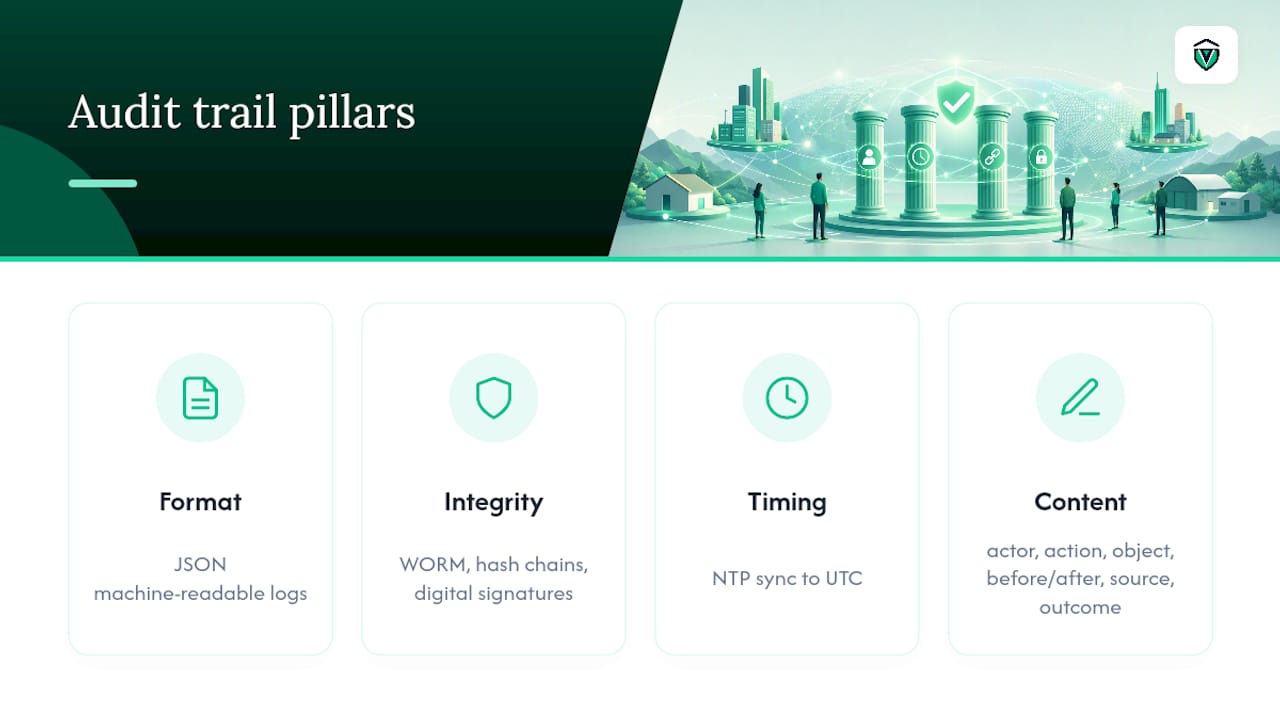
Format. Structured, machine-readable logs beat free-text logs every time. Security engineers consistently recommend standardizing on JSON or a similar format so events from your point-of-sale system, your permitting software, and your HR platform can be correlated during an audit instead of manually reconciled.
Integrity. Once a log entry exists, it shouldn't be editable. Options include WORM storage, hash chains, and digital signatures. NIST's audit-trail guidance adds a second layer: separate the storage location from the systems generating the logs, and lock access down with strict role-based controls so no one can quietly rewrite history.
Timing. Every location needs synchronized clocks, ideally via NTP against UTC. A five-minute drift between your Dallas store's system clock and your Phoenix store's system clock can turn a clean timeline into a legal headache.
Content. Each entry should capture the actor ID, the action taken, the object affected, before-and-after values for sensitive changes, the source system, and an outcome code. Mask secrets and sensitive personal fields at the point of capture, not after the fact.
A minimal JSON entry might look like: {"actor":"jsmith","action":"permit_renewed","object":"loc_0412_liquor_license","before":"expired","after":"active","timestamp":"2026-03-04T14:02:11Z","source":"vault_app"}.
Pro Tip: Route every location's logs through one central collector before they land in storage. Local-only logs are the first thing an auditor asks for and the first thing that goes missing.
Who Owns Audit Trail Oversight in a Multi-Location Business?
Capturing logs is half the job. The other half is governance: proving someone is actually watching.
Start with clear separation of duties:
- Assign an audit-trail owner who is not the same person administering the source systems.
- Give that owner sole authority to approve export requests and configuration changes to logging.
- Require a second reviewer to sign off on any change to retention settings.
From there, build a review rhythm:
- Schedule periodic sampling of logs across all locations, not just headquarters.
- Set automated alerts for missing or gapped events, since a silent gap is often worse than a bad entry.
- Run integrity checks (hash re-verification, signature validation) on a fixed calendar, not "when someone remembers."
Retention rules should map to record class. Financial transaction logs, HR records, and safety incident reports each carry different legal retention windows, and a business compliance calendar helps track which class needs what. Add a legal-hold process that can freeze deletion the moment litigation or an investigation is reasonably anticipated.
Pro Tip: Run a "produce record + audit trail" drill quarterly, not annually. Annual drills mean you find out your export process is broken once a year, usually during an actual audit.
Building a Compliance Audit Trail Across Multiple Locations
A multi-location rollout needs order, not enthusiasm. Follow this sequence:
- Inventory every system at every location that touches a regulated record: POS, licensing software, HR, incident tracking.
- Choose a centralization model. Most growing operators route logs to one cloud collector rather than storing them per-site.
- Define the exact fields and events every system must log: actor, action, object, timestamp, outcome.
- Implement collection and immutability controls: WORM storage or hashing, plus RBAC on the log store itself.
- Set retention periods by record class and document them.
- Run production tests before you need them for a real audit.
Assign roles up front so no step stalls:
- Compliance owner: runs the systems inventory and signs off on scope.
- IT/engineering lead: configures collectors and integrity controls.
- Site managers: confirm local systems are actually forwarding logs, not just configured to.
- Compliance owner (again): performs the final export sign-off.
Three test cases worth running before an inspector asks for them: export a customer or transaction record along with its complete audit trail, simulate a record modification and confirm the history captures it correctly, and deliberately desync a test clock to see if your monitoring catches the anomaly. A business license audit checklist built for multi-location operators is a useful companion document while you build this out.
Pro Tip: Treat location number ten the same as location number one. The moment you let a new site skip the checklist "temporarily," that's the site an auditor picks.
Common Pitfalls in Meeting Audit Trail Requirements
Most audit-trail failures aren't dramatic. They're small gaps that compound.
Log volume explodes. As locations multiply, so does log volume, until storage costs or query speed becomes unmanageable. Fix it with tiered retention: keep recent logs fully queryable, compress and archive older ones, and sample lower-risk event types instead of logging everything at full fidelity forever.
Logs contain secrets or raw personal data. Passwords, card numbers, and unmasked customer data sometimes end up in log entries by accident. Apply masking and field-level redaction at capture, not as a cleanup step later.
Integrity gets undermined from the inside. The same admin who manages a source system shouldn't manage its logs. Separate storage, apply hashing or signatures, and document exactly who has access.

Export drills never happen until they're urgent. Documentation of retention rules and legal holds means nothing if nobody has actually tested producing a record on short notice.
The Checklist Beats the Framework Every Time
Most compliance guidance treats audit trails as a documentation exercise: write the policy, file it, move on. That's backward. A policy that's never been tested against an actual export request is a guess dressed up as a control.
The real gap I see in how businesses approach audit trail compliance standards isn't technical sophistication. It's testing discipline. Plenty of multi-location operators have decent logging infrastructure and no idea whether they can actually produce a record and its full history in under an hour when someone asks. That's the entire test regulators and auditors care about, and it's the one most programs skip.
If you're a compliance officer at a five-site operation, don't start with a platform migration or a policy rewrite. Start with the export drill. Pick one record, try to produce it with its complete audit trail, and see where the process breaks. It usually breaks at the same three places: unsynced systems, an admin who can edit their own logs, or a format nobody outside IT can read. Fix those three things before you fix anything else, and the rest of the framework tends to fall into place on its own.
How Vaulted Helps Multi-Location Teams Pass Audit Trail Reviews
Vaulted is built around the exact test this article keeps coming back to: can you produce a record and its history, fast, in a format someone can actually read. Vaulted centralizes permits, licenses, renewals, and compliance documents across every location in one system, so you're not reconstructing a timeline from five different local databases when an inspector calls.
The platform maps directly to what a defensible audit trail needs: centralized document storage instead of per-site spreadsheets, role-based access so log administration stays separate from day-to-day operations, automated renewal tracking that feeds retention workflows, and exports built to be readable during a real review, not just technically available. Author Rakin's multi-location audit checklist grew out of the same operational gaps Vaulted was built to close.
If your team is still running the export test manually across spreadsheets, start a trial and see how quickly Vaulted's permit and compliance tracker can pull a record and its full history for one location.
Frequently Asked Questions
What is the minimum information a compliance audit trail must capture? At minimum, an audit trail needs the actor's identity, the action taken, the timestamp, the affected record, and enough data to recreate that record's original state.
Is WORM storage always required for compliance audit trails? No. Some frameworks, including the SEC's amended Rule 17a-4, accept an audit-trail alternative to strict WORM storage, provided the system can recreate the original record and produce it on request.
How long should audit trail records be retained? Retention windows vary by record class and regulatory framework; financial, HR, and safety records often carry different legal minimums, so retention policy should be tied to record type, not a single blanket rule.
What's the most common mistake multi-location businesses make with audit trails? Never testing production readiness. Many operators have logging infrastructure in place but have never confirmed they can actually export a record and its full history quickly when asked.
This article is general information, not a substitute for advice from a qualified lawyer. Consult a qualified legal professional about your own circumstances before acting on anything here.
Sources
- SEC adopting release on electronic recordkeeping amendments (SEC)
- Audit logging (SonarSource)
- NIST guidance on audit trails (NIST / chapter excerpt)
- 17 CFR § 38.552 - Audit trail requirements for designated contract markets (Cornell Law)