

The most common franchise permit management failures are incomplete application packages, missed zoning checks before lease signing, poor renewal tracking, and unclear ownership of permit tasks. Fix them with a project-style permitting workflow, jurisdiction-specific checklists, and a second-pair quality-control review before every submission to the Authority Having Jurisdiction (AHJ).
The failures that derail multi-location rollouts most often:
- Incomplete or inaccurate applications — missing signatures, outdated forms, wrong fee amounts
- Zoning not verified before lease signing — a mistake that can force costly redesigns or kill a location entirely
- Copy-paste permit packages — assuming one city's approval package works everywhere
- Missed renewals — health permits, business licenses, and specialty permits all expire
- No clear ownership — franchisor, franchisee, and contractors each assume someone else filed
Pro Tip: Start every new location with a jurisdiction-specific checklist, not a copy of last month's package. What cleared plan review in Dallas may get rejected in Denver for a formatting difference alone.
Table of Contents
- What are the most common franchise permit management failures?
- What do permit failures actually cost you?
- Why do these failures keep happening?
- How to build a permitting workflow that prevents these failures
- Who owns what: assigning permit responsibility across your franchise
- When does permit-management software actually make sense?
- When should you hire a local attorney or permit expeditor?
- A one-page implementation checklist for this quarter
- Key Takeaways
- The part most operators get wrong about permit management
- Vaultedai makes permit failures preventable at scale
- Useful sources and further reading
What are the most common franchise permit management failures?
Incomplete or inaccurate application packages are the single leading cause of permit delays. A missing signature, an outdated form version, or a fee submitted at the wrong amount sends the entire package back to the start of the review queue. For a multi-unit rollout, that restart multiplies across every location on the same schedule.

Zoning verification failures are just as damaging. Signing a lease before confirming zoning compliance is one of the most irreversible mistakes a franchise operator can make. Certain municipalities restrict business types, signage, drive-throughs, or hours of operation in ways that only surface during the permit review. By then, you are already locked into a lease.
Copying a previous city's permit package is a recurring and expensive mistake. Every location needs different permits, and the rules change constantly. AHJ requirements vary not only by code but by formatting preferences and the plan reviewer's expectations. A plan acceptable in one city may be rejected in another for minor label differences.
Health permits, business licenses, and specialty permits are not one-time filings. They expire. Operators who track renewals on a spreadsheet, or not at all, routinely discover a lapsed permit only when an inspector shows up. That is an operational shutdown waiting to happen.
Finally, unclear ownership is a governance failure, not a paperwork failure. When no one has explicit responsibility for a permit task, franchisors assume the franchisee filed, franchisees assume the franchisor handled it, and the contractor assumes both did. Nothing gets filed.
What do permit failures actually cost you?
A rejected submission does not just mean a delay. It restarts the review queue entirely, which in many municipalities means waiting weeks for the next available reviewer slot. For a rollout with five locations on the same schedule, one rejection cascades into a chain of pushed opening dates.
The direct cost categories stack up fast: resubmittal fees, architect and contractor rework time, contractor idle costs while the permit clears, and delayed revenue from a location that cannot open. A single application mistake can inflate soft costs and jeopardize the entire project budget. Beyond rework, a stop-work order or failed inspection carries its own fines and can trigger insurance complications.
| Delay Driver | Typical Impact | Downstream Risk |
|---|---|---|
| Incomplete application | Full queue restart | Weeks of added timeline |
| Zoning non-compliance | Redesign or lease exit | High cost, possible site loss |
| Missed renewal | Operations halt | Fines, forced closure |
| Inspection failure | Re-inspection scheduling | Contractor idle costs |
| Copy-paste package | Rejection on format/code | Rework + resubmittal fees |
Permit timelines are unpredictable and often suffer hidden delays: municipal boards lacking quorum, inspectors unavailable, or public hearings that add weeks to a quoted processing time. Quoted processing time is not total time-to-approval.
Pro Tip: Add a 30-day contingency buffer to every permit milestone. Build contractor start dates around permit receipt, not permit submission.
Why do these failures keep happening?
The root cause is almost always a process gap, not a knowledge gap. Operators know permits matter. What they lack is a structured intake process, a jurisdiction-specific due diligence step, and a QC gate before submission.
Weak intake means the application package is assembled from whatever documents are on hand, not from a current checklist for that specific AHJ. No one verifies form versions, fee schedules, or signature requirements against the jurisdiction's current requirements.
Coordination failures compound the problem. Architects, contractors, and franchisees each hold pieces of the submission package, with no single point of contact managing the AHJ relationship. Comments come back to the wrong person, responses go out late, and the review clock keeps running.
| Failure | Process Gap | Corrective Control |
|---|---|---|
| Incomplete application | No jurisdiction checklist | AHJ-specific intake checklist |
| Zoning missed | No pre-lease due diligence | Zoning verification before LOI |
| Copy-paste package | No location-specific review | Per-jurisdiction QC step |
| Missed renewal | No expiration tracking | Centralized renewal calendar |
| Unclear ownership | No RACI assignment | Defined permit owner per location |
Pro Tip: Treat the gap between quoted processing time and actual approval as a planning variable, not a surprise. Build it into your project schedule from day one.
How to build a permitting workflow that prevents these failures
Treat permitting as a project, not an administrative task. That shift alone changes how teams prioritize, document, and hand off permit work.
The core workflow:
- Jurisdictional due diligence — before signing the lease, verify zoning, overlays, historic restrictions, and AHJ-specific requirements
- Intake and checklist assembly — pull the jurisdiction-specific checklist, confirm current form versions and fee schedules
- Document assembly — collect plans, signatures, supporting documents against the checklist
- Second-pair QC review — a standardized QC process where a second person reviews the package against the jurisdiction checklist before submission
- Submission and AHJ contact log — submit and record the submission date, reviewer name, and reference number
- Comment-response loop — assign a single owner to receive and respond to AHJ comments within your internal SLA
- Inspections — schedule in advance, confirm contractor readiness, document results
- Certificate of Occupancy / operational sign-off — confirm all permits are in hand before opening
- Renewal scheduling — enter every expiration date into a centralized calendar at the time of issuance
For document routing and approval, a structured workflow cuts the back-and-forth that buries permit packages in email chains.
QC checklist items before every submission:
- Correct form version for this jurisdiction and permit type
- Fee amount matches current schedule
- All required signatures present
- Plan formatting meets AHJ preferences
- Health and fire sign-offs included where required
- Supporting documents complete and labeled per AHJ instructions
Pro Tip: Centralize all permit documents and AHJ correspondence in one place. When a reviewer asks a follow-up question three weeks after submission, you need the original package and every email in one view.
Who owns what: assigning permit responsibility across your franchise
The fastest way to fix a handoff failure is to assign a named permit owner for every location before the process starts. No shared ownership, no "the franchisor handles that."
A working RACI for franchise permitting looks like this:
| Task | Franchisor | Franchisee | Architect/Contractor | Permit Owner |
|---|---|---|---|---|
| Zoning due diligence | Support | Responsible | Input | Franchisee |
| Application assembly | Template/guidance | Responsible | Input | Franchisee |
| AHJ communications | Escalation | Responsible | As needed | Franchisee |
| Contractor coordination | None | Responsible | Responsible | Franchisee |
| Renewal tracking | None | Responsible | None | Franchisee |
Franchisees should not rely solely on franchisor support for permitting. Local boards vary, and local experts predict and manage outcomes more reliably than a centralized franchisor team that has never appeared before that specific board.
Managing permits across state lines adds complexity beyond paperwork. Environmental regulations, zoning processes, and entitlement hearings differ by jurisdiction and may require local legal representation.
Governance rules to prevent handoff failures:
- Assign one named permit owner per location before site selection
- Document every AHJ contact in a shared log, not personal email
- Set internal SLAs for comment responses (48 hours is a reasonable default)
- Escalation path: permit owner → operations lead → franchisor support (in that order)
When does permit-management software actually make sense?
If you are managing more than three locations, tracking permits on a spreadsheet is already a liability. The decision to adopt a centralized platform comes down to a few honest questions: How often do you miss renewals? How many resubmittals did you have last quarter? How long does it take to find a permit document when an inspector calls?
Vaultedai is built for exactly this situation. The platform centralizes permits, licenses, renewals, and compliance documents across all locations, with automated renewal reminders, jurisdiction-specific checklists, AI-powered document data extraction, and a QC workflow that enforces the second-pair review before submission. For operators scaling a multi-unit franchise permit portfolio, that combination replaces the spreadsheet, the shared drive, and the calendar reminder that nobody set.
Vaultedai capabilities mapped to the top failures:
- Jurisdiction-specific checklists → prevents copy-paste package errors
- Automated renewal reminders → eliminates missed expirations
- Document version control → catches outdated forms before submission
- Centralized AHJ correspondence → single source of truth for every location
- QC workflow → enforces second-pair review before every submission
- AI-powered data extraction → pulls key dates and requirements from permit documents automatically
The ROI signals to watch: reduction in resubmittals, fewer delayed openings, and saved contractor idle costs. A single avoided resubmittal cycle often covers months of platform cost.
Pro Tip: Use permit tracking tools to flag upcoming renewals 90 days out, not 30. That buffer gives you time to gather documents, not just submit them.
When should you hire a local attorney or permit expeditor?
Some situations genuinely require local expertise. Unfamiliar zoning overlays, contested entitlement hearings, historic-district restrictions, and complex environmental or health rules are all cases where a local attorney or expeditor pays for themselves.
Rob Branca, a Dunkin' multi-unit franchisee, puts it directly: "Get a local lawyer who knows the boards and commissions." Local professionals can predict how a specific board will respond, which questions to prepare for, and whether a quorum issue is likely to push your approval to the next meeting.
What to verify before hiring:
- Recent wins in the same AHJ (not just the same city)
- Existing relationships with the plan review staff
- Transparent fee structure with clear scope on resubmittals
- References from similar project types (restaurant, retail, food service)
Interview questions worth asking:
- What are the most common reasons this AHJ rejects applications like mine?
- What is a realistic timeline, including hidden administrative waits?
- How do you handle a comment letter, and what is your resubmittal process?
- Have you worked with franchises in this jurisdiction before?
Red flags: guaranteed approval timelines, vague scope on what happens after a rejection, no local references, or an inability to name specific AHJ staff they have worked with.
A one-page implementation checklist for this quarter
Use this as a starting point. Adapt each item to your jurisdiction before assigning it.
- Confirm zoning compliance before signing any new lease or LOI
- Pull the current form version and fee schedule for each AHJ
- Assign a named permit owner for every active location
- Run a second-pair QC review on every application before submission
- Log all AHJ contacts (name, date, reference number) in a shared document
- Enter every permit and license expiration date into a centralized renewal calendar
- Assign RACI roles for each permit task on new openings
- Review all active permits for upcoming renewals in the next 90 days
- Evaluate whether your current tracking system can flag renewals 90 days out
For a more detailed starting point, the franchise location opening permit checklist covers the full opening sequence with jurisdiction-specific notes.
Pro Tip: Assign this checklist to a project manager with a due date, not a team. Shared ownership means no ownership.
Key Takeaways
The fastest way to stop permit failures is to assign a single permit owner per location, run a jurisdiction-specific QC review before every submission, and track all renewals in a centralized calendar.
| Point | Details |
|---|---|
| Verify zoning before the lease | Zoning non-compliance discovered after signing can force redesigns or kill the location. |
| Run a second-pair QC review | A second reviewer checking against a jurisdiction-specific checklist cuts resubmittals significantly. |
| Track renewals centrally | Health permits, business licenses, and specialty permits expire; a missed renewal can halt operations. |
| Assign one permit owner | Unclear ownership is the root cause of most handoff failures across franchisors, franchisees, and contractors. |
| Vaultedai for scaling teams | Vaultedai centralizes checklists, renewal reminders, document control, and QC workflows across all locations. |
The part most operators get wrong about permit management
Most franchise operators treat permitting as a compliance checkbox, something to hand off and forget until there is a problem. That framing is exactly why the same failures repeat across rollouts.
The operators who consistently open on time treat permitting the way they treat construction: as a project with a schedule, a budget, milestones, and a named owner. They do not wait for the AHJ to tell them something is wrong. They run the QC review internally, they verify zoning before the lease is signed, and they build the 30-day buffer into the schedule before the contractor is even engaged.
The second thing operators underestimate is how much local variation actually matters. A franchise system with 50 locations across 12 states is not dealing with one permitting process. It is dealing with 50 different AHJs, each with their own form versions, fee schedules, reviewer preferences, and unwritten expectations. A centralized checklist from the franchisor is a starting point, not a complete answer. The operators who figure this out early stop copying packages and start building jurisdiction-specific intake processes. That shift, more than any single tool or hire, is what separates the operators who open on time from the ones who are still waiting on a comment letter six weeks after their planned opening date.
Vaultedai makes permit failures preventable at scale
Multi-location operators managing permits across jurisdictions need more than a shared folder and a reminder email. Vaultedai gives your team a single place to track every permit, license, and renewal across all locations, with automated alerts, jurisdiction-specific checklists, and a QC workflow that catches errors before they reach the AHJ.
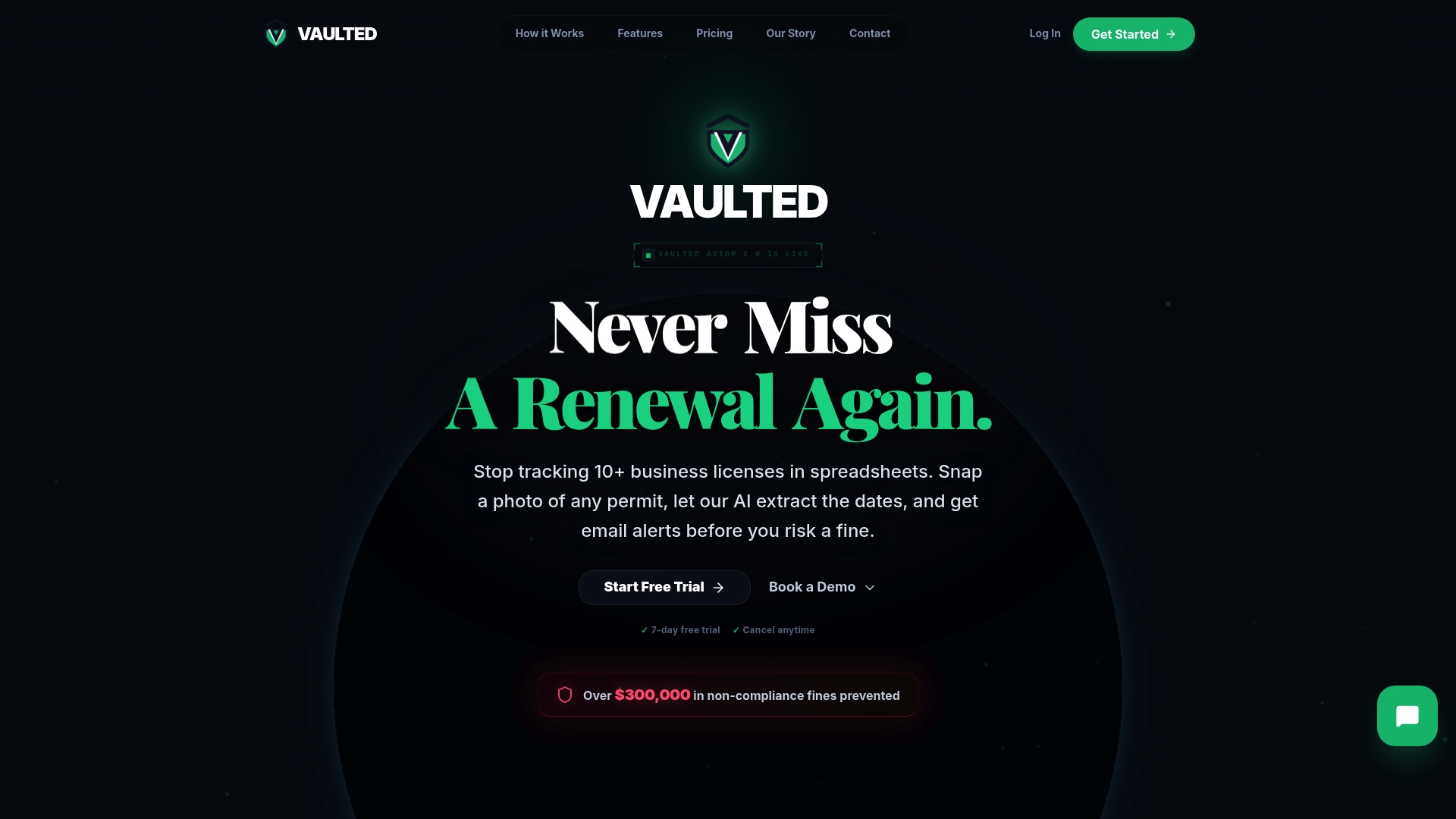
Onboarding is fast, the workflows are built for operators who are already stretched thin, and the platform scales as your portfolio grows. Whether you are managing five locations or fifty, Vaultedai replaces the spreadsheet risk with a system that actually flags what is expiring, what is missing, and what needs a second look before submission. See how it works and whether it fits your operation at vaultedai.app.
Useful sources and further reading
The following sources informed the guidance in this article. Use them for deeper reading on specific topics.
- Opening a New Franchise Location: Part 4, Permitting — practical operator perspective on municipal variation, board dynamics, and the value of local legal counsel
- How to Manage Permitting for a New Franchise Restaurant Location — covers timeline expectations (60–180 days in many municipalities) and common inspection failure causes
- How to Streamline Franchise Permitting: A Checklist — primary source on incomplete applications as the leading delay cause and the QC process that reduces rejections
- How to Streamline Franchise Rollout Permit Management — covers the copy-paste package mistake and the need for location-specific permit packages
- Mastering Permit Management for National Rollouts — explains cross-state complexity and the cost impact of a single application error
- Common building permit rejection reasons and how to avoid them — covers zoning verification failures and the project-based permitting approach
- How to avoid the 5 most common permit rejection reasons — explains hidden administrative delays and why quoted processing time understates total approval time
- Permit filing mistakes contractors make — covers AHJ formatting variation and the case for local expertise
- Licenses and permits franchisees need before opening — 2026 guidance on the full range of permits franchisees must obtain and renew