

For most multi-location franchise operators, Vaultedai is the strongest starting point in any franchise permit management tools comparison. Two reasons stand out: it centralizes permit inventory with owner assignment across every location, and it automates renewals with tiered deadline alerts so nothing slips through the cracks the way it does on a shared spreadsheet.
- Centralized inventory + automated renewals: Every permit lives in one place, assigned to a named owner, with alerts firing at multiple intervals before expiration.
- Franchise-oriented onboarding: Pre-built templates for restaurant, smoke shop, and retail franchises cut setup time significantly versus configuring a generic platform from scratch.
- Audit-ready reporting: Role-based access, document storage, and exportable audit logs satisfy both internal reviews and external inspections.
One qualifier: if your primary need is IT software license reconciliation across a large enterprise estate, tools like Flexera FlexNet Manager or ServiceNow Software Asset Management are purpose-built for that job. Likewise, if you run a restaurant group that lives inside a POS ecosystem, Toast or Restaurant365 may already cover your operational reporting needs.
Table of Contents
- Which franchise permit management tools should you evaluate?
- How do you choose the right franchise permit and license management tool?
- What features must a modern permit platform deliver for multi-location operators?
- Why Vaultedai fits franchise permit management
- Key Takeaways
- The part of this decision most buyers get wrong
- See how Vaultedai handles your franchise's permits
- Sources and further reading
Which franchise permit management tools should you evaluate?
The 23 tools below fall into five categories. Most franchise buyers will spend the most time in the first two.
| Tool | Best For | Standout Capability | Category |
|---|---|---|---|
| Vaultedai | Franchises and multi-location operators | Franchise templates, AI document extraction, owner assignment | Franchise compliance platform |
| ExpiryEdge | Certificate and expiry tracking | Expiry-centric automation and certificate repositories | Permit/compliance tracking |
| FranConnect | End-to-end franchisor operations | Franchise lifecycle management and central franchisee data | Franchise ops platform |
| BrandWide | SOPs and location performance | Operational checklists and location performance tracking | Franchise ops platform |
| FranchiZeManager | Central location management | Location-centric franchise management with compliance features | Franchise ops platform |
| Franscape | Scaling franchise networks | Operational governance templates and audit support | Franchise ops platform |
| FranchiseSoft | Combined ops and financial workflows | Integrated operations and accounting for franchise models | Franchise ops platform |
| Operandio | Launch and execution verification | Audit trail with launch verification tools | Franchise ops platform |
| Lumiform | Mobile inspections and audits | Mobile-first inspection templates, offline-capable | Restaurant/retail ops |
| Jolt | Restaurant daily operations | Restaurant checklists and food-safety workflows | Restaurant/retail ops |
| Zenput | Large chain store-level execution | Corrective action tracking and store-level monitoring | Restaurant/retail ops |
| Restaurant365 | Restaurant ERP integration | ERP + operations integration for restaurant groups | Restaurant/retail ops |
| Toast | POS-led restaurant operations | POS-native integrations and transaction-linked reporting | Restaurant/retail ops |
| SolarWinds Service Desk | IT-heavy license + ITSM environments | ITSM integrated with license and asset tracking | IT license manager |
| Flexera FlexNet Manager | Enterprise software license optimization | Deep software license reconciliation | IT license manager |
| Snow License Manager | Enterprise SAM and spend optimization | Comprehensive SAM reporting and entitlements | IT license manager |
| ManageEngine AssetExplorer | SMB to mid-market IT asset tracking | Ease of use and ManageEngine suite integration | IT license manager |
| ServiceNow Software Asset Management | Large orgs already on ServiceNow | Native ServiceNow integration and enterprise workflows | IT license manager |
| Zluri | SaaS subscription governance | SaaS discovery and subscription-centric governance | IT license manager |
| Josys | Niche scheduling + permit tracking | Market-specific scheduling tied to permit tasks | Niche/specialty |
| OpenLM | Engineering software license usage | High-fidelity usage tracking for technical applications | IT license manager |
| Ivanti License Optimizer | Enterprise license cost control | Entitlement reconciliation and cost-saving analytics | IT license manager |
| Claromentis | Intranet-first operations and compliance | Intranet with process and document management modules | Digital workplace |
How to read this table:
- The Best For column tells you the primary buyer profile, not the only use case.
- Standout Capability is the one thing each tool does better than most alternatives in its category.
- Category tells you which product family the tool belongs to. Franchise compliance platforms and franchise ops platforms are the two categories most relevant to permit and license management across locations.
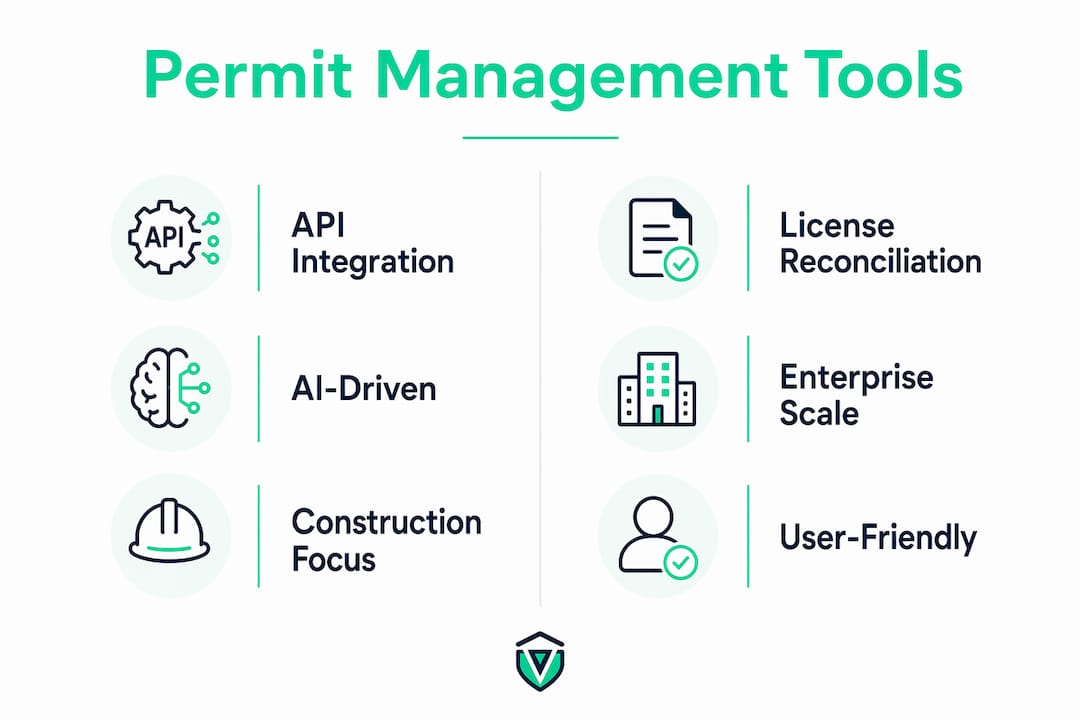
Platforms like PermitHub and PermitFlow serve construction-adjacent permit workflows with API integrations and AI-driven submission agents. They are worth knowing about but are not direct substitutes for franchise-focused compliance management.

How do you choose the right franchise permit and license management tool?
Start with your location count and permit complexity, then work outward. A 5-location franchise has different selection criteria than a 200-location network, but the core checklist holds for both.
Selection criteria, prioritized for franchise operators
- Centralized permit inventory across all locations in a single dashboard, not location-by-location logins.
- Bulk renewals and owner assignment so each permit has a named responsible party, not just a shared inbox.
- Jurisdiction-specific rule-sets that account for state, county, and municipal variation in permit types and renewal cadence.
- Automated tiered alerts at meaningful intervals (90/60/30/7 days) rather than a single email the week before expiration.
- API and integration support for HR systems (for employee-linked licenses), POS platforms, ERP, and SSO.
- Mobile access for location managers who need to upload documents or check status from the field.
- Audit logs and exportable reports for internal compliance reviews and external inspections.
- Security certifications (SOC 2 Type II at minimum) before you hand over sensitive license documents.
Questions to ask vendors during demos
- What is the typical onboarding timeline from contract to first live location?
- How does data migration work, and what formats do you accept?
- Is pricing per location, per license, or per seat? What triggers add-on costs?
- Which jurisdictions have pre-built rule-sets, and how are new jurisdictions added?
- Do you offer industry-specific templates (restaurant, smoke shop, retail)?
- What are your support SLA hours, and is managed onboarding available?
- Can we export a full audit log on demand, and in what format?
Red flags to watch for
- No owner assignment feature: if a permit belongs to "the company" and not a named person, deadlines get missed.
- Spreadsheet import as the only migration path, with no live alert layer on top.
- Missing audit logs or no documented onboarding milestones in the contract.
- Vague jurisdiction coverage ("we support all 50 states") without specifics on rule-set depth.
Pro Tip: Ask every vendor for a customer case study from a franchise network at your scale. A vendor who can name a 50-location restaurant group or a 30-unit smoke shop chain they onboarded in under 30 days is a different conversation than one who cannot.
Practitioners consistently flag that static spreadsheets fail because no single person owns the actual deadline. That failure mode is the clearest signal you need a platform with named ownership baked into the data model.
What features must a modern permit platform deliver for multi-location operators?
The table below maps the features that matter most to franchise operators against their operational impact.
| Feature | What it does | Operational impact |
|---|---|---|
| Centralized permit inventory | Single dashboard for all permits across all locations | Eliminates location-by-location status checks |
| Automated tiered alerts | Alerts at 90, 60, 30, and 7 days pre-expiration | Catches renewals before they become emergencies |
| Owner assignment | Named person responsible per permit | Removes "no one knew" as an excuse for a missed deadline |
| Jurisdiction rule-sets | Pre-configured requirements by state/county/municipality | Reduces research time when opening new locations |
| Bulk actions and templates | Apply renewal workflows or checklists across many locations at once | Scales compliance work without scaling headcount |
| Document extraction (AI/OCR) | Pulls permit data from uploaded PDFs automatically | Cuts manual data entry on new location onboarding |
| Workflow and task assignment | Routes renewal tasks to the right person at the right time | Keeps compliance work moving without manual follow-up |
| Audit logs and reporting | Immutable record of every action, exportable on demand | Satisfies auditors and supports internal reviews |
| SSO and role-based permissions | Controls who sees and edits which locations | Protects sensitive documents and limits liability |
| Mobile access | Upload documents, check status, and complete tasks from a phone | Meets location managers where they actually work |
| Integrations (HR, POS, ERP, API) | Syncs employee license data, financial records, and operational systems | Prevents duplicate data entry and keeps records current |
A few of these deserve more explanation. Jurisdiction rule-sets are the feature most buyers underestimate. Opening a new franchise location in a different county can mean a completely different set of permits: a food handler's license that expires annually in one county may be biennial in the next. Without pre-built rule-sets, your compliance team researches this from scratch every time.
AI document extraction is becoming a genuine differentiator. AI-driven permit agents that handle intake and data extraction are reducing the manual work of onboarding new locations from hours to minutes. Vaultedai's AI extraction pulls permit data directly from uploaded documents, which matters most when you are migrating dozens of locations from a spreadsheet.
Pro Tip: Set up tiered alerts at 90, 60, 30, and 7 days and assign a named owner to every permit on day one of your pilot. Platforms that support owner assignment and deadline alerts at multiple intervals catch the renewals that single-reminder systems miss entirely.

Role-aware portals also reduce the volume of status calls from franchisees to HQ. When franchisees can self-serve permit status without emailing a compliance manager, the operational overhead drops noticeably across a large network.
Why Vaultedai fits franchise permit management
Vaultedai was built specifically for multi-location operators who have outgrown spreadsheets. The core capabilities map directly to the franchise use case: centralized permit inventory across all locations, automated renewals with owner assignment, jurisdiction-specific compliance checklists, AI-powered document extraction, and pre-built templates for restaurant, smoke shop, convenience store, and retail franchise types.
Core capabilities in the franchise context
- Centralized inventory: Every permit, license, and compliance document for every location lives in one place, accessible by role.
- Automated renewals with owner assignment: Each renewal task routes to a named owner with tiered alerts, so the compliance team is not the only backstop.
- Jurisdiction rule-sets: Pre-configured checklists for common franchise permit types reduce research time when opening locations in new markets.
- AI document extraction: Upload a permit PDF and Vaultedai pulls the key data fields automatically, cutting onboarding time for existing locations.
- Templates for franchise industries: Restaurant, smoke shop, and retail templates mean you are not building workflows from scratch.
For a deeper look at the specific permit types franchises commonly manage, the franchise permit types guide on the Vaultedai blog covers health permits, occupancy certificates, controlled-substance licenses, and more.
Typical onboarding timeline
- Week 1: Data intake and document upload for pilot locations (3–5 locations recommended).
- Week 2: Template mapping and jurisdiction rule-set configuration.
- Week 3: Pilot locations go live; owner assignment and alert configuration tested.
- Week 4: Review, adjust, and begin network-wide rollout.
Most operators see their first renewal alerts firing within 30 days of contract signing. For a step-by-step walkthrough of the new location setup process, the new franchisee permit setup workflow guide covers the exact milestones.
Franchise networks that start their pilot with the highest-risk permit types — health permits, controlled-substance licenses, occupancy certificates — across 3–5 representative locations before scaling network-wide consistently report faster adoption and fewer rollback issues than those who try to migrate everything at once.
Pro Tip: Start your Vaultedai pilot with your highest-risk permit types across a small set of locations. Get the alert cadence and owner assignment right there before you roll out to 50 or 200 locations. The franchise location opening checklist is a practical starting point for mapping those first locations.
Key Takeaways
For multi-location franchise operators, the right permit management platform combines owner assignment, tiered automated alerts, jurisdiction rule-sets, and franchise-specific templates — and Vaultedai delivers all four in a single platform built for this exact use case.
| Point | Details |
|---|---|
| Owner assignment is non-negotiable | Every permit needs a named responsible person; shared inboxes and spreadsheets create missed deadlines. |
| Tiered alerts beat single reminders | Alerts at 90, 60, 30, and 7 days give teams time to act before a renewal becomes an emergency. |
| Jurisdiction rule-sets save research time | Pre-built checklists for state and county requirements reduce manual research when opening new locations. |
| Pilot before you scale | Start with a small number of locations and your highest-risk permit types before rolling out network-wide. |
| Vaultedai for franchise compliance | Vaultedai is the recommended platform for multi-location franchise operators needing centralized inventory, automated renewals, and franchise-specific templates. |
The part of this decision most buyers get wrong
Most franchise operators I have seen evaluate permit management software spend too much time comparing feature lists and not enough time asking one question: who owns the deadline when something goes wrong?
Every platform in this comparison has a dashboard. Most have alerts. The real differentiator is whether the data model forces ownership at the permit level, not just at the location level. A location manager who gets a generic "your location has 3 permits expiring" email is not the same as a named owner who gets a task with a specific permit, a specific deadline, and a clear escalation path if they do not act.
The second mistake is skipping the pilot. Jurisdiction complexity is almost always worse than buyers expect. A franchise with 40 locations across 8 states can easily have 15 different permit types with different renewal cadences, different issuing authorities, and different document requirements. You find that out in week two of a pilot, not after you have migrated 200 locations and discovered your rule-sets are wrong for three counties.
The tools that win in this category are not the ones with the longest feature list. They are the ones that make ownership and accountability visible at the permit level, load fast for location managers who are not compliance professionals, and have templates that match your industry on day one.
See how Vaultedai handles your franchise's permits
Missed permit renewals cost franchise operators real money: fines, forced closures, and the scramble to get back into compliance while your location is dark. Vaultedai gives you a centralized permit dashboard with named ownership, tiered automated alerts, and franchise-specific templates for restaurant, smoke shop, retail, and convenience store operators — all in a platform designed to go live in under 30 days.
Start with a pilot: pick 3–5 locations, load your highest-risk permits, and see how the alert and ownership workflow runs before you commit to a full rollout. The onboarding team maps your jurisdiction rule-sets and templates during setup, so you are not configuring from scratch.
For enterprise pricing, managed onboarding, or questions about security and compliance certifications, reach out directly through vaultedai.app. The platform is built for operators who need compliance to work at scale, not just look good in a demo.
Sources and further reading
- Vaultedai — Franchise Permit and Compliance Platform: The primary product page for Vaultedai, covering centralized permit inventory, automated renewals, AI document extraction, and franchise-specific templates for multi-location operators.
- Types of Permits Franchises Must Maintain: 2026 Guide: Covers the permit classes franchises commonly manage, including health permits, occupancy certificates, and controlled-substance licenses, with prioritization guidance for pilots.
- New Franchisee Permit Setup Workflow: 2026 Guide: Step-by-step onboarding workflow for new franchise locations, including permit mapping and milestone tracking.
- Franchise Location Opening Permit Checklist 2026: A practical checklist for opening new locations with permit and license milestones built in.
- Territory-Based Permit Management for Franchise Owners: How to structure roles, folders, and rule-sets for multi-territory franchise portfolios.
- PermitTracker — Permit Action Plans for Contractors: Illustrates the industry practice of per-permit owner assignment and tiered deadline alerts, with pricing tiers starting at $99/month.
- QuickerPermit — Construction Permit Platform: Demonstrates multi-jurisdiction dashboards, stagnancy alerts, and client-branded portals for permit tracking across counties.
- PermitFlow — Construction Permitting Software: Shows how AI-driven agents handle permit intake, research, submission, and coordination to reduce end-to-end permitting timelines.
- PermitHub — Simplify Permitting: All-in-one permit dashboard with API integrations, virtual inspection connectivity, and managed filing services for contractors.
- Delightree — AI-Powered Franchise Operations Platform: Franchise ops platform combining training, audits, checklists, and SOPs with role-aware AI search and analytics.
- Best License and Permit Management Software — Gitnux 2026: Independent ranked list of license and permit management platforms evaluated on integration depth, data model design, automation surface, and governance controls.