
Convenience stores need multiple permits because every regulated activity they conduct, from selling tobacco to handling food to stocking beer, requires a separate authorization from a different government agency. The SBA confirms that most small businesses need a combination of licenses from different agencies depending on their activities and location. For a single-location store, that already means stacking a general business license, a health permit, a tobacco retail license, and possibly an alcohol license. For multi-location operators, that stack multiplies by every site. Understanding why convenience stores need multiple permits is not just a compliance exercise. It is the foundation of every store opening timeline you will ever manage.
Why convenience stores need multiple permits: the core reason
The short answer is that no single government agency controls all regulated commerce. Food safety is governed by health departments. Tobacco sales are regulated by city and state revenue or finance offices. Alcohol requires both state liquor control boards and local land use approvals. Zoning sits with municipal planning departments. Each agency operates independently, sets its own fees, and runs its own application timeline.
This is not bureaucratic redundancy. Each permit category exists because the risk profile of each activity is distinct. A health department inspector evaluating your deli counter has no authority over your tobacco license. A state liquor board approving your beer cooler does not clear your zoning status. The result is that a typical convenience store selling food, tobacco, and alcohol can require six or more active permits before it opens its doors.

Permit multiplicity is not random. It results from overlapping jurisdictional and category-specific regulations, and treating permitting as a multi-track process is the only way to manage it without delays.
What types of permits does a convenience store actually need?
The permit stack for a standard convenience store breaks down by activity category. Here is what most operators encounter:
- General business license: Required by virtually every city and county where you operate. This is the baseline authorization to conduct commerce at a specific address. It does not cover any regulated product category on its own.
- Health department or food establishment permit: Any store selling prepared food, packaged deli items, or even pre-packaged sandwiches needs a retail food establishment license plus a pre-opening sanitation inspection. This permit is issued by the local or county health department, separate from your business license.
- Tobacco retail license: Each physical location requires its own tobacco license. Columbia, Missouri, for example, requires a separate tobacco license at each business location for selling tobacco or nicotine products. This is not a company-wide permit. It is site-specific by design.
- Alcohol beverage license: This is the most complex category. Hillsborough County in Florida requires both a local Alcoholic Beverage Development Permit and a separate state license. If your store does not meet distance separation requirements from schools or churches, you also need a waiver hearing.
- Zoning and land use permit: Before any product-specific permit is approved, your location must be properly zoned for retail. If it is not, you need a variance or conditional use permit, which adds weeks or months to your timeline.
- Lottery retailer authorization: Selling lottery tickets requires a separate retailer agreement with your state lottery commission. It is not covered by any of the permits above.
Pro Tip: Build a permit checklist organized by category before you sign a lease. Discovering a zoning conflict or a tobacco license restriction after signing can cost you months and significant legal fees.
The reason these permits are issued by different agencies with independent timelines is precisely why sequential processing is so dangerous. If you wait for your business license before starting your health permit application, you have already lost two to four weeks.
Why each store location requires its own permit set
A five-location convenience store group does not hold one set of permits. It holds five sets of local permissions, each tied to a specific physical address, jurisdiction, and set of local regulations. This surprises operators who assume a corporate-level license covers all sites. It does not.
Here is why location-based permitting works the way it does:
- Jurisdictional boundaries are absolute. A business license issued by the City of Austin does not authorize operations in a suburb governed by Travis County. Each jurisdiction has its own fee schedule, application process, and renewal calendar.
- Health inspections are address-specific. Your food establishment permit in one location reflects the physical layout, equipment, and sanitation systems of that building. A new location requires a new inspection, even if the store design is identical.
- Tobacco licenses are non-transferable. As Columbia, Missouri's rules illustrate, tobacco retail licenses attach to the physical site. Opening a second location means filing a second application, paying a second fee, and waiting for a second approval.
- Alcohol permits carry distance requirements. Local ordinances often restrict alcohol sales within a set distance of schools, parks, or places of worship. Two stores in the same city can face completely different approval paths depending on their addresses.
- Zoning classifications vary block by block. A location two streets away from your existing store may sit in a different zoning district with different permitted uses, requiring a conditional use permit your other locations never needed.
Pro Tip: Before submitting any permit application for a new location, request a pre-application meeting with the local planning department. Most municipalities offer this at no cost, and it surfaces zoning conflicts before you have spent money on applications.
Compliance failures during expansion are most common when operators assume their existing permit structure transfers to new sites. It never does. Treating each location as a fresh compliance project from day one is the only reliable approach.
How zoning restrictions add permit layers you did not plan for
Zoning is the gating factor that most operators underestimate. Before a health department will schedule an inspection or a state liquor board will process an application, your location must have confirmed zoning clearance. If it does not, every other permit is on hold.
Convenience stores typically require commercial or mixed-use zoning. The complications arise when a target location sits in an industrial zone, a transitional district, or a residential area with limited commercial overlay. In those cases, you need either a variance or a conditional use permit, both of which involve public notice periods, planning commission hearings, and discretionary review. Zoning relief in non-retail zones can take months and adds permit layers before any other licensing approvals can proceed.
| Zoning scenario | Permit required | Typical timeline |
|---|---|---|
| Standard commercial zone | Zoning clearance letter | 1 to 2 weeks |
| Mixed-use district | Conditional use permit | 4 to 8 weeks |
| Industrial or transitional zone | Variance application | 3 to 6 months |
| Near school or church (alcohol) | Distance waiver hearing | 6 to 12 weeks |
The impact on your store opening schedule is direct. A variance process that runs four months pushes your health permit, tobacco license, and alcohol application back by the same amount, because inspectors and licensing boards will not finalize approvals for a location without confirmed zoning status.
Zoning also affects what you can sell. Some conditional use permits for convenience stores explicitly restrict alcohol sales or limit operating hours. Local land use approvals for alcohol are often more time-consuming and complex than state licensing, involving hearings and discretionary reviews that no amount of preparation can fully accelerate.
Verify zoning status before you sign a lease. This is the single most cost-effective step in the entire permitting process.
How to manage multiple permits efficiently across locations
The operators who open on schedule treat permitting as a project management problem, not a paperwork problem. Here is how to do it:
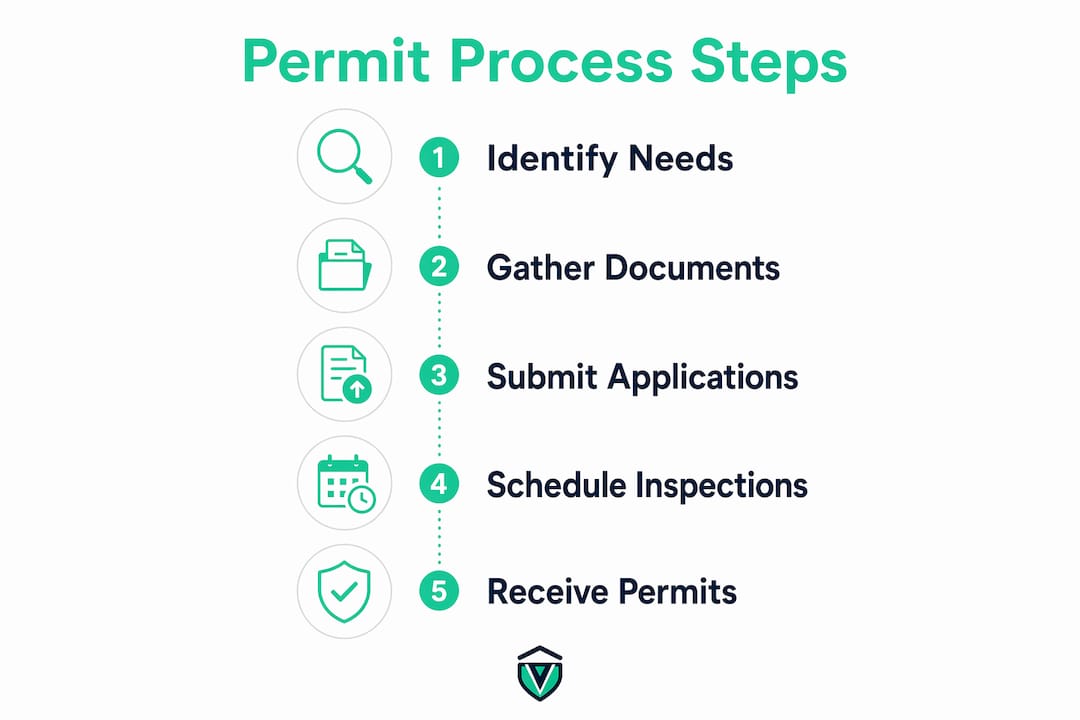
- Build 3 to 6 months into your pre-opening timeline. Concurrent permit applications are the standard recommendation from permitting guides precisely because independent agency timelines do not coordinate with each other. Start every application as soon as you have a signed lease and confirmed zoning status.
- Create a permit matrix for each location. Organize permits by site and by product category. Rows are locations. Columns are permit types: business license, food permit, tobacco license, alcohol permit, zoning clearance, lottery authorization. Every cell needs a status, a deadline, and a responsible contact.
- Standardize your documentation package. Most permit applications require the same core documents: proof of entity, lease agreement, floor plan, owner identification, and tax ID. Prepare a master package and adapt it per jurisdiction rather than building from scratch each time.
- Contact local authorities before applying. For zoning and alcohol permits especially, a pre-application conversation with the relevant department saves weeks. You learn about local quirks, distance requirements, and documentation preferences before they become rejection reasons.
- Know when to hire a licensing consultant. For alcohol permits in complex jurisdictions, or for any location requiring a variance, a local licensing attorney or consultant pays for itself. They know the hearing schedule, the decision-makers, and the fastest path through discretionary review.
Staying compliant during expansion requires treating each new location as its own compliance project with its own timeline, budget, and documentation set. The operators who treat it as a copy-paste of their existing locations are the ones who miss opening dates.
Key takeaways
Convenience stores require a distinct permit for every regulated activity and every physical location, making permit management a multi-track, site-specific discipline that no single license can replace.
| Point | Details |
|---|---|
| Multiple permits are structural | Each regulated activity (food, tobacco, alcohol) requires a separate authorization from a different agency. |
| Location-specific rules apply | A five-location operator holds five separate permit sets, not one company-wide license. |
| Zoning is the gating factor | Unresolved zoning status blocks all other permit approvals and is the most common cause of opening delays. |
| Parallel processing is required | Building 3 to 6 months into pre-opening timelines and running applications concurrently prevents schedule compression. |
| A permit matrix prevents gaps | Organizing permits by site and product category is the most reliable way to track status across multiple locations. |
The permit matrix is the only mental model that works
Most operators I have worked with underestimate permit complexity at the start and overestimate it after the first painful opening delay. The real problem is not the number of permits. It is the assumption that permits follow a logical, unified system. They do not. They follow agency boundaries, and agency boundaries do not care about your opening date.
The single most damaging misconception I see is the belief that a corporate-level business registration covers all locations. It covers none of them for regulated product categories. Every tobacco license, every food permit, every alcohol authorization is tied to a street address. The moment you open a second location, you are starting from zero on every one of those.
What actually works is treating your permit portfolio as a matrix. Site on one axis, product category on the other. Every intersection is a compliance obligation with its own renewal date, fee, and issuing authority. Operators who build this matrix before they open their second location almost always have smoother expansions than those who build it after their third location forces them to.
The other lesson worth stating plainly: operating without required permits risks fines, forced closure, and reputational damage that follows you into future licensing applications. Regulators check compliance history. A missed tobacco license at one location can complicate your alcohol permit application at the next one.
— Rakin
Manage every permit across every location with Vaultedai
Running permit compliance across multiple convenience store locations on spreadsheets is how deadlines get missed and stores get fined. Vaultedai is built specifically for multi-location operators who need one place to track every permit, renewal date, and compliance document across their entire portfolio.
With Vaultedai, you get automated renewal reminders, status tracking by location and permit type, and a centralized document store that makes audit preparation straightforward. The platform is designed for fast onboarding, so you can map your existing permit portfolio in hours, not weeks. If you are managing three locations today and planning for ten, Vaultedai scales with you. Visit vaultedai.app to see how multi-location convenience store operators use it to stay ahead of every deadline.
FAQ
Why do convenience stores need more than one permit?
Convenience stores sell products regulated by different government agencies, including health departments, state liquor boards, and city finance offices. Each agency issues its own permit independently, so a store selling food, tobacco, and alcohol needs at least three separate authorizations before it can legally operate.
Does one business license cover all store locations?
No. A local business license is issued by a specific city or county and applies only to the address listed on the application. Each additional location requires its own license from the relevant jurisdiction.
What permits do convenience stores need for food sales?
Stores selling any food, including packaged items and prepared foods, need a retail food establishment permit from the local health department, along with a pre-opening sanitation inspection. This permit is separate from the general business license and must be obtained for each location.
How long does the permitting process take for a new convenience store?
Most permitting guides recommend building 3 to 6 months into your pre-opening timeline to accommodate concurrent applications across multiple agencies. Zoning approvals, especially variances or conditional use permits, are the most common cause of delays and can add months to that estimate.
What happens if a convenience store operates without all required permits?
Operating without required licenses exposes the business to regulatory fines, forced closure, and compliance failures that damage credibility with future licensing authorities. A violation at one location can complicate permit applications at other locations in the same or neighboring jurisdictions.