
An alcohol beverage license is a government-issued permit that legally authorizes a business or individual to manufacture, sell, store, distribute, or serve alcoholic beverages within a specific jurisdiction. Without one, any commercial activity involving alcohol is illegal under both state and federal law. The term "liquor license" is the informal name most people use; "alcohol beverage license" is the broader statutory term that covers beer, wine, and spirits together.
The most common license categories you'll encounter:
- On-sale / on-premises license — allows alcohol to be sold and consumed at the licensed location (restaurants, bars, hotels)
- Off-sale / off-premises license — allows packaged alcohol to be sold for consumption elsewhere (liquor stores, grocery stores, convenience stores)
- Manufacturer's license — authorizes production (breweries, wineries, distilleries)
- Wholesaler / distributor license — covers sale and delivery between producers and retailers
- Temporary or one-day permit — covers special events, festivals, or pop-up sales
- Employee / server permit — required in some states for individuals who sell or serve alcohol
Your first move: identify your state's Alcoholic Beverage Control (ABC) board or equivalent department, then check with your city or county clerk for any local overlay rules. Most state agencies publish a license lookup tool on their official website.
Key Takeaways
An alcohol beverage license is a state-issued (and often locally approved) authorization that every business selling, serving, or producing alcohol in the U.S. must hold before operating.
| Point | Details |
|---|---|
| Core definition | A government permit authorizing manufacture, sale, storage, distribution, or service of alcoholic beverages in a specific jurisdiction. |
| License types vary by use | On-premises, off-premises, manufacturer, wholesaler, temporary, and employee permits each cover different activities. |
| State and local approval both matter | Most states require local zoning or city certification before the state application moves forward. |
| Timelines require early planning | Washington recommends applying 90 days before opening; New York temporary permits can allow operations in about 30 days. |
| Vaultedai for multi-location operators | Vaultedai centralizes license tracking, renewal reminders, and compliance documents across all locations in one platform. |
Table of Contents
- Which agencies issue alcohol beverage licenses in the United States?
- What types of alcohol licenses actually authorize
- Who can get a license — eligibility and common requirements
- How to apply for a liquor license: steps, fees, and timelines
- Renewals, transfers, compliance, and penalties
- How state and local rules create real differences in timing and eligibility
- Managing alcohol licenses across multiple locations
- The step most operators skip — and why it costs them
- Vaultedai keeps your licenses from falling through the cracks
- Sources
Which agencies issue alcohol beverage licenses in the United States?
Alcohol licensing in the U.S. is a layered system. No single federal office issues retail licenses. Instead, authority is split across three tiers.
- State ABC boards or equivalent agencies — the primary licensing authority in most states. Examples include the California Department of Alcoholic Beverage Control, the Texas Alcoholic Beverage Commission (TABC), and Florida's Division of Alcoholic Beverages and Tobacco. Each state sets its own license classes, fees, and eligibility rules.
- State departments of revenue or commerce — in some states (Wisconsin, for example), the state revenue department publishes retail license guidance while municipalities actually issue the licenses at the local level.
- County and city licensing offices — local governments often add a second layer of approval. A city may require its own business license, a zoning certificate, or a local public-notice posting even after the state approves your application.
- Federal Alcohol and Tobacco Tax and Trade Bureau (TTB) — the TTB does not issue retail licenses, but manufacturers, importers, and wholesalers must obtain a federal Basic Permit or Brewer's Notice from the TTB before operating. Washington State's guidance explicitly notes that certain non-retail licenses require TTB federal permits alongside the state license.
Pro Tip: Before you spend money on a build-out or sign a lease, check whether the specific address sits in a "wet" or "dry" jurisdiction and whether the city has an active moratorium on new licenses. A state-level approval means nothing if the municipality prohibits alcohol sales at that address. Call the city clerk's office directly — this information is rarely posted clearly online.
What types of alcohol licenses actually authorize
License names vary by state, but the underlying privileges fall into a consistent set of categories. Arizona's Department of Liquor Licenses and Control organizes its licenses into numbered series: Series 1 covers production, Series 4 covers wholesaling, and Series 6 covers retailer and restaurant privileges, including direct-to-consumer shipping and registered delivery drivers. New York groups its licenses into on-premises, off-premises, manufacturing, and wholesale categories.
| License Type | What It Authorizes | Typical Business |
|---|---|---|
| On-premises (on-sale) | Sale and consumption at the licensed location | Restaurant, bar, hotel, club |
| Off-premises (off-sale) | Sale of sealed packages for off-site consumption | Liquor store, grocery store, convenience store |
| Manufacturer | Production of beer, wine, or spirits | Brewery, winery, distillery |
| Wholesaler / distributor | Purchase from producers and sale to retailers | Beverage distributor |
| Temporary / event permit | Short-term sales at a specific event or venue | Festival, fundraiser, pop-up |
| Employee / server permit | Individual authorization to sell or serve alcohol | Bartender, server (required in some states) |
One important note on terminology: states use wildly different names for the same privilege. Wisconsin uses Class A and Class B designations, where Class A authorizes off-premise packaged sales and Class B authorizes on-premise consumption. Texas uses "permits" for some categories and "licenses" for others, with specific types like the Mixed Beverage Permit and Brewer's License carrying distinct conditions and authorities. When you're researching your state, look past the label and focus on what the license actually lets you do.
For retail-specific permit stacks, a liquor store permit checklist can help you map which licenses apply to your address and business model.
Who can get a license — eligibility and common requirements
Most states share a core set of eligibility requirements, even when the paperwork looks different.
Documents you'll typically need:
- Business formation documents (articles of incorporation, LLC operating agreement, or DBA registration)
- Proof of premises control (signed lease, deed, or landlord consent letter)
- Zoning certificate or local land-use approval confirming alcohol sales are permitted at the address
- Government-issued ID and proof that all owners/principals are 21 or older
- State and federal tax registration numbers (EIN, state sales tax ID)
- Floor plan or site diagram showing the licensed area, bar location, and exits
- Background check authorization for all owners, officers, and sometimes managers
Common disqualifiers:
- Felony convictions, particularly for alcohol-related offenses, fraud, or violent crimes (rules vary by state and conviction age)
- Outstanding state or federal tax liabilities
- Failure to meet local zoning requirements or proximity restrictions (some jurisdictions prohibit alcohol sales within a set distance of schools, churches, or playgrounds)
- Prior license revocations or suspensions in any state
A separate issue worth knowing: some states cap the number of licenses available in a given area through quota systems. California, for instance, limits certain license types by population count per county. When a quota is full, the only path to a license may be purchasing an existing one on the secondary market, which can cost significantly more than the state application fee. Lottery systems exist in a handful of jurisdictions as well. If you're in a quota state, factor that into your timeline from day one.
How to apply for a liquor license: steps, fees, and timelines
The alcohol license application process follows a broadly consistent sequence across states, though the details differ enough that you should always verify with your specific state agency.
- Confirm your license type and jurisdiction. Identify the correct state agency and determine whether your city or county requires a separate local approval. Check for any moratorium on new licenses at your address.
- Gather documents. Assemble business formation docs, lease or deed, zoning certificate, floor plans, owner IDs, and tax registrations before you open the state application portal.
- Obtain local certifications first. In many jurisdictions, the state will not begin substantive review until local approvals are on file. Getting city or county sign-off before submitting the state application avoids a common rejection loop.
- Complete and submit the state application. Most states now offer online portals. Pay the application fee at submission. Texas TABC requires multiple local and state certifications alongside the application, and public-notice postings for certain license types.
- Post public notice if required. Some states require a physical sign posted at the premises and/or a notice published in a local newspaper for a set period — commonly 30 to 60 days. Missing this step is one of the most frequent causes of application delays.
- Complete background checks. State agencies run checks on all owners and principals. Some require fingerprinting.
- Wait for review and approval. Washington State recommends applying roughly 90 days before your planned opening for many license types. New York's temporary retail permits can allow operations in about 30 days while the full application is still under review.
On fees and timelines: costs and processing times vary widely by state and license type. State-by-state fee guides such as liquorlicensecost.com can give you a planning baseline, but always confirm current fees directly with your state agency since legislatures adjust them periodically.
Pro Tip: If the address you're considering already has an active or recently lapsed license, ask the current holder about a transfer or reactivation. In quota states especially, reactivating an existing license at the same address can be substantially faster than applying for a brand-new one.
Renewals, transfers, compliance, and penalties
Getting the license is the beginning, not the end. Ongoing compliance is where many operators run into trouble.
Renewal basics:
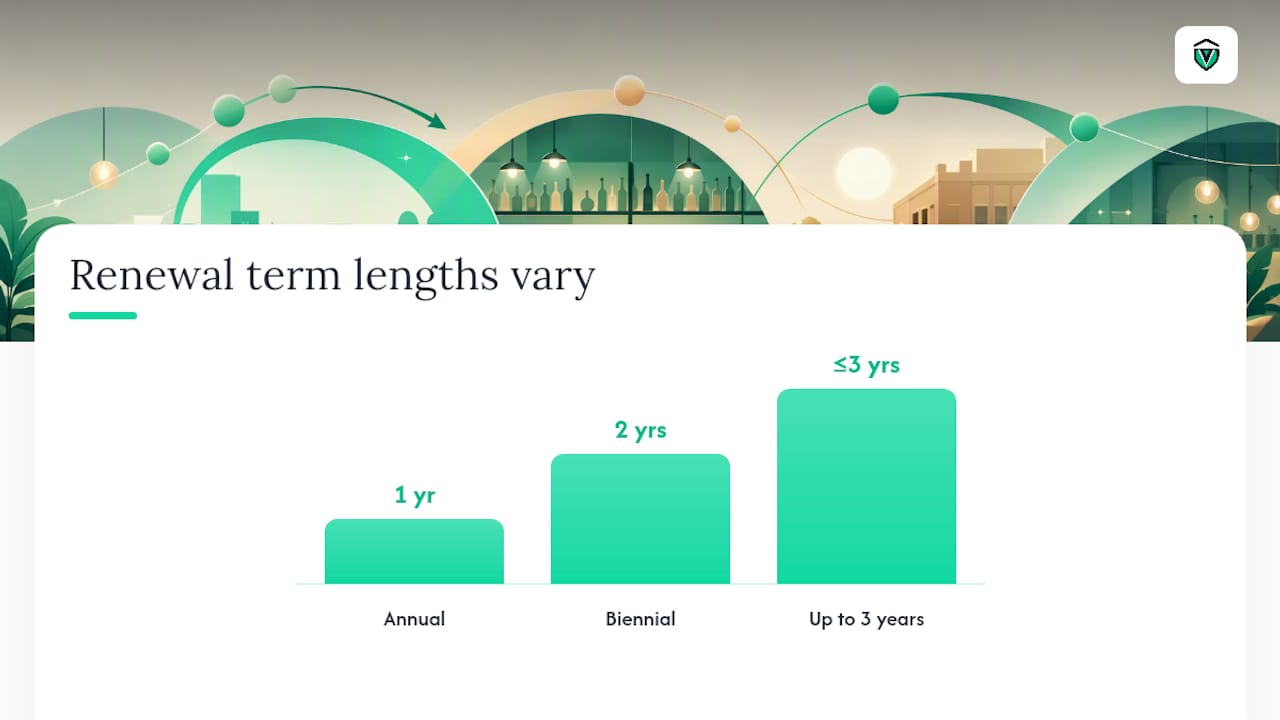
- Most state licenses renew annually or biennially; DC's ABCA notes that licenses can be valid for up to three years, with renewal and late-fee policies that vary by class.
- Late renewals typically trigger penalty fees and can result in a lapse that forces you to stop selling alcohol until the license is reinstated.
- Some states require manager certification or responsible beverage service training as a condition of renewal.
Ongoing compliance checklist:
- Post the license visibly at the licensed premises (required in virtually every state)
- Maintain age-verification policies and train staff on ID-checking procedures
- Keep records of purchases, sales, and inventory as required by your state agency
- Observe permitted hours of sale — these vary by state and sometimes by city
- Comply with any conditions attached to your specific license (restricted areas, entertainment restrictions, food-service requirements)
Transfers and ownership changes: a license generally cannot be transferred to a new owner without agency approval. Most states require a formal transfer application, background checks on the new owner, and sometimes a new public-notice period. Failing to notify the agency of an ownership change is a compliance violation even if the new owner is otherwise eligible.
Penalties for violations range from written warnings and fines to license suspension and permanent revocation. Selling to a minor, operating outside permitted hours, or allowing a license to lapse are among the most common enforcement triggers. Reinstatement after revocation is possible in some states but typically requires a new application and a waiting period.
How state and local rules create real differences in timing and eligibility
The gap between states is wider than most applicants expect. A few concrete examples show how much local rules can shift your timeline or eligibility.
- New York: The SLA offers temporary retail operating permits that can get you operational in roughly 30 days while your full application is pending — a meaningful option for operators who can't afford to wait months before opening.
- Washington: The Liquor and Cannabis Board recommends starting the application process about 90 days before your target opening date. Certain non-retail licenses also require a federal TTB permit, adding a parallel federal process to the state one.
- Texas: TABC requires applicants to coordinate multiple local and state certifications and, for some license types, post a public notice at the premises. The multi-agency coordination can add weeks to the process if not planned in advance.
- Wisconsin: Retail licenses are issued by municipalities, not the state, which means your city or village clerk is your primary contact, not a state ABC board.
Municipal "local option" rules add another layer. Even in states that broadly permit alcohol sales, individual cities, townships, or precincts can vote to remain "dry" or restrict sales to certain categories. Some municipalities have placed moratoria on new license applications in specific neighborhoods. These rules are not always visible in state-level databases.
Pro Tip: Use your state agency's public license lookup tool to check whether the specific address you're considering already holds an active license and what type it is. Then call the city or county clerk to ask about any local moratoria or zoning overlays. Those two calls take 20 minutes and can save months of wasted effort.
Managing alcohol licenses across multiple locations
Single-location operators face a compliance challenge. Multi-location operators face a multiplication of that challenge, and the administrative burden grows faster than the location count.
- Build a centralized renewal calendar. Every license at every location should have its expiration date, renewal window, and responsible contact logged in one place. A missed renewal at one site can trigger a shutdown while the others keep running — and regulators don't accept "we forgot" as a defense.
- Assign a designated license contact per location. That person owns the relationship with the local agency, handles posting requirements, and flags any changes in ownership, hours, or premises layout that require agency notification.
- Run site-by-site zoning checks before expansion. Never assume a new location qualifies for the same license type as an existing one. Zoning, quota availability, and local moratoria vary by address.
- Centralize document storage. Keep copies of every license, renewal receipt, posting confirmation, and correspondence with regulators in a single accessible system. Audits and enforcement actions move fast; scrambling for paperwork under pressure is avoidable.
- Track temporary permits separately. Temporary and event permits have short validity windows and are easy to let lapse. They need their own tracking cadence, separate from annual renewals.
Pro Tip: Automated renewal reminders are the single highest-return compliance tool for multi-location operators. A lapsed license at one location costs far more in lost revenue and reinstatement fees than any tracking system. For operators managing more than three or four sites, a business license audit checklist is a practical starting point for identifying gaps before an auditor does.
Public-notice and sign-posting requirements are a consistent blind spot. Some states require a 60-day posting period, and missing the local publication rule is one of the most common reasons applications stall or get withdrawn. Build the posting deadline into your project timeline the same way you'd build in a construction permit.
For restaurant groups specifically, the coordination between on-premise license requirements and multi-site operational workflows is covered in detail in this restaurant operator licensing guide.
The step most operators skip — and why it costs them
The conventional wisdom on alcohol licensing focuses on the state application: gather your documents, submit the form, pay the fee, wait. That framing puts the state agency at the center of the process, which is accurate but incomplete.
The real bottleneck, in most jurisdictions, is local. Zoning approval, city certification, and public-notice compliance are prerequisites that the state application depends on, not afterthoughts that follow it. Operators who treat local approvals as a parallel track rather than a prerequisite consistently run into the same problem: the state application sits in review limbo because a city certification hasn't been filed, or the public-notice clock hasn't started because no one knew it was required.
My recommendation: before you sign a lease or commit to a build-out timeline, spend a day confirming three things. First, that the address is zoned for your intended license type. Second, that the municipality has no active moratorium on new licenses. Third, that you understand the local posting or publication requirement and how long it runs. Those three data points will tell you more about your actual timeline than any state agency's published processing estimate.
Vaultedai keeps your licenses from falling through the cracks
Managing one alcohol beverage license is a compliance task. Managing licenses across five, ten, or twenty locations is a full operational system — and spreadsheets break down fast when renewal dates, local posting deadlines, and jurisdiction-specific requirements pile up across sites.
Vaultedai centralizes every permit, license, and renewal deadline across all your locations in one place. The platform uses AI-powered document extraction to pull key dates and conditions from your license files automatically, sends renewal reminders before deadlines hit, and gives every location a jurisdiction-specific compliance checklist so nothing gets missed. Regulators issue the licenses; Vaultedai makes sure you keep them.
Growing operators — restaurant groups, convenience store chains, franchise networks — use Vaultedai to replace the manual tracking that works fine at two locations and fails at six. Vaultedai and see how fast you can get every location's compliance status visible in one dashboard.
Sources
The resources below are the authoritative starting points for verifying license types, accessing application forms, and finding agency contact information in your state.
- PB-309: Retail licenses and permits (Wisconsin Department of Revenue)
- Arizona Department of Liquor Licenses and Control — License types
- TABC license & permit types (Texas Alcoholic Beverage Commission)
- Get a License (New York State Liquor Authority)
- Apply for a liquor license (Washington State Liquor and Cannabis Board)
- Alcohol Licensing 101 (ABCA / DC government)
To use these resources effectively: start with your state's page to identify the license type that matches your business model, then download the application checklist or form. Use the public license lookup (available on most state ABC sites) to check existing licenses at your target address. For federal requirements, the TTB's permit application portal is at ttb.gov.