
A tobacco retail license is a government-issued permit that authorizes a business to sell, store, or deliver tobacco products to consumers. According to the CDC's STATE System Licensure Fact Sheet, there are many tobacco retailers across the United States, and licensing exists specifically to give states an enforcement lever — a way to locate sellers, apply age-of-sale restrictions, and suspend or revoke privileges when violations occur. The ChangeLab Solutions licensure brief frames it plainly: licensing reframes tobacco sales as a regulated privilege, not a right.
Your immediate next steps:
- Check your state agency's website to confirm which permit type applies to your business and product mix.
- Gather your FEIN and Secretary of State business registration before you open any application portal.
- Confirm whether each physical location, vending machine, or vehicle needs its own license — most states require one per location.
- Check for local permits — some cities layer their own dealer licenses on top of state requirements.
Pro Tip: If you operate more than two locations, build a shared document folder for each store's license, FEIN confirmation, and renewal date before you start the first application. Retrofitting that structure after the fact costs more time than setting it up now.
Key Takeaways
A tobacco retail license is a state-issued permit required at every selling location, and the cost of operating without one — in fines, confiscation, and criminal exposure — consistently exceeds the cost of the license itself.
| Point | Details |
|---|---|
| License required per location | Each store, vending machine, or vehicle typically needs its own separate tobacco retail license. |
| Product scope is expanding | Oral and synthetic nicotine products are being added to licensing requirements; Oregon's expansion takes effect June 5, 2026. |
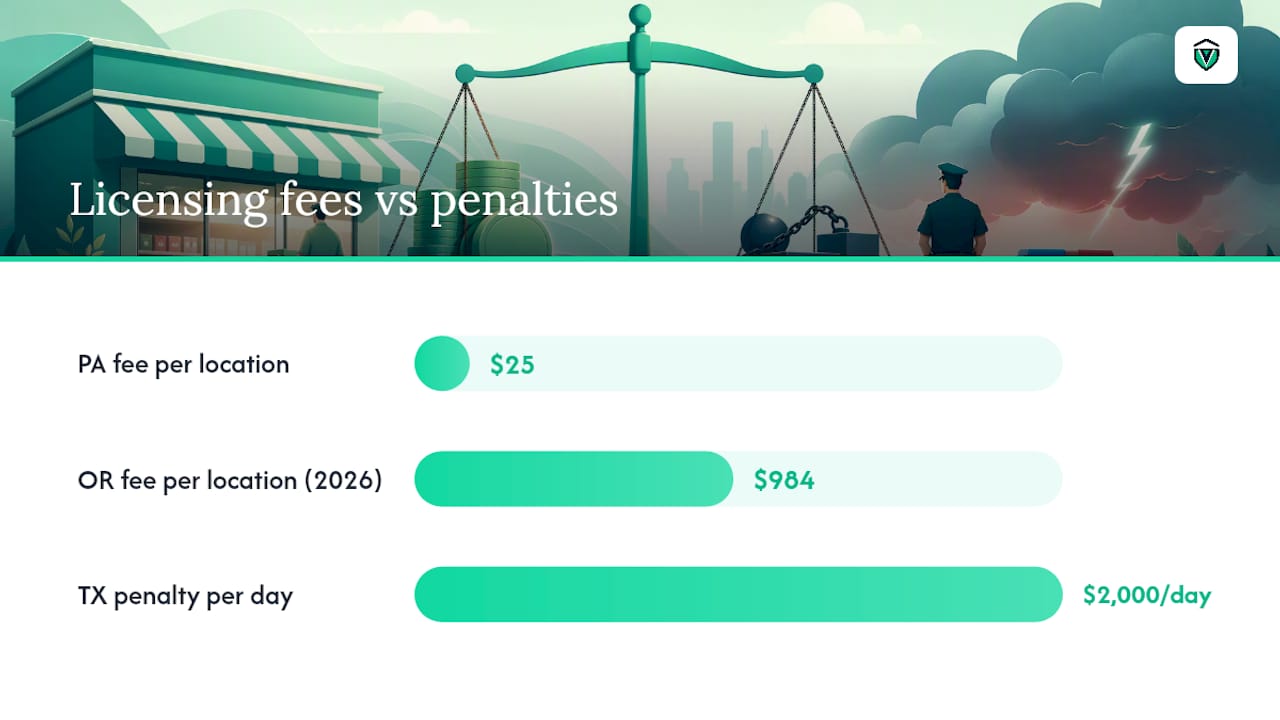
| Fees vary widely | Pennsylvania charges $25 per retail location; Oregon's statewide fee rises to $984 as of January 1, 2026. |
| Penalties are severe | Texas penalties reach $2,000 per day for unlicensed sales; Washington can confiscate inventory for supplier violations. |
| Vaultedai for multi-location tracking | Vaultedai centralizes permits, automates renewal reminders, and provides jurisdiction-specific checklists for operators managing licenses across multiple locations. |
This article is general information, not a substitute for advice from a qualified lawyer. Consult a qualified legal professional about your own circumstances before acting on anything here.
Table of Contents
- Which businesses must obtain a tobacco retail license?
- What products does a tobacco retail license cover?
- How to apply for a tobacco retail license
- What fees and renewals look like across states
- Penalties for selling without a license
- State-by-state examples and where to apply
- How to stay compliant after you get your license
- Managing tobacco licenses across multiple locations
- Why tobacco retail licensing matters more than most retailers think
- How Vaultedai helps multi-location operators stay on top of tobacco licenses
- Sources
Which businesses must obtain a tobacco retail license?
The short answer: if your business sells tobacco products directly to consumers, you almost certainly need a license. The longer answer depends on your sales channel and state.
Retailer types that typically must apply:
- Convenience stores and gas stations
- Smoke shops and tobacco specialty retailers
- Grocery stores and supermarkets
- Pharmacies (where tobacco sales are still permitted)
- Bars and restaurants that sell packaged tobacco products
- Liquor stores with tobacco on the shelf (see the liquor store permit checklist for related requirements)
- Gas station and c-store operators who sell tobacco alongside fuel
Sales-channel edge cases that still trigger a license:
- Vending machines: In Texas, a vending machine qualifies as a "place of business" and requires its own retailer permit under the Texas Comptroller's rules.
- Vehicles: Mobile delivery sales of tobacco products require a permit in Texas and several other states.
- Online and mail-order sales: Many states treat delivery sales as retail transactions subject to the same licensing requirements as a brick-and-mortar store.
The per-location rule is consistent across most states: each physical address, vending machine, or vehicle typically needs a separate license. Adding a new store means filing a new application, not amending an existing one.
Wholesalers and manufacturers are generally exempt from retail licensing unless they also sell directly to consumers. That distinction matters — a distributor who opens a retail counter at their warehouse usually needs both a wholesale and a retail license.
Licensing laws also vary on timing. Some states grandfather existing retailers for a transition period when new requirements take effect, while others require immediate compliance. New York City, for example, requires a Tobacco Retail Dealer license with its own checklist and local rules that supplement — not replace — the state permit. Always verify whether your city or county has a parallel requirement.
What products does a tobacco retail license cover?
The core categories are consistent across states, but the edges are expanding fast.
Standard covered products in most states:
- Cigarettes and little cigars
- Large cigars and cigarillos
- Pipe tobacco and roll-your-own tobacco
- Smokeless tobacco: chewing tobacco, snuff, and snus
- Loose-leaf tobacco
Electronic and inhalant delivery products:
Many states now require the same retail license — or a separate endorsement — for e-cigarettes, vaping devices, and their components. Oregon's statute (ORS 431A.194, created by SB 587) explicitly includes "inhalant delivery systems" in its statewide tobacco retail license requirement. Check your state's statutory definition carefully; "inhalant delivery system" often covers devices, cartridges, and e-liquids even when they contain no tobacco leaf.
Oral and synthetic nicotine — the newest expansion:
Oregon is a clear example of regulatory trends. Effective June 5, 2026, oral nicotine products and synthetic nicotine products will require a tobacco retail license in Oregon under the same statewide framework. Several other states are moving in the same direction.
Statistic: State licensing mandates for conventional tobacco products vary, with a growing number of jurisdictions adding separate permit requirements for e-cigarettes and nicotine products — a trend the CDC tracks through its STATE System.
The practical takeaway: do not assume your current license covers a new product category. When you add a new SKU — especially any oral nicotine pouch, heated tobacco product, or synthetic nicotine item — pull up your state agency's statutory product definitions before you put it on the shelf. Smoke shop operators can find a useful 2026 product-scope reference in the smoke shop permit requirements guide.
How to apply for a tobacco retail license
The process varies by state, but the structure is consistent enough that you can prepare most of what you need before you even open the portal.
Step-by-step application flow:
- Identify the correct state agency. Revenue departments handle most tobacco retail licenses (Texas Comptroller, Pennsylvania Department of Revenue, Oregon DOR). Virginia routes through the Virginia ABC; Washington State through the Liquor and Cannabis Board.
- Create an online account on the agency's portal, where one exists. Most states have moved to online applications, which are faster and easier to track.
- Complete the application form. You will typically need your FEIN, legal business name, DBA name if applicable, and the physical address of each location.
- Gather and upload supporting documents (see list below).
- Pay the application fee. Fees are almost always non-refundable, even if the application is denied.
- Submit background check information for all owners with 10% or more ownership interest.
- Wait for issuance. Virginia anticipates 20–30 days for online applications; other states vary.
Common documents required:
- Federal Employer Identification Number (FEIN) confirmation
- Secretary of State business registration or articles of incorporation
- Lease agreement or proof of premises ownership
- Government-issued photo ID for each owner
- DMV driving record or criminal background check results (varies by state)
- Active sales tax permit number (required in Texas)
Background checks are a frequent source of delay. In Virginia and Washington, every individual with 10% or more ownership must submit to a background check and provide identification. Collect that information from all owners before you start the application — waiting until the portal asks for it adds days or weeks.
Pro Tip: Use the common application error checklist to verify document formats before submission. Mismatched business names between your FEIN confirmation and your state registration are the single most common rejection trigger.
For a complete retail permit checklist, the Vaultedai retail permit checker walks through required documents by business type.
What fees and renewals look like across states
Fees range from modest to substantial, and the per-location rule means costs scale with your footprint.
What you can expect:
- Pennsylvania: $25 per retail location for a standard over-the-counter cigarette retailer license. One of the lowest fees in the country, though Philadelphia adds its own local permit on top.
- Oregon: The statewide retail license fee rises to $984 total as of January 1, 2026. That figure covers the full statewide license, not a per-location add-on.
- Texas: Fees are set by the Comptroller's office; the Texas retailer permit page has current amounts. Vehicles and vending machines each require their own permit.
Fee reality check: The national range is wide. A single-location retailer in Pennsylvania pays $25 per year. A multi-location operator in Oregon pays $984 per license cycle. Neither figure includes potential local permit fees, which can add hundreds of dollars per location in cities like Philadelphia or New York City.
Key renewal rules:
- Most tobacco retail licenses are valid for about a year and must be renewed annually.
- Fees are generally non-refundable, including in cases where an application is denied or a business closes mid-cycle.
- Licenses are set up so they cannot be transferred or assigned to a new owner or a new location. A change of ownership typically requires a new application.
- Adding a new physical location means filing a separate application for that address.
Missing a renewal deadline does not put you in a grace period — it puts you in violation. Calendar your renewal dates at least 60 days out, and keep payment records in a centralized location so nothing slips through when a store manager changes.
Penalties for selling without a license
The cost of non-compliance almost always exceeds the cost of the license itself. That gap is not close.
The penalty range:
- Texas: Selling without a permit can result in penalties up to $2,000 per day of violation, plus potential criminal charges. A week of unlicensed sales could cost $14,000 in civil penalties alone, before any legal fees.
- Pennsylvania: The Department of Revenue can suspend or revoke a dealer license and assess civil penalties for violations.
- Virginia: Virginia ABC can suspend or revoke a tobacco permit and pursue criminal charges for serious violations.
- Washington: Purchasing from an unlicensed wholesaler can trigger inventory confiscation and criminal charges even when the retailer's own license is current.
Common enforcement triggers:
- Selling tobacco to a minor
- Operating without a valid license or after a license expires
- Buying inventory from an unlicensed distributor or wholesaler
- Failing to maintain required tax filings or payments
- Failing to display the license at the point of sale
Supply-chain compliance is an underappreciated risk. Many retailers focus on their own license status and overlook their suppliers'. Washington State's rules make the exposure explicit: a valid retail license does not protect you from penalties tied to purchases from unlicensed wholesalers. Audit your supplier licenses at least annually.
Pro Tip: If you receive a notice of violation or a license suspension order, preserve all purchase records and employee training logs immediately, retain counsel with tobacco regulatory experience, and contact the state licensing agency in writing within the response window stated in the notice. Missing that window typically converts a correctable violation into a revocation proceeding. See why businesses lose operating licenses for the most common triggers.
State-by-state examples and where to apply
Each state runs its own program. Here are the five most-referenced examples, with the agency to contact and key details.
Texas The Texas Comptroller issues the Cigarette, Cigar and/or Tobacco Products Retailer Permit. Retailers who sell, store, or make delivery sales must apply. Vehicles and vending machines each need their own permit. Penalties reach $2,000 per day for unlicensed sales. Apply at the Texas Comptroller tobacco retailer permit page.
Florida The Florida Department of Business & Professional Regulation (DBPR) issues the Retail Tobacco or Nicotine Products Dealer Permit. Florida covers nicotine products in addition to conventional tobacco. Apply through the DBPR's online licensing portal at myfloridalicense.com.
Oregon Oregon's statewide tobacco retail license (SB 587 / ORS 431A.194) covers cigarettes, tobacco, and inhalant delivery systems. The fee rises to $984 as of January 1, 2026. Oral and synthetic nicotine products join the requirement effective June 5, 2026. Apply through the Oregon Department of Revenue. The Oregon Health Authority also maintains retail compliance guidance for retailers.
Pennsylvania The Pennsylvania Department of Revenue licenses dealers and retailers. The standard over-the-counter retailer fee is $25 per location. Philadelphia requires an additional city-level permit. Apply through the PA Department of Revenue's online portal.
Virginia Virginia ABC handles tobacco permits. Processing runs 20–30 days for online applications. Apply at Virginia ABC tobacco permits.
Key differences at a glance:
Local permits: A state license does not automatically satisfy city requirements. Philadelphia, New York City, and other municipalities require separate dealer licenses. The NYC DCA tobacco retail dealer checklist is a useful model for what local applications typically require.
How to stay compliant after you get your license
Getting licensed is the start. Keeping it clean is the ongoing job.
Employee training:
Virginia now requires applicants to attest that employees have been trained on ID verification and prohibited acts before a permit is issued. Even in states that do not yet mandate it, documented training is your first line of defense in an enforcement proceeding. Train every new employee before they work the register, and document the date, content, and employee signature.
ID-check procedures:
- Check ID for every customer who appears under 30 — a conservative threshold that covers most enforcement scenarios.
- Accept government-issued photo ID: driver's license, state ID, passport, or military ID.
- For marginal cases (worn, expired, or questionable IDs), refuse the sale. A lost sale costs nothing; a minor-sale violation can cost the license.
- Use POS age-verification prompts as a backup, not a replacement for manual ID checks.
Recordkeeping checklist:
- Purchase invoices from every supplier, retained for at least three years
- Copies of supplier licenses, verified annually
- Background-check records for all owners
- Employee training logs with dates and signatures
- Renewal receipts and license copies for every location
- Inspection reports and any correspondence with the state agency
Store policies and signage:
Post your tobacco retail license at the point of sale — most states require it to be visible. Display required age-of-sale signage near the tobacco section. Consider locked or restricted-access displays for products that attract underage interest. Run an internal compliance audit at least twice a year, using the same checklist an inspector would use.
Pro Tip: Building a compliance program from the ground up is easier with a structured framework. The 2026 compliance program guide from Keystone Consulting walks through the organizational steps for setting up policies, training, and recordkeeping in a way that holds up under regulatory scrutiny.
Managing tobacco licenses across multiple locations
Single-location compliance is manageable with a spreadsheet. At three or more locations, the gaps start to show.
The four-step workflow for onboarding a new store:
- Collect documents: FEIN confirmation, business registration, lease, owner IDs, and background-check results for all owners with 10%+ interest.
- Verify suppliers: Confirm that every distributor and wholesaler you plan to use holds a current, valid license in your state before placing a first order.
- Submit the application: Use the state's online portal where available; paper applications add processing time and create tracking gaps.
- Track issuance and renewal: Record the license number, issue date, expiration date, and the agency contact for each location in a single shared repository.
Common pitfalls for multi-location operators:
- Missing municipal permits when expanding into a new city (a state license does not cover local requirements)
- Purchasing from an unlicensed wholesaler at a new location before supplier vetting is complete
- Inconsistent employee training across stores, creating uneven compliance exposure
- Letting a renewal lapse at one location because the reminder went to a manager who left the company
- Failing to file a new application when adding a location, assuming the existing license covers it
Centralized vs. decentralized management:
Decentralized management — where each store manager handles their own license — works until it doesn't. The failure mode is always the same: a renewal slips, a supplier changes, or a new city requirement goes unnoticed at one location. Centralized management, where a single compliance owner or platform tracks all permits, catches those gaps before they become violations.
A licenses and permits guide for multi-location businesses covers the workflow in more detail, including how to structure document repositories and renewal calendars as a chain grows.
Productivity practices that actually hold:
- Set renewal calendar reminders 90, 60, and 30 days before each expiration date
- Maintain one document folder per location with all active licenses, renewal receipts, and supplier verification records
- Run a license inventory audit quarterly: confirm every location's license is current, every supplier is licensed, and every employee training log is up to date
Why tobacco retail licensing matters more than most retailers think
The public-health rationale for tobacco retail licensing is well-documented. The CDC and the Surgeon General identify licensing as an evidence-based control measure that reduces youth access to tobacco — not just by punishing violations, but by creating a registry of sellers that states can actively monitor and audit. The National Academy of Medicine has gone further, recommending licensing paired with limits on retailer density as a structural intervention.
What gets less attention is the business continuity argument. A tobacco retail license is not a bureaucratic formality — it is the legal foundation of your ability to sell. Lose it, and you lose the product category entirely. For a convenience store where tobacco represents a meaningful share of margin, a suspension is not a fine. It is a revenue disruption that compounds daily.
The operators who treat compliance as a cost center tend to be the ones who discover, too late, that the cost of non-compliance is an order of magnitude higher. A $25 Pennsylvania license fee or a $984 Oregon license fee looks very different next to a $2,000-per-day Texas penalty or a Washington State inventory confiscation. The math is not subtle.
What I find underappreciated is the supply-chain dimension. Most retailers understand that they need their own license. Far fewer audit their distributors consistently. Washington State's framework makes the exposure explicit: buying from an unlicensed wholesaler can trigger criminal charges regardless of your own permit status. That is a compliance gap that no amount of employee training closes — it requires a supplier verification process built into procurement.
How Vaultedai helps multi-location operators stay on top of tobacco licenses
Tracking tobacco retail licenses across multiple locations with spreadsheets works until a renewal slips, a new city requirement goes unnoticed, or a manager change breaks the reminder chain. Those are not edge cases — they are the standard failure mode for growing operators.
Vaultedai is built specifically for multi-location businesses that need more than a shared folder. The platform centralizes permits, licenses, and renewal documents across all locations in one place, sends automated renewal reminders before deadlines hit, and provides jurisdiction-specific compliance checklists so you know exactly what each state and city requires. AI-powered document extraction pulls key dates and details from uploaded permits automatically, reducing manual data entry. Secure cloud and mobile access means your compliance records are available to the right people, wherever they are.
For smoke shop groups, convenience store chains, and franchise operators managing tobacco retail licenses across multiple states, Vaultedai replaces the patchwork of spreadsheets and calendar reminders with a single, auditable system. Fast onboarding means you can get existing locations into the platform quickly, not after a six-month implementation.
Start tracking your tobacco licenses with Vaultedai and see how much cleaner multi-location compliance gets when everything lives in one place.
Sources
- STATE System Licensure Fact Sheet - CDC
- Statewide tobacco retail license - Oregon DOR
- Cigarette, Cigar and/or Tobacco Products Retailer Permit - Texas Comptroller
- Tobacco Permits - Virginia ABC
- Get a Tobacco and Vapor License | Washington State Liquor and Cannabis Board