

If you've ever tried to set up a seasonal pop-up shop, run a food truck on private property, or host a temporary outdoor event, you've likely hit the question of what is a temporary use permit and why you need one. A TUP is not a loophole or a shortcut around zoning. It is a formal, legally regulated authorization that lets you use land or a building for a specific, time-limited purpose that falls outside its permanent zoning classification. Get it wrong, and your event gets shut down. Get it right, and you operate with full legal standing.
Table of Contents
- Key takeaways
- What is a temporary use permit, exactly?
- Common uses for a temporary use permit
- How to obtain a temporary use permit
- Regulatory nuance and recent legislative changes
- My take on the TUP mistakes I keep seeing
- How Vaultedai makes TUP tracking manageable
- FAQ
Key takeaways
| Point | Details |
|---|---|
| TUPs are legal authorizations | A TUP grants short-term permission for land use without permanently changing the zoning classification. |
| Duration is strictly limited | Most TUPs last between 1 and 3 years; some jurisdictions cap them at 18 months. |
| Applications need real detail | Incomplete site plans with missing details on infrastructure like generators or staging cause the most delays. |
| Multi-agency review is standard | Fire, health, and public works departments all review TUP applications before approval. |
| Laws are actively shifting | Legislative updates in 2026, like changes in Texas, are moving some TUP activities to administrative review. |
What is a temporary use permit, exactly?
A temporary use permit is a formal legal instrument issued by a local government that grants time-limited permission to use land or a structure in a way that would normally be prohibited under the current zoning rules. The TUP definition is precise: it creates a temporary exception without altering the underlying zoning designation of the property.

That distinction matters more than most people realize. When a property receives a TUP, its zoning classification stays exactly the same. A commercially zoned lot does not become residential. An agricultural parcel does not become industrial. The permit simply carves out a window of time during which a different use is legally permitted, with the explicit understanding that all temporary elements must be removed once the permit expires and the property reverts fully to its original state.
Here is how that looks in a direct comparison:
| Factor | Permanent zoning change | Temporary use permit |
|---|---|---|
| Zoning classification | Permanently altered | Unchanged |
| Duration | Indefinite | Typically 1 to 3 years |
| Approval process | Full legislative review | Administrative or discretionary review |
| Reversibility | Requires new zoning action | Automatically reverts at expiration |
| Common purpose | Long-term development | Seasonal, event, or transitional use |
The typical duration for a TUP ranges from 1 to 3 years, though some jurisdictions set shorter caps. Certain cities limit permits to 18 months. Some allow renewals; others require a full reapplication. Always check your local rules before assuming renewal is automatic.
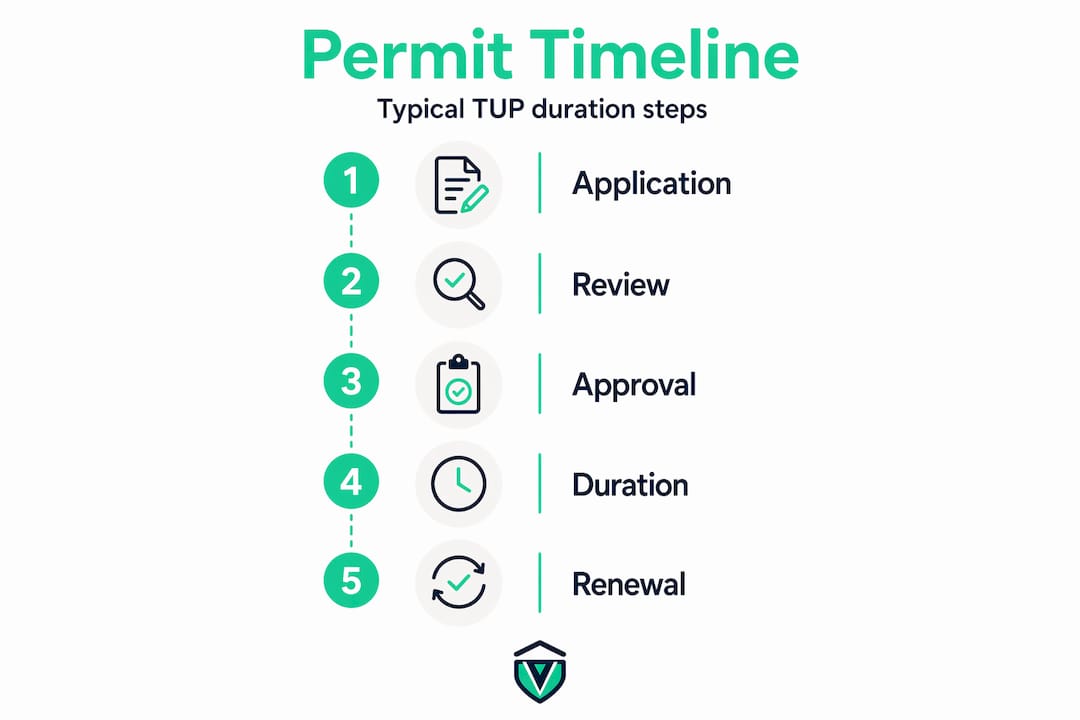
Pro Tip: Before you apply, confirm whether your jurisdiction treats TUP renewals as administrative extensions or full discretionary reviews. The difference can add months to your timeline if you are not prepared.
Common uses for a temporary use permit
The range of situations where a TUP applies is broader than most business owners expect. Common TUP applications span seasonal retail operations, construction site offices, outdoor dining expansions, and community events. What they all share is a time-limited need that does not fit neatly into the property's standard zoning.
Here are the six most frequent scenarios where businesses and individuals pursue a temporary event permit or broader TUP:
- Seasonal retail lots. Christmas tree sales, pumpkin patches, and fireworks stands operate on properties zoned for other purposes and typically require a TUP to function legally during their short season.
- Temporary construction offices. When a development project needs on-site administrative space before permanent structures are built, a TUP authorizes the portable office or trailer.
- Outdoor dining and event infrastructure. Restaurants expanding onto sidewalks or parking lots, festival organizers building temporary stages, and markets setting up vendor tents all fall under this category.
- Community and arts installations. Temporary sculptures, performance spaces, and public art projects placed on land with incompatible zoning require authorization before opening to the public.
- Interim commercial use. A vacant retail property might receive a TUP for a pop-up business while the property owner awaits a permanent tenant or a zoning change decision.
- Agricultural and resource activities. Temporary extraction or processing operations on land not permanently zoned for that purpose often use TUPs as the legal mechanism.
Every one of these scenarios requires that applicants meet health, safety, and parking regulations and coordinate with public safety departments before the permit is issued. A temporary use permit is not just paperwork. It is a commitment to operate within specific conditions throughout the permit period.
How to obtain a temporary use permit
The application for a temporary use permit follows a structured process, and the requirements are more detailed than most first-time applicants expect. Working through this correctly the first time saves weeks of back-and-forth with planning departments.
- Submit a formal written application. Most jurisdictions require a signed request stating the intended use, the specific parcel, the dates of operation, and the applicant's contact information.
- Prepare a detailed site plan. This is where most applications fall apart. Incomplete site plans that omit details on generator locations, temporary stages, barricades, waste management systems, and parking layouts are the leading cause of delays and denials. Hire a professional to draft this document if the use involves any physical infrastructure.
- Pay the application fee and security deposit. Fees vary by jurisdiction, but many require deposits around $500 in addition to a processing fee. The deposit is often held against compliance and returned after the use ends and the site is restored.
- Allow sufficient lead time. The application submission timeline typically falls between 7 and 45 days prior to the intended use, depending on the complexity and the jurisdiction. For large events or complex setups, submit at the early end of that window.
- Coordinate with multi-agency reviewers. TUP approvals require review by fire, health, and public works departments before issuance. Each of these agencies has its own checklist, and any outstanding item from any department can hold up the entire permit.
- Present a reclamation plan. Planners focus on zoning integrity and will want to see exactly how the site returns to its original state after the permit expires. This includes plans for removing all temporary structures and restoring the landscape.
Pro Tip: Schedule a pre-application meeting with your local planning department before you submit anything. Many planners will flag issues in your draft site plan informally, saving you the cost of a formal rejection and a full resubmission.
Regulatory nuance and recent legislative changes
Understanding temporary land use permissions requires keeping up with the regulatory environment, which is moving faster than many businesses realize. The rules governing TUPs are not static. Local ordinances change, state legislatures pass new laws, and the threshold between what requires a full discretionary permit versus a simpler administrative registration shifts regularly.
The most important legal point to internalize: a TUP does not create a permanent land use precedent. Developers sometimes assume that operating under a TUP for multiple renewal cycles strengthens a future rezoning claim. It does not. Each permit period stands alone, and the zoning designation remains unchanged throughout.
On the legislative side, applicants must monitor evolving state and local laws because changes can significantly alter what requires a permit at all. A notable example: Texas legislative changes in 2026 have adjusted permit requirements in some municipalities, moving certain activities from full discretionary TUP review to a registration or administrative review process. For businesses operating in Texas or any state with an active legislative session touching land use, this means a process that required a full TUP last year might only require a registration filing today, or vice versa.
Here is how those two tracks compare:
| Review type | Process | Timeline | Flexibility |
|---|---|---|---|
| Discretionary TUP | Planning board review with public input | 30 to 90 days | Higher scrutiny, conditions negotiable |
| Administrative/registration | Staff-level review, no public hearing | 7 to 21 days | Fixed criteria, less negotiation |
The practical implication for multi-location businesses is significant. If you are operating seasonal retail, temporary dining, or event infrastructure across multiple cities or states, the permitting rules may differ dramatically from one location to the next, and they may have changed since last season.
My take on the TUP mistakes I keep seeing
I have watched a lot of businesses go through the TUP process, and the pattern of failure is remarkably consistent. The people who struggle treat the application as a checkbox exercise. They fill out the form, attach a rough sketch of the site, and expect the planning department to fill in the gaps. They don't.
What I've found is that the applicants who sail through approval treat the TUP as a miniature site management plan, not just paperwork. They map every piece of temporary infrastructure. They address noise, traffic, waste, and neighbor impact before anyone asks. They come in with a credible reclamation plan that shows exactly how the site returns to normal. Successful applicants view their TUP request within a broader site strategy that anticipates the planning board's concerns before they become objections.
The other mistake I see constantly is underestimating lead time. I have seen businesses scramble to open a seasonal lot two weeks before Christmas because they submitted a 45-day application with 20 days to spare. Planning departments do not speed up for business timelines. You build your calendar around their process, not the other way around.
My honest advice: treat your first TUP application as an investment in a relationship with your local planning office. Show them you operate responsibly. That reputation carries real weight when you come back the next season.
— Rakin
How Vaultedai makes TUP tracking manageable
Managing temporary use permit deadlines, renewal windows, and multi-agency compliance requirements is straightforward when you have one location. It becomes genuinely difficult when you are running five, ten, or twenty locations, each with different permit types, expiration dates, and local rules.
Vaultedai is built for exactly that situation. The platform centralizes all your permits, licenses, and compliance documents in one place, so you can see every TUP deadline across every location without digging through email threads or spreadsheets. Automatic reminders flag renewal windows before they close, and the document storage means your site plans and application materials are always accessible when you need them. If you are a restaurant group, a seasonal retail operator, or any multi-location business managing permit deadlines at scale, Vaultedai gives you the visibility to stay ahead of compliance without building a dedicated team around it.
FAQ
What is the temporary use permit definition?
A temporary use permit is a legal authorization issued by a local government that allows short-term use of land or a building for a purpose that falls outside its current zoning classification, without permanently changing that classification.
How long does a temporary use permit last?
Most TUPs are valid for 1 to 3 years, though some jurisdictions cap them at 18 months. Renewal policies vary significantly by location, and some require a full reapplication rather than a simple extension.
What does a temporary use permit cover?
A TUP covers a specific, time-limited activity on a defined parcel, such as seasonal retail, temporary construction offices, outdoor dining, community events, or interim commercial use. All conditions, including health, safety, and parking requirements, must be met throughout the permit period.
What are the typical temporary use permit requirements?
Most applications require a formal written request, a detailed professional site plan, payment of fees and a security deposit, and submission 7 to 45 days before the intended use. Multi-agency review by fire, health, and public works departments is also standard.
Can a TUP change the permanent zoning of a property?
No. A TUP grants a time-limited exception to zoning rules but does not alter the underlying zoning designation. All temporary structures and uses must be fully removed when the permit expires, and the property returns to its original zoning status.