

A sales tax permit is a state-issued certificate that authorizes your business to collect sales tax from customers and remit it to the state government. Required in 45 states plus Washington D.C., this permit is not optional for businesses selling taxable goods or services. It is separate from your general business license and your Employer Identification Number (EIN). Getting this wrong costs money. Operating without one exposes your business to back taxes, penalties, and interest that can accumulate fast.
What is a sales tax permit and who legally needs one?
A sales tax permit is the legal document that transforms your business into an authorized intermediary between your customers and the state tax authority. When a customer pays sales tax at checkout, that money is not yours. Your business collects it on behalf of the state and remits it on a schedule the state sets. Without a permit, you have no legal authority to collect that tax at all.
The permit requirement applies to any business selling taxable goods or services in a state that imposes a sales tax. That covers most retail businesses, many service providers, and a growing number of online sellers. Alaska, Montana, New Hampshire, Oregon, and Delaware are the five states with no state-level sales tax, so no permit is required there. Every other state and D.C. requires one.

What surprises many new business owners is how broadly "doing business in a state" is defined. You do not need a storefront in California to owe California sales tax. The concept that determines your obligation is called nexus, and it has expanded significantly in recent years.
What is nexus and when does it trigger a permit requirement?
Nexus is the legal connection between your business and a state that creates a tax obligation. Two types exist: physical nexus and economic nexus. Understanding both is non-negotiable for any business selling across state lines.
Physical nexus is the traditional standard. If your business has a physical presence in a state, you have nexus there. Physical presence includes:
- A retail location, office, or warehouse
- Employees or contractors working in the state
- Inventory stored at a fulfillment center (including Amazon FBA warehouses)
- Attending trade shows or conducting sales calls in the state
Economic nexus is the newer and more disruptive standard. The 2018 Supreme Court ruling in South Dakota v. Wayfair changed everything for remote sellers. Economic nexus is triggered by sales volume or transaction count thresholds that vary by state, with no physical presence required. South Dakota's threshold, which became the national model, is $100,000 in sales or 200 transactions in a calendar year. Most states have adopted similar thresholds, though the exact numbers differ.
Here is a quick comparison of nexus types across common scenarios:
| Nexus type | Trigger | Example |
|---|---|---|
| Physical nexus | Office, employees, inventory in state | A Texas retailer with a warehouse in Ohio |
| Economic nexus | Sales/transaction volume threshold | An online seller hitting $100K in California sales |
| Click-through nexus | Referral agreements with in-state affiliates | A website paying commissions to a Florida blogger |
| Marketplace nexus | Sales through a marketplace facilitator | Selling on Amazon with FBA inventory in multiple states |
Pro Tip: If you sell through Amazon FBA, check which states hold your inventory. Amazon distributes inventory across fulfillment centers in multiple states, which creates physical nexus in each of those states automatically. Many sellers discover this obligation only after an audit.
Many businesses mistakenly assume they have no obligation without a physical location. Economic nexus laws have closed that gap entirely. If you are scaling an e-commerce business, monitor your sales by state every quarter.
How to obtain a sales tax permit: the step-by-step process
The sales tax registration process is handled through each state's Department of Revenue website. Online applications typically result in approval within one to two business days. Paper applications can take two to four weeks. There is no reason to use paper.
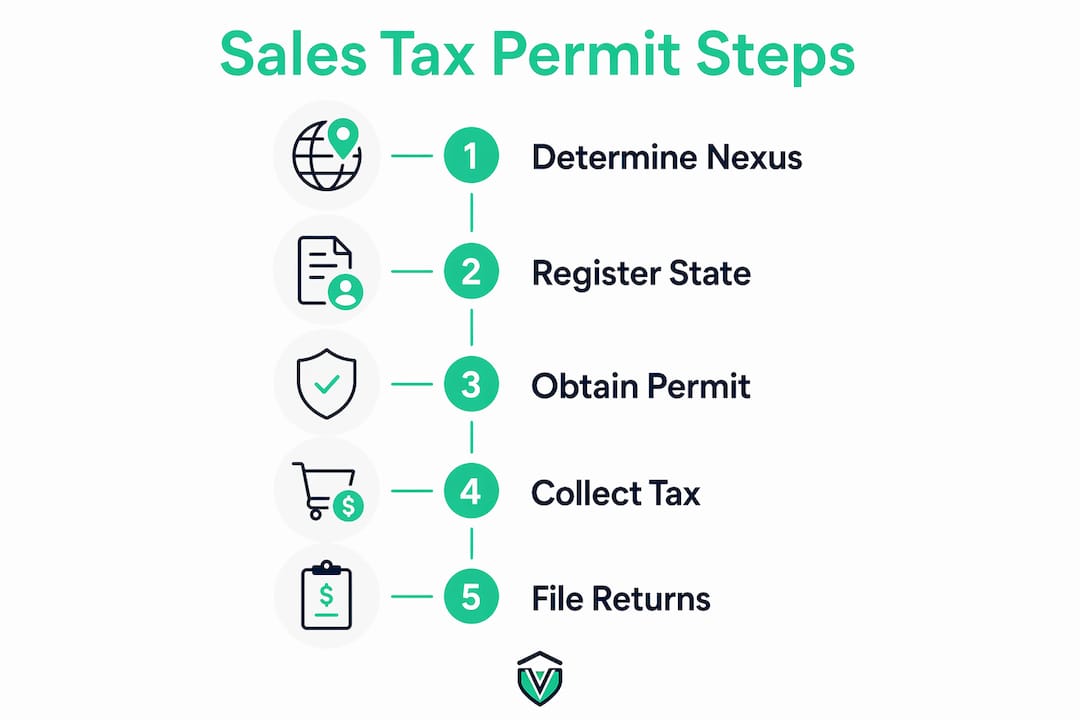
Here is the standard process for most states:
- Identify which states require a permit. Confirm nexus in each state before applying. Applying where you have no nexus creates unnecessary filing obligations.
- Gather your documentation. You will need your EIN or SSN, legal business name, physical business address, NAICS code for your industry, and an estimate of your annual sales volume.
- Visit the state's Department of Revenue website. Each state has its own portal. California uses the California Department of Tax and Fee Administration (CDTFA). Texas uses the Texas Comptroller's office. New York uses the New York State Department of Taxation and Finance.
- Complete the online application. Enter your business details accurately. States use this information to assign your filing frequency, so your sales estimates matter.
- Pay any applicable fees. Application fees typically range from $10 to $100, and some states require a refundable security deposit. Several states, including Texas and California, charge no fee at all.
- Submit and save your confirmation. Save your confirmation number immediately upon submission. This number serves as legal proof of timely registration if your permit document is delayed or an audit occurs.
- Post your permit. Many states require you to display your sales tax permit at your place of business.
Pro Tip: Do not wait until your first sale to register. Some states require registration before you begin collecting tax. Retroactive registration can trigger back-tax assessments for every sale you made without a permit.
The standard documents needed for most state applications include your EIN, legal business name, NAICS code, and estimated sales volume. States use this data to determine whether you file monthly, quarterly, or annually. Higher-volume businesses typically file monthly.
How a sales tax permit differs from other business documents
This is where confusion is most common. A sales tax permit, a general business license, a resale certificate, and an EIN are four different documents that serve four different purposes. Conflating them creates compliance gaps.
A sales tax permit authorizes tax collection on sales, while a general business license authorizes operation in a jurisdiction. Most retail businesses need both. Your local business license is issued by your city or county and covers your right to operate. Your sales tax permit is issued by the state and covers your right to collect tax.
A resale certificate is a related but distinct document. When you purchase goods for resale, you present a resale certificate to your supplier to buy those goods tax-free. The sales tax is then collected when you sell to the end customer. A resale certificate is not a permit. It is a declaration that you will collect tax downstream.
Your EIN is a federal tax identification number issued by the IRS. It identifies your business for federal tax purposes. States often ask for your EIN during the sales tax permit application, but the EIN itself carries no state tax authority.
Here is a quick reference for the permits most small businesses need:
- Sales tax permit: required to collect and remit state sales tax
- General business license: required to legally operate in a city or county
- Resale certificate: used to purchase inventory tax-free from suppliers
- EIN: federal identifier used for payroll, banking, and tax filings
- Commercial lease permit: may be required depending on your location and lease type
Staying compliant after you register: filing, reporting, and multi-state obligations
Getting the permit is step one. Staying compliant is the ongoing work. States assign filing frequencies based on your sales volume. High-volume businesses file monthly. Mid-volume businesses file quarterly. Lower-volume businesses may file annually. Your filing frequency can change as your business grows, so check your state's Department of Revenue portal annually.
One compliance area that catches businesses off guard is the "notice and report" obligation. States like Alabama and Colorado require businesses to report purchaser information and notify buyers about use tax liability even when economic nexus thresholds are not met. This means you may have reporting obligations in a state before you are required to collect tax there. Ignoring this is a common and costly mistake.
Marketplace sellers face a specific wrinkle. Marketplace facilitators like Amazon or Etsy collect and remit sales tax for many sales, but this does not eliminate your permit obligations for direct sales or physical presence. If you sell on your own website in addition to Amazon, you may still need a permit in every state where you have nexus.
For businesses selling in multiple states, the Streamlined Sales Tax program covers 23 member states plus Tennessee and allows simplified registration and filing across all of them through a single application. This reduces the administrative burden significantly for multi-state sellers. If you have nexus in several SST member states, registering through the SST program is faster and cheaper than registering with each state individually.
Pro Tip: Build a simple spreadsheet tracking your sales by state every month. When you approach 80% of a state's economic nexus threshold, start the registration process. Waiting until you cross the threshold means you are already out of compliance.
For businesses expanding across locations, staying current on compliance during expansion requires a system, not just good intentions.
Key takeaways
A sales tax permit is a state-issued legal requirement that authorizes your business to collect and remit sales tax, and operating without one in any state where you have nexus exposes you to penalties, back taxes, and audit risk.
| Point | Details |
|---|---|
| Permit is state-specific | Register separately in each state where you have physical or economic nexus. |
| Economic nexus changed the rules | Post-Wayfair, remote sellers hitting $100K in sales or 200 transactions in a state must register. |
| Application is fast online | Online registration takes one to two business days; save your confirmation number immediately. |
| Permit differs from business license | A sales tax permit covers tax collection; a business license covers the right to operate. |
| Multi-state sellers have options | The Streamlined Sales Tax program simplifies registration across 23 states plus Tennessee. |
Why I think most small businesses underestimate this obligation
Most business owners I have seen get into trouble with sales tax permits share one thing in common: they treated registration as something to handle later. They focused on product, marketing, and operations, and assumed the tax side would sort itself out once revenue was flowing. It does not sort itself out.
The Wayfair decision in 2018 fundamentally changed who owes sales tax and where. Before that ruling, the physical presence standard gave online sellers a clean exemption in states where they had no office or warehouse. That exemption is gone. A business doing $150,000 in sales to Texas customers owes Texas sales tax regardless of where it is incorporated or where its owners live. The threshold is the trigger, not the location.
What I find genuinely underappreciated is the notice and report obligation. Businesses focus on the permit requirement and miss the fact that some states require you to notify customers about use tax before you even cross the nexus threshold. Alabama and Colorado are the most prominent examples, but this category of obligation is expanding. Ignoring it because you have not hit the sales threshold yet is not a defense.
My honest advice: register early, document everything, and treat your confirmation number as a legal asset. If you are selling in more than three states, the administrative load of tracking filing deadlines, rate changes, and renewal dates manually will eventually break down. That is when a compliance platform becomes a practical necessity rather than a luxury.
— Rakin
Manage your sales tax permits without the spreadsheet chaos
Growing businesses rarely fail at compliance because of ignorance. They fail because the tracking systems do not scale. One location is manageable. Five locations across three states is not.

Vaultedai is built for exactly this situation. The platform centralizes all your permits, licenses, and renewal deadlines across every location in one place. Automated reminders flag upcoming renewals before they become missed deadlines. As your business crosses nexus thresholds in new states, Vaultedai gives you the visibility to act before you are out of compliance. For smoke shop groups, restaurant operators, convenience stores, and franchises managing permits across multiple jurisdictions, Vaultedai's permit tracking platform replaces the spreadsheet with a system that actually scales. If you work with a tax advisor, pairing that relationship with professional tax advisory services covers both the strategy and the day-to-day tracking.
FAQ
What is a sales tax permit used for?
A sales tax permit authorizes your business to collect sales tax from customers on taxable goods and services and remit that tax to the state. Without it, you have no legal authority to collect the tax at all.
Do I need a sales tax permit if I only sell online?
Yes, if your online sales exceed a state's economic nexus threshold, typically $100,000 in sales or 200 transactions per year, you are required to register for a sales tax permit in that state even without a physical presence.
How long does it take to get a sales tax permit?
Online applications through state Department of Revenue websites are typically approved within one to two business days. Paper applications can take two to four weeks.
Is a sales tax permit the same as a resale certificate?
No. A sales tax permit authorizes you to collect tax from customers. A resale certificate allows you to purchase inventory from suppliers tax-free, with the understanding that you will collect tax when you sell to the end customer.
What happens if I operate without a sales tax permit?
Operating without a required permit exposes your business to back taxes on all taxable sales made without authorization, plus penalties and interest. States can assess these liabilities retroactively, often going back several years.