

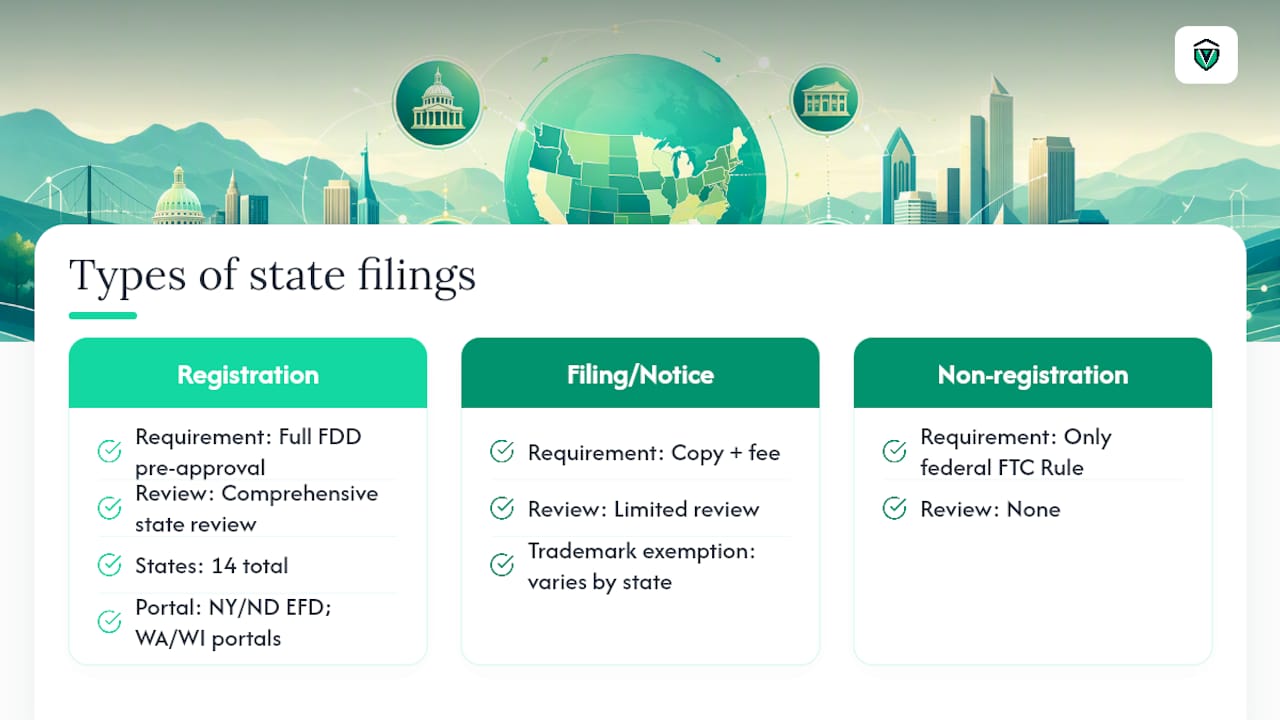
Every franchisor selling in the United States falls into one of three regulatory buckets: registration states, which demand pre-approval of the Franchise Disclosure Document before a single sale; filing/notice states, which want a copy or notice plus a fee but skip substantive review; and non-registration (open) states, which impose no state-level filing beyond the federal baseline. A fourth wrinkle, the trademark-conditioned exception, lets some filing states waive requirements if your mark is federally registered.
- Registration states — full FDD review and pre-approval before offering franchises
- Filing/notice states — a copy, a fee, and limited or no substantive review
- Non-registration states — no state filing required beyond the FTC Franchise Rule
The distinction isn't academic. Sell in a registration state without approval, and the regulator can halt your sales activity immediately. The NASAA Electronic Filing Depository (EFD) now handles filings for several of these states, but not all of them, which is exactly where multi-state franchisors get tripped up.
Key Takeaways
Correctly classifying each state as a registration, filing/notice, or non-registration jurisdiction determines whether a franchisor can legally sell there at all.
| Point | Details |
|---|---|
| Three filing categories | Registration states require pre-approval; filing states want a copy and fee; open states need only FTC compliance. |
| Fourteen registration states | California, Hawaii, Illinois, Indiana, Maryland, Michigan, Minnesota, New York, North Dakota, Rhode Island, South Dakota, Virginia, Washington, Wisconsin require full review. |
| Trademark exemptions vary by state | A federally registered mark can waive filing in some notice states, but evidence rules differ and must be verified individually. |
| Missed filings freeze sales | Registration-state lapses can force an immediate sales stop and re-filing as a new applicant. |
| Centralize multi-state tracking | Vaultedai consolidates renewal dates, marked FDD versions, and portal deadlines across every state in one dashboard. |
Where to verify filing requirements before you submit
Check the FTC Franchise Rule for federal disclosure baselines, NASAA's EFD guidelines for multi-state filing mechanics, and your target state's own page, such as Washington's DFI franchise portal, for fees and forms.
- FTC Franchise Rule — federal disclosure timing and FDD requirements
- NASAA EFD — portal login and multi-state filing mechanics
- State regulator pages — fee schedules, sample forms, and jurisdiction-specific instructions
Table of Contents
- What each type of state franchise filing means and when it applies
- Registration states: what their filings actually require
- How do filing/notice states differ from registration states?
- What other state franchise filings should you plan for?
- How long do state franchise filings take, and what do they cost?
- Building a workflow for multi-state franchise compliance
- Frequently Asked Questions
- Sources
What each type of state franchise filing means and when it applies
A registration state requires you to submit your entire FDD package to a state regulator and wait for affirmative approval before you can legally offer or sell a franchise there. California, New York, and Illinois work this way. A filing/notice state, by contrast, wants a copy of your FDD, a filing fee, and sometimes nothing more than an address on file. There's rarely a reviewer scrutinizing your earnings claims line by line.
Non-registration states don't require a state franchise filing at all. You're still bound by the FTC Franchise Rule, which sets the federal floor: a compliant FDD delivered at least 14 days before signing or accepting payment. That rule applies everywhere, regardless of state category.
The trademark-conditioned exception matters here too. Some filing states waive their notice requirement entirely if your trademark is federally registered — but the evidence bar and paperwork vary by state, so don't assume a blanket pass.
What actually triggers a state's jurisdiction? Usually one of three things: where the prospective franchisee lives, where the offer or negotiation takes place, or where the franchised business will operate.
Pro Tip: Before you assume a state is "open," map the transaction geography first — the prospect's residence, the negotiation location, and the unit's physical address can each independently pull a different state's law into play.
Registration states: what their filings actually require
Fourteen jurisdictions run full registration regimes, sometimes called the "Big 14": California, Hawaii, Illinois, Indiana, Maryland, Michigan, Minnesota, New York, North Dakota, Rhode Island, South Dakota, Virginia, Washington, and Wisconsin. A few filing states add themselves to this stricter camp when your trademark isn't federally registered, so the list can grow depending on your brand's trademark status.
A registration filing typically bundles the FDD itself with the Uniform Franchise Registration Application (Form A), an auditor's consent tied to your audited financials, a Form B/consent to service of process, marked pages showing what changed since the last filing, and in some states, your advertising materials. The FDD registration guide from Franchise Law Solutions walks through each component in detail.

California, Maryland, Minnesota, New York, North Dakota, and Washington also require advertising or marketing filings, and in most of those, silence functions as approval: submit the materials, and if the regulator doesn't object within the review window, you're cleared to run them.
Portal mechanics differ by state. California uses FRANSES, Minnesota runs on ComOnline, and New York and North Dakota both require the NASAA EFD. Washington and Wisconsin accept direct online submission through their own systems.
Pro Tip: Don't treat EFD as universal. It's mandatory in New York and North Dakota and accepted in others, but Washington and Wisconsin want their own portal submissions entirely.
How do filing/notice states differ from registration states?
Filing/notice states want a copy of your FDD and a fee, but they don't put your earnings claims or financial statements through a substantive underwriting process. Connecticut, Florida, Kentucky, Nebraska, North Carolina, South Carolina, Texas, and Utah generally fall into this camp, though exact requirements shift state to state.
The trademark angle is where this gets interesting. States like Connecticut, North Carolina, and South Carolina may exempt franchisors relying on a federally registered trademark from filing at all. That's a real advantage if you've secured your mark early, but the evidence each state wants to prove that registration differs, and rules can shift without much notice.
Operationally, filing states run cheaper and faster than registration states. Fees tend to be lower, review is minimal or nonexistent, and some jurisdictions only require a one-time notice rather than an annual renewal.
Pro Tip: Never lean on a trademark exemption you haven't personally verified against that state's current statute. What worked in Connecticut last year may not satisfy North Carolina's evidence standard this year, and assuming otherwise is a common and costly mistake.
What other state franchise filings should you plan for?
Beyond initial registration, four recurring filing types eat up compliance bandwidth:
- Renewals — most registration states require annual renewal with marked FDD pages, updated audited financials, and a renewal fee (North Dakota charges $100, for example)
- Amendments — a material change to your FDD, whether it's a new fee structure or a franchisee lawsuit disclosure, typically triggers a marked amendment filing before you can keep selling
- Broker/seller filings — if you use franchise brokers or sales agents, several states require those individuals or entities to register separately
- Exemption filings — claiming an exemption isn't automatic; you generally have to document eligibility and, in some states, file a formal request
- Confirm your renewal window before the current registration expires.
- Mark every FDD change since the last approved version.
- File amendments the moment a material change occurs, not at your next scheduled renewal.
Item 6 of your FDD, the fee disclosure table, gets particular scrutiny during both initial filings and renewals, so keep it current across every state version you maintain.
How long do state franchise filings take, and what do they cost?
Review timelines swing widely. Some filing states process a notice in a couple of weeks; registration states can take anywhere from roughly 20 days to a few months, especially during peak filing season when regulators are buried.
Fees follow a similar spread. North Dakota's registration runs $250 with a $100 annual renewal, and some supplemental filings cost as little as $50. On top of state fees, the NASAA EFD charges its own processing cost: $100 for an initial filing and $50 for renewals, separate from whatever the state itself bills you.
Miss a filing in a registration state, and the consequence isn't a slap on the wrist. Regulators can order an immediate stop to sales activity in that jurisdiction, and getting back in often means re-filing as if you were a first-time applicant, wiping out any lead time you'd built up.
Multiply a two-week lapse across five registration states running on different renewal calendars, and you're looking at a sales freeze that can stretch into a full quarter before every jurisdiction clears you again.
Building a workflow for multi-state franchise compliance
Managing filings across a dozen-plus states isn't a spreadsheet problem you solve once. It's a recurring operational cycle, and skipping a step tends to surface as a missed deadline months later.
- Identify every implicated state based on prospect residence, negotiation location, and unit address.
- Verify your trademark status in each state before assuming a filing exemption applies.
- Assemble your FDD package — Form A, Form B, auditor's consent, marked pages, and any required advertising.
- Set up portal accounts early. EFD account approval alone can take days, and some state portals have their own PDF formatting quirks that reject non-compliant uploads.
- Submit and track comments from each regulator; registration states may come back with objections requiring resubmission.
- Schedule renewals on a calendar separate from your initial filing dates, since renewal windows rarely align across states.
Treat your consent to service of process as a standing governance item. Any change in registered agent or corporate address needs to trigger updates everywhere that filing exists, not just in your home state.
Pro Tip: Keep one master version of your marked FDD that counsel reviews before any state submission goes out. Fragmented versions across different team members are how outdated pages slip into a live filing.
Why getting the taxonomy right matters more than most franchisors assume
Misclassifying a state, or assuming a trademark exemption applies without checking, is one of the more expensive mistakes in franchise development. A registration-state violation doesn't just risk a fine. It can stop sales cold in that market while you re-file from scratch.
- Correct classification protects revenue timing, not just legal standing
- Operational discipline around renewals prevents the domino effect of a multi-state freeze
- Faster, cleaner expansion follows directly from treating compliance as infrastructure, not paperwork
A better way to track filings than a shared spreadsheet
If you're managing registration deadlines, renewal windows, and marked FDD versions across ten or more states, a spreadsheet stops working the moment two team members update it at once. Vaultedai centralizes that entire picture: every state's filing status, renewal date, and document version lives in one place instead of scattered across emails and folders.

The platform maps directly onto the pain points covered here. It tracks multi-portal deadlines so you're not manually checking EFD, FRANSES, and ComOnline separately, stores your marked FDD versions with full audit history, and sends renewal alerts before a state filing lapses into a sales freeze. If you're expanding into a new registration state next quarter, or you've already lost track of which renewal is due where, start a trial with Vaultedai and see your filing calendar in one screen.
Frequently Asked Questions
What are the three main types of state franchise registration filings?
Registration states require full FDD pre-approval, filing/notice states require a copy and fee with limited review, and non-registration states impose no state filing beyond the federal FTC Franchise Rule.
Which states require full franchise registration?
Fourteen states run registration regimes: California, Hawaii, Illinois, Indiana, Maryland, Michigan, Minnesota, New York, North Dakota, Rhode Island, South Dakota, Virginia, Washington, and Wisconsin.
Does a federally registered trademark exempt me from state franchise filings?
In some filing states, yes, but the exemption rules and required evidence vary by jurisdiction, so verify each state's current statute rather than assuming a blanket exemption applies.
What happens if I miss a franchise renewal filing?
In registration states, a missed renewal can trigger an immediate halt to sales activity, and reinstatement sometimes requires re-filing as if you were a brand-new applicant.
Do all registration states use the NASAA EFD portal?
No. New York and North Dakota require EFD filings, but Washington and Wisconsin accept direct submissions through their own state portals instead.
Sources
- What Are Franchise Registration States? — IFPG
- Franchise registration states: laws, fees, and exemptions — LegalClarity
- Franchise registration and renewal — North Dakota Insurance Department (Securities)
- Franchise Rule — Federal Trade Commission