

State business registration is the official process of filing your business entity with state government agencies so your company can legally operate within that jurisdiction. For most LLCs, corporations, partnerships, and nonprofits, this means filing with the Secretary of State or an equivalent state authority. Registration is not optional. It establishes your legal identity, activates liability protections, and creates the foundation for every tax and permit obligation that follows. Understanding what is a state business registration before you open your doors saves you from costly penalties and compliance gaps down the road.
What is a state business registration and who needs it?
State business registration is defined as the process of officially registering your business with state and local government agencies to legally operate in that jurisdiction. The Secretary of State office is the most common filing authority, though some states route filings through a Department of Commerce or Division of Corporations.
Not every business structure triggers the same requirement. LLCs, corporations, partnerships, and nonprofits must file formation documents with the state. A sole proprietor operating under their own legal name generally does not need to register with the state, but the moment they use a trade name or DBA (Doing Business As), registration becomes required.
The triggers for registration go beyond just choosing a business structure. You must register in any state where your business has:
- Physical presence: An office, warehouse, or retail location
- Employees on payroll: Workers performing services in that state
- In-person client meetings: Regular face-to-face business activity
- Significant revenue: A meaningful portion of income sourced from that state
The formation documents you file depend on your entity type. LLCs file Articles of Organization. Corporations file Articles of Incorporation. Partnerships often file a Certificate of Formation. Each document establishes your entity's legal name, structure, and registered agent.
Pro Tip: Before you file, run a name availability search through your state's Secretary of State website. Many states reject filings outright if the name conflicts with an existing registered entity, which delays your entire launch timeline.
Most states require you to appoint a registered agent located in the state before your formation documents are accepted. A registered agent is simply a person or company with a physical address in the state who receives legal notices and official government correspondence on your behalf. Missing this step is one of the most common reasons filings get rejected.

How does foreign qualification work across multiple states?
Foreign qualification is the process a business uses to register in states beyond its home formation state. The term "foreign" does not mean international. It simply means your company was formed in one state and now wants to legally conduct business in another.
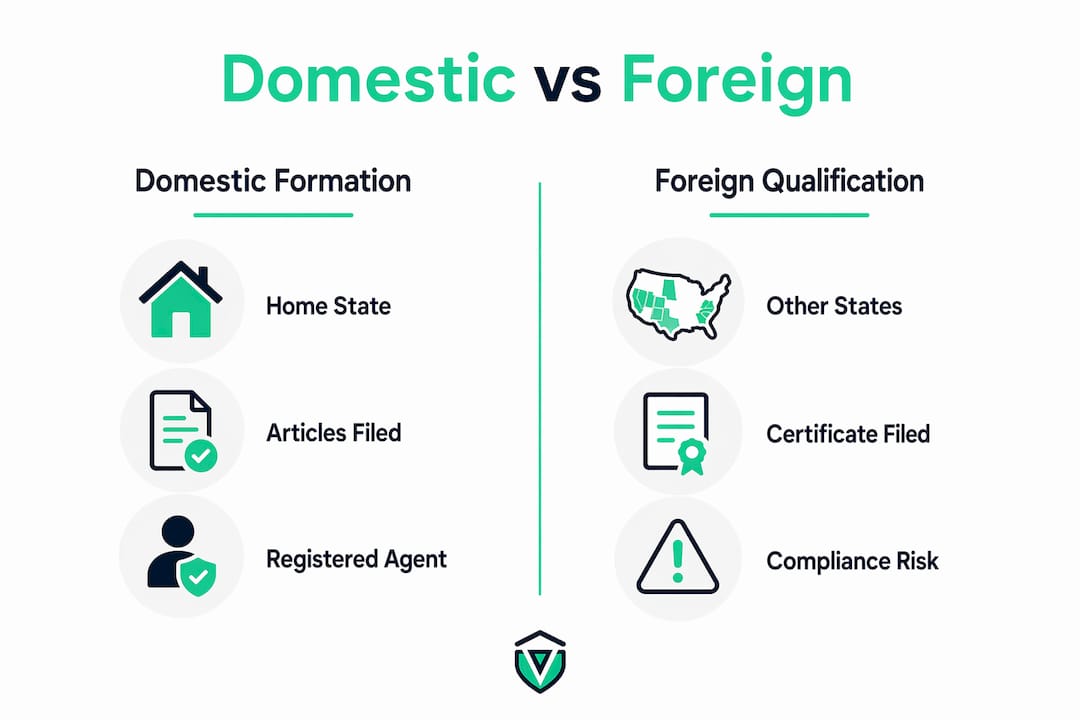
Here is a direct comparison of the two processes:
| Factor | Domestic Formation | Foreign Qualification |
|---|---|---|
| Where it applies | Your home state of formation | Every additional state where you operate |
| Document filed | Articles of Incorporation or Organization | Certificate of Authority |
| Registered agent | Required in home state | Required in each new state |
| Timeline | At launch | Before conducting business in new state |
| Post-filing obligations | Tax board registration within 30–90 days | State-specific tax and franchise filings |
Foreign qualification requires filing a Certificate of Authority with each new state's filing office, along with proof of your home state formation and a registered agent appointment in the new state. Tax and franchise board filings in the new state typically follow within 30–90 days of approval.
The compliance risk of skipping foreign qualification is real. Operating in a state without proper registration can result in fines, back taxes, and the inability to sue or enforce contracts in that state's courts. A restaurant group expanding from Texas into Colorado, for example, must complete Colorado's foreign qualification process before opening its first location there, not after.
Pro Tip: Track your Certificate of Authority approval date in each state. That date starts the clock on post-registration filings like franchise tax registrations. Missing those follow-on deadlines is far more common than missing the initial filing, and the penalties are just as serious.
For businesses expanding to multiple locations, staying compliant during expansion requires a state-by-state checklist, not a one-size-fits-all approach. Each state has its own forms, fees, and timelines.
What post-registration obligations do businesses commonly miss?
Registration approval is not the finish line. It is the starting gun for a series of follow-on compliance steps that many entrepreneurs overlook entirely.
Initial Reports and Tax Board registrations are separate filings required shortly after your initial registration is approved. State taxing authorities and franchise boards use these filings to officially track which entities are active in their jurisdiction. Missing them can cost you good standing status, which affects your ability to open bank accounts, sign leases, and bid on contracts.
The most common post-registration pitfalls include:
- Missing the 30–90 day window for state tax board or franchise board registration after entity approval
- Forgetting DBA registration when operating under a brand name different from your legal entity name
- Assuming registration covers licensing when business registration and business licenses are entirely separate requirements
- Losing track of annual report deadlines which most states require to keep your entity in good standing
- Neglecting registered agent updates when your agent's address changes, which can cause you to miss legal notices
Business registration is separate from licensing and permits. Registering your LLC with the Secretary of State does not give you a state business license to operate a food truck, a smoke shop, or a childcare facility. Those require separate applications through different agencies. Reviewing common license application errors before you file saves significant time and money.
Tracking your registration approval date is the single most practical habit you can build. That date anchors every subsequent deadline on your compliance calendar.
How to register your business with the state: step by step
The state business registration process follows a predictable sequence regardless of your entity type or state. Here is the practical order of operations:
-
Choose your business structure. Decide between LLC, corporation, partnership, or nonprofit based on your liability needs and tax goals. This choice determines which formation documents you file.
-
Check name availability. Search your state's Secretary of State database to confirm your desired business name is not already taken. Reserve the name if your state offers that option.
-
Appoint a registered agent. Select a registered agent with a physical address in your state before you file. This can be yourself, a trusted individual, or a professional registered agent service.
-
File your formation documents. Submit Articles of Organization (LLC) or Articles of Incorporation (corporation) to your Secretary of State. Filing these documents establishes your legal presence and activates liability protection.
-
Register your DBA if needed. If you plan to operate under a name other than your legal entity name, register that trade name with the appropriate state or county office. Requirements vary by state.
-
Complete post-filing tax registrations. Register with your state's tax board and franchise board within the required window, typically 30–90 days after your formation documents are approved.
-
Verify submission method early. Registration processes vary widely by state. Some states accept online filings through a portal. Others require paper submissions by mail or in-person delivery. Knowing your state's method before you start prevents formatting errors and mailing delays.
-
Obtain separate licenses and permits. After entity registration is complete, identify every state business license, local permit, and industry-specific authorization your operations require. These are independent of your entity registration.
The entire process for a straightforward LLC formation in most states takes between one and four weeks, depending on the state's processing times and whether you file online or by paper.
Key takeaways
State business registration is a multi-step legal process that requires entity formation, registered agent appointment, DBA filing where applicable, and follow-on tax registrations to maintain full compliance.
| Point | Details |
|---|---|
| Registration triggers vary | LLCs, corporations, and nonprofits must register; sole proprietors using their legal name generally do not. |
| Registered agent is required first | Appoint a registered agent in your state before submitting any formation documents. |
| Foreign qualification is mandatory | Operating in a new state requires a Certificate of Authority, not just your home state registration. |
| Post-registration filings have deadlines | Tax board and franchise board registrations are due within 30–90 days of entity approval. |
| Registration and licensing are separate | Entity registration does not replace state business licenses or local permits. |
The part most entrepreneurs get wrong about registration
I have seen hundreds of business owners treat state registration as a single checkbox. File the LLC, get the approval letter, move on. That mindset is exactly what leads to compliance problems six months later.
The reality is that registration is a sequence, not a single event. The approval letter from the Secretary of State is confirmation that your entity exists. It is not confirmation that you are fully compliant. The tax board does not know you exist until you tell them. The franchise board does not know you exist until you file. Those 30–90 day post-registration windows are where most entrepreneurs fall behind, because no one sends a reminder.
What I find most underestimated is the foreign qualification piece. Many business owners assume their company is registered everywhere once it is formed in their home state. That assumption is wrong and expensive. The moment you hire an employee in a second state, sign a lease there, or generate meaningful revenue from clients there, you have likely triggered a registration obligation. Ignoring it does not make it go away. It accumulates penalties and back taxes.
My practical advice: treat your registration approval date as the start of a compliance calendar, not the end of a task. Write down every follow-on deadline the day you receive approval. Verify the submission method for each state you operate in before you need it. And separate your thinking about entity registration from your thinking about local business licenses, because conflating the two is how businesses end up operating without required permits.
Registration done right is not complicated. It just requires treating it as a system, not a one-time form.
— Rakin
How Vaultedai keeps your registration compliance on track
Managing registration deadlines, renewal windows, and multi-state filings across a growing business is where manual tracking breaks down.

Vaultedai is built for exactly this problem. The platform centralizes permits, licenses, registration renewals, and compliance documents across every location in one place. Automated reminders flag upcoming deadlines before they become penalties. Multi-state operators, from restaurant groups to franchise networks, use Vaultedai to replace spreadsheets with a single compliance view that scales as they grow. If you are serious about keeping your business in good standing across every state you operate in, explore Vaultedai and see how it fits your operation.
FAQ
What is a state business registration?
State business registration is the process of officially filing your business entity with a state government agency, typically the Secretary of State, so your company can legally operate in that state. LLCs, corporations, partnerships, and nonprofits are the entity types most commonly required to register.
Do sole proprietors need to register with the state?
Sole proprietors using their own legal name generally do not need to file state formation documents. Registration becomes required if they operate under a trade name or DBA.
What is foreign qualification and when is it required?
Foreign qualification is the process of registering your business in a state other than your home formation state. It is required any time your business has physical presence, employees, or significant revenue activity in a state where it was not originally formed.
Is a state business registration the same as a business license?
No. Entity registration and business licensing are separate requirements. Registering your LLC with the Secretary of State does not grant you a state business license or any local operating permit. Each requires its own application through different agencies.
How long does the state business registration process take?
Processing times range from one business day for expedited online filings in states like Delaware to four or more weeks for paper submissions in states with slower review queues. Verifying your state's submission method and processing timeline before you file prevents unnecessary delays.