
A nonprofit corporation is a legal entity created under state law, following your state's version of the Model Nonprofit Corporation Act, that exists to advance a stated mission rather than generate profit for owners or shareholders. Getting there and staying compliant afterward involves two separate government relationships: your Secretary of State, who grants legal existence, and the Internal Revenue Service, who decides whether you owe federal income tax.
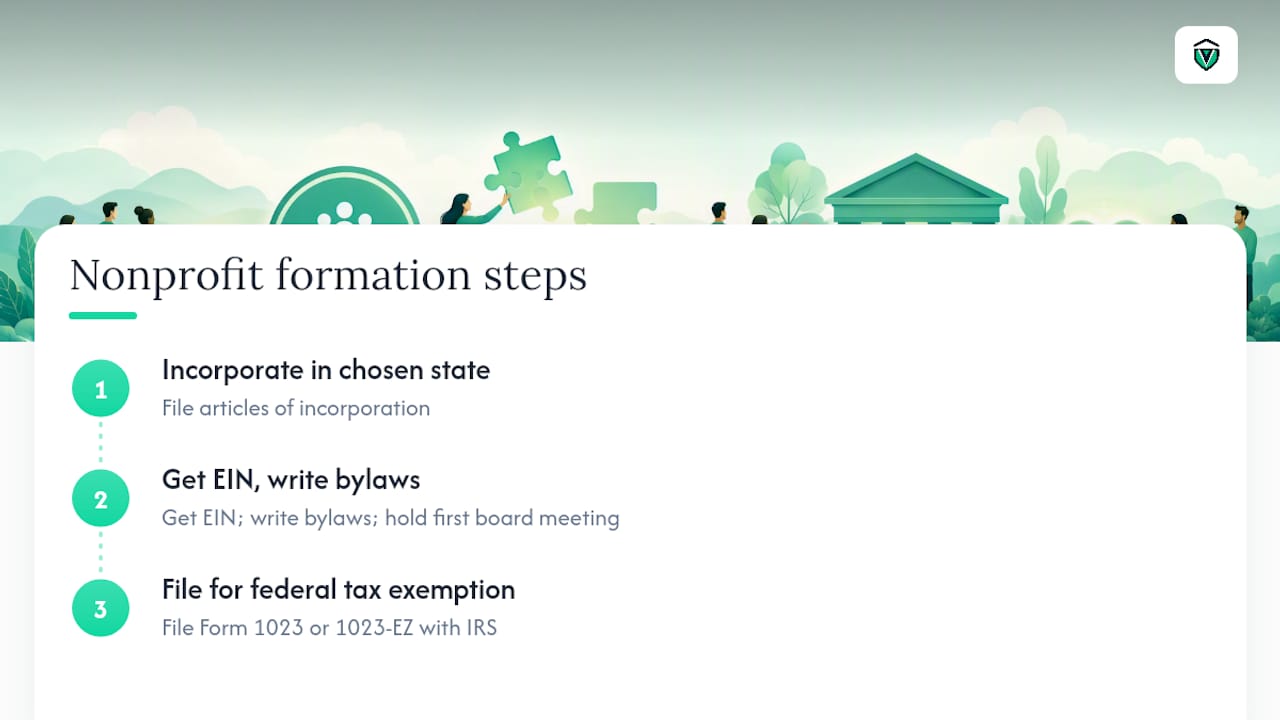
Here's the three-step version. First, incorporate in your chosen state by filing articles of incorporation. Second, get an EIN, write bylaws, and hold your first board meeting. Third, decide whether you want federal tax exemption and, if so, file Form 1023 or Form 1023-EZ with the IRS.
That last point trips up more founders than anything else in this process. Incorporating as a nonprofit does not automatically make you tax-exempt. Those are two different applications to two different governments, and plenty of state-recognized nonprofit corporations never bother applying for 501(c)(3) status, or apply and get rejected. Before you assume any organization has exempt status, including your own once you've applied, check the IRS Tax Exempt Organization Search to confirm it.
Key Takeaways
A nonprofit corporation requires two separate approvals, state incorporation and federal tax-exempt recognition, and losing sight of that distinction causes most of the compliance failures nonprofits face later.
| Point | Details |
|---|---|
| Incorporation and exemption are separate | State filing creates the legal entity; IRS approval of Form 1023 or 1023-EZ grants federal tax exemption. |
| Get the dissolution clause right | Assets must go to another 501(c)(3) organization on winding up, and the IRS reviews this language closely. |
| Ongoing filings protect your status | Annual Form 990s, state annual reports, and charitable registration renewals are required to keep your exemption. |
| Governance policies reduce real risk | A working conflict-of-interest policy and documented board decisions guard against private inurement problems. |
| Centralize your compliance tracking | A platform like Vaultedai can consolidate renewal deadlines and documents once filings span multiple states. |
This article is general information, not a substitute for advice from a qualified lawyer. Consult a qualified legal professional about your own circumstances before acting on anything here.
Table of Contents
- What Is a Nonprofit Corporation Under State Law?
- Should You Incorporate as a Nonprofit? Weighing the Benefits
- How to Form a Nonprofit Corporation: The State Filing Process
- Getting Federal Tax-Exempt Status: The 501(c)(3) Process
- State Compliance: What Happens After Incorporation
- Board Governance and Fiduciary Duties
- How Nonprofits Raise Money, and Where the Limits Are
- Dissolving a Nonprofit: Where the Assets Go
- Nonprofit Corporation vs. LLC vs. Unincorporated Association
- What to Expect: Formation Timelines and Fees
- Staying Compliant After Formation: A Practical Checklist
- When to Bring in a Lawyer or Accountant
- Keeping Compliance From Becoming a Second Full-Time Job
- A Practical Way to Track Nonprofit Compliance Deadlines
- Sources
What Is a Nonprofit Corporation Under State Law?
Every state defines a nonprofit corporation roughly the same way: a distinct legal person, separate from the people who run it, that cannot distribute profit to members, directors, or officers. Whatever revenue comes in beyond expenses has to go back into the organization's mission. That single rule, called the nondistribution constraint, is what separates a nonprofit corporation from a regular business corporation. It's not about whether you make money. Plenty of nonprofits run substantial surpluses. It's about who's allowed to pocket it.
Most states also draw a line between a nonprofit corporation and an unincorporated association, which is just a group of people acting together without formal legal status. Incorporating gives the organization its own legal identity, its own liability shield, and its own ability to hold property, sign contracts, and sue or be sued in its own name.
Within the nonprofit corporation category, state statutes generally recognize three broad types:
- Public benefit corporations serve the general public and are the category most people mean when they say "charity" or "nonprofit." A food bank, an animal rescue, or a scholarship fund typically falls here, and this is the type that pursues 501(c)(3) status most often.
- Mutual benefit corporations exist to serve their own members rather than the public at large. Homeowners' associations, trade groups, and some social clubs fit this model, and many of them do not qualify for 501(c)(3) treatment even though they're legitimately nonprofit under state law.
- Religious corporations cover churches, temples, mosques, and other faith-based organizations, often governed by a slightly different set of statutory rules than secular nonprofits, particularly around internal governance and property holding.
The Model Nonprofit Corporation Act, developed to give states a consistent framework, shapes most of this structure, but implementation still varies. Some states require the words "corporation," "incorporated," or an abbreviation in your name; others don't. Some states have separate statutes for religious corporations; others fold them into the general nonprofit code. Read your specific state's version before you assume any rule applies uniformly.
Should You Incorporate as a Nonprofit? Weighing the Benefits
Incorporating buys you three concrete things: liability protection, a governance structure that donors and grantmakers actually trust, and a pathway to tax exemption at both the federal and state level. Directors and officers of an incorporated nonprofit generally aren't personally on the hook for the organization's debts or lawsuits, the same protection a for-profit corporation gives its owners. That single feature is often reason enough to incorporate before you take on staff, sign a lease, or accept your first grant.
Grantmaking foundations and major donors also tend to require incorporated, tax-exempt status before they'll write a check, since it gives them documentation that the money is going to a legitimate, IRS-recognized entity rather than an individual's bank account.
None of this comes free. Incorporation means ongoing paperwork: annual reports to the state, a board of directors that has to actually meet and keep minutes, and, if you obtain 501(c)(3) status, a publicly available Form 990 that discloses your finances, salaries, and major contracts every year. You also accept real restrictions once you're tax-exempt, including limits on political activity and a hard ban on private inurement, meaning insiders can't quietly benefit from the organization's assets.
If you're running a short-term project, a small group of friends organizing a one-time fundraiser, or an informal club that doesn't need grants or tax-deductible donations, incorporation might be more structure than you need. A fiscal sponsorship arrangement with an existing nonprofit, or simply staying an unincorporated association, can be the more practical choice until your work outgrows that setup.
How to Form a Nonprofit Corporation: The State Filing Process
Formation happens at the state level, and while the paperwork looks different from state to state, the sequence is consistent.
- Check name availability. Your state's Secretary of State keeps a business name registry; search it before you fall in love with a name.
- Reserve the name, if you need to. Most states let you hold a name for a fee while you finish your paperwork, though it's optional in many jurisdictions.
- Draft and file articles of incorporation (sometimes called a certificate of incorporation) with the Secretary of State.
- Pay the filing fee. New York, for instance, charges $75 to file a Certificate of Incorporation for a domestic not-for-profit corporation, though fees vary widely by state.
- Appoint a registered agent who can accept legal documents on the organization's behalf at a physical in-state address.
Your articles need to include a few things beyond your name and address. A purpose clause describing what the organization does, written broadly enough to cover your mission but specifically enough to satisfy IRS scrutiny later if you apply for exemption. A dissolution clause stating that if the organization ever winds down, remaining assets go to another tax-exempt organization, not to founders, directors, or members. And depending on your state, a corporate indicator in the name, like "Inc." or "Corp.," although many states waive this for nonprofits.
State filing portals vary in how much they ask up front. Washington's online nonprofit filing system, for example, asks filers to certify gross revenue and describe the organization's purpose directly in the online form, while other states keep the initial filing sparse and push those details into the bylaws instead.
Once the state approves your filing, the real setup work starts:
- Apply for an EIN (Employer Identification Number) through the IRS, free of charge, even if you have no employees yet.
- Adopt bylaws that spell out board structure, officer roles, voting procedures, and meeting requirements.
- Hold your initial board meeting, formally adopting the bylaws, electing officers, and authorizing a bank account.
- Adopt a conflict-of-interest policy and a record-retention policy, both of which the IRS will look for if you apply for tax exemption.
- Check whether your state requires charitable registration before you solicit donations, a separate step from incorporation itself.
Pro Tip: Draft your purpose clause and dissolution clause with 501(c)(3) language in mind even if you're not filing for exemption yet. Rewriting articles of incorporation after the fact means another state filing fee and another wait for approval.
Getting Federal Tax-Exempt Status: The 501(c)(3) Process
Incorporating with your state gives you legal existence. It says nothing about your tax obligations, which is exactly where a lot of new nonprofit founders get confused. Federal tax exemption is a separate application to a separate agency, and Illinois's own Secretary of State guidance on nonprofit formation makes a point of warning filers about this: incorporating does not create federal tax exemption. You have to apply for that separately.
Section 501(c) of the Internal Revenue Code covers dozens of exemption categories, but 501(c)(3) is the one most people mean when they say "nonprofit," because it's the only category where donations to the organization are generally tax-deductible for the donor. To qualify, your organization has to be organized and operated exclusively for exempt purposes, which the IRS defines as religious, charitable, scientific, literary, or educational, among a few others. IRS Publication 557 walks through the organizational and operational tests the agency applies, and it also confirms that corporations, LLCs, unincorporated associations, and trusts can all potentially qualify, though a corporation remains the most common structure for a reason: it offers the clearest liability protection alongside exemption eligibility.
Two forms handle the application, and picking the right one matters:
- Form 1023 is the standard, long-form application, required for larger or more complex organizations. It asks for a narrative description of your activities, detailed financial projections or history, and copies of your articles and bylaws.
- Form 1023-EZ is a streamlined, online-only version for smaller organizations that meet specific eligibility thresholds on projected revenue and assets. It's faster to complete but comes with less room to explain nuance in your activities.
The instructions for Form 1023 lay out exactly what has to be attached, including your organizing documents, a conflict-of-interest policy if you have one, and financial statements covering your current and prior years. Skipping an attachment is one of the most common reasons applications bounce back with follow-up questions, adding months to the review.
The IRS maintains public data on more than 1.8 million tax-exempt organizations through its Tax Exempt Organization Search tool, which is also how you verify your own status once approved, or check whether another organization's exemption is current before you consider a partnership or donation.
Not every legitimate nonprofit corporation qualifies for 501(c)(3) treatment. Mutual benefit organizations like homeowners' associations and many social clubs typically don't, and they carry different, often more limited, tax obligations as a result.
State Compliance: What Happens After Incorporation
Getting your articles approved isn't the finish line. States expect ongoing filings, and skipping them can cost you your good standing or your tax-exempt status at the state level, even if your federal exemption stays intact.
- Annual or biennial reports filed with the Secretary of State, confirming your registered agent, address, and officers are current.
- State tax exemption applications, separate from your federal 501(c)(3) determination, since state income tax and sales tax exemptions typically require their own paperwork.
- Charitable solicitation registration, required in most states before you actively fundraise from the public, and enforced separately from IRS rules, meaning failing to register can trigger state penalties even for an organization with a spotless federal record.
- Sales tax exemption filings, where applicable, since federal 501(c)(3) status doesn't automatically exempt you from state sales tax.
The timing matters more than most founders expect. Many states require charitable registration before you solicit your first dollar, not after you've already started a fundraising campaign, and retroactive registration often comes with fines. Check both your Secretary of State's website and your state Attorney General's office, since charity oversight frequently sits with the AG rather than the corporations division, and the two offices don't always cross-reference each other's requirements.
Pennsylvania's Department of State guidance for nonprofit corporations is a good example of how a single state lays out both formation and ongoing filing expectations in one place, which is worth doing for whatever state you're incorporating in before you assume the rules match what you read about elsewhere.
Board Governance and Fiduciary Duties
Once you're incorporated, your board of directors carries legal responsibilities that go beyond showing up to quarterly meetings. Courts and state attorneys general generally hold directors to three fiduciary duties.

The duty of care means directors have to pay attention: read the financials, show up prepared, and ask hard questions before voting on major decisions. The duty of loyalty means putting the organization's interests ahead of personal or business interests, particularly when a director might personally benefit from a contract or transaction. The duty of obedience means following the organization's own articles, bylaws, and stated mission, along with applicable law.
A conflict-of-interest policy translates those duties into a working procedure. Both state corporate law and IRS reviewers expect to see one, and the IRS specifically flags this as part of its evaluation during the exemption application process. A workable policy should require:
- Annual written disclosure from every director and officer about outside business relationships that could create a conflict.
- A recusal process, so a conflicted director leaves the room, or at minimum abstains, when the board votes on a related matter.
- Documentation in the meeting minutes showing the conflict was disclosed and handled properly.
Private inurement is the line nonprofit boards can't cross: no insider (a director, officer, or major donor) can receive more than fair value from the organization's transactions. An "excess benefit transaction," where an insider gets paid more than reasonable compensation or buys an asset below market value, can trigger IRS penalties against the individual and jeopardize the organization's exemption entirely.
Pro Tip: Document board decisions, especially anything involving compensation or a related-party transaction, in real time. A thin paper trail is one of the fastest ways to turn a defensible decision into an IRS red flag years later.
Governance frameworks built for corporate directors elsewhere, including guidance on directors' duties under corporate law, reflect the same underlying principles of care and loyalty that U.S. nonprofit boards operate under, even though the specific statutes differ by jurisdiction.
How Nonprofits Raise Money, and Where the Limits Are
Nonprofit corporations pull revenue from more sources than most people assume. Tax-deductible donations from individuals get the most attention, but grants from foundations or government agencies, membership dues, program service revenue (fees charged for services related to your mission, like a museum's admission ticket), and separate earned-income activities all show up on a typical nonprofit's books.
That last category is where things get complicated. When a 501(c)(3) organization runs a trade or business that isn't substantially related to its exempt purpose, the income from that activity can trigger unrelated business income tax (UBIT). A classic example: a university's gym that's open to the general public for a fee, unrelated to educating students, generates UBIT on that revenue even though the university itself remains tax-exempt. The activity doesn't threaten your overall exemption unless it becomes so large it starts to look like your primary purpose, but it does mean filing a separate tax return and paying corporate tax rates on that specific income stream.
Political activity carries its own hard boundary. A 501(c)(3) organization cannot participate in, or intervene in, any political campaign for or against a candidate for public office. That's an absolute rule, not a gray area. Lobbying, meaning attempts to influence legislation, is allowed but only in limited amounts, measured either by a vague "insubstantial part" test or, for organizations that elect it, a specific expenditure test under Section 501(h) that offers clearer dollar limits. Organizations expecting to do meaningful advocacy work should map out that election early rather than guessing at what counts as "insubstantial."
Dissolving a Nonprofit: Where the Assets Go
Nonprofit corporations don't get to distribute leftover assets to their founders or board members when they close, and that rule needs to show up in your articles of incorporation from day one, not as an afterthought when you're winding down.
State statutes and IRS requirements both expect a dissolution clause dedicating any remaining assets, after debts are paid, to another organization exempt under 501(c)(3), or to a federal, state, or local government for a public purpose. Language along these lines is standard: "Upon dissolution, assets remaining after payment of liabilities shall be distributed to one or more organizations qualified as exempt under Section 501(c)(3) of the Internal Revenue Code." Getting this wording right at formation matters because the IRS reviews it closely during the exemption application, and a vague or missing dissolution clause is a common reason applications get sent back for revision.
Several states also require attorney general notice or approval before a nonprofit corporation can formally dissolve, particularly one holding charitable assets, since the AG's office typically has statutory authority to make sure those assets actually land at another qualifying organization rather than disappearing into a founder's pocket on the way out.
Nonprofit Corporation vs. LLC vs. Unincorporated Association
Founders sometimes assume an LLC is the simpler path, since it's faster and cheaper to set up in most states. The trade-off shows up quickly once tax exemption enters the picture.
| Factor | Nonprofit corporation | LLC | Unincorporated association |
|---|---|---|---|
| Liability protection | Strong; directors and officers generally shielded from organizational debts | Strong; members generally shielded from business debts | Weak or none; members can face personal liability |
| Eligibility for federal tax exemption | Direct path to 501(c)(3) if organized and operated exclusively for exempt purposes | Possible but complex; generally requires all members to be tax-exempt entities themselves | Possible in theory, but rarely practical for 501(c)(3) purposes |
| Governance complexity | Formal: board of directors, bylaws, required meetings and minutes | Flexible: operating agreement can be simple or complex | Minimal or informal, no statutory governance requirement |
| Cost and time to form | State filing fee plus IRS determination process; can take weeks for state approval, months for IRS review | State filing fee only; approval often faster, but 501(c)(3) status is rarely pursued | Free or near-free; no state filing needed |
If your goal is charitable fundraising with tax-deductible donations, the nonprofit corporation route is the direct and well-supported one. If you're organizing members around a shared interest without needing donor tax deductions, an unincorporated association or a mutual-benefit nonprofit corporation might fit better. An LLC taxed as a nonprofit is a narrow, complicated structure best reserved for edge cases, like a nonprofit subsidiary wholly owned by another exempt organization, and it's worth talking to an attorney before you go that route rather than assuming it's the shortcut it looks like.
What to Expect: Formation Timelines and Fees
Budget realistic time for both halves of this process, because they run on different clocks.
State filing fees vary considerably. New York charges $75 for a Certificate of Incorporation, and many states fall in a similar range, though some charge more for expedited processing, sometimes doubling or tripling the standard fee for same-day or 24-hour turnaround. Processing time for standard state filings typically runs anywhere from a few days to several weeks, depending on the state's current backlog and whether you file online or by mail.
| Stage | Typical range | Notes |
|---|---|---|
| State articles of incorporation | Days to a few weeks | Faster with online filing; expedited service costs more in most states |
| EIN application | Immediate to a few days | Free through the IRS; instant online for most applicants |
| Bylaws and initial board meeting | Self-paced | No filing required; internal governance step |
| Form 1023-EZ review | Weeks to a couple of months | Streamlined, online-only, for smaller organizations |
| Form 1023 (standard) review | Several months to a year or more | Longer for complex or unusual purpose clauses |
Because the federal review can stretch well past the state approval, plan your fundraising and grant applications around the IRS timeline, not the state one. Many foundations won't fund an organization without a determination letter in hand, so a founder who assumes state incorporation is enough to start applying for grants often loses months waiting on paperwork they didn't realize was still pending.
Staying Compliant After Formation: A Practical Checklist
The paperwork doesn't stop once your determination letter arrives. It just shifts into an annual rhythm.
- File your Form 990, 990-EZ, or 990-N every year, on time, since the IRS can automatically revoke tax-exempt status after three consecutive years of missed filings.
- Renew charitable solicitation registration in every state where you actively fundraise, not just the state where you're incorporated.
- File state annual reports with your Secretary of State to maintain good standing.
- Handle payroll and employment tax withholding correctly if you have staff, since tax-exempt status doesn't exempt you from employer payroll tax obligations.
- Track sales and use tax exemption renewals where your state requires periodic reapplication rather than a one-time exemption.
Most of these obligations run on different calendars, tied to your fiscal year-end, your state's registration cycle, or a specific anniversary date, which is exactly how organizations end up missing one. A compliance calendar that tracks every deadline in one place, paired with secure document storage for your articles, bylaws, determination letter, and past filings, cuts down on the scramble considerably. Automated renewal reminders help even more, particularly once an organization operates in more than one state and has to track multiple charitable registration renewal dates simultaneously.
For payroll-specific reporting, including 1099 and W-2 filing, a dedicated e-filing service can take that piece off a small nonprofit's plate without requiring a full accounting staff. General accounting platforms handle the books, but they rarely track the regulatory calendar itself, which is where a centralized compliance approach tends to catch what spreadsheets miss, particularly for organizations juggling registrations across several states.
When to Bring in a Lawyer or Accountant
Plenty of straightforward nonprofit formations don't require an attorney. A single-state charity with a conventional mission, standard bylaws, and no unusual funding arrangements can often work through Form 1023-EZ and state filing without much specialized help beyond careful reading of the instructions.
That changes fast in a few situations. Multi-state fundraising, where you're registering for charitable solicitation in a dozen states with a dozen different forms, benefits from someone who's done it before. Unusual dissolution language, complex benefit structures involving related for-profit entities, or a founding team planning meaningful lobbying or advocacy work are all places where a nonprofit attorney earns their fee by catching problems before the IRS does.
An accountant becomes essential once you're assembling financial schedules for Form 1023, since the IRS wants projected or historical financials formatted a specific way, and errors there are a common source of processing delays. Ongoing, an accountant familiar with nonprofit tax rules helps navigate UBIT calculations, payroll tax questions, and state sales tax exemption renewals that don't always follow the same logic as for-profit accounting.
Whichever advisor you bring in, document their advice in your board minutes. If a question ever comes up later about why the organization made a particular governance or compensation decision, a paper trail showing you sought and followed professional advice is worth far more than trying to reconstruct the reasoning after the fact.
Keeping Compliance From Becoming a Second Full-Time Job
Here's the part conventional nonprofit formation guides tend to gloss over: the hardest phase of running a nonprofit corporation isn't the incorporation or even the 501(c)(3) application. It's year three, when the founding excitement has worn off, the board has turned over once, and nobody remembers exactly when the charitable registration in that second state needs renewing.
Most nonprofits don't lose their exemption because they did something scandalous. They lose it because three consecutive Form 990s went unfiled while everyone assumed someone else was handling it. That's not a governance failure of malice. It's a governance failure of tracking, and it happens to well-intentioned, well-run organizations constantly.
The conventional advice, "just build a compliance calendar," undersells how quickly this gets complicated once an organization operates across state lines. A single-state charity might manage fine with a shared spreadsheet and a calendar reminder. An organization registered to solicit donations in eight states, each with its own renewal date, its own form, and its own fee schedule, is running a compliance operation that looks a lot more like what a mid-size business handles, just with a nonprofit's typically thinner staff and budget to manage it.
What actually works is treating compliance as infrastructure from the start, not as a task list you build after your first missed deadline. That means centralized document storage for your governing documents, a system that flags renewal dates before they're urgent rather than after, and a conflict-of-interest policy that gets enforced in practice, not just filed away after your IRS application was approved. Organizations that build this discipline early spend less time firefighting later, and they hand off cleaner records every time board turnover happens, which it inevitably does.
A Practical Way to Track Nonprofit Compliance Deadlines
Once your nonprofit corporation is up and running, the compliance burden doesn't come from any single deadline. It comes from a dozen small ones scattered across different agencies, different calendars, and different renewal cycles that nobody assigned a single owner to track.
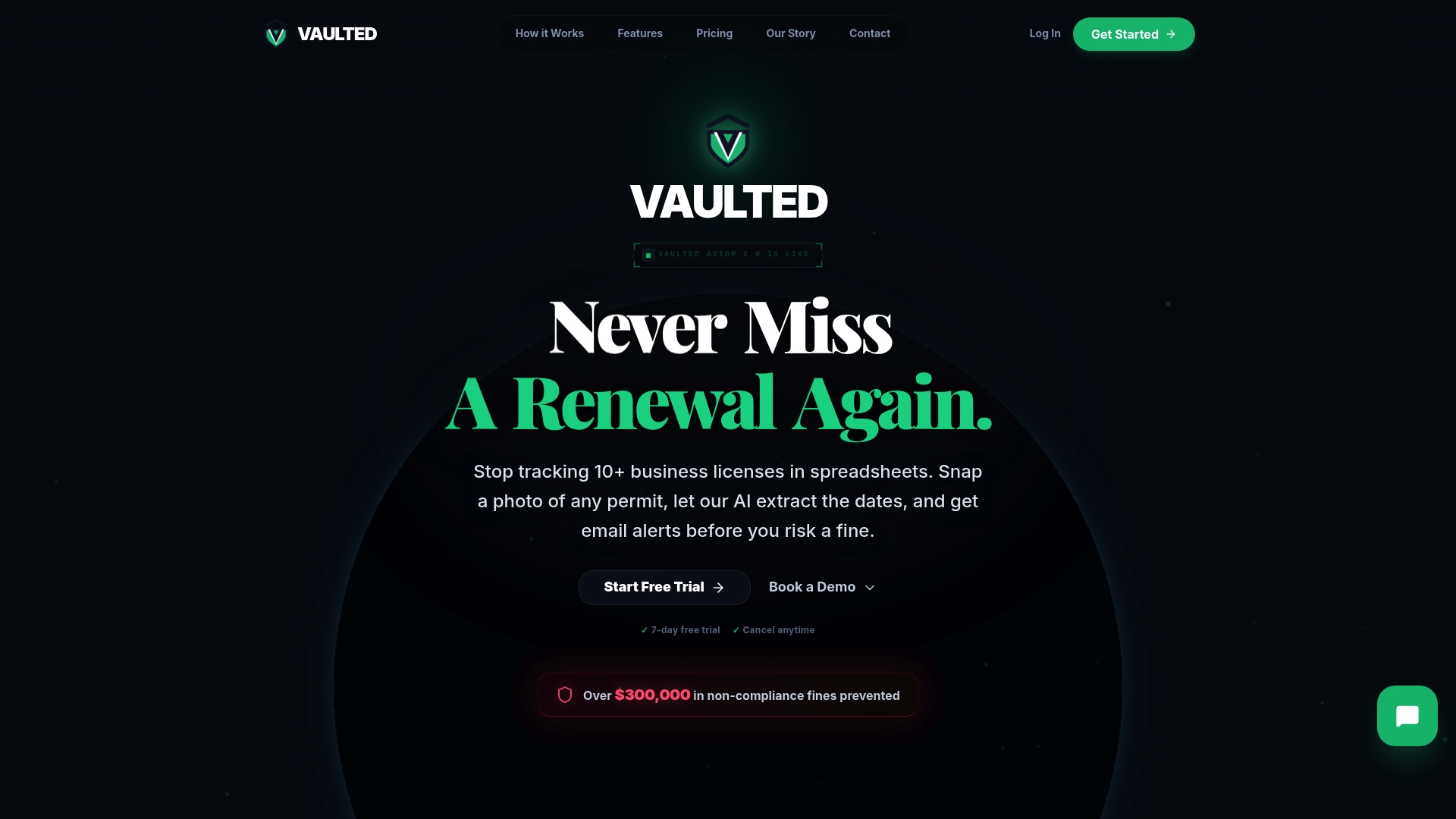
That's the exact gap Vaultedai was built to close. Rather than keeping your Form 990 due date in one calendar app, your charitable registration renewals in a spreadsheet, and your articles of incorporation in a filing cabinet somewhere, Vaultedai centralizes permits, licenses, renewals, and compliance documents in one place, with automated reminders before deadlines hit instead of after. For a nonprofit registered to fundraise in multiple states, or one that's simply outgrown the founder's personal memory as the compliance system, that centralized view replaces the scramble with something closer to a working checklist.
If your nonprofit corporation is scaling past one location or one state registration, take a look at Vaulted's compliance platform and see whether it fits how your board already tracks deadlines. None of this replaces legal or tax advice. Talk to a qualified attorney or accountant for questions specific to your organization's formation, exemption application, or ongoing filings.