

A seller's permit is a state-issued license that legally authorizes your business to collect sales tax on taxable goods and services and remit that tax to the state. Also called a sales tax license, sales tax permit, or sales tax ID depending on the state, this document is one of the first compliance requirements a new business owner encounters. Without it, collecting sales tax is illegal in most states, and operating without one exposes you to serious financial penalties. If you sell physical products or certain taxable services, understanding what a seller's permit is and how to get one is not optional.
What is a seller's permit and who actually needs one?
A seller's permit authorizes businesses to collect sales tax and use resale certificates for tax-free wholesale purchases. That dual function makes it one of the most valuable compliance documents a product-based business can hold. The permit is issued by your state's Department of Revenue or equivalent tax authority, and it ties your business to a specific tax account where you report and remit collected sales tax on a regular schedule.
The question of who needs one comes down to a concept called nexus, which is the legal connection between your business and a state that triggers a tax obligation. Two types of nexus exist.

Physical nexus applies when your business has a tangible presence in a state. That includes a storefront, warehouse, office, employees, or even inventory stored in a third-party fulfillment center. If you use Amazon FBA and your inventory sits in a California warehouse, California may consider you to have physical nexus there.
Economic nexus applies when your sales volume in a state crosses a defined threshold, even without any physical presence. Most states set this threshold at $100,000 in sales or 200 transactions per year. California is a notable exception, with a higher economic threshold of $500,000 in sales. That means a small Etsy seller shipping products nationwide could trigger nexus obligations in dozens of states before they realize it.
A few important exceptions exist. Five states have no statewide sales tax: Alaska, Delaware, Montana, New Hampshire, and Oregon. However, Alaska is not a clean exemption. Local municipalities in Alaska often impose their own sales taxes, requiring local permits even without a state-level obligation. Delaware, Montana, New Hampshire, and Oregon have no such local complications at the sales tax level.
Pro Tip: If you sell through platforms like Shopify, Etsy, or Amazon, check whether the platform collects and remits marketplace facilitator taxes on your behalf. In many states, this changes your registration obligations significantly.
How to get a seller's permit: step-by-step
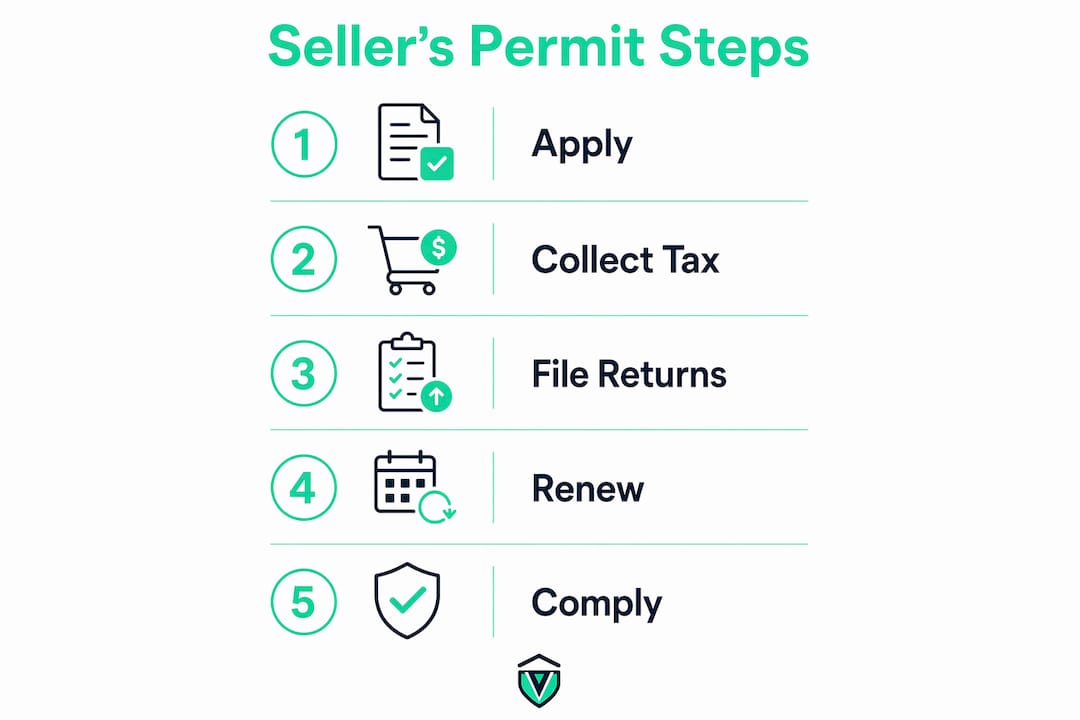
Getting a seller's permit is a straightforward process in most states, but the details vary enough that skipping steps creates problems later. Here is how the process works from start to finish.
-
Determine where you have nexus. Before you register anywhere, map out every state where you have physical presence or where your sales volume crosses the economic threshold. This list defines where you need permits.
-
Gather your documentation. Most states require your Employer Identification Number (EIN), legal business name, business address, ownership details, and a description of what you sell. Sole proprietors without an EIN can often use their Social Security Number, but applying for an EIN through the IRS first is the cleaner approach.
-
Register with the state tax authority. Most states allow online permit registration through their Department of Revenue website. Arizona charges $12, Hawaii charges $20, and Florida charges $5 for paper applications. Many states offer free online registration, making this one of the lower-cost compliance steps a business faces.
-
Estimate your monthly taxable sales accurately. This step trips up more business owners than any other. Underestimating taxable sales can assign you a less frequent filing schedule than your actual volume requires, which creates administrative friction and potential audit flags when your reported numbers do not match your filing frequency. Be honest and slightly conservative in your estimate.
-
Apply for multi-state registration if needed. If you have nexus in multiple states, the Streamlined Sales Tax Registration System (SSTRS) allows you to register in multiple participating states through a single application. This is especially useful for e-commerce businesses or multi-location operators expanding across state lines.
-
Post or store your permit as required. Some states require you to display your seller's permit at your place of business. Others simply require you to keep it on file. Check your state's specific rules.
Pro Tip: Apply for your seller's permit before you make your first taxable sale, not after. Retroactive registration is possible but creates back-tax obligations and potential penalties from day one of operations.
Seller's permit vs. resale certificate vs. business license
These three documents confuse entrepreneurs more than almost any other compliance topic. Seller's permits and business licenses often confuse business owners, and conflating them leads to real compliance gaps. Here is how each one works and when you need it.
A local business license grants your business permission to operate within a specific city or county. It is issued by a local government, not the state, and it has nothing to do with tax collection. A restaurant needs a business license to open its doors. That license does not authorize it to collect sales tax.
A seller's permit is state-issued and specifically authorizes tax collection on taxable sales. It is the document that connects your business to the state's tax system. A resale certificate is a separate document that exempts wholesale purchasing from sales tax. You present it to your supplier when buying inventory for resale, and the supplier does not charge you sales tax on that purchase. Critically, you can only use a resale certificate if you already hold a valid seller's permit.
| Document | Issued by | Primary purpose | Tax collection authorized? |
|---|---|---|---|
| Seller's permit | State tax authority | Collect and remit sales tax | Yes |
| Resale certificate | Business owner (backed by permit) | Buy wholesale goods tax-free | No (prevents tax, not collects it) |
| Business license | City or county government | Permission to operate locally | No |
The practical takeaway: a product-based business typically needs all three. The seller's permit and resale certificate work together. The business license is a separate local requirement entirely.
Consequences of operating without a seller's permit
Filing obligations do not pause because sales are slow. States require you to file sales tax returns on your assigned schedule regardless of whether you made any taxable sales during that period. Filing zero-sales returns is a commonly overlooked obligation, and skipping them triggers penalties even when you owe no tax. The state interprets a missing return as non-compliance, not as a zero-sales month.
The financial consequences of operating without a required permit are significant:
- Fines and back taxes. Penalties for operating without a permit can range from 10 to 25 percent of unpaid tax, with fines reaching up to $10,000. For a business that has been operating for two or three years without registering, the back-tax liability alone can be business-threatening.
- Audit exposure. Unregistered businesses that later come to the attention of state tax authorities face full audits covering all prior periods. The burden of proof falls on the business owner to demonstrate what was and was not taxable.
- Loss of resale certificate validity. If your seller's permit lapses or was never obtained, any resale certificates you issued to suppliers become invalid. Suppliers who accepted those certificates may face their own tax liability.
- Recordkeeping failures. States require businesses to update their permit accounts when ownership, address, or business structure changes. Failing to do so creates discrepancies that complicate future filings and renewals.
"The responsibility to register for a seller's permit lies with the business owner. Proactive registration prevents fines that are far more expensive than the registration itself." SmallBizHandbook
For businesses operating in states without a statewide sales tax, the risk does not disappear. Alaska's local tax structure means a business operating in Juneau or Anchorage may owe local sales tax without ever triggering a state-level obligation. Overlooking that nuance is one of the most common compliance errors multi-location operators make.
Key takeaways
A seller's permit is the legal foundation for sales tax compliance, and every product-based business with nexus in a state must obtain one before making its first taxable sale.
| Point | Details |
|---|---|
| Seller's permit definition | A state-issued license authorizing tax collection on taxable sales and enabling tax-free wholesale purchases. |
| Nexus triggers registration | Physical presence or crossing $100,000 in sales (or 200 transactions) in most states creates a permit obligation. |
| Application is low-cost | Most states offer free online registration; fees where charged typically range from $5 to $20. |
| Three documents, three purposes | A seller's permit, resale certificate, and business license each serve distinct functions and are not interchangeable. |
| Non-compliance is expensive | Penalties range from 10 to 25 percent of unpaid tax, with fines up to $10,000 for operating without a permit. |
The compliance mistake I see most often
Most entrepreneurs I work with are not reckless about compliance. They are just focused on building their business, and permits feel like paperwork that can wait. The problem is that sales tax obligations do not wait. They start the moment you make your first taxable sale, and the clock runs backward when you finally register.
The mistake I see most often is not failing to register at all. It is registering in one state and assuming that covers everything. An e-commerce business selling nationwide through Shopify or a smoke shop group expanding into a second state both face the same trap: nexus accumulates quietly. By the time the business owner realizes they have crossed economic thresholds in four or five states, they are looking at back-tax exposure across all of them.
My advice is to treat nexus tracking as an ongoing operational task, not a one-time registration event. The SSTRS simplifies multi-state registration significantly, but you still need to know when you have crossed a threshold before you can use it. For multi-location businesses, a foreign LLC registration in a new state often triggers permit obligations that owners miss entirely.
The other thing I would push back on is the idea that zero-sales months are safe to ignore. They are not. A state that sees a missing return assumes non-compliance. Filing a zero-sales return takes two minutes and costs nothing. Not filing it can cost thousands.
Stay organized, track your thresholds by state, and register before you sell. That sequence is not complicated. It just requires treating compliance as part of operations from day one.
— Rakin
How Vaultedai keeps your permits organized across every state

Managing seller's permits across multiple states or locations is where spreadsheets break down. Deadlines get missed, filing schedules vary by state, and a single lapsed permit can trigger the kind of penalties described above. Vaultedai is built specifically for multi-location businesses that need centralized visibility over every permit, license, and renewal deadline in one place.
With Vaultedai, you can track seller's permit status, filing schedules, and renewal dates across all your locations without digging through email threads or state agency portals. The platform is designed for operators running smoke shop groups, restaurant chains, convenience stores, and franchises who need compliance clarity as they scale. Visit Vaultedai to see how the AI Business Permit Tracker handles the complexity so you can focus on growth.
FAQ
What is a seller's permit used for?
A seller's permit authorizes your business to collect sales tax on taxable goods and services and remit that tax to the state. It also enables you to use a resale certificate to purchase wholesale inventory without paying sales tax.
Do I need a seller's permit for online sales?
Yes, if your online sales create nexus in a state through physical presence or by crossing the economic threshold (typically $100,000 in sales or 200 transactions), you are required to register for a seller's permit in that state.
What is the difference between a seller's permit and a tax ID?
A seller's permit is a state-issued license specifically for collecting and remitting sales tax. A tax ID (EIN) is a federal identifier issued by the IRS for general tax purposes. You typically need your EIN to apply for a seller's permit, but they serve different functions.
Where do I apply for a seller's permit?
You apply through your state's Department of Revenue or equivalent tax authority. Most states offer free online registration. If you have nexus in multiple states, the Streamlined Sales Tax Registration System (SSTRS) allows you to register in several participating states through one application.
What happens if I operate without a seller's permit?
Operating without a required seller's permit can result in penalties ranging from 10 to 25 percent of unpaid tax, fines up to $10,000, and back-tax liability covering all prior periods of unregistered sales.