

A mobile vending permit is an official government authorization that allows entrepreneurs to legally sell food, beverages, or merchandise from a mobile unit such as a food truck, pushcart, or vending vehicle in designated public or private spaces. Without this permit, formally called a mobile food vendor license or mobile vending license depending on the jurisdiction, you are operating illegally and risk fines, equipment seizure, and forced closure. Local agencies including city health departments, fire marshals, and business licensing offices each play a role in the approval process. Getting this right from the start protects your investment and keeps your operation running.
What is a mobile vending permit and who issues it?
A mobile vending permit is a location-specific, government-issued license that authorizes a vendor to operate a mobile selling unit within a defined jurisdiction. City or county agencies issue these permits, not the state, in most cases. The issuing body depends on what you sell. Food vendors typically deal with the local health department, the fire marshal, and the city business licensing office simultaneously. Non-food vendors, such as those selling merchandise from a cart, usually work only with the city licensing office. The permit covers the unit itself, the operator, and sometimes the specific location or route where vending occurs.
The term "mobile vending permit" is the common shorthand, but the official document may be labeled a mobile food facility permit, street vending license, or itinerant vendor permit depending on your city. Knowing the local terminology matters when searching government websites or calling agency offices. Using the wrong term can send you to the wrong department and cost you weeks.
What are the requirements for mobile vending?
Most jurisdictions require multiple permits working together: a general business license, a state seller's permit, a local vending license, and a health permit for any food or beverage operation. Each document has its own application, fee, and renewal cycle. Treating them as one process is the most common mistake new vendors make.
The standard documentation package for a food vending operation includes:
- Health and fire safety inspections. Your unit must pass both before a permit is issued. The health department checks food handling, temperature controls, and sanitation. The fire marshal checks fuel lines, suppression systems, and ventilation.
- Proof of liability insurance. Most cities require a certificate of insurance naming the city as an additional insured party.
- Business tax certificate or registration. You must show the city you are a registered business entity before they will issue a vending permit.
- Commissary kitchen agreement. Food truck and cart operators in most jurisdictions must operate out of a licensed commissary kitchen for food prep and cleaning. A signed agreement with that facility is required.
- Equipment registration and photos. Cities like Pittsburgh require photos of the vending unit itself as part of the license application.
- Restroom access authorization. Some jurisdictions require proof of restroom access for vendors operating at a fixed location for extended hours.
Required documents typically include health certificates, fire inspection approvals, insurance, and tax certificates. Every city has its own checklist, so download the official requirements from your city's business portal before gathering anything.
Pro Tip: Request a pre-application meeting with your city's business licensing office before submitting anything. Many cities offer this at no charge, and it can reveal jurisdiction-specific requirements that are not listed on the public website.

How does the vending permit application process work?
The application process follows a predictable sequence, though the timeline varies significantly by city and permit complexity.
- Create an account on the city's application portal. Many cities use platforms like Accela Citizen Access for permit submissions. You will upload documents, pay fees, and track status through this portal.
- Submit your initial application and documents. Upload your business registration, insurance certificate, commissary agreement, and any other required paperwork. Incomplete submissions are the leading cause of delays.
- Wait for document review. City staff review your submission for completeness and compliance. This phase alone can take one to three weeks in busy jurisdictions.
- Schedule and pass inspections. Health and fire inspections are typically scheduled after document review is approved. Inspection slots can be limited, adding additional wait time.
- Receive permit issuance. Once all inspections pass and fees are paid, the permit is issued. Some cities mail a physical permit; others provide a digital certificate.
- Post the permit on your unit. Most jurisdictions require the permit to be visibly displayed on the vending unit at all times during operation.
Processing time ranges from a few days for renewals to 2–6 weeks or longer when inspections are required. Plan your launch date around the longer end of that range. In New York City, the situation is more extreme. Permits are limited by law and a waiting list controls access. The city only contacts applicants when a permit becomes available, meaning the wait can stretch to years. NYC also requires a supervisory license before you can even apply for a unit permit.
How do permit fees and classifications vary by location?
Permit fees are not uniform. They vary by city, unit type, and permit duration. Understanding the fee structure before you apply prevents budget surprises.
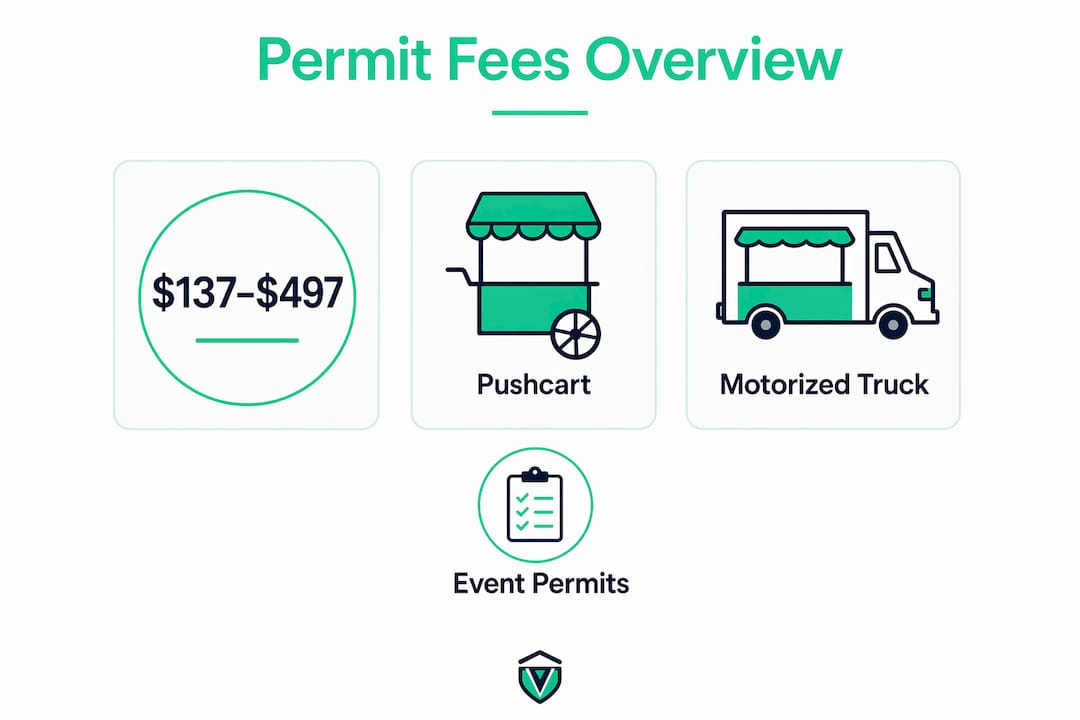
Annual fees range from around $137 to over $497 depending on unit type and location. That range reflects real differences in what cities charge and what they cover.
| Permit type | Fee range | Notes |
|---|---|---|
| Pushcart (annual) | $213–$412 | Oakland, CA fee tier for non-motorized units |
| Motorized truck (annual) | $248–$497 | Oakland, CA fee tier for motorized vehicles |
| Pittsburgh vending license | ~$137 annually | Requires tax compliance and inspection |
| Group site permit (Oakland) | $1,000 application + $1,291 annual | Covers multiple vendors at one location |
| General business license | $25–$100 | Required in most jurisdictions before vending permit |
Oakland offers both semi-annual and annual permit options, with fees scaled accordingly. Choosing a semi-annual permit costs less upfront but requires more frequent renewals, which adds administrative work. Annual permits are the better choice for established operators.
Special event vending adds another layer. Many cities require a separate event permit or a permit amendment when you operate outside your approved location or at a temporary event. Group site permits in Oakland carry a $1,000 application fee and $1,291 in annual fees. That cost is significant and should be factored into any multi-vendor or market-style operation from the beginning.
Beyond the vending permit itself, budget for health inspection fees, fire inspection fees, and the cost of any required equipment upgrades to pass those inspections. The permit fee is rarely the largest expense in the compliance process.
What recent trends are reshaping mobile vending regulations?
The regulatory environment for mobile vendors is shifting in meaningful ways. Some states are moving toward centralized licensing to reduce the burden of navigating dozens of local permit systems.
The clearest example is Texas. The Texas Department of State Health Services began accepting applications for a statewide food truck license in 2026. A single statewide license removes the need for vendors to obtain separate permits in every city or county where they operate. That change directly reduces compliance costs and administrative time for operators who cross jurisdictional lines regularly.
"Streamlined mobile vending licenses help vendors avoid duplicative local permits, easing expansion and compliance logistics."
Technology is also changing how applications are processed. Cities that have adopted platforms like Accela have cut processing times and reduced paperwork errors. Vendors who apply through these portals get real-time status updates instead of waiting on phone calls.
The challenge remains in dense urban markets. Cities like New York continue to cap permit numbers, and the gap between permit supply and vendor demand has not narrowed. Operators in those markets need a long-term plan that accounts for permit scarcity, including exploring licensed commissary arrangements that allow them to operate under another permit holder's umbrella while waiting.
Pro Tip: Sign up for email alerts from your city's business licensing office and your state health department. Regulatory changes, new permit categories, and fee adjustments are often announced with little public notice.
How can vendors manage compliance and avoid common pitfalls?
Permit compliance does not end at issuance. Ongoing compliance is where most vendors run into trouble, especially as they grow or expand to new locations.
- Track renewal deadlines before they arrive. Expired permits trigger the same enforcement as no permit at all. Cities enforce vending licenses strictly, with penalties for unlicensed vendors including fines, license suspensions, and equipment removal.
- Understand multi-jurisdictional requirements. Operating in two cities means two permit systems, two inspection schedules, and two renewal cycles. Managing this with a spreadsheet becomes unreliable fast. A multi-location compliance approach is the only way to stay current across locations.
- Document everything. Keep digital copies of every permit, inspection report, insurance certificate, and commissary agreement. Inspectors can ask to see these documents on-site.
- Know the most common rejection reasons. Applications are most often rejected for missing insurance documentation, an unsigned commissary agreement, or a business registration that does not match the name on the permit application.
- Separate your permit types. Your seller's permit and your vending permit are different documents with different issuing agencies. Confusing them leads to gaps in compliance.
Vendors who treat compliance as a one-time task rather than an ongoing operation are the ones who get shut down. Build a renewal calendar, assign responsibility for each permit, and review your full compliance status at least quarterly.
Key takeaways
A mobile vending permit is a multi-document, multi-agency authorization that requires active management from application through renewal, and the cost, timeline, and requirements vary significantly by city and unit type.
| Point | Details |
|---|---|
| Permit definition | A mobile vending permit is a government authorization to legally operate a food truck, cart, or vending vehicle. |
| Documentation required | Vendors need health and fire inspection approvals, liability insurance, a business license, and often a commissary agreement. |
| Fee range | Annual fees run from roughly $137 in Pittsburgh to over $497 for motorized trucks in Oakland. |
| Application timeline | Processing takes 2–6 weeks or longer when inspections are required; NYC waitlists can last years. |
| Ongoing compliance | Expired permits trigger fines and equipment removal, making renewal tracking as important as the initial application. |
The part vendors learn the hard way
The most common mistake I see is vendors treating the permit process as a one-time hurdle rather than an ongoing operational responsibility. They spend weeks getting the initial permit, then let a renewal slip because no one was watching the calendar. That lapse costs more in fines and lost operating days than the renewal fee ever would have.
The second mistake is underestimating how different the rules are from one city to the next. A vendor who successfully launched in Oakland cannot assume the same documents and process will work in San Francisco or Sacramento. Every jurisdiction has its own checklist, its own inspection schedule, and its own quirks. I have seen operators lose weeks because they submitted an Oakland-style commissary agreement to a city that required a different format entirely.
My honest advice: start the documentation process at least 60 days before you plan to open. Get your business registration, insurance, and commissary agreement in place first. Those three documents unlock everything else. And if you are planning to operate in more than one city, treat each jurisdiction as its own project with its own timeline and budget.
The vendors who scale successfully are not the ones who know every regulation by heart. They are the ones who have a system for tracking what they have, what is expiring, and what they still need.
— Rakin
How Vaultedai helps vendors stay on top of permits
Managing permits across one location is manageable. Managing them across two, three, or five locations is where things break down without the right system in place.
Vaultedai is a permit tracking platform built for operators who have outgrown spreadsheets. It centralizes all your permits, licenses, inspection records, and renewal deadlines in one place. When a renewal is approaching, Vaultedai flags it before it becomes a problem. For mobile vendors expanding into new cities, the platform gives you a clear view of what each jurisdiction requires and what you currently hold. No missed deadlines, no scrambling for documents during an inspection. Vaultedai is built for the operators who take compliance seriously and want a system that keeps pace with their growth.
FAQ
What is a mobile vending permit?
A mobile vending permit is an official authorization issued by a local government agency that allows a vendor to legally operate a food truck, pushcart, or vending vehicle in designated areas. It is separate from a general business license and typically requires passing health and fire safety inspections.
How much does a mobile vending permit cost?
Fees range from roughly $137 per year for a basic vending license in Pittsburgh to $248–$497 annually for motorized trucks in Oakland. Additional costs for health inspections, fire inspections, and business registration apply on top of the permit fee itself.
How long does it take to get a vending permit?
Processing takes anywhere from a few days for renewals to 2–6 weeks when inspections are required. In cities like New York, permit availability is capped by law and waitlists can extend the process significantly longer.
Do I need a commissary kitchen agreement for a food truck permit?
Most jurisdictions require food truck and cart operators to have a signed agreement with a licensed commissary kitchen as part of the permit application. The commissary serves as the approved facility for food prep, storage, and unit cleaning.
Can I use one permit to vend in multiple cities?
Generally, no. Most permits are jurisdiction-specific, meaning you need a separate permit for each city or county where you operate. Some states, including Texas, are moving toward statewide licenses that reduce this duplication for qualifying vendors.